HAIR REMOVAL / TREATMENT COMPARISON
Electrolysis vs. Laser Hair Removal: Which Is Better for You?
Compare what works for your hair and skin, what permanent results really mean, and how the appointments and costs add up.
Editorial details
Independent editorial research. How we review evidence · Disclosures
THE ANSWER FIRST
Start with your hair, then compare the treatments.
Laser is usually the more practical starting point for a large area of coarse, dark hair. Electrolysis is the stronger option to discuss for white, gray or blonde hairs, or a small number of hairs you want removed individually. Red hair also responds poorly to conventional laser hair removal. Both methods can suit darker skin when the treatment and provider are appropriate. Sources and how we evaluated them.
The tradeoff is coverage versus precision: laser treats an area with light; electrolysis treats follicles one at a time. Your best choice may be different for your legs and your chin. Find the situation closest to yours →
1 · THE COMPARISON
Electrolysis vs. laser hair removal at a glance
Both aim to reduce the work of managing unwanted hair. The important differences are which hairs they can target, how appointments add up and what a finished result means.
| What matters | Electrolysis | Professional laser |
|---|---|---|
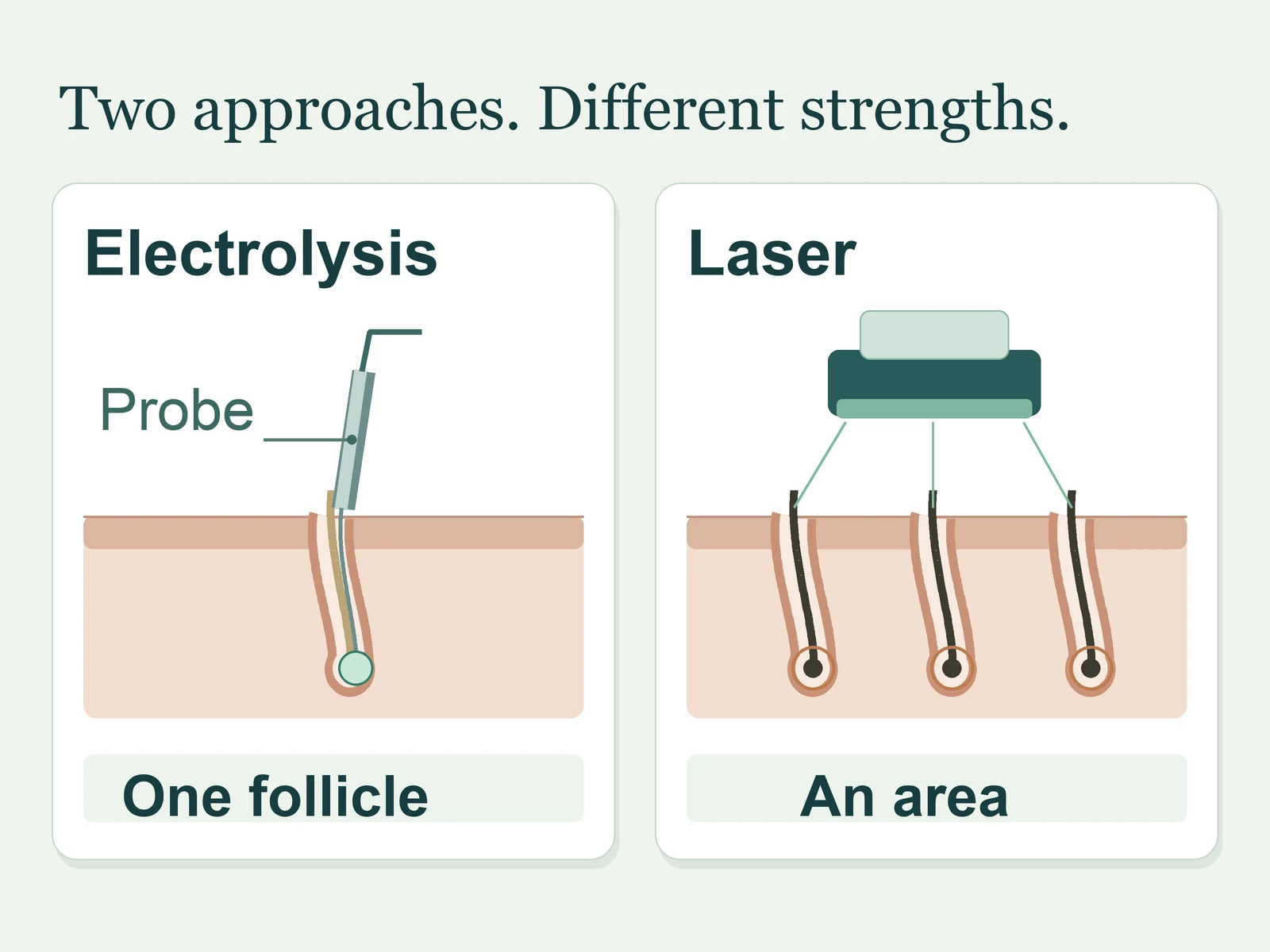
| How it works | A fine probe delivers electrical energy inside an individual follicle. | Light absorbed by pigment in the hair becomes heat that damages the follicle. |
| Hair color | Works independently of hair pigment. | Best suited to pigmented hair; white, gray, blonde and red hair are poor targets. |
| Skin tone | An option across skin tones; technique and skin response still matter. | An option across skin tones with a suitable laser, settings and experienced provider. |
| Practical advantage | Individual hairs, lighter hairs and precise cleanup. | Covering a larger area of suitable hair efficiently. |
| Long-term result | Permanent removal from successfully treated follicles; completing an area takes repeated visits. | Lasting hair reduction; some hairs may be permanently removed and others may regrow. |
| What you pay for | Usually appointment time, often in 15-, 30- or 60-minute blocks. | Usually a named area per visit or a package of visits. |
Clinical basis: American Academy of Dermatology, Mayo Clinic and the American Electrology Association. This guide compares professional treatments. At-home IPL is a separate comparison.
2 · YOUR HAIR AND SKIN
Which method fits your situation?
A full leg of dark hair and six pale chin hairs are different jobs. Start with the hairs you actually want treated, rather than choosing a method from a promise of “permanent” results.
| Your situation | The useful next step |
|---|---|
| Coarse, dark hair across the legs, underarms or bikini area | Ask about laser first. Area coverage is its practical advantage. Confirm that the proposed device suits your skin. |
| White, gray or blonde hairs; red hair that responds poorly to laser | Ask about electrolysis. Its electrical action does not need pigment in the hair. |
| A few remaining hairs after laser | Compare targeted electrolysis with another laser visit. The color and thickness of the remaining hairs matter more than the method you started with. |
| Darker skin and coarse, dark hair | Compare both with appropriately experienced providers. Darker skin alone does not rule out laser. Ask specifically about the wavelength, cooling and experience with your skin tone. |
| Chin or upper-lip growth, including PCOS-related hair | Assess the hair and the reason for growth. A few light hairs and dense dark growth may call for different approaches. Discuss the facial-hair considerations below. |
| Fine facial fuzz | Get a careful assessment before buying a laser package. Fine hair can be a poor target. Decide whether treatment is worthwhile and discuss alternatives. |
These are discussion priorities, drawn from the clinical guidance below, rather than a diagnosis or a treatment prescription.
For darker skin, the laser and the operator belong in the same question
The Endocrine Society’s hirsutism guideline favors a long-wavelength, long-pulse laser, such as Nd:YAG or diode with appropriate cooling, for women with darker skin choosing light-based hair removal. The recommendation concerns hirsutism; it is useful context for a device discussion, not a universal setting for every person.
Ask: “Why does this laser fit my skin, and who will assess and adjust the treatment?” A device name by itself says little about how an appointment will be delivered. Electrolysis avoids relying on hair pigment, but it still requires skilled technique and attention to how your skin heals.
For facial hair and PCOS, plan for both removal and regrowth
Laser can help reduce facial hair associated with polycystic ovary syndrome (PCOS). A 2024 systematic review included six studies and 423 patients, but the evidence was heterogeneous, of low certainty and limited for skin of color. A provider can discuss removal alongside assessment of the underlying condition. Neither procedure treats the hormonal cause of new growth. Read the review.
There is also a specific laser/light risk to discuss: paradoxical hypertrichosis, meaning increased hair growth in or around the treated area. A review of 22 studies involving 9,733 patients found the association concentrated on the face and neck. Its pooled estimate was 3%, with very high variation between studies, so that number is not a forecast of your personal risk. Review and limitations.
For your consultation, make the question concrete: “Are these hairs thick and pigmented enough to justify laser, and what will we do if growth increases?” Our facial laser hair removal guide goes further into choosing areas and setting expectations.
3 · WHAT PERMANENT MEANS
Is electrolysis more permanent than laser?
Electrolysis permanently removes hair from follicles whose growth cells are successfully destroyed. Laser is generally described as permanent hair reduction. That distinction matters, but it does not mean electrolysis finishes an area in one visit or that every laser-treated hair inevitably returns.
With electrolysis, the probe follows the follicle’s natural opening alongside the hair. Galvanic treatment uses a chemical reaction, thermolysis uses heat, and the blend method combines them. The electrologist then removes the treated hair. Some follicles need repeat treatment, and other hairs become available as growth cycles progress. AEA process explanation.
In laser device records, the FDA defines permanent reduction through a stable decrease in regrowing hairs measured after a completed series of treatments, including follow-up at six, nine and 12 months. It describes a sustained reduction, not a promise of zero hair forever. Example FDA clearance record.
What do studies comparing the two methods actually show?
A 2000 split-underarm study of just 12 people compared three laser sessions with four electrolysis sessions. It favored laser at six months after the first treatment. That small, older protocol cannot establish a lifetime winner for every body area. Original trial.
A 2022 survey of 52 people preparing for vaginoplasty included 22 who used electrolysis alone, 15 laser alone and 15 both. Laser-only participants reported fewer, shorter, less expensive and less painful appointments than electrolysis-only participants. These were genital surgical-preparation cases, not a randomized trial or a price forecast for a chin. Original study.
A separate review of long-term laser studies found only five eligible randomized trials, totaling 223 participants. It supports lasting reduction, while showing how limited comparable long-term data remain. Systematic review.
4 · THE TIME COMMITMENT
How many sessions will you need?
Laser usually means fewer, more widely spaced appointments. Electrolysis usually means more frequent work on individual hairs. For both, distinguish the length of one appointment from the number of months on the calendar.
What the appointment calendar can look like
Laser: weeks between visits
Mayo Clinic describes 4–8 treatments, usually several weeks apart. Here is an illustrative six-visit schedule with six-week gaps:
0
6
12
18
24
30
Six visits → five gaps → 30 weeks
About seven months from the first visit to the sixth.
Electrolysis: closer visits over many months
Cleveland Clinic describes weekly or every-other-week visits. This five-week view shows the difference in cadence:
Weekly visits
1
2
3
4
5
Every-other-week visits
1
2
3
4
5
Appointments continue beyond this five-week view. Some treatment plans last about 18 months; the area, hair and response affect the total.
With electrolysis, a “clearance” means clearing the visible treatable hairs in an area. More hairs can appear afterward as cycles progress. Ask how much of the area is likely to fit into your appointment, how visits may taper and when the estimate will be reassessed.
With laser, hair may shed over the following days or weeks. A few visible hairs immediately after a visit do not tell you whether treatment worked. Our laser shedding guide explains what to watch and record.
Ask your provider: “How many visits are you proposing, how far apart, and when will we review the response?” The schedule should account for the area and the hairs available to treat.
5 · THE REAL BUDGET
Is electrolysis or laser cheaper?
Laser often has the economic advantage for a large area of suitable hair. Electrolysis can be the more sensible purchase for a few hairs or hairs laser cannot target well. A low price per visit does not tell you the cost of completing the job.
Our eight-practice electrolysis price audit, checked October 25, 2026, found:
| Booked time | Observed range | Sample median |
|---|---|---|
| 15 minutes | $40–$65 | $55 |
| 30 minutes | $55–$105 | $80 |
| 60 minutes | $75–$165 | $122.50 |
Eight selected U.S. practices, not a national average. Base schedules have different fee and preparation-time rules. Download the public price data (CSV) or read the method and individual menus.
Laser menus instead price an area. For example, Central Minnesota Dermatology’s menu lists $500 for six underarm treatments and $900 for six Brazilian treatments, checked October 27, 2026. Those are one practice’s offers; they do not predict how many visits you will need. View the menu.
What does a $900 budget buy?
Compare the advertised laser package with whole electrolysis appointments at our sample medians:
| Purchase | Cost and included treatment |
|---|---|
| Brazilian laser package | $900 for six visits at the example practice. |
| 16 × 15-minute electrolysis visits | $880 for four booked hours; $20 left. |
| 11 × 30-minute electrolysis visits | $880 for 5.5 booked hours; $20 left. |
| 7 × 60-minute electrolysis visits | $857.50 for seven booked hours; $42.50 left. |
The unknown is how much work your hair requires. An electrologist’s estimate of total time is more useful than assuming 16 short visits will clear the same hair as six laser visits.
The price of one booked hour
Equivalent hourly cost at each booking length, using our eight-practice sample medians.
At those medians, four 15-minute visits cost $97.50 more, or about 80% more, than one 60-minute visit for the same booked time. Ask about the rate for an appointment length that fits your treatment and comfort.
Ask for these terms before paying
- The boundaries: exactly which hairs or areas are covered, including both sides where relevant.
- The initial plan: proposed laser visits or estimated electrolysis time, plus the point at which you will review progress.
- The extra-visit price: what more treatment or later maintenance would cost.
- The fees: consultation, preparation, supplies, numbing if used, taxes and payment surcharges.
- The exit terms: expiration, refunds, cancellations and what happens if the method is a poor fit.
For an area-by-area budget and package examples, use our laser hair removal cost guide. Keep travel and missed work in the comparison too; a manageable treatment price can still come with a demanding appointment schedule.
6 · COMFORT AND SAFETY
Which hurts more, and can either leave marks?
Laser commonly feels like brief hot snaps, often accompanied by cooling. Electrolysis produces repeated localized heat or stinging as individual follicles are treated. The area, settings, appointment length and your tolerance all affect the experience. A short assessment or test treatment can make the discussion more useful than a promise of “painless” hair removal. AAD laser information; Cleveland Clinic electrolysis information.
Both can cause temporary redness and tenderness. Burns, pigment changes, infection and scarring are possible, particularly with unsuitable treatment or poor technique. For electrolysis, ask about sterile, single-use probes and infection-control procedures. For laser, protective eyewear and a provider experienced with your skin are essential. Discuss any history of keloids, cold sores, unusual healing, tanning and current medicines before treatment. Consultation guidance; electrolysis consumer guidance.
If you want numbing, ask the treating medical professional what to use and how. The FDA warns against certain high-strength topical pain products sold for cosmetic procedures and against unsafe use on large areas or under coverings. FDA warning.
Preparation differs in one important way
Laser appointments generally involve shaving beforehand. Mayo Clinic advises avoiding waxing, plucking and electrolysis for at least four weeks before laser; follow the treating provider’s instructions for your plan. Mayo Clinic preparation.
Electrolysis needs visible hairs for the electrologist to identify and remove. Ask how much growth to leave and how to manage it between visits. Avoid setting your own alternating schedule that removes the hairs the next provider needs to treat. Example electrologist preparation instructions.
Plan aftercare around the appointment. Protect laser-treated skin from sun and follow the practice’s instructions. Cleveland Clinic advises avoiding sweating, tanning, prolonged sun exposure and makeup on the treated area for the first 24 hours after electrolysis. Get instructions for your skin, including whom to contact if the reaction is stronger than expected.
7 · USING BOTH METHODS
Can you get electrolysis after laser?
Yes. A planned combination can make sense for mixed hair colors or remaining hairs after laser. Laser can reduce suitable dense hair first, followed by electrolysis for selected hairs that remain. Electrolysis does not automatically undo the results of laser. UCSF discusses using the methods together in a coordinated plan. UCSF guidance.
One possible sequence: laser, review, electrolysis
Reduce suitable dark hair
Laser covers the larger area of coarse, pigmented hair.
Reassess what remains
Allow recovery, then review the remaining hair’s color and thickness.
Target selected hairs
Electrolysis can address light hairs or individual hairs that remain.
The practical issue is timing: the skin needs to recover, and each provider needs the right hairs available for treatment. Have them agree on the sequence and spacing instead of booking both on the same area independently.
8 · YOUR NEXT STEP
Five questions that make the consultation useful
You should leave knowing why the method fits, what progress should look like and how the practice will respond if it does not.
- Which hairs are good targets? Have the provider assess color, thickness, density and skin tone in the actual area.
- What experience do you have with hair and skin like mine? Ask who treats you, who evaluates complications and how qualifications are verified.
- What is our goal, and when do we reassess? Agree on photos or other useful records, such as shaving frequency or electrolysis time needed for the same area.
- What does the starting plan cost, and what could add to it? Ask for written prices and terms.
- What would make you change the plan? Examples include poor response, skin reactions or remaining hair that is a better target for another method.
Our view: choose the plan that fits your hair and can be reviewed as you go. For dense dark body hair, that often begins with laser. For light hairs or precise cleanup, it often begins with electrolysis. The provider’s explanation should be as specific as the area you want treated.
COMMON QUESTIONS
Electrolysis vs. laser: your questions answered
Is electrolysis 100% permanent?
A follicle whose growth cells are successfully destroyed cannot keep producing hair. Completing an area still requires repeated treatment, and new or previously untreated hairs can become visible. “Permanent” describes the result at treated follicles, not a guarantee that one appointment clears an area forever. AEA explanation.
Which is better for chin and upper-lip hair?
Hair characteristics matter more than the area name. Electrolysis is particularly useful for a few hairs or light-colored hairs. Dense, coarse, dark facial hair may suit laser after assessment, including a discussion of increased-growth risk. Hormonal growth also deserves evaluation beyond the removal procedure. Compare the facial-hair considerations.
Which is better for a Brazilian?
For coarse, dark hair over a larger external area, laser usually offers a faster way to cover it. Electrolysis can address light hairs and individual remaining hairs. Agree on the exact boundaries, skin suitability and goal before treatment. Surgical hair removal needs a separate plan from the surgical team.
Why does hair grow back after electrolysis?
Visible hair can come from follicles that were not previously treated or need further treatment. Hairs also appear at different points in their growth cycles. An electrologist should review the pattern and how much work the area needs over time, rather than judging completion from one clearance.
Does laser work on blonde, gray or red hair?
Conventional hair-removal lasers perform poorly on these colors because the target pigment is limited or differs from that in dark hair. Electrolysis works without relying on pigment. Ask for a clear explanation before paying for laser on light hair. AAD overview.
Can I shave, wax or pluck between appointments?
Ask for instructions for your method. Shaving generally fits a laser plan; waxing and plucking remove the hair the laser needs to target. Before electrolysis, leave the visible growth your electrologist requests. Coordinate any change of method with both providers. Preparation and aftercare.
Is IPL the same as laser hair removal?
No. IPL uses a broad range of light wavelengths; a laser uses a specific wavelength. Both light-based approaches depend on suitable pigment and device-specific eligibility. An at-home IPL device is also a different purchase and treatment routine from either professional method here. Compare at-home IPL with professional laser.
Will insurance cover electrolysis or laser?
Cosmetic hair removal is usually self-pay. Coverage can differ when treatment is medically necessary, including some surgical-preparation situations. Ask your insurer and treating team about eligibility, documentation and authorization before paying. Mayo Clinic; UCSF.
SOURCES AND EDITORIAL METHOD
How we made this comparison
NuWays MD reviewed clinical guidance, original studies, FDA device documentation and public price menus. We prioritized suitability, the appointment burden and the terms a reader can verify. This is an editorial research comparison, not hands-on treatment testing. Clinical review remains pending.
Prices are in U.S. dollars. The electrolysis figures reuse our October 25, 2026 eight-practice audit; the Central Minnesota laser menu was checked October 27. The $900 illustration uses whole appointments at the audit’s medians. It excludes fees, travel and maintenance and does not compare equal treatment outcomes. There is no referral arrangement with the example practice.
- American Academy of Dermatology: hair-removal options. Hair-color eligibility and method distinctions.
- Mayo Clinic: laser hair removal. Updated July 21, 2026; treatment schedule, preparation and expectations.
- Cleveland Clinic: electrolysis. Appointment patterns, discomfort and aftercare.
- American Electrology Association: the electrolysis process. Professional association explanation of technique and repeated treatment.
- Endocrine Society hirsutism guideline. Recommendations have a defined clinical population.
- 2024 review of laser and light treatment for PCOS-related hirsutism. Six studies, 423 patients; low-certainty, heterogeneous evidence.
- 2021 review of paradoxical hypertrichosis. Mixed laser/light studies; high heterogeneity.
- FDA K200525 clearance summary. Example of the permanent-reduction definition, not a device recommendation.
- 2000 electrolysis–alexandrite laser comparison; 2022 pre-vaginoplasty comparison; 2022 long-term hair-reduction review. Study scope is explained above.
- AAD laser FAQs and consultation guidance; Massachusetts electrologist consumer guidance; FDA topical pain-product warning.
- UCSF hair-removal guidance. Used for coordination and surgical-planning context; this 2016 page is not our source for current device eligibility.
- NuWays MD electrolysis price audit and Central Minnesota Dermatology price menu.
Prepared and edited by Darryl H. for NuWays MD. Read our editorial policy or send a correction.