How to Choose a Med Spa, Injector or Laser Provider: Credentials and Consultation Questions
Choosing a med spa, Botox injector or laser clinic can be difficult when every office has polished photographs and excellent reviews. You need to know who will actually treat you, whether their qualifications fit the procedure, and what happens if the result or recovery is not what you expected.
You do not need medical training to have a useful consultation. You do need a few verifiable details and enough time to understand the proposal before paying. This guide is written for US readers; professional titles and rules differ elsewhere.
Editorial details
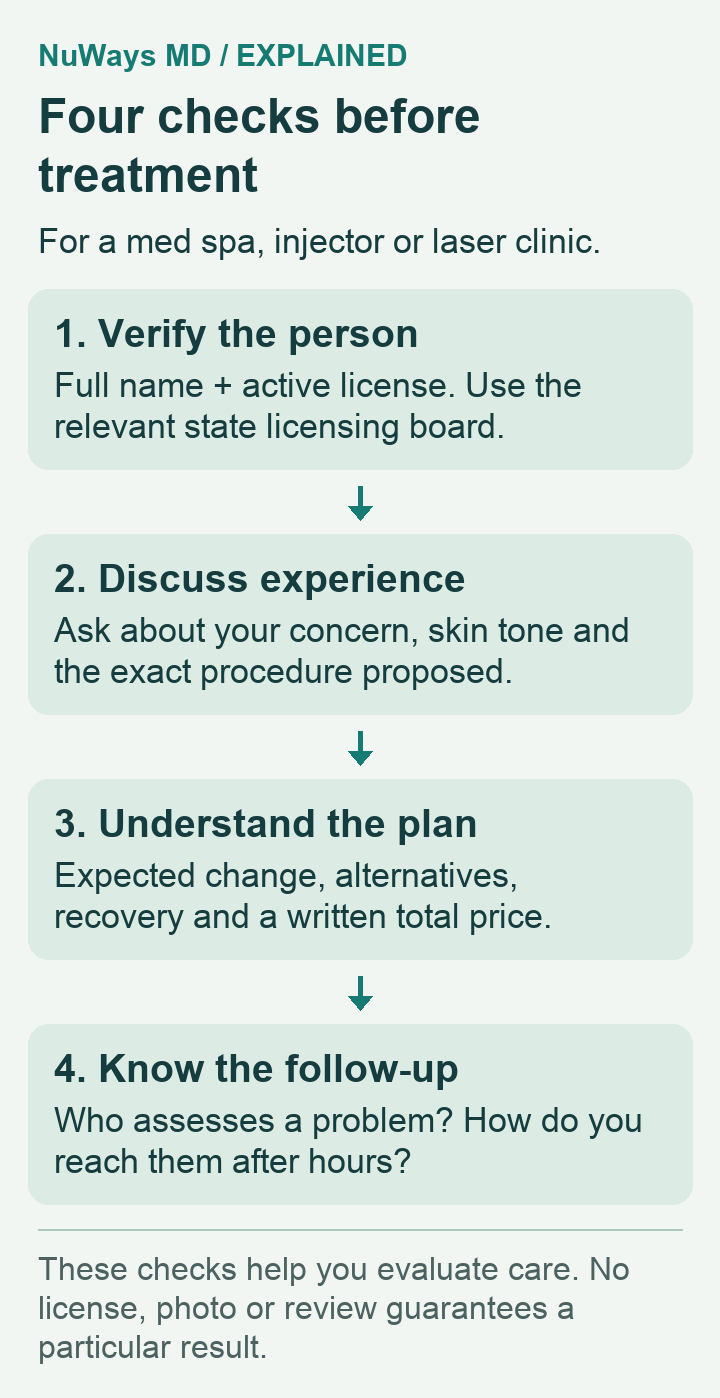
Four things to establish before treatment
The person
The treating professional’s full name, license type and relevant procedure experience
The reason
An explanation of what they see, the improvement they expect and why the proposed treatment fits
The care
Preparation, recovery, a named contact for concerns and a clear route to medical assessment
The commitment
An itemized price, package terms and time to decide without pressure
Start with the person who will perform the procedure
Get the treating person’s full name and professional designation before booking treatment. A clinic’s medical director, founder or social-media spokesperson may not be the person assessing or treating you. Find out who does each part and who is responsible for follow-up. Ask how you can reach the clinician responsible for medical assessment if a concern arises. A name on the website is less useful than a clear explanation of who is available and how the office handles urgent problems.
Relevant experience matters as well as a license. For laser work, for example, experience with your skin tone, pigment history and the proposed device is useful to discuss. For injections, ask about the particular area and product. A person may be highly experienced in one procedure and newer to another. The American Academy of Dermatology’s consultation questions include training, experience, alternatives, risks and expected results.
A useful first message: “Who would assess me and perform the treatment, what are their professional qualifications, and can I arrange a consultation before deciding on a package?” You are requesting basic information, not being a difficult patient.
How to check a provider’s license and credentials
Search the appropriate official licensing register using the full professional name, state and, if available, license number. Match the record carefully. Check whether the license is current, whether restrictions are shown and whether linked public disciplinary documents explain any listed action. A name match alone is not enough if several people share it.
| Credential or claim | Where to check | What it does and does not tell you |
|---|---|---|
| MD or DO physician license | The relevant state medical or osteopathic board; the FSMB board directory helps locate it | Confirms state licensure information. It does not establish experience with every aesthetic procedure. |
| Physician board certification | ABMS Certification Matters or the AOA’s physician-certification resources | Check the actual specialty and certifying body. A general claim of “board certified” leaves that question unanswered. |
| RN or advanced practice nursing credentials | The state nursing board and Nursys QuickConfirm, where the board participates | Verify the appropriate license and advanced-practice information. A training certificate is not a nursing license. |
| PA license and certification | The relevant state licensing board; NCCPA provides certification verification | State authorization and national certification are different records. Check the role and arrangement proposed for your care. |
| Esthetician or cosmetology license | The state cosmetology or professional-licensing regulator | Does not by itself establish authorization to perform injections or other medical procedures. |
| “Certified injector,” “laser specialist” or a manufacturer badge | Ask what the credential is, who awarded it and which underlying professional license applies | May describe training or participation in a training course. It is not a substitute for checking licensure and permitted practice. |
Nursys includes participating boards, so a missing result is a reason to check the state board directly, not proof that someone is unlicensed. Similarly, verify a physician’s claimed certification with the stated certifying body rather than assuming every credential is listed in one directory.
Is a nurse or PA a reasonable choice, or should I only see a doctor?
The answer depends on the procedure, the professional’s authorized role, their relevant training and the clinical arrangements. An experienced appropriately authorized nurse or PA can be part of an aesthetic-care team. A physician title alone does not demonstrate specialty expertise or familiarity with a particular device.
Rules about assessment, prescribing, delegation and supervision vary by state. The Medical Board of California’s medical-spa guidance, for example, distinguishes medical treatment from esthetic services and explains California-specific responsibilities. Do not apply its exact rules to every state. If the clinic’s explanation is unclear, ask the relevant board about the procedure and professional role.
Board certification in a relevant specialty can be meaningful evidence of training. It is still one part of the decision, alongside procedure experience, communication and the actual care setting. No credential guarantees an uncomplicated result.
What should happen at a cosmetic consultation?
A useful consultation starts with the change you want and an assessment, rather than a presumption that you need the treatment you mentioned. You may arrive asking for filler and learn that another approach, a smaller intervention or no treatment better matches your goal.
Discuss medical history, medicines, allergies and previous procedures privately with the clinician. Include earlier treatment areas, approximate dates and products or devices if known. Do not stop a prescribed medicine on your own to qualify for an appointment. NuWays MD does not need your medical history to help organize your research.
The proposed plan should connect the finding to the treatment in language you understand: what may improve, what probably will not, how results develop and what uncertainty remains. Ask whether the use is within the product’s approved or cleared labeling. An off-label use is a separate discussion about rationale and evidence, not something to infer from “FDA approved” in advertising.
Two fictional consultation conversations
A useful explanation
“The line you pointed to is visible both when you frown and when your face is relaxed. This treatment can reduce the muscle movement, but the crease may remain. Let us discuss what improvement would satisfy you and the alternatives before deciding.”
Why it helps: the explanation addresses the actual concern, describes a limitation and leaves room for your preference. It does not guarantee the outcome.
An answer that needs more detail
“Everyone loves this package. It stimulates collagen, and you can save today if you book three.”
What is missing: the finding being treated, why that procedure and visit count fit, relevant risks and the proposed review point. Ask for those details before comparing the discount.
These invented examples illustrate communication, not diagnoses or recommended treatment plans. A confident manner can feel reassuring, but an explanation you can repeat back is more useful than confidence alone.
What should you ask for each kind of treatment?
You do not need to memorize every device name or ingredient. Start with the questions that change the decision for the procedure you are considering.
| If you are considering… | The specific questions worth asking | Read next |
|---|---|---|
| Botox or another wrinkle-relaxing injection | Which product and areas are proposed? What movement should remain? When is the result reviewed, and how is additional treatment priced? | Botox for beginners and Botox costs, units and quote inclusions |
| Dermal filler | What is the exact product, area and intended change? How does the clinician recognize and manage a possible blood-vessel complication? Who is available afterward? | FDA filler information |
| Laser hair removal | Which device is suitable for my hair and skin? What are the area boundaries, preparation, expected response and plan for a reaction? | Laser hair removal guide |
| Microneedling or RF | Are needles alone or RF being proposed? Why? Will a new cartridge be used? What added products or comfort measures are included? | Microneedling versus RF |
| Laser resurfacing | Which laser, treatment intensity and areas? What wound care or visible recovery should I plan for? How does my skin’s pigment history affect the options? | Laser resurfacing explained |
For injections, product sourcing matters even when someone has a professional license. FDA reports of counterfeit Botox have involved both licensed and unlicensed individuals. Ask the practice to identify the exact product and its authorized supply source. A recognizable box or a low price cannot establish authenticity on its own. FDA counterfeit Botox alert.
For microneedling, the FDA specifically advises a new needle cartridge for each patient and each session. Cleaning a used cartridge does not make reuse consistent with the agency’s authorization. FDA microneedling guidance.
How much should you trust before-and-after photos and reviews?
Photos can show the kind of change a practice wants to demonstrate. They cannot tell you the average result or the chance of a complication. Use them to make the consultation more specific.
Look for comparable lighting, camera angle, distance, facial expression and makeup. Ask when the after-photo was taken, how many sessions occurred and whether other procedures were performed. A swollen early result, a changed expression or a different light can make comparison difficult.
Ask to see examples relevant to your concern and, where appropriate, skin tone. A dramatic improvement in a different problem does not answer your question. If the photographs belong to a device manufacturer rather than the treating clinician’s patients, they demonstrate a different kind of evidence.
Reviews are useful for recurring experiences such as communication, unexpected charges and the handling of concerns. They do not independently verify technical skill. A high volume of enthusiastic reviews should not replace a license check, and an isolated negative review should be read in context rather than treated as a clinical finding.
Make sure follow-up is more than “message us if you need anything”
Before treatment, establish which number to use, when it is monitored, who assesses a concern and what happens outside office hours. A social-media inbox is a poor substitute for a clear clinical contact route.
Ask for written instructions that explain expected recovery and changes requiring prompt assessment. For a more involved procedure, understand the planned review appointment and who covers the clinician’s absence. If the practice is far from home, consider the practical cost and availability of returning.
Complications can happen despite appropriate care. What matters is that the risk is discussed honestly and that there is a credible response plan. Do not wait for a routine clinic reply if you have an emergency. After an injection, sudden vision changes or trouble breathing require emergency medical care. FDA filler risks; FDA Botox alert.
Compare the written plans before comparing the prices
Two estimates may cover different areas, products, session counts or follow-up. Put them side by side and mark what each actually includes. An unanswered question is still unknown, even when the package has a single attractive total.
| Detail to bring home | What should be clear |
|---|---|
| The proposed procedure | Product or device, intended areas, goal and recommended treatment plan |
| The full price | Consultation, treatment, required supplies or products, routine review and possible additional charges |
| The package rules | Expiration dates, cancellations, unused visits and what happens if the plan changes |
| Recovery arrangements | Instructions, expected limitations and contact information |
| Your decision | What you agreed to, what you declined and what remains undecided |
You can pay for a consultation without agreeing to treatment if that is the clinic’s stated arrangement. Clarify the consultation charge and whether it is credited before the visit. If you are comparing a series or package, our treatment budget helps organize the costs without selecting the treatment for you.
Reasons to pause or seek another opinion
- You cannot obtain the treating person’s name, professional role or an explanation of supervision where it is required.
- A treatment is described as risk-free or a result is guaranteed.
- Your medical-history questions, pigment concerns or previous bad experience are brushed aside.
- A large package is proposed before a meaningful assessment, or a same-day discount is used to prevent you taking time to decide.
- The clinic will not explain the product, device, written price or follow-up arrangements.
- You feel pressured to fix additional features you did not ask about and do not want treated.
These are reasons to slow the decision, not an automated rating system for clinics. You are allowed to say, “I would like to take the written plan home and think about it.” Choosing no procedure is a legitimate outcome of a good consultation.
A short checklist to take with you
- Who assesses me, who performs treatment and who handles follow-up?
- What do you think is causing the feature I want to change?
- What improvement is realistic, and what will this treatment leave unchanged?
- What alternatives should I consider, including waiting or doing nothing?
- What risks and recovery obligations matter for my circumstances?
- What is the complete written price, including the rules if I stop a package?
- When will we review the outcome, and how do I contact you about a concern?
Keep the questions you want answered
Build a saved research plan and take your unresolved questions to the consultation. It does not book an appointment or authorize sharing your details with a practice.
Save my consultation questions →Frequently asked questions
Is a med spa automatically less safe than a doctor’s office?
The sign on the building is not a complete description of care. Check the individuals, the proposed procedure, the clinical arrangements and the response to complications. The same questions are useful in either setting.
Does a manufacturer directory mean the provider has been independently vetted?
Read what that directory actually checks. A listing can show that a practice offers a device or participates in a program. It should not be assumed to establish independent clinical quality or a comparison with other practices.
What if a license record lists a disciplinary action?
Read the official document, its date and any current restrictions. If something remains unclear, contact the regulator. Avoid deciding from a label alone or assuming that an expired action means no current issue needs checking.
Should I bring photos of the result I want?
They can help explain your preference, but another person’s face is not a promised outcome. Also bring a simple description of the feature that bothers you and what you would consider worthwhile improvement.
Does NuWays MD choose or certify providers for readers?
We do not operate a nationwide verified provider-matching service. This guide helps you evaluate information and prepare questions. Any local introduction has its own availability, permission and disclosure information; it is not a ranking or a clinical endorsement. Commercial disclosures.
Sources and editorial notes
Sources checked September 27, 2026. This guide combines official credential-verification resources with professional and regulatory guidance on cosmetic consultations and treatment safety.
Checking professional credentials
- Federation of State Medical Boards: state board directory: links to the regulators responsible for physician licensure.
- ABMS Certification Matters: certification questions: specialty-certification information and how it differs from a medical license.
- American Osteopathic Association: information for patients: osteopathic specialty-certification resources.
- National Council of State Boards of Nursing: license verification: Nursys verification and participating-board information.
- NCCPA: certification resources: PA certification verification; state licensure must also be checked with the relevant regulator.
- Medical Board of California: medical spas: a California-specific example of the distinction between medical and esthetic services. Its rules should not be treated as nationwide requirements.
Consultation and treatment-safety guidance
- American Academy of Dermatology: questions to ask before cosmetic treatment: training, experience, alternatives, risks and expected results.
- FDA: dermal filler do’s and don’ts: provider selection, product identity and serious injection risks.
- FDA: counterfeit Botox alert: supply-source concerns and adverse-event warning signs.
- FDA: microneedling devices: patient questions, authorized uses and a new cartridge for each patient and session.
What this guide can establish
The checklist, verification diagram and two consultation conversations are original educational material. The conversations are fictional, not accounts of named clinics. The guide does not certify a provider or assign clinical-quality scores. A current license establishes one part of the picture; it does not by itself establish procedure-specific experience or guarantee a result.
Licensing and practice rules vary by state and can change. Use the current official regulator’s record for an individual professional. NuWays MD is an educational publication, not a medical provider, and this guide is not medical or legal advice. Independent clinical review remains pending. How we prepare and update guides · Commercial disclosures.