Laser Hair Removal Not Working? What to Review After Several Sessions
Laser hair removal takes several appointments, but progress matters more than the number of visits. If you have completed a series with little lasting reduction, review the remaining hair, device, timing and treatment record before buying more. You may still have some hair even when treatment has meaningfully reduced it.
Editorial details
The quick answer
How many sessions?
There is no universal cutoff. The area, remaining hair and response matter more than the appointment count.
Still shaving after a series?
Compare density, thickness and time between shaves. Little lasting change deserves a documented review.
New, coarser facial hair?
Have it assessed before deciding whether to continue, change or pause treatment.
What to bring
Your appointment dates, consistent photos, hair-removal routine and remaining-package terms.
This guide is about progress across several appointments. If you had one recent treatment and are waiting for the hairs to come out, start with our laser shedding guide. Shedding after a visit and lasting reduction across a series answer different questions.
What counts as laser hair removal working?
Useful progress can mean less hair, finer regrowth or a longer interval before shaving. You may still need maintenance after a successful initial series. AAD: laser hair removal FAQs
Published session counts are general expectations, not treatment limits. The AAD’s FAQ describes 2–6 treatments, while its overview says six sessions or more. Mayo Clinic describes 4–8 treatments for best results. These descriptions do not establish a maximum or a point at which treatment has failed. Your clinician should explain the plan for your treatment area, hair and skin, and review how you are responding.
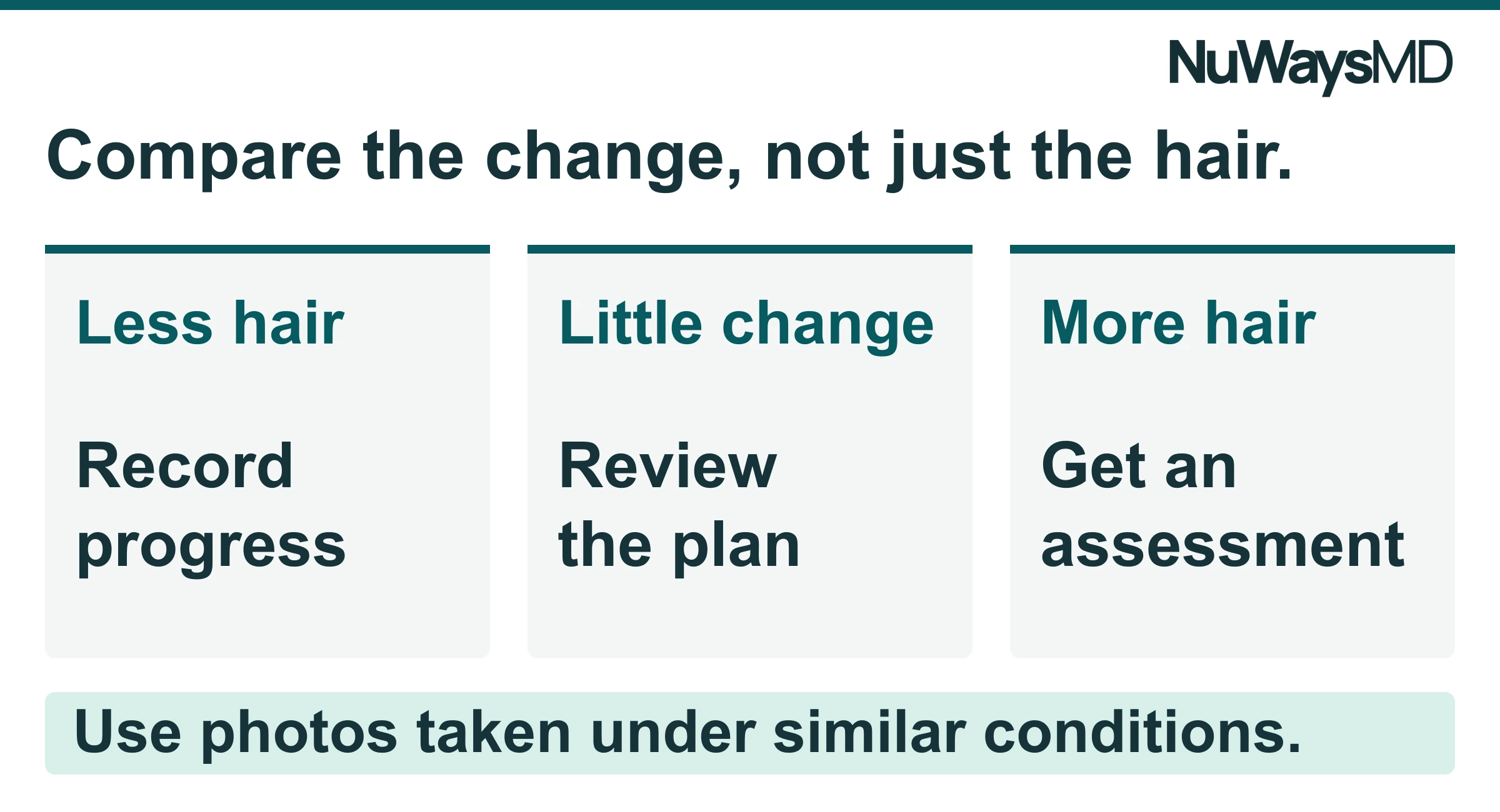
The most useful comparison is your treated area now versus the same area before the series, under similar conditions. A smooth photograph taken immediately after shaving tells you very little about hair reduction. Nor is a close-up of one stubborn patch a fair measure of an entire leg.
| What you notice | What it can tell you | What to review |
|---|---|---|
| Fewer hairs, but you still shave | There may be meaningful reduction without complete clearance | How much the remaining hair bothers you and what additional treatment could realistically achieve |
| Regrowth takes longer or feels finer | The pattern may be changing even if the area never looks completely bare | Compare the same number of days after shaving |
| Temporary shedding, then apparently unchanged density | A post-treatment change has not established lasting reduction | Baseline photos, the full treatment record and results between sessions |
| Dense strips beside clearer patches | The uneven pattern deserves a closer look | Ask the clinician to examine the pattern and treatment coverage; a photo cannot identify the cause |
| More or coarser hair, particularly on the face or neck | This is different from simply retaining some original hair | A clinical assessment of new growth, including possible treatment-related stimulation |
Make your own progress record useful
Our suggested record is deliberately simple: choose the same small area, take photographs in similar light and at a similar distance, and note how long it has been since shaving. Record appointment dates and what changed between them. Keep following your clinic’s grooming and preparation instructions while making the record.
Bring the original images, not filtered social-media versions. Ask your clinician to compare them with the practice’s baseline photographs. You are looking for a trend that both of you can describe, not a perfect percentage calculated from phone pictures.
Why several sessions can still leave substantial hair
Laser targets hair pigment. Hair-growth cycles, hair color and skin tone affect treatment planning and results. Mayo Clinic: how laser hair removal works
The question is therefore not simply “Have I had enough sessions?” It is “Was this a suitable target, was there a suitable plan, and is that plan producing a useful change?”
The remaining hair may be a less suitable target
White, gray, blonde and red hair respond less well to pigment-targeting lasers because they absorb the treatment light less effectively. Mayo Clinic: hair color and response Hair that grows back after treatment may also be finer and lighter than before. Fine hair can absorb less laser energy than coarse, dark hair, so earlier improvement does not guarantee the same response from what remains. Ask which remaining hairs are suitable targets before buying another package. ASPS: hair thickness and treatment response
For unwanted white or blonde hair, the Endocrine Society’s hirsutism guideline identifies electrolysis as an option instead of photoepilation. That is a discussion about the appropriate method, not evidence that every remaining hair requires another laser session. Endocrine Society guideline
Face and body results are not interchangeable
A long-term review found only five randomized trials, covering 223 participants, that met its follow-up requirements. Outcomes varied by treatment and body site; the authors reported better long-term reduction on legs than on the face in the included studies. Those results do not provide a reliable percentage for your own chin or bikini area. Krasniqi and colleagues, 2022
This is why a friend’s successful underarm series is a poor yardstick for persistent facial hair. Our facial laser hair removal guide covers the facial decision in more detail.
The appointment interval needs a reason
Hairs in the same area are at different stages of growth. Laser treatment works best during the active growth phase, so one visit does not treat every follicle equally. Spaced appointments give the clinician opportunities to treat hairs as they enter a responsive phase. ASDS: active growth and treatment response The AAD describes four to six weeks as a common interval, while emphasizing that the clinician determines the appropriate timing. Ask how the interval fits your treatment area and current regrowth. AAD FAQs
Ask what the practice is looking for before the next visit. “This is when your package renews” is a billing explanation; it does not explain why that interval fits your hair growth. If appointments were delayed, ask how to adjust the plan rather than assuming you must restart and buy everything again.
Preparation and treatment-day changes matter
Tell the clinic about tanning, medicines, waxing or plucking between visits. Removing hairs by the root is different from shaving. Mayo Clinic preparation guidance
The AAD recommends discussing previous treatment reactions, scarring history and medications during consultation. Keep that conversation current across the series. Update the clinic about a new prescription or recent tan even if you have attended many times. AAD: preparation
Should the clinic change the laser or turn it up?
The treatment settings and coverage are worth reviewing when progress stalls. Laser energy must affect the hair follicle while protecting the surrounding skin, so a setting that suits one person may be inappropriate for another. Mayo Clinic: treatment choice and skin safety Ask the clinician to review the settings used, any adjustments, skin reactions and coverage of the area, especially if dense strips remain beside clearer patches. That pattern alone cannot prove missed treatment. More pain is not a reliable measure of a better treatment, and asking for a higher setting without that review is not the answer.
A 2023 network meta-analysis included 13 randomized trials and 652 participants. It did not find a statistically significant difference in hair-count reduction between the laser interventions it compared. That does not make every device identical; it makes a universal “best laser” claim difficult to defend from this evidence. 2023 network meta-analysis
| Ask the practice | Why the answer helps |
|---|---|
| Is this a laser or IPL, and what is the device? | IPL is a different light technology. Know what service your package actually includes. |
| Why is this appropriate for my current hair and skin? | The choice should fit the person and area, not just the equipment available. |
| Were the settings or treatment approach changed across visits? | A useful review considers the treatment record and response together. |
| What would justify changing the plan, and what would make you stop? | You need a reassessment point before committing to more of the same. |
| Who assesses an unexpected reaction or poor response? | Clarifies access to the clinician responsible for treatment decisions. |
For women with darker skin seeking photoepilation for hirsutism, the Endocrine Society guideline favors a long-wavelength, long-pulse approach, such as appropriate Nd:YAG or diode treatment, with cooling. This is a clinical selection issue, not a do-it-yourself settings guide. Endocrine Society guideline
See our main laser hair removal guide for the broader device comparison and choosing a provider for consultation preparation.
Could hormones or new hair growth explain the result?
Yes. Hormonal conditions can help explain persistent or new facial hair, and deserve assessment alongside the treatment record. Unwanted coarse hair can accompany conditions such as polycystic ovary syndrome. The Endocrine Society distinguishes managing existing hair from investigating and treating an underlying condition. Hirsutism guidance for patients
Tell a medical clinician if growth is new or rapidly changing, or occurs with menstrual changes or other new symptoms. Do not try to diagnose PCOS from a treatment response or start hormone treatment on the strength of an online checklist. The point of this review is to identify when an aesthetic treatment plan needs a medical conversation. Endocrine Society: evaluation recommendations
The Endocrine Society suggests medication first for most premenopausal women with persistent, troublesome hirsutism despite cosmetic measures; hair removal can be added. For mild hirsutism without an endocrine disorder, either approach can be reasonable. This guidance concerns a diagnosed condition, rather than everyone seeking cosmetic hair removal. Full recommendation summary, sections 2.1 and 4.4
Useful questions include: “Are we seeing remaining original hair, new growth, or both?” and “Does this pattern need assessment outside the laser appointment?” A clinician may not be able to settle that from one visit, but should be able to explain the next step.
What if the hair seems thicker after laser?
More or coarser hair deserves reassessment. Paradoxical hypertrichosis is the term for increased hair growth associated with laser or IPL treatment. It is not the same as normal shedding or discovering hairs that were already there.
A 2021 systematic review of 22 studies and 9,733 patients estimated a pooled prevalence of 3%, with a very wide variation between studies. The association was concentrated on the face and neck. This is not a personal three-in-100 prediction: the underlying studies differed substantially, and the review could not reliably resolve every proposed risk factor. Snast and colleagues, 2021
A 2025 prospective observational study reported facial paradoxical growth in 16.2% of its group of Jordanian women receiving long-pulse alexandrite treatment. That specific population and treatment setting cannot supply a risk estimate for everyone having laser elsewhere on the body. It reinforces why the pooled 3% figure should not be presented as a universal rate. Within that study, increased growth was associated with PCOS, irregular periods, family history of hirsutism, skin types III–IV and 6–10 treatment sessions; regular sunscreen use was associated with a lower rate. Those associations cannot establish that a session number or lack of sunscreen caused the problem, or that sunscreen prevents it. Qeyam and colleagues, 2025
Continuing treatment can sometimes help. In three of the four studies reporting what happened afterward, the extra growth improved with continued treatment; the 2021 review’s authors considered continuation a possible preferred approach. This limited, mostly observational evidence supports a clinician-led decision, not an automatic stop or renewal. Snast review: management findings
Bring baseline and current photographs to a dermatologist or suitably qualified treating clinician. Confirm what explains the growth and which area should be treated before expanding onto nearby fine hair or changing settings.
A specific caution about facial hirsutism
The Endocrine Society’s 2018 guideline identifies increased paradoxical-growth risk in Mediterranean and Middle Eastern women with facial hirsutism and suggests considering topical treatment or electrolysis instead of light-based removal. This is a reason for an individualized risk discussion before another facial treatment, rather than a diagnosis based on ancestry. Guideline, section 4.2
For faster response to light-based treatment, the same guideline suggests prescription eflornithine cream in appropriate patients. Ask a clinician whether it fits your facial-hair plan and is available locally. Guideline, section 4.3
Still growing after six, eight or ten sessions: what next?
After six, eight or ten sessions, the useful question is how much lasting reduction you have achieved. Little improvement deserves a review of the treatment plan; the appointment count alone does not establish that treatment has failed. Some people need additional treatment, but the practice should explain why it fits your response and remaining hair.
Use the following discussion before deciding whether to continue:
- Describe the change. What is different from baseline, including shaving frequency, density and thickness?
- Identify the target. Is the hair that remains suitable for the proposed treatment?
- Review the record. Look at the area treated, appointment spacing, device, treatment adjustments and reactions.
- Name the next decision. Continue the current plan, modify it, consider another method or seek a medical assessment.
- Agree on a review point. What observable change would make further treatment worthwhile, and when will you reassess?
This is an editorial consultation framework, not a diagnostic score. A second opinion can be useful when the first practice cannot explain its plan or when you feel pressured to renew without a review. A different clinic should still evaluate suitability rather than promise to correct another provider’s work sight unseen.
Maintenance or an unfinished series?
Ask the practice to say which one it means. Occasional treatment after a useful response is a different buying decision from paying repeatedly without measurable progress. The AAD notes that maintenance can be needed; it does not define every extra appointment as successful maintenance. AAD FAQs
Review the next package before paying for it
The money already spent does not tell you whether the next purchase is worthwhile. Compare the proposed additional cost with the change the clinician expects to assess, the alternatives and your own priorities. Considering a home handset instead? Compare home IPL with professional laser before assuming the switch will solve the problem.
Fictional example: six visits at $150 cost $900. Another three at the same price add $450, bringing treatment spending to $1,350. That is simple budget arithmetic, not a typical price or recommended treatment schedule. Before adding the $450, ask what is different about the next phase and what happens if progress remains limited.
| Item to get in writing | What to clarify |
|---|---|
| Remaining appointments | Number left, expiration date and transfer rules |
| Additional treatment | Same area and service, or an extra charge for a different area/device? |
| Review visit | Whether assessment is included or separately charged |
| Refund or credit terms | What the agreement actually allows if you pause or stop |
| Maintenance | Price and eligibility after the original package ends |
Our laser hair removal cost guide explains the full quote comparison. Use the treatment budget planner to total the spending you are considering. Neither a lower session price nor a larger prepaid package establishes better clinical value.
When to contact a clinician promptly
Contact the treating clinician promptly about blistering, burns, significant pain or concerning pigment changes. The AAD lists burns, scars and skin-color changes among possible complications. AAD risks and complications
Seek urgent care for an eye injury or a vision change after treatment. Mayo Clinic warns about serious eye injury and advises against treating the eyelids, eyebrows or surrounding area. Mayo Clinic safety guidance
If the concern is ordinary post-appointment hair release rather than injury or poor reduction across visits, use the shedding timeline to frame your follow-up questions.
Frequently asked questions
Does no shedding mean the laser did not work?
Not by itself. Hair release takes time; a single post-treatment observation cannot establish the series outcome. See what shedding can look like and the Mayo Clinic overview.
Why do I still have hair after ten laser sessions?
Remaining hair after ten sessions does not, by itself, mean treatment failed. You may have achieved useful reduction, while finer or lighter remaining hair responds less well. If there has been little lasting change, review the device, timing, treatment record and possible ongoing growth with your clinician before buying more. Compare current density and shaving frequency with your starting point.
Does shaving make laser hair removal stop working?
No. Shaving does not make laser hair removal stop working. It cuts hair at the surface rather than removing it from the root, as waxing or plucking does. Mayo Clinic includes shaving in its preparation guidance. Follow your clinic’s instructions about when to shave. Mayo Clinic preparation guidance
Should I switch from IPL to laser?
Possibly, but the answer depends on the current device, target hair, skin and treatment record. Ask why the proposed alternative is a better fit. A technology label alone cannot predict your outcome; comparative research does not establish one universal winner. 2023 review
Can laser remove the blonde hairs left behind?
Light hair is a less suitable target for pigment-based treatment. Ask about alternatives, including electrolysis, rather than purchasing more light-based treatment without a clear rationale. Endocrine Society guideline
Should I finish a prepaid package if I am worried about new hair growth?
Arrange a clinical review before deciding. Having paid for appointments does not establish that continuing unchanged is appropriate. Separately ask the practice about pausing, credits and the written package terms.
Sources and editorial notes
Prepared from clinical guidance and published reviews; sources checked October 4, 2026. Independent clinical review is pending. This guide cannot assess your treatment or recommend device settings. The progress record, consultation framework and package example are NuWays MD editorial tools, not validated clinical instruments.
- American Academy of Dermatology: laser hair removal FAQs. General expectations, follow-up and risks.
- AAD: preparing for laser hair removal. Consultation and treatment-history questions.
- AAD: laser hair removal overview. General session expectations, including six sessions or more.
- American Society for Dermatologic Surgery: lasers for unwanted hair. Why active growth affects response and appointments are spaced.
- American Society of Plastic Surgeons: planning laser hair removal. Clinician explanations of growth phases and differences between fine and coarse hair.
- Mayo Clinic: laser hair removal. Mechanism, hair color, preparation and recovery.
- Krasniqi et al., 2022, systematic review of long-term hair reduction. Five eligible randomized studies; limited long-term evidence and differing body areas.
- 2023 network meta-analysis of laser and light-based hair removal. Comparative trial evidence; not a machine ranking for an individual patient.
- Qeyam et al., 2025, facial paradoxical hypertrichosis. Published abstract reviewed; observational findings in a specific population and treatment setting.
- Snast et al., 2021, paradoxical hypertrichosis systematic review. Pooled estimates have substantial heterogeneity and should not be read as an individual’s risk.
- Endocrine Society hirsutism clinical practice guideline, 2018, complete recommendation summary, patient explanation and evaluation summary. These sources concern hirsutism and should not be generalized to every cosmetic hair-removal request.