EQUIPMENT BUYING GUIDE · DEKA
DEKA Motus AX and Motus PRO: Price, Moveo and FDA Clearance
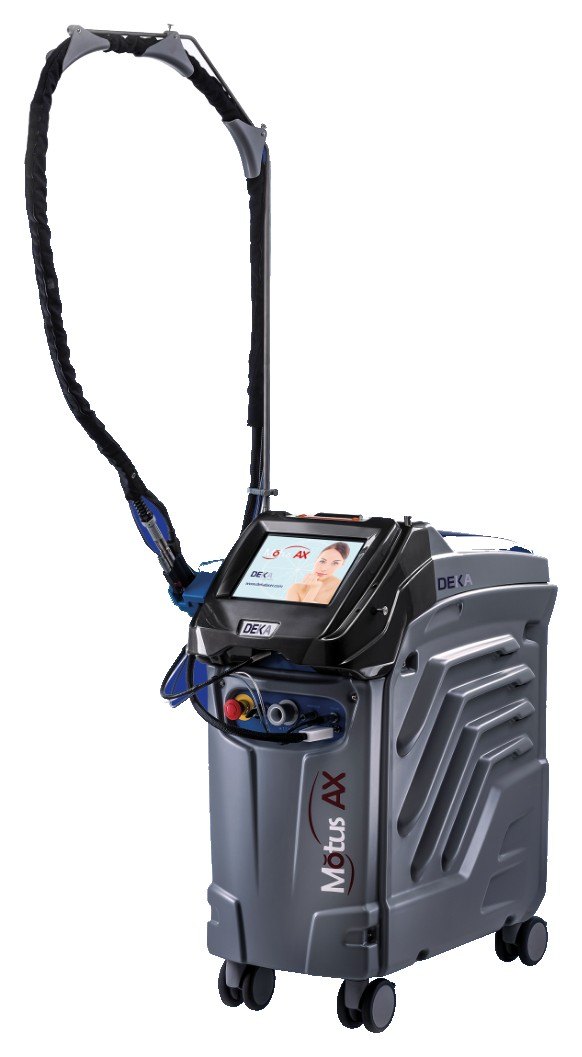 Motus AX
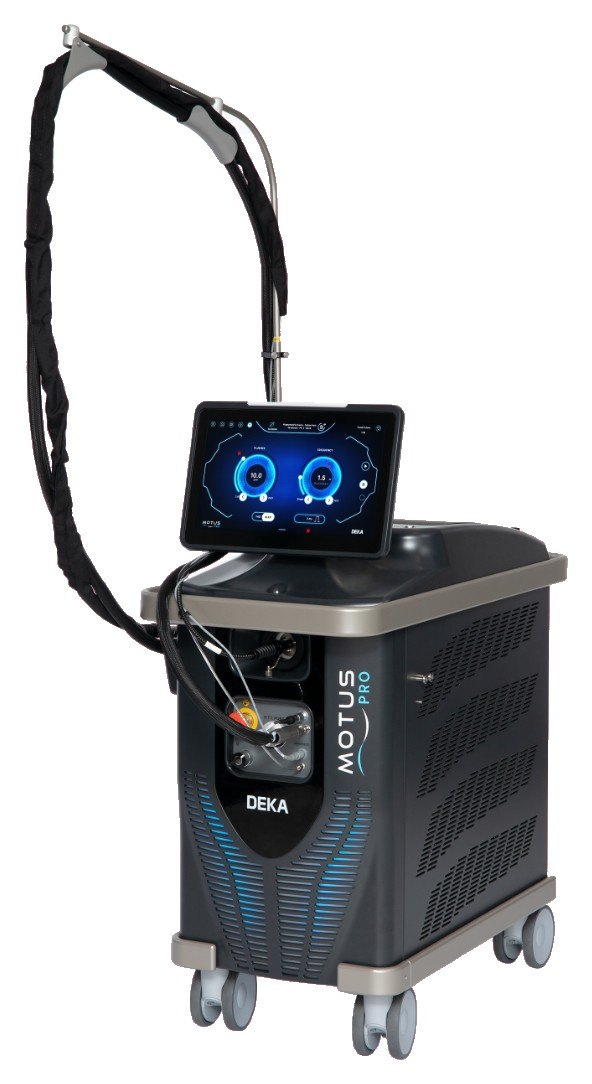 Motus PRO
Motus is DEKA’s alexandrite laser hair removal line, from the Motus AX laser to the MOTUS PRO family, with Moveo, an in-motion technique that scored far lower for pain than standard pulses in a randomized trial on the Motus AX. The AX is alexandrite only; the MOTUS PRO family adds spots to 24 mm and Nd:YAG (except on the PRO AX). DEKA doesn’t publish a price. Here are the specifications, what each FDA clearance covers, what the evidence shows and what to get in writing.
Document-based buying analysis, informed by Darryl’s 9+ years in the industry. Not sponsored; NuWays MD has no commercial arrangement with DEKA. Disclosures.
OUR TAKE
Motus is DEKA’s laser hair removal line, built around a 755 nm alexandrite laser and Moveo, a handpiece used in motion with many low-fluence passes in contact with the skin. The Motus AX, cleared by the FDA in 2017, is alexandrite only. The MOTUS PRO family, cleared in 2024, adds a 1064 nm Nd:YAG source (except on the alexandrite-only PRO AX), stamp spots up to 24 mm and a system maximum of 12 pulses a second. In the US, DEKA’s own product list names only the MOTUS PRO and sends buyers to Cartessa Aesthetics, which also lists only the PRO, so an AX, AY or AZ here is likely a used unit; ask.
Comfort is the case for Motus, and one trial backs it: in a randomized split-body pilot of 108 patients on the Motus AX, Moveo scored 1.5 for pain against 4.2 for standard alexandrite pulses. Hair reduction was 78.5% with Moveo against 87% with standard pulses, a gap the authors reported as not significant, though with those averages it looks like Moveo removed less hair. The PRO’s Moveo handpieces are cleared for up to 40 J/cm² (alexandrite), against 8 J/cm² on the AX, so the AX result may not carry over. DEKA doesn’t publish a price, and we found no federal purchase of a Motus. See the price breakdown.
Strengths
- Moveo in-motion technique, with a pain advantage in one trial
- Alexandrite on every model; Nd:YAG on the AY, AZ and PRO
- PRO: stamp spots to 24 mm and a 12 Hz system maximum
- FDA labels on both wavelengths name skin types I to VI
Watch for
- AX stamp fluence falls to 12 J/cm² at 18 mm
- The AX has no Nd:YAG for the darkest skin
- No federal purchase to benchmark a quote
- In the US, Cartessa lists only the Motus PRO
How much does a DEKA Motus cost?
PRICE CHECK · NOVEMBER 20, 2026
- New
- Not published by DEKA. Quotes depend on the model, whether it has Nd:YAG, and which handpieces are included.
- Government orders
- None found for Motus or DEKA hair removal lasers.
- Maintenance
- DEKA says the Motus AX needs no maintenance; get service terms in writing anyway.
- Context
- Federal orders for other alexandrite systems: GentleMax Pro $88,043 to $99,002 in 33 DLA catalog orders; GentleMax Pro Plus median $107,495. Not Motus prices.
Start a Motus quote with the exact model name. DEKA’s menu lists the Motus AX, AY, AZ, AZ+ and PRO, and warns that some configurations and accessories on its site aren’t available in the US; in the US, DEKA lists only the MOTUS PRO and sends buyers to Cartessa Aesthetics. The FDA filings cover four: the AX with alexandrite only (2017), the AY with alexandrite and Nd:YAG (2018), the AZ with both (2021), and the PRO family with both, plus an alexandrite-only PRO AX (2024). Older models may now be available only used. Make sure the quote names the model and every source it contains, because an AX and a PRO are very different machines for darker skin.
| Quote item | Why it changes the cost | A comparable answer includes |
|---|---|---|
| Model and sources | AX and PRO AX are alexandrite only; AY, AZ and PRO add Nd:YAG. | The model by name and both wavelengths listed if included |
| Power and site | The AZ filing lists 230 V single phase on a 16 A breaker and a weight of about 100 kg. | Power, circuit and room requirements for the model quoted |
| Handpieces | DEKA lists 10 standard handpieces for the AX and 12 for the PRO, plus Moveo handpieces. | Every stamp and Moveo handpiece by spot size |
| Cooling | The filings list skin cooling as integrated in Moveo or optional and external. | Whether an air chiller is included, and its model |
| Fiber and wear parts | All four Motus filings describe a user-replaceable optical fiber. | Fiber price, expected life and warranty coverage |
| Service | DEKA says the AX needs no maintenance, but parts and repairs still happen. | Warranty term, the plan price from year two, response time and loaners |
| Training | Moveo’s multi-pass technique has to be learned to work as intended. | Who attends, how long, and the cost to train a new hire |
Is a used Motus cheaper?
The asking price is lower, but the full cost may not be. In Darryl’s experience owning and managing a med spa, a used system can need a manufacturer recertification or inspection fee before the maker will service it. With Motus, confirm the exact model and sources first, then DEKA’s service terms for the serial number, in writing.
Motus AX vs. Motus PRO: specifications
The PRO adds Nd:YAG, larger stamp spots and a faster system repetition rate; its filing doesn’t list fluence by spot size.
| Specification | Motus AXK162886, 2017 | MOTUS PRO familyK241459, 2024 |
|---|---|---|
| Wavelengths | 755 nm alexandrite | 755 nm and 1064 nm Nd:YAG; alexandrite only on the PRO AX |
| Stamp spots | 2.5 to 20 mm | 2.5 to 24 mm |
| Moveo handpieces | Moveo, up to 8 J/cm² | 7 and 14 mm (alexandrite), up to 40 J/cm²; 5 and 14 mm (Nd:YAG), up to 50 J/cm² |
| Maximum fluence | Falls with spot size: 40 J/cm² at 10 mm, 12 at 18 mm, 10 at 20 mm | Up to 600 J/cm² on the stamp handpieces |
| Pulse duration | 0.25 to 300 ms | 0.2 to 300 ms |
| Repetition rate | Up to 10 Hz | Up to 12 Hz |
| Skin cooling | Integrated in the Moveo handpiece; external optional for the others | Optional; 15 °C |
From FDA 510(k) summaries K162886 and K241459, read November 20, 2026. The PRO filing names the 2021 Motus AZ (K211821) as its predicate and says the changes include a restyled chassis and software, new spot sizes, pulse duration and a higher 755 nm maximum fluence than the AZ’s 200 J/cm². The PRO’s 600 J/cm² is probably its ceiling at the smallest spot, as on the AX at 2.5 mm, though the filing doesn’t say; ask DEKA for the fluence available at 18 to 24 mm.
Why the AX relies on Moveo
The AX filing lists a maximum fluence for each stamp spot, and every one works out to roughly 31 J per pulse by our arithmetic (fluence times spot area). So the larger the spot, the lower the fluence: 40 J/cm² at 10 mm, 20 at 14 mm, 12 at 18 mm and 10 at 20 mm. For comparison, one 22-patient series, removing hair from forehead skin used to rebuild the nose, stamped an 18 mm alexandrite spot at 14 to 18 J/cm² (Yen and colleagues), more than the AX’s 18 mm ceiling. The AX’s answer is Moveo: many passes at low fluence, which DEKA says reduces the energy reflected by the skin and heats the follicle gradually. In the Moveo trial, the AX’s standard single-pass arm reduced hair by 87%, but the abstract doesn’t report the spot sizes used, so it doesn’t show how the AX stamps at 18 to 20 mm. If you want to stamp large areas at higher fluence, ask DEKA or Cartessa for the PRO’s fluence at its 18 to 24 mm spots before assuming it does better; its filing doesn’t say.
From FDA 510(k) K162886. Larger spots spread the same energy over more skin.
MAKE THE QUOTES COMPARABLE
AX, AZ or PRO? Put the quotes side by side.
Line up a Motus quote with a GentleMax or Soprano quote: wavelengths, handpieces, service after year one and financing.
Free, works in your browser, no account needed.
What is the DEKA Motus FDA cleared for?
The FDA cleared the Motus AX through a 510(k), K162886, on June 19, 2017; the Motus AY through K181486 on August 30, 2018; the Motus AZ through K211821 on July 6, 2021; and the MOTUS PRO family through K241459 on June 21, 2024, all to El.En., the applicant named on DEKA’s filings. A 510(k) clearance means the FDA found each substantially equivalent to devices already sold; it isn’t a ranking.
| Wavelength | Hair indications | Skin types on the label |
|---|---|---|
| 755 nm alexandriteAX, AY, AZ, PRO, PRO AX | Temporary hair reduction, and stable long-term or permanent hair reduction | I to VI, including tanned skin |
| 1064 nm Nd:YAGAY, AZ and PRO | Removal of unwanted hair, permanent hair reduction and pseudofolliculitis barbae | I to VI, including tanned skin |
From K162886, K181486, K211821 and K241459, read November 20 and 21, 2026. “Permanent hair reduction” means a long-term, stable reduction in the number of hairs regrowing at 6, 9 and 12 months after a treatment regime, not that every hair is gone.
The AX’s alexandrite label names skin types I to VI, but Nd:YAG at 1064 nm is generally considered better suited to dark skin (Ross and Domankevitz), and the AX doesn’t have it. If you see many patients with skin types V and VI, the PRO is the Motus to price new.
What does the research show for Motus and Moveo?
We found one randomized trial of Moveo, and its finding was about comfort, not more hair reduction. In 108 patients with skin types I to VI, one side of the body was treated with standard single-pass alexandrite and the other with Moveo, for 3 to 8 sessions six weeks apart, with a 6-month follow-up (Bonan, Troiano and Verdelli).
HAIR REDUCTION, MOVEO
78.5%
Against 87% for standard pulses; the authors called it not significant
PAIN SCORE, MOVEO
1.5
Against 4.2 for standard pulses (P = .0002)
PATIENT PREFERENCE
84%
Preferred Moveo over standard pulses
From the trial’s abstract. A pilot from a single Italian clinic; the abstract doesn’t state the pain scale’s range.
So Moveo’s advantage in this trial was a far more comfortable treatment. The authors reported the hair reduction gap as not significant, but averages of 78.5% and 87% with small spreads across 108 patients look like a real difference, and we couldn’t read the full paper to check. The abstract doesn’t report results by skin type. For a practice, comfort matters: it affects whether patients finish a package and refer friends. But don’t market Moveo as more effective on the strength of this study.
The broader alexandrite evidence applies too. In a small randomized trial on the legs of skin types III and IV, in which 15 of 20 people finished, an 18 mm alexandrite spot reduced hair by 84% at 18 months, with no significant difference from 12 mm alexandrite or Nd:YAG (Davoudi and colleagues). Paradoxical hypertrichosis, hair growing thicker near a treated area, had a pooled rate of 3% in a 2021 meta-analysis, mostly on the face and neck (Snast and colleagues); in one clinic’s review, 24 of its 25 cases followed alexandrite treatment, which made up 70% of its treatments (Inoue and colleagues), though the meta-analysis found no effect of device type.
How many visits pay for a Motus?
With no public price, use your quote. In the worked example in our laser hair removal machines guide, each $100,000 financed over five years at 10% APR costs about $2,125 a month: about 14.4 full-leg visits at $250, or 37.3 underarm visits at $100, after assumed provider time, supplies, card fees and the cost of finding the patient.
PER $100,000 FINANCED
$2,125
A month over 60 months at 10% APR
FULL-LEG VISITS A MONTH
14.4
At $147.50 left each; illustrative
UNDERARM VISITS A MONTH
37.3
At $57 left each
Illustrative: 100% financed, no fees, before tax, installation and service. Moveo uses several passes over each area, so time a full-leg treatment in the demo before you use 45 or 60 minutes in your own plan. Visit prices are one practice’s standard single-visit prices (Central Minnesota Dermatology); the costs are our assumptions. Packages lower the per-visit price: at that practice’s six-visit prices ($500 underarms, $1,400 full legs), the same payment takes about 52 underarm or 16 full-leg visits a month if each visit carries the same costs. Covering the payment isn’t breaking even: rent, other staff and your own pay come on top. Not a quote or a forecast.
What should you compare with Motus?
Price one other alexandrite and Nd:YAG workstation and one comfort-focused diode, so you can see what Moveo is worth.
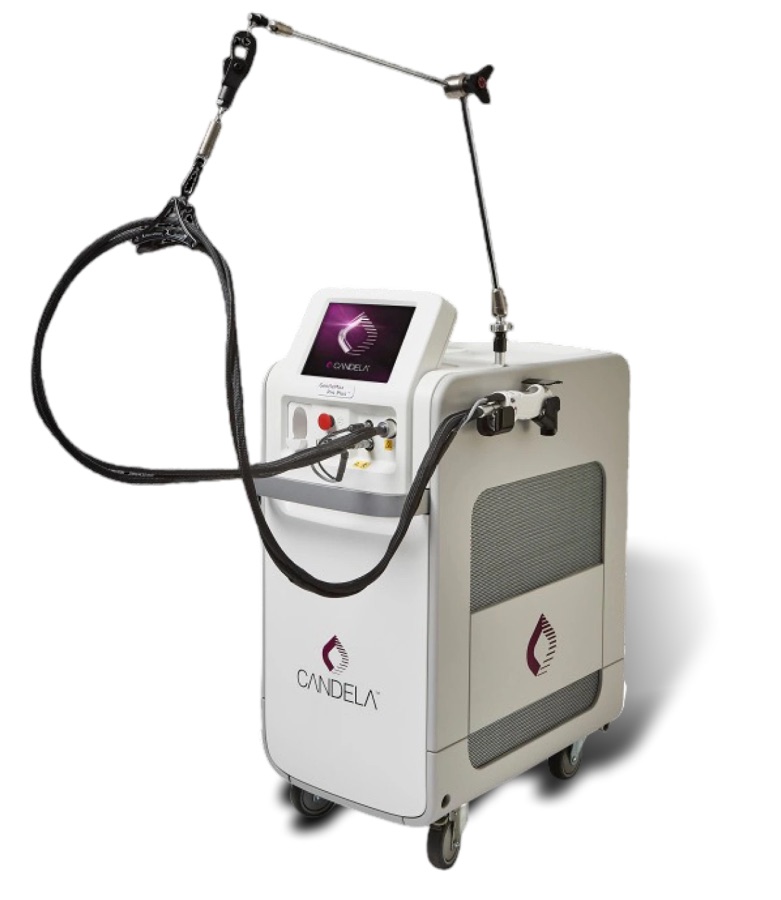
Alexandrite + Nd:YAG
Candela GentleMax Pro Plus
Candela; FDA cleared May 2020 (K201111)
Both wavelengths with 68 J at 755 nm, spots to 26 mm and cryogen cooling or an air-cooled option. Federal orders ran $92,982 to $123,082; the lowest may exclude the large-spot kit, which buyers ordered separately for $24,725.
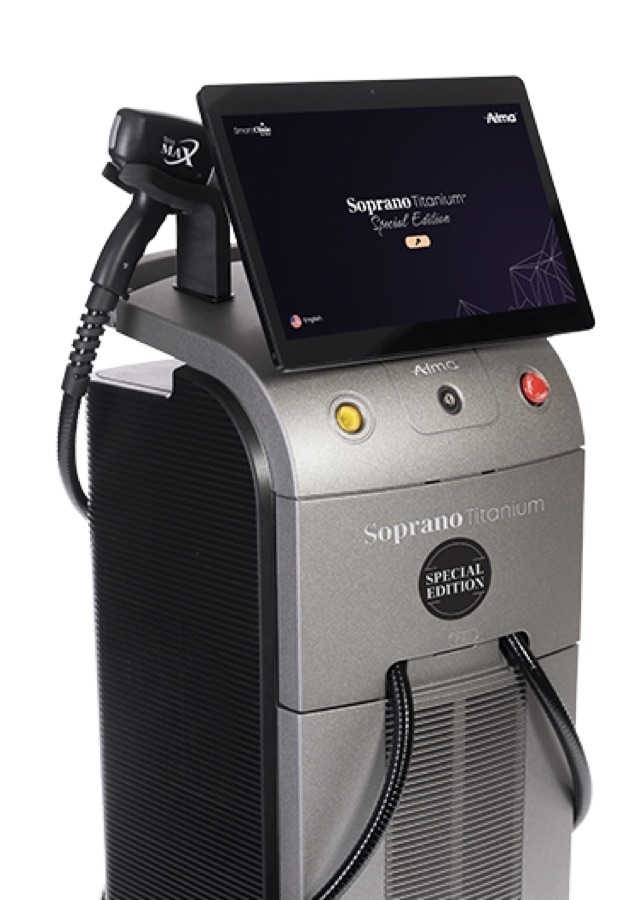
Three-wavelength diode, in motion
Alma Soprano Titanium
Alma Lasers; FDA cleared 2022 and 2023
Another in-motion, low-fluence approach, with a diode instead of an alexandrite laser, and separate 810 and 755 nm applicators.
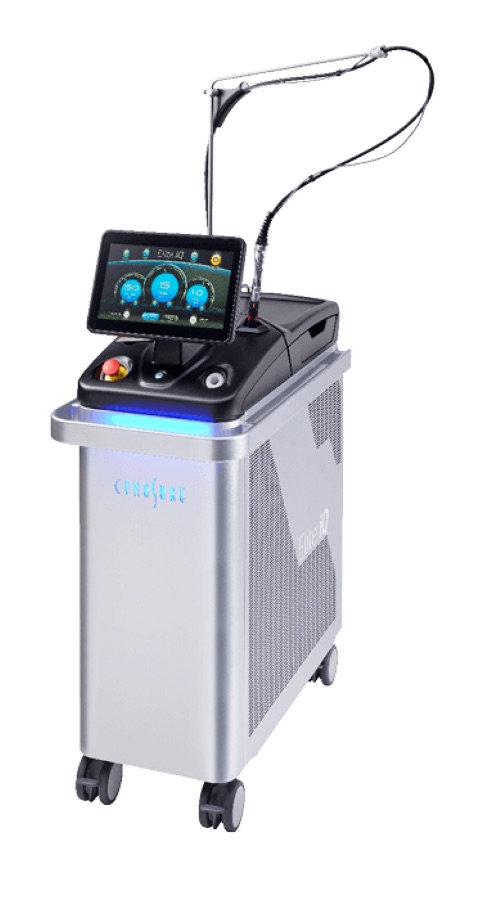
Alexandrite + Nd:YAG, air cooled
Cynosure Elite iQ
Cynosure; Elite iQ PRO cleared 2024
Both wavelengths, compatible with a cold-air chiller, a melanin reader for test spots (an accessory to confirm), and a 30 mm spot and 12 Hz system maximum on the PRO.
Images: Candela, Alma Lasers, Cynosure. Compare all eight systems in our laser hair removal machines guide.
What should the demo and written quote prove?
- The exact model: AX, AY, AZ, AZ+, PRO or PRO AX, both sources listed if included, and the 510(k) number on the unit. We found no FDA filing under the AZ+ name, so ask which clearance covers it.
- Every handpiece: stamp spots and Moveo handpieces by size and wavelength, and the price of any left out.
- A timed Moveo treatment: full legs or a back, by the person who will treat your patients, with the number of passes they use.
- Darker skin: Nd:YAG test spots on your darkest skin types, if the model has it.
- Service: warranty term, what “no need of maintenance” covers in writing, the plan price from year two and response time.
- Training: Moveo technique for new hires, and its cost.
Ask Cartessa for references from US practices with a patient mix like yours. Already bought one? Our paid consulting covers device launches.
DEKA Motus buying questions
How much does a DEKA Motus AX cost?
As of November 2026, DEKA doesn’t publish a price, and we found no federal purchase of a Motus. In the US, DEKA lists only the MOTUS PRO, so an AX here is likely a used unit. Ask for an itemized quote naming the model and handpieces, and compare it with another alexandrite system whose federal price is public, such as the GentleMax Pro ($88,043 to $99,002 across 33 Defense Logistics Agency catalog orders from 2016 to 2025).
Is Motus laser hair removal permanent?
Not in the everyday sense. Every Motus filing lists alexandrite for temporary hair reduction and for stable long-term or permanent hair reduction, and Nd:YAG, where fitted, for hair removal and permanent hair reduction. In FDA terms, permanent means fewer hairs regrowing at 6, 9 and 12 months, not every hair gone. The one Moveo trial measured hair 6 months after treatment.
What is the difference between the Motus AX and the Motus PRO?
The AX, cleared in 2017, is alexandrite only, with stamp spots to 20 mm and up to 10 Hz. The PRO family, cleared in 2024, adds Nd:YAG (except on the PRO AX), stamp spots to 24 mm and a 12 Hz system maximum; DEKA’s US distributor, Cartessa, lists only the PRO.
What is Moveo?
Moveo is DEKA’s in-motion technique: a handpiece kept in contact with the skin and moved over a small area in multiple low-fluence passes, heating the follicle gradually. In a randomized split-body pilot of 108 patients, it was far less painful than standard pulses; average hair reduction was lower (78.5% against 87%), a gap the authors reported as not significant.
Is the Motus AX good for dark skin?
Its alexandrite label names skin types I to VI, but the AX has no Nd:YAG, the wavelength providers usually use for the darkest skin. The Moveo trial included skin types I to VI but its abstract doesn’t report results by skin type. For many patients with skin types V and VI, price the PRO, which adds Nd:YAG.
Is the DEKA Motus FDA approved?
It is FDA cleared, not approved: the Motus AX in 2017 (K162886), the Motus AY in 2018 (K181486), the Motus AZ in 2021 (K211821) and the MOTUS PRO family in 2024 (K241459).
Who makes the Motus laser?
DEKA, an Italian laser company in the El.En. group; the FDA filings list El.En. as the applicant.
Sources and editorial notes
Last updated November 21, 2026. Specifications, FDA wording and maker claims were checked November 20, 2026. Prepared by Darryl, drawing on 9+ years of med spa experience (he owned and managed a practice for 7+ years, then helped build another), with source-based research. Clinical review pending. Darryl hasn’t owned a Motus; his hands-on hair removal experience is with a handpiece on an Alma Harmony XL Pro. Payment examples are illustrative. NuWays MD is an education and referral resource, not a medical provider. This guide is general business education based on public records, not legal, regulatory or medical advice: confirm indications and advertising wording with the manufacturer and your own counsel, and treatment settings with your medical director. Product names are trademarks of their makers.
View all 20 sources
- FDA K162886: DEKA Motus AX (2017): indications, stamp spots to 20 mm, maximum fluence by spot, Moveo at 8 J/cm², pulse duration, repetition rate and cooling.
- FDA K211821: DEKA Motus AZ (2021): alexandrite and Nd:YAG indications.
- FDA K241459: MOTUS PRO family (2024): the PRO and PRO AX, stamp spots to 24 mm, Moveo handpieces, fluence, pulse duration, 12 Hz, cooling and the changes from the AZ.
- FDA: Premarket notification 510(k): what a 510(k) clearance is.
- DEKA: Motus AX: Moveo, 10 standard handpieces of 5 to 20 mm, and the “no need of maintenance” claim.
- DEKA: Motus PRO: 755 and 1064 nm, 12 standard handpieces to 24 mm, Moveo modes, and DEKA’s current model menu.
- USAspending.gov: searched November 20, 2026 for Motus and DEKA; no hair removal laser purchases found.
- Bonan, Troiano and Verdelli, Dermatologic Therapy, 2020: Moveo against standard single-pass alexandrite in 108 patients. Free abstract on PubMed.
- Davoudi and colleagues, Archives of Dermatology, 2008: alexandrite 12 and 18 mm against Nd:YAG. Free abstract on PubMed.
- Yen and colleagues, Lasers in Medical Science, 2020: 755 nm alexandrite at 18 mm and 14 to 18 J/cm², removing hair from forehead flaps in 22 patients; a fluence reference. Free abstract on PubMed.
- Snast and colleagues, American Journal of Clinical Dermatology, 2021, and Inoue and colleagues, Aesthetic Surgery Journal, 2024: paradoxical hypertrichosis. Free abstracts on PubMed: Snast and Inoue.
- USAspending: DLA order 0795 and SPE2D525F054K: the GentleMax Pro’s federal order range, for context.
- Central Minnesota Dermatology: the $100 underarm and $250 full-leg single-visit prices in the example, from a menu headed “DiolazeXL Laser Hair Reduction”; read November 21, 2026.
- Skin Works, Torrance, California: the stated treatment times (underarms 10 to 15 minutes, full legs 45 to 60) used in the example.
- USAspending: DLA order SPE2D524F512T: GentleMax Pro Plus, $123,082.13, September 2024, the highest of 16 Pro Plus orders from March 2023 to May 2026 (median $107,494.63), for context.
- USAspending: DLA orders SPE2D523F159A and SPE2D523F159B: a $93,519.63 GentleMax Pro Plus and a separate $24,725 GentleMax large spot option kit, both June 26, 2023.
- NuWays MD: Laser hair removal machines: the full worked example and the other systems’ records. It also backs the facts on this page’s comparison cards; each system’s own guide lists its sources in full.
- FDA K181486: DEKA Motus AY (2018): the AY, which the AZ filing describes with both 755 nm and 1064 nm lasers.
- DEKA USA and Cartessa: Motus: DEKA’s US product list names only the MOTUS PRO and links it to Cartessa, which says it alone sells the Motus PRO in the US; read November 21, 2026.
- Ross and Domankevitz, Lasers in Surgery and Medicine, 2021: a randomized study of a Candela blended 755/1064 nm prototype in 36 people; its introduction describes 1064 nm as optimized for dark skin and 755 nm as not ideal for darker skin; one author is a Candela employee. Free abstract on PubMed.
Useful next reads
BEFORE YOU SIGN
Know what your laser quote leaves out.
Get the free practice decision kit: a quote-review checklist that goes past the sticker price, plus the planning questions and tools owners use before they commit.
Free. No account needed. Your request isn’t shared with clinics or vendors.THE KIT INCLUDES
- A quote-review checklist that goes beyond the sticker price
- Opening, software and capacity planning questions
- Direct links to the editable planning tools