Laser Hair Removal Machines: Costs, Technology and Buying Guide
A laser hair removal machine needs to fit the patients you can appropriately treat, the appointments your team can deliver and the payments your practice can carry while bookings develop. A familiar brand helps start a comparison. The actual purchase includes a specific configuration, service arrangement and operating commitment.
This guide focuses on buying a new system through the manufacturer or an authorized seller. Compare alexandrite/Nd:YAG, diode and multiservice platforms, then evaluate the quoted configuration, training, warranty and operating costs together.
Editorial details
What to establish before requesting quotes
Clinical fit
Have your clinical lead define the intended hair, skin and treatment-area mix before shortlisting machines.
Configuration
Identify the exact model, delivery system, cooling, accessories and supported applications.
Purchase budget
Request a configured new-system quote with installation, training and warranty terms. Public resale prices cannot establish that budget.
Business fit
Test completed appointments, staffing, recurring supplies and a slow-booking month before judging affordability.
Which type of laser hair removal machine fits your practice?
Start with a short service brief: the areas patients request, their relevant skin and hair characteristics, the qualified staff available, and the room time you can commit. Have the clinical lead assess which of those requests can reasonably become treatments. An inquiry count is not a count of appropriate, paying patients.
| Equipment category | Systems worth investigating | What the owner needs to compare |
|---|---|---|
| Dual-wavelength alexandrite/Nd:YAG | Candela GentleMax Pro/Pro Plus; Cynosure Elite iQ | Exact generation, 755/1064 nm delivery, spot sizes, cooling package and service access |
| Diode platform | Alma Soprano Titanium | Standard or Special Edition configuration, applicator, delivery workflow and cooling |
| Multiservice workstation | InMode OptimasMAX with the proposed hair-removal applicators | Which modules are actually included, what overlaps existing equipment and how one console will be scheduled |
| Existing IPL platform | Your installed platform, if its labeling and configured handpieces support the proposed service | Whether it meets the clinical plan, or whether a dedicated laser adds capabilities worth paying for |
The Candela and Cynosure systems pair 755 nm alexandrite with 1064 nm Nd:YAG. Alma describes Soprano Titanium as clustered diode wavelengths. The wavelength numbers alone do not make the sources, delivery or workflow interchangeable.
OptimasMAX offers several modalities. Ask for the specific hair-removal applicators and other modules in the U.S. proposal, rather than assuming every capability on a platform webpage is included. Our IPL and vascular equipment guide explains when a modular platform becomes a different purchase from a dedicated hair-removal laser.
Match the demonstration to your actual appointments
A speed claim usually describes only part of an appointment. Time a representative workflow: room preparation, patient review, photographs or documentation, positioning, treatment, aftercare and turnover. Compare the same areas and staffing assumptions on both systems. Your clinical lead should control treatment decisions during the demonstration.
Cooling also affects workflow. Establish what comes with the purchase, what must be replenished or replaced, and whether an external chiller has its own maintenance needs. Compare handpiece handling, access around the treatment bed, cleaning instructions and how comfortably the operator can repeat the work through a shift.
How much do professional laser hair removal machines cost?
For a new system, build your budget from a written quote from the manufacturer or a seller whose authorization the manufacturer confirms. The manufacturer pages reviewed do not provide comparable public U.S. prices for the configurations discussed here. We therefore do not publish a verified new-machine price range. A third-party used listing is a different purchase and cannot establish what a new, manufacturer-supported system will cost.
Ask each representative to quote the same service requirements and separate the machine from the launch and support package. That makes a higher or lower total easier to explain.
| Part of the proposal | What to have itemized | Why it can change the comparison |
|---|---|---|
| System and configuration | Exact model, generation, wavelengths, delivery system and included applicators | The same platform name can cover different capabilities |
| Cooling and accessories | Included cooling, spot sizes, eyewear, supplies and optional accessories | An attractive console price may leave essential items outside the total |
| Delivery and installation | Freight, installation, commissioning and site requirements | Electrical work, room preparation or rescheduling can add cash needs |
| Training and launch support | Who is trained, where, for how long, and what follow-up access is included | Your staff need preparation before you can reliably deliver appointments |
| Warranty and service | Coverage period, start date, parts and labor, exclusions, travel and renewal options | Initial protection and later ownership costs are separate commitments |
| Payment terms | Cash price, deposit, amount financed, payment schedule, fees and any end-of-term obligation | A lower monthly payment can reflect a longer commitment rather than a lower total cost |
Compare the final configured cash price before judging a discount. Then compare financing separately. If a trade-in is included, show its allowance on its own line so you can see the price of the new system and the value assigned to the equipment you are giving up.
Two proposals can look similar and buy different support. For example, one might include installation, on-site training for the current team and a stated parts-and-labor warranty. Another might exclude delivery or cover the console differently from the handpiece. Resolve those differences in writing before comparing totals. Our annotated equipment quote comparison provides a reusable format.
Record the date, seller, exact configuration and inclusions with every price. If reliable new-system pricing becomes available for publication, it belongs beside that context. Until then, a precise-looking estimate would create more confidence than the evidence supports.
Installation, training and manufacturer support
Buying the machine is the beginning of the service. Your agreement should make clear how the system becomes ready for patients, how your team learns to operate it and who helps when something goes wrong.
| Before you accept the proposal | What a useful answer includes |
|---|---|
| Who stands behind this purchase? | The selling entity, confirmation of any distributor authorization and the organization responsible for warranty service |
| How is the machine put into service? | Site preparation, installation, documented function and output checks, and the commissioning process for that model |
| What training does the team receive? | Included attendees, hands-on time, clinical support, manuals, refresher options and fees for training future hires |
| What does the warranty actually cover? | Start date, covered components, exclusions, shipping or travel charges and how a claim is handled |
| What happens after the warranty? | Preventive maintenance, calibration requirements, service-contract choices, replacement costs and access to parts |
| Which practice resources are included? | Training portals, approved marketing materials, provider-directory participation and any conditions for using official badges or logos |
Manufacturer documents show why these questions matter. InMode’s U.S. terms distinguish system coverage from consumables and accessories, and place conditions on servicing. Candela’s service information describes different protection plans and ties its official service badge to an active qualifying plan. Confirm the terms attached to your own purchase; a brand name alone does not describe the entire support package.
Have your clinical lead review the training and readiness plan. Equipment instruction supports operation of the device; it does not replace the professional qualifications or supervision required for the treatments your practice offers.
A brief distinction: manufacturer-certified pre-owned versus third-party used
A manufacturer-certified pre-owned system is still pre-owned. What distinguishes it is the manufacturer’s documented inspection, refurbishment or testing and the support offered with that specific sale. Verify the program, warranty and training directly. Candela’s published pre-owned buying guide discusses its certification, support and training approach; current availability and terms require confirmation.
An independent seller’s refurbished label or warranty does not establish manufacturer certification. Before comparing the purchase with a new system, obtain written answers about whether that serial number can receive manufacturer support, any inspection or recertification process and fees, required repairs, official training and warranty eligibility. Arrange a documented technical inspection and appropriate calibration or performance checks before clinical use. Include transport, potential downtime and those additional costs in the comparison.
Also verify access to official marketing assets, directories, portals and branded badges. These benefits may have separate conditions. We do not assume that every brand charges the same fee, accepts every used device or applies the same permissions. The practical point is to establish the complete path to a supported, treatment-ready system before committing to an independent resale purchase.
What belongs in the ownership budget?
The monthly payment is easy to see. Other costs arrive at different times, which can make a busy service feel less profitable than the sales projection suggested.
| Cost layer | Examples to price | How to enter it in your model |
|---|---|---|
| Opening cash | Deposit, delivery, room work, initial supplies, training time | Cash required before the first paid appointment |
| Monthly commitments | Equipment payment, added marketing, insurance or service costs | Fixed costs payable even in a slow month |
| Per-treatment costs | Cooling supplies, gel where used, cleaning supplies, incremental labor | Costs associated with each completed visit |
| Periodic or unexpected costs | Optical components, handpieces, service visits, shipping, loaner arrangements | Quoted schedule or a clearly labeled reserve, then a separate disruption scenario |
Request a written exclusion list for service: lamps or heads, fibers, optics, handpieces, accidental damage, travel and shipping. Establish response times and whether a loaner is actually available under contract. If the system stops, you may still owe visits to package purchasers while making the equipment payment.
The operating perspective: Darryl H., founder and editor of NuWaysMD.com, spent approximately seven years as a med spa co-owner and practice manager, handling purchasing, suppliers, scheduling, staff support and marketing. That experience is why these buying guides examine the work surrounding each appointment. It is not a claim that he owned every model in this comparison. Read the editorial background.
A worked model: what happens when bookings slow?
How to use this fictional model: replace the equipment payment with your actual lender or manufacturer financing proposal. The $1,500 below is an arithmetic placeholder, not an expected payment for any machine in this guide. In this example, the practice allocates $180 in collected treatment revenue to each completed visit after package discounts. Variable supplies cost $15 and added labor costs $45, leaving $120 per completed visit toward fixed costs. Added monthly commitments are $1,500 for equipment payments, $700 for marketing and $300 for a service reserve, totaling $2,500.
| Completed visits in a month | Treatment revenue | Variable supplies and labor | Balance after $2,500 added fixed costs |
|---|---|---|---|
| 12 | $2,160 | $720 | −$1,060 |
| 21 | $3,780 | $1,260 | $20 |
| 35 | $6,300 | $2,100 | $1,700 |
| 50 | $9,000 | $3,000 | $3,500 |
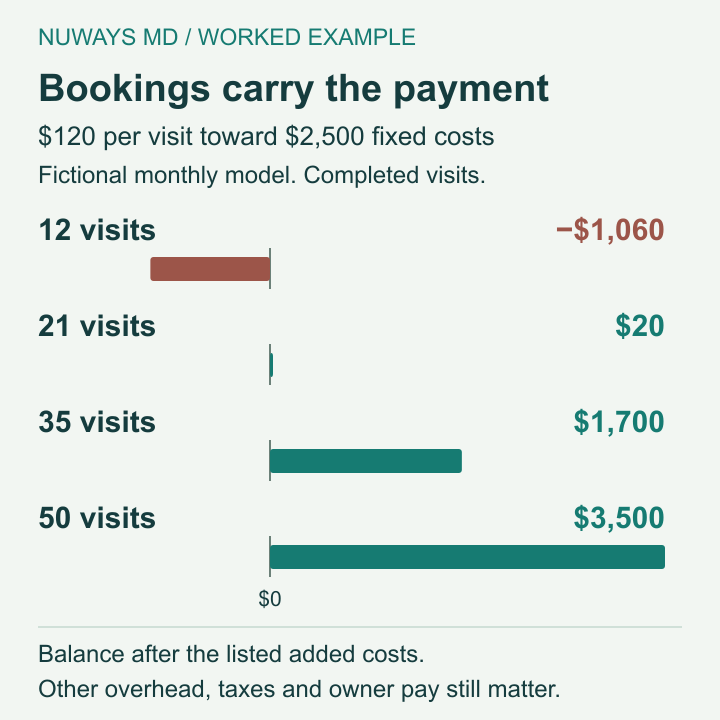
Break-even for these listed costs is $2,500 ÷ $120 = 20.83, rounded up to 21 completed appointments per month. The remaining balance is not take-home profit: existing overhead, taxes, owner compensation and excluded costs still matter.
Demand changes the outcome
Twelve visits lose $1,060 against the listed costs. Having room for 50 appointments does not create 50 buyers.
Discounts change the threshold
At $150 collected per visit with the same $60 variable cost, contribution falls to $90. The threshold rises to 28 completed visits.
Downtime consumes the cushion
At 35 visits, losing 10 visits without replacing them reduces contribution by $1,200. The $1,700 balance falls to $500 before any repair bill.
If the actual equipment payment is $4,000 instead of the illustrative $1,500, keeping the other assumptions unchanged raises added fixed costs to $5,000. At $120 contribution per visit, the threshold becomes 42 completed visits per month. Neither payment is a market quote; the comparison shows why your actual financing terms must go into the model.
Keep booking capacity separate from demand. A fictional 30-minute treatment plus 15 minutes for review and turnover uses a 45-minute slot. Twelve usable room hours allow at most 16 such slots weekly, before cancellations or scheduling gaps. Your provider’s availability may lower that ceiling further. Use the capacity planner to find the actual constraint.
Package cash also arrives before all the work is delivered. Selling ten fictional six-visit packages at $900 brings in $9,000 but creates 60 visits to fulfill. At an allocated $150 per visit, the same $60 variable cost leaves $90 toward fixed costs. Keep the remaining visits visible; do not count the entire package payment as revenue again when each appointment is completed. Your accountant can establish the appropriate revenue recognition for the business.
Use the equipment ROI calculator to test your own numbers, including slower demand and financing. The ownership-cost guide helps identify missing costs, and the startup cash-flow model addresses opening delays and cash reserves.
Which buying approach fits your stage?
Opening with unmeasured demand
Protect working capital. Validate demand and staffing before committing to a large platform, and compare a narrower launch plan with rental or other access options where feasible. A machine that uses the entire equipment budget may leave too little for marketing, training and a delayed opening.
Adding to an established service menu
Use actual inquiries, consult-to-treatment conversion and the existing appointment mix. Measure what the new system adds beyond equipment you already own. If it only frees ten minutes but the room sits empty afterward, those minutes have not yet created extra revenue.
Expanding into several services
Assign each proposed module its own demand, staffing and supply assumptions. One console cannot be in two treatment rooms at the same time, and an outage may interrupt several service lines. Compare that dependency with the capital and space required for separate devices.
Frequently asked questions
Which machine is best for a new med spa?
Start with your qualified team, intended patients and service demand. A dual-wavelength system, a diode platform and a configured multiservice workstation can represent different sensible shortlists. The demonstration, support terms and financial model should determine which deserves a final offer.
How many treatments should a sales forecast assume per patient?
Use the clinical lead’s proposed series and a realistic completion pattern for your service mix. A six-visit package creates repeat appointment obligations; it does not prove six paid visits will arrive from every new inquiry. The consumer laser guide explains why session estimates vary.
Does faster treatment automatically improve ROI?
It can increase capacity, but revenue improves only when appropriate demand fills that capacity and staffing allows delivery. Compare total appointment time and collected revenue, then include cancellations, supplies and follow-up work.
Should I accept the vendor’s payback estimate?
Use it as a scenario to inspect. Replace its treatment price, daily volume, discounts, staffing and operating costs with your own evidence. Model a slow month and downtime before relying on a payback date.
Can NuWays MD help review a quote?
Yes. You can ask for help choosing equipment or reviewing a quote. Describe the practice, proposed system, timing and questions you want to resolve. Darryl follows up personally; a request does not authorize a manufacturer introduction.
Sources and editorial notes
Sources checked September 28, 2026. This is business planning guidance, not a treatment protocol, equipment appraisal or assurance of profitability.
- Platform configurations: Candela Gentle Pro, Cynosure Elite iQ, Alma Soprano comparison and InMode OptimasMAX. Manufacturer descriptions identify technology; they do not establish a head-to-head clinical winner or the contents of your quote.
- Support and purchase-channel distinctions: Candela service plans, Candela’s pre-owned buying guide and InMode U.S. terms. These document specific manufacturer approaches, not universal fees or eligibility. Confirm the current agreement for the model, serial number and seller.
The operating model, discount comparison, capacity illustration and package example are original fictional teaching examples with inspectable calculations. The payment input is not a new-machine price estimate and was not derived from used listings. No private invoices or negotiated supplier terms were used. Founder experience is attributed only to the operational background described above. The existing catalog below remains an unranked research starting point, not an endorsement or inspection of a machine for sale.