IPL Machines, BBL and Vascular Lasers: A Buying Guide for Aesthetic Practices
An IPL machine can add photofacials, treatment of selected brown spots and redness, and sometimes hair reduction to a practice. But two systems advertised for “pigment and vascular” work can differ substantially in what they treat, which patients they suit and what is actually included in the purchase.
This guide explains the technologies, the major platforms and the ownership questions behind a useful comparison. Whether you are opening a med spa or adding capacity to a dermatology practice, the goal is to identify the services you can responsibly deliver and the configuration that supports them.
Editorial details
Which direction deserves a closer look?
Photofacials and mixed sun damage
Compare IPL configurations, including BBL, for your actual patient mix and treatment areas.
A substantial vascular practice
Include dedicated vascular lasers in the comparison. IPL and vascular lasers overlap, but are not interchangeable.
Pigment plus texture services
A modular platform may help, provided the resurfacing module is included and adds something you do not already own.
An opening or uncertain demand
Price the smallest configuration that supports a viable service. Optional capabilities still create payments and training obligations.
IPL, BBL and vascular lasers: what is the difference?
IPL means intense pulsed light. A flashlamp produces a band of wavelengths. Filters limit which part of that light reaches the skin. Depending on the device and treatment, light energy is absorbed by pigment such as melanin or by hemoglobin, the light-absorbing protein in blood, producing heat in the intended tissue. Cooling, pulse delivery and patient selection matter alongside the filter.
BBL, or BroadBand Light, is Sciton’s branded pulsed-light technology. BBL HERO and HEROic are generations of that technology, not separate categories of laser. A quote for a used BBL HERO configuration is not automatically comparable to a new HEROic package. Sciton’s mJOULE specifications distinguish the BBL applicator from the platform’s laser options.
A vascular laser produces a specified wavelength rather than an IPL spectrum. Common examples include a 595 nm pulsed dye laser, a 532 nm laser and a long-pulsed 1064 nm Nd:YAG laser. The abbreviation nm means nanometers: it describes the wavelength, not how powerful the treatment is. These wavelengths interact differently with blood, skin pigment and tissue depth. The purchasing implication is a different clinical tool, not a simple ranking in which the largest wavelength or newest name wins.
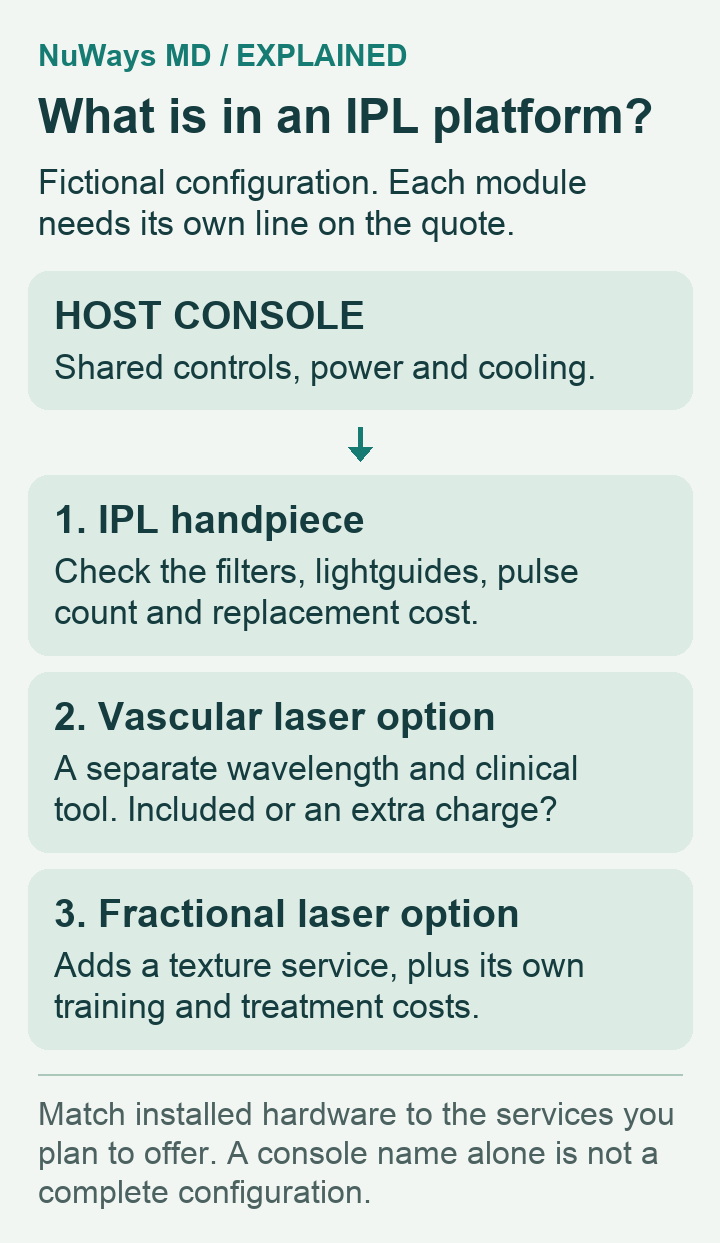
A modular platform is the console that supports multiple technologies. The console name does not tell you whether the offer includes only IPL or also a vascular laser, fractional resurfacing or another application. Think of the console as shared infrastructure and each installed treatment module as a separate capability with its own training and cost implications.
Match the services to the technology
Start with the consultations your practice already has, or the specific patient group your opening plan serves. “Skin rejuvenation” is too broad to use as the demand estimate for a machine.
| Service or presenting concern | Technologies worth evaluating | What changes the buying decision |
|---|---|---|
| Sun spots and mixed facial photodamage | IPL/BBL and selected pigment lasers | Diagnosis, skin tone, tanning exposure, lesion type, treatment area and whether diffuse redness is also a priority. |
| Diffuse redness with visible facial vessels | IPL/BBL, pulsed dye laser, selected 532/1064 nm vascular systems | The mix of diffuse redness versus individual vessels; expected recovery, operator experience and the actual indication. |
| Deeper or larger vessels | Appropriate vascular lasers, often including long-pulsed 1064 nm | Requires a clinical service definition. A photofacial attachment should not be assumed to replace a vascular program. |
| Acne scars or textural change alongside pigment | A separate fractional resurfacing module or other scar-directed treatment | Clearing color is a different endpoint from changing a depression in the skin. Price and train for both if offering both. |
| Hair reduction | An appropriately configured IPL or dedicated hair-removal laser | Compare patient skin/hair mix, treatment area, speed and overlap with an existing hair-removal system. |
| Melasma or an unexplained/changing dark lesion | Clinical diagnosis before an equipment-driven plan | Melasma needs an individual plan that often combines sun protection and medication; a suspicious lesion requires assessment before cosmetic treatment. |
The AAD’s melasma guidance describes laser/light treatment as a possible addition to an individualized plan, rather than a stand-alone answer for every pigment concern.
This is a service-planning map, not a treatment protocol. Your clinical lead should determine which indications and patients belong in each service. For texture work, use the resurfacing laser buying guide; for a dedicated hair service, compare laser hair-removal equipment.
What does the comparative evidence actually say?
A 2024 meta-analysis of IPL and pulsed dye laser for rosacea included four studies and 141 participants. It found no significant difference in the greater-than-50% clearance outcome or change in erythema index, a redness measurement; some other outcomes favored one treatment. A separate systematic review of 14 IPL studies found generally favorable results but poor methodological quality and variable treatment parameters.
For an owner, this supports investigating both approaches for appropriate vascular services. It does not establish that one current branded machine is superior, that every skin tone was adequately represented, or that treatment of redness cures every component of rosacea. A vendor’s case photos should supplement an evidence discussion rather than settle it.
What filters, wavelengths and applicators mean in a proposal
Filters select a band of light
An IPL filter labeled 560 nm does not turn the handpiece into a 560 nm laser. It typically defines a boundary or part of a transmitted band; some filters transmit more than one band. Lumenis, for example, lists a vascular IPL filter with two wavelength windows in its Stellar M22 brochure.
Get the actual filter inventory and compatibility for the quoted generation. “Full filter set” is less useful than part numbers, included quantities and replacement prices. Do not compare filter numbers as if they were clinical settings that could be copied across systems.
Applicators affect access and workflow
A large treatment window may help cover broad areas. Smaller adapters can help access localized targets. That matters only if the operator can use them appropriately and cooling, contact and technique remain consistent. A demonstration should include the areas you plan to treat, not just the easiest patch on a volunteer’s arm.
A separate laser module adds a separate service
On Stellar M22, ResurFX is a 1565 nm fractional laser module. On Nordlys, Frax 1550 and Frax 1940 are separate from SWT pulsed light. MOXI is a 1927 nm fractional laser associated with Sciton platforms. Adding one can expand texture or resurfacing discussions, but also introduces its own appointment preparation, consumables, recovery counseling and follow-up.
Which IPL and vascular systems should an owner compare?
These are examples with different configurations, not an ordered ranking or a claim that the systems produce equivalent outcomes. Manufacturer documents establish architecture and advertised capabilities. Final US indications, compatible attachments and included items need the current labeling and written offer.
| System | What the name represents | A useful reason to investigate | The configuration question that matters |
|---|---|---|---|
| Sciton BBL HEROic on an appropriate platform | Branded pulsed light with filters/adapters | A practice building a substantial photofacial service or extending treatment areas | Which host, BBL generation, filters and adapters? Is MOXI or a vascular laser actually included? |
| Lumenis Stellar M22 | Modular IPL and laser platform | Mixed pigment/redness work with possible vascular or resurfacing expansion | Itemize IPL, ResurFX, MultiSpot Nd:YAG and any Q-switched module separately. |
| Candela Nordlys | SWT narrowband IPL plus available laser modules | A practice comparing combined color and texture services | Which SWT applicators and which Frax/1064 nm modules are installed and licensed? |
| InMode OptimasMAX with Lumecca Peak | Multi-application workstation with an IPL option | Adding pulsed light alongside other explicitly needed applications | Is Lumecca Peak included? Separate its scope from RF microneedling, external RF and hair-removal attachments. |
| Alma Harmony XL PRO with Dye-VL | Modular system with narrowband pulsed light | An additional configuration to compare for selected vascular/pigment services | Dye-VL is pulsed light, not a pulsed dye laser. Verify the exact Harmony generation and applicators. |
| Cutera excel V+ | 532/1064 nm vascular/pigment laser system | A vascular-focused service needing a different tool from broad-area IPL | Which handpieces and operating modes are supplied? What does service cover despite the no-consumables marketing claim? |
| Candela Vbeam Prima | 595 nm pulsed dye plus 1064 nm laser | A practice with enough vascular demand and clinical expertise to justify a dedicated system | Verify model generation, cooling supplies, dye-system maintenance and component coverage. |
Primary configuration references: Sciton, Lumenis, Candela Nordlys, InMode, Alma, Cutera and Vbeam Prima.
For additional device records, use the equipment catalog and side-by-side equipment comparison. Return to the configuration questions here before treating two catalog entries as equivalent offers.
Two IPL platform proposals that are not the same purchase
The following proposals are fictional teaching examples, not current prices for any named manufacturer. Both sellers call their offer a “pigment and vascular platform.” The differences only become clear when the items are separated.
Offer A: focused IPL configuration
- Equipment: $70,000.
- IPL handpiece, three named filters and one treatment window.
- Delivery/installation: $2,000; training: $1,000.
- Starting supplies: $500; total opening outlay: $73,500 before tax.
- Year-one service included, with the lamp/handpiece excluded after its stated limit.
- No fractional resurfacing or separate vascular laser module.
Offer B: IPL plus vascular laser
- Equipment: $92,000.
- IPL handpiece with a broader filter set plus a 1064 nm vascular module.
- Delivery and initial training included.
- Starting supplies: $500; total opening outlay: $92,500 before tax.
- Year-one coverage includes specified applicators; accidental damage excluded.
- No fractional resurfacing module; adding one requires a separate quote.
Including the listed opening expenses brings the difference to $19,000, compared with $22,000 between the equipment prices alone. Offer B may add valuable capacity for an established vascular practice. For a startup planning mainly photofacials, the added module could sit unused. The more expensive offer is not automatically better value, and the lower-priced one is not a substitute for a capability it does not contain.
Now price both offers over the same period. Separate capital cost from financing, identify when warranty ends, and add renewal service, replacement components, staff time and marketing. If paying cash, include the purchase in the cash-flow model. If financing, use the actual down payment, installments and final obligations without also counting the full financed purchase as an expense. The annotated equipment quote comparison provides the fuller framework.
How much does an IPL machine cost to own?
Published examples checked September 27, 2026: a refurbished M22 with IPL and ResurFX was listed at $30,000, while a 2018 BBL tabletop configuration was $48,800. These are seller asking prices for older systems. They do not establish a current new-system price for Stellar M22, HEROic or a dedicated vascular laser.
| Seller and listed configuration | Asking price | What the listing includes | What the buyer still needs |
|---|---|---|---|
| All States MED: refurbished Lumenis M22 | $30,000 | IPL handpiece, ResurFX and a 90-day service warranty | Build year, exact filters, pulse counts, inspection, delivery and parts coverage |
| The Laser Source: 2018 Sciton BBL tabletop | $48,800 | Advertised as serviced, with BBL filters plus 420, ST-2 and named Forever protocols | Exact installed configuration, handpiece condition, current warranty and transfer/support eligibility |
Read the warranty sentence closely. The M22 listing describes a service warranty, while its policy excludes parts unless separately specified. That difference matters if an expensive component fails. Bring the written coverage into the comparison, rather than treating “90 days” as a complete answer.
Neither listing is a completed transaction or an endorsement. A new-system quote may add a different generation, training or contracted support. Ask vendors to itemize those additions so you can judge the price difference.
We do not have a verified, comparable national new-system price range for these configurations. New, demo and used listings also differ in support, transfer eligibility and accessories. Treat a published asking price as an observation, not an appraisal or a price for the latest generation.
The most easily missed operating cost is often a component that is neither a per-patient disposable nor covered indefinitely. Ask for the applicable lamp, handpiece or applicator life policy, current replacement price and shipping/service terms. If a component has a count limit, get the remaining count documented for a used machine. A seller’s “no consumables” statement does not mean no maintenance or zero treatment supplies.
| Cost or commitment | What to put in your ownership model |
|---|---|
| Delivery and setup | Freight, taxes, installation, electrical requirements and any room changes. |
| Components and consumables | Replacement handpiece/lamp terms, gels, cooling supplies, protective eyewear and disposables actually required. |
| Service | Coverage start/end, excluded parts, preventive maintenance, loaner availability and response time. |
| People | Clinical assessment, treatment time, training, refreshers, photography, documentation and follow-up. |
| Acquiring and retaining patients | Incremental advertising, consultations that do not convert, packages outstanding and cancellations. |
| Interruption | Repairs, delayed consumables, rescheduling, refunds where owed and payments continuing during downtime. |
A useful replacement reserve is a planning estimate, not permission to reuse a component beyond its instructions. For example, a fictional $6,000 replacement expected after 600 completed treatments adds a $10 reserve per treatment. If actual utilization before replacement is only 300 treatments, the allocated cost is $20. Do not invent a pulse-to-patient conversion; it depends on treatment area and protocol.
Can your schedule and patient demand support it?
Time an entire appointment during the demonstration: assessment, photos, preparation, treatment, cleaning, documentation and turnover. A vendor’s light-delivery time cannot be used as the room slot.
Fictional capacity example: eight usable room hours provide 480 minutes weekly. A 45-minute slot permits ten complete appointments, with 30 minutes left. At six completed appointments, that service uses 60% of those ten slots. A faster handpiece does not increase revenue if only six suitable patients want treatment or the qualified operator is available for fewer hours.
For a multi-application console, also test conflicts: can one room and console support both the photofacial list and the resurfacing list? Budgeting both services at full independent capacity double-counts the same equipment. Use the weekly capacity model before adding the expected revenues together.
Solo startup
Prioritize a focused service, credible local demand and support you can afford during a slow opening. A smaller configuration can be sensible when it covers the work you are prepared to deliver.
Established med spa
Look at your existing consultations, skin-tone mix and current equipment. A new IPL that duplicates a working service needs a capacity, reliability or clinical reason to justify the payment.
Dermatology or plastic surgery practice
A more specialized vascular platform may fit a different referral base and clinician skill set. Evaluate case mix and outcomes rather than importing a med-spa photofacial revenue projection.
What should happen before signing?
- Write a one-page service list: core services now, optional services later and what existing equipment already covers.
- Have the clinical lead review patient selection, current US indications, risks and operator training. Do not treat manufacturer training as proof of legal scope of practice.
- Request the exact console generation, serial number for used equipment, modules, licenses, filters, adapters and component condition.
- Get replacement and renewal-service pricing in writing, including transfer restrictions and eligibility for manufacturer support.
- Run a realistic demonstration and a slower-booking model. Agree who handles adverse events and service interruption.
- Compare the final contract and financing documents with the quote. An upgrade mentioned in a conversation is not an included item until it is written into the agreement.
Have two offers that are difficult to compare?
Tell us what your practice wants to offer, or bring an existing quote. Darryl can help organize the configuration and cost questions. Asking NuWays MD for help does not authorize a manufacturer introduction.
Get help comparing my equipment options →Frequently asked questions
Is BBL better than IPL?
BBL is a branded form of pulsed light. Its hardware, cooling, filters and delivery features may matter, but “BBL versus IPL” does not identify two equivalent treatment plans. Compare exact systems for the patient group, service and operator training you need.
Can one machine replace an IPL, hair laser and resurfacing laser?
A modular platform may provide several applications with the right attachments. It does not necessarily match a dedicated system’s workflow, and one console cannot be scheduled in two rooms at once. Compare each service separately, then account for shared capacity.
Does a 532 nm IPL filter equal a 532 nm vascular laser?
No. The filter shapes a band of pulsed light; the laser has a specified laser wavelength and its own delivery characteristics. Similar numbers on a menu are not evidence of interchangeable treatment or performance.
Should I buy used or refurbished?
Consider it only after verifying ownership, service history, component counts where applicable, transfer/licensing terms and written support eligibility. A low purchase price can lose its advantage if an applicator needs replacement or manufacturer service is unavailable.
Is the machine with the most indications the safest investment?
Not necessarily. An unused indication does not cover a payment. A focused configuration with suitable demand may be stronger than a platform whose revenue model assumes you will immediately launch several unfamiliar services.
Sources and editorial notes
Sources checked September 27, 2026. This is purchasing education for owners and teams. It does not prescribe treatment settings or establish individual clinical suitability. Independent clinical review has not been completed.
Technology and configuration
- Sciton mJOULE specifications: BBL HEROic filters and the distinction between BBL, MOXI and laser options. Manufacturer documentation does not establish comparative superiority.
- Lumenis Stellar M22 brochure: IPL filter bands and separate laser modules; the product page provides current platform context.
- Candela Nordlys technical overview: SWT, Frax 1550/1940 and Nd:YAG architecture.
- InMode OptimasMAX: workstation and Lumecca Peak description. Inclusion depends on the purchased configuration.
- Alma Harmony XL PRO Dye-VL brochure: narrowband pulsed-light applicator, distinct from a pulsed dye laser.
- Cutera excel V+: laser wavelengths, delivery options and the manufacturer’s consumables claim.
- Candela Vbeam Prima clearance announcement: 595 nm pulsed dye and 1064 nm laser configuration, not a review of all subsequent Vbeam generations.
Clinical evidence and interpretation
- AAD melasma diagnosis and treatment: clinical assessment and combination treatment context.
- Zhai and colleagues, 2024: small IPL-versus-PDL rosacea meta-analysis. Its outcomes do not rank the current platforms in this guide.
- Martignago and colleagues, 2024: IPL rosacea review, including heterogeneity, limited skin-type representation and poor methodological quality.
Published asking prices
- All States MED: M22: refurbished-system price, included applicators and service-only warranty language.
- The Laser Source: 2018 BBL tabletop: preowned-system asking price and seller-described configuration. Checked September 27, 2026; availability and terms can change. We did not inspect these machines.
Original analysis and commercial disclosure
The configuration graphic, two proposals, component reserve and schedule example are original NuWays MD teaching material. The two teaching proposals and financial examples use fictional assumptions. The separate seller-price table contains dated asking-price observations; neither represents completed sale prices or expected earnings. Models omit taxes and costs expressly outside their stated scope. No manufacturer has paid for placement in this guide; no equipment-vendor referral agreement is represented. See our editorial and commercial approach and the full ownership-cost guide.