Resurfacing Lasers for Med Spas and Clinics: Compare the Machines and the Business Case
A resurfacing laser can add a valuable service when your patients want the improvement it can realistically offer and your team can deliver the treatment and follow-up care. The purchase becomes harder to justify when the payment starts before demand, staffing and follow-up are ready.
This guide helps a solo owner-provider, an established med spa manager or a dermatology or plastic surgery team compare CO2, erbium, non-ablative and hybrid platforms. It includes representative machines, a worked operating model and the questions that turn a demonstration into a purchase you can evaluate.
Editorial details
The buying decision at a glance
Patients want texture improvement with manageable disruption
Investigate a suitable non-ablative or lighter fractional service. Validate the proposed number of sessions, appointment time and demand at your actual collected price.
You already manage more involved resurfacing care
Compare ablative platforms, scanners and service support against the procedures your qualified clinical team intends to offer.
You want one platform for several services
Price the exact configuration. Additional handpieces help only if the services have demand, clinical coverage and room capacity.
Bookings are still hypothetical
Delay the payment, validate demand or consider a carefully reviewed rental arrangement before buying capacity you have not yet demonstrated you need.
What do CO2, erbium, fractional and hybrid actually mean?
These terms describe different parts of a treatment. CO2 and Er:YAG identify laser technologies. Ablative describes removal of tissue. Fractional describes a pattern of separated treatment columns. A laser can therefore be both CO2, ablative and fractional. “Fractional” alone does not tell you the recovery burden.
Non-ablative fractional systems heat selected tissue without the same surface-removal approach as an ablative procedure. Hybrid systems combine technologies or wavelengths. Their operating requirements depend on the treatment you actually deliver, not the number of wavelengths on the brochure. ASDS: non-ablative laser rejuvenation; DermNet: fractional laser treatment.
| Technology family | Examples of the service discussion | Business implication | Poor reason to buy |
|---|---|---|---|
| Non-ablative fractional | Selected texture, fine-line, pigment or scar concerns, depending on wavelength and indication | Model a series of appointments, repeat room use and any per-treatment charges. A shorter recovery does not mean zero follow-up. | Assuming every patient will need or complete the same package |
| Fractional ablative CO2 | Resurfacing with tissue removal in a fractional pattern | Include clinical preparation, comfort measures, wound-care instructions and access to complication assessment. Intensity can vary substantially. | Treating a light branded protocol as the workload for every CO2 procedure |
| Ablative Er:YAG | Fractional or full-field resurfacing, depending on platform and configuration | Compare scanner capabilities, the intended clinical use and the care the team can support. | Assuming “erbium” always means a light treatment |
| Hybrid or multi-wavelength | A plan combining different effects in one platform or session | Price the required components and test the whole workflow. A broader menu can increase training and scheduling complexity. | Paying for versatility without a plan to use it |
For a patient-facing explanation of treatment and recovery, use our laser resurfacing guide. The decisions below concern operating a service, not selecting clinical settings.
Which resurfacing machines deserve consideration?
The table is a representative starting set, not a ranking or a complete market catalog. Manufacturer documents establish the described technology and configuration options. They do not establish which machine will produce better results, lower complication rates or a stronger return in your practice. Confirm current US availability, labeling and the exact quoted configuration.
| Platform or family | What the manufacturer describes | What to resolve in the quote or demonstration |
|---|---|---|
| DEKA Tetra PRO, distributed by Cartessa | CO2 platform with multiple emission modes; CoolPeel is a branded treatment associated with the platform | Which scanners, comfort accessories and training are included? Demonstrate the particular light and more involved services you intend to offer. |
| Lumenis AcuPulse | CO2 platform with fractional and other ablative capabilities | Identify the scanner and modes being purchased, maintenance obligations and who supports the unit locally. |
| Lumenis UltraPulse family | CO2 platform with named fractional applications such as ActiveFX, DeepFX and TotalFX | Specify generation, accessories and intended application. A used UltraPulse listing and a new Alpha proposal are not the same configuration. |
| Sciton Contour TRL / ProFractional | Erbium resurfacing options for full-field and fractional approaches | Establish the base platform, required modules, scanner access and additional training for each service. |
| Fotona SP Dynamis | Er:YAG and Nd:YAG platform; Er:YAG options include full-field and fractional work | List the handpieces and scanners supporting your actual service menu. Do not value every possible application as immediate revenue. |
| Fraxel FTX 1550/1927 | Two non-ablative fractional wavelengths with different tissue targeting | Confirm treatment-tip costs, service coverage, software access and expected total appointment time. |
| Candela Frax Pro | Non-ablative fractional 1550 nm and 1940 nm technologies | Establish whether both handpieces are included and how supplies and coverage differ from a broader Candela platform quote. |
| Sciton HALO TRIBRID | Three independently controlled wavelengths: 1470, 1927 and 2940 nm | Confirm the required platform, included components, treatment charges and upgrade terms. An older HALO proposal is not automatically equivalent. |
You can also browse the equipment catalog and compare saved device selections. Catalog records are starting references; request current, configuration-specific proposals before relying on prices or included equipment.
Wavelength is one part of a device comparison. Pulse delivery, fractional coverage, controls, accessories and the clinician’s treatment design also matter. Two systems sharing a wavelength are not proven clinical equivalents, and a treatment trademark does not replace the device’s instructions for use.
If pigment or redness is the main unmet need, first compare the intended service with IPL platforms. IPL is not a resurfacing laser. If the conversation concerns RF, use the RF microneedling equipment guide rather than grouping it with laser purchases.
Fraxel FTX and older DUAL systems
Fraxel FTX launched in 2025 as the newer 1550/1927 nm platform, with updates to treatment delivery, cooling and the handpiece. Fraxel DUAL still appears in used-equipment proposals. Record the actual generation on each quote: an FTX brochure does not describe the hardware included with a used DUAL. Ask for generation-specific consumable prices, service eligibility and a demonstration of the exact system. Solta launch announcement.
Which type fits your practice model?
A solo injector adding a first energy-based service
Your first constraint may be your own time. If numbing occupies the only room and you are also the treating clinician, a short laser pass does not create a short appointment. Test the complete visit, the work displaced from your existing schedule and the follow-up you can provide when you are away.
A narrower service can be a stronger first purchase than a platform with a dozen applications you cannot staff. A broad platform becomes more defensible when you can name the first services, their qualified operators and where the appointments fit.
An established med spa with recurring patient demand
Separate documented interest from actual willingness to proceed. Ten patients asking about a familiar brand are not ten purchases at your proposed price and recovery commitment. Record which concern they want addressed, whether they will accept the expected recovery, and what stopped previous consultations from converting.
Also check overlap with equipment you already own. A new laser may improve an existing offering, but shifting the same appointments between two financed machines can leave total practice revenue unchanged while payments rise.
A dermatology or plastic surgery practice
An existing clinical infrastructure can make a more involved service feasible. It still does not make every scanner or upgrade economical. Identify the gap in your current treatment capability, the cases you presently refer out and the aftercare capacity already in place. Compare added contribution from the new service with the full cost of adding it.
Recovery changes the workload and the sale
Ablative resurfacing can involve wound care, visible healing and more substantial comfort planning. Non-ablative treatment often has a lighter recovery burden, but may involve repeated visits and still carries risk. Skin-color changes, infection and scarring belong in the clinical assessment and informed-consent process. Mayo Clinic: laser resurfacing.
For owners, the implication is operational: the advertised procedure time is only part of the service. Someone must prepare the patient, provide instructions, handle questions and recognize when clinical review is required. The clinical lead must decide eligibility and protocols, including how skin tone, pigment history, medication history and previous procedures affect the plan.
| Part of the service | What to measure before buying |
|---|---|
| Consultation and preparation | Clinician minutes, photography, suitability assessment and preparation instructions |
| Numbing or other comfort care | Staff responsibility, room occupancy, supplies and any additional monitoring or transport requirements |
| Treatment and turnover | Complete room time, setup, cleaning and supply use, not only laser-on time |
| Routine recovery support | Expected reviews, telephone work, written instructions and who covers leave or weekends |
| Unexpected problems | Clinical escalation arrangements, documentation and whether your insurance covers the intended procedures |
Laser eye protection and environmental controls must fit the device and procedure. For treatments producing surgical plume, budget the appropriate smoke-evacuation setup, filters and training. OSHA discusses plume hazards and local evacuation; this is not a claim that one generic room checklist satisfies every jurisdiction. OSHA: laser and electrosurgery plume.
How much does a resurfacing laser cost to own?
Published used-system asking prices provide a starting point. The two listings below were checked September 27, 2026. They cover different technologies and configurations; they are neither new-system prices nor records of completed sales.
| Listed equipment and seller | Asking price | Included scope described by seller | Still needed before purchase |
|---|---|---|---|
| 2017 Lumenis AcuPulse, Array Medical | $38,500 | Used CO2 system with AcuScan 120, Surgitouch scanner and other accessories; 30-day parts-and-labor warranty | Exact serial number, inspection report, scanner condition, delivery and support after the short warranty |
| Sciton JOULE Erbium, The Laser Source | $54,500 | Preowned Erbium configuration advertised with ProFractional, MicroLaserPeel and TRL | Build year, exact enabled applications, current service terms and installed accessories |
What these prices tell an owner: you can find substantial acquisition differences even before financing. They do not establish which platform will deliver your intended service at the lower total cost. A $38,500 purchase with a 30-day warranty leaves a very different repair exposure from a new system with longer contracted coverage. Obtain itemized new-system quotes to compare that tradeoff; no comparable new-device prices were supplied for this guide.
The final acquisition budget should include tax, shipping, installation, training, needed accessories and a repair reserve. Use the annotated equipment quote comparison to put those items beside the seller’s headline price.
A used asking price is a useful lead to investigate, not a confirmed transaction price or the total cost of a supported machine. Before treating a low listing as a bargain, get written confirmation about inspection, repair, transfer eligibility, software or account access, training and service availability for that serial number.
| Cost layer | Examples to include | Frequent omission |
|---|---|---|
| Getting the service open | Deposit or purchase, delivery, installation, training, room preparation and launch materials | Staff training time and the delay before the first paid appointment |
| Fixed monthly commitments | Equipment payment, service reserve or contract, added staffing commitments, insurance and marketing | Payments continuing through slow months or downtime |
| Each completed treatment | Tips or treatment credits, supplies, comfort care, added labor and payment-processing fees | Included follow-up consuming clinician time |
| Interruptions and exit | Repairs outside coverage, loaner terms, cancellations, shipping and financing settlement | Assuming resale proceeds will clear the remaining debt |
Ask whether a disposable is charged per patient, per area, per tip or per treatment cycle. Ask when the warranty starts and what it excludes. A manufacturer’s warranty, a dealer warranty and an independent service contract can have very different remedies.
The equipment ownership costs guide and equipment quote comparison with annotated examples explain how to normalize these terms across two offers.
A worked monthly laser business case
The following is a fictional operating example, not a forecast, device quote or clinical protocol. It models cash contribution after a limited set of added costs. It excludes existing rent and overhead, taxes, opening investment and owner pay not already included in the labor figure.
Assume an average $900 collected per completed appointment after discounts and refunds. Variable costs are $180: $60 supplies, $95 added labor and $25 payment fees. Contribution is therefore $720 per visit. Added monthly commitments total $4,800: $2,500 equipment payment, $500 service reserve, $1,200 marketing and $600 other added costs.
| Completed appointments per month | Collected revenue | Variable costs | Contribution after $4,800 added fixed costs |
|---|---|---|---|
| 4 | $3,600 | $720 | −$1,920 |
| 7 | $6,300 | $1,260 | $240 |
| 12 | $10,800 | $2,160 | $3,840 |
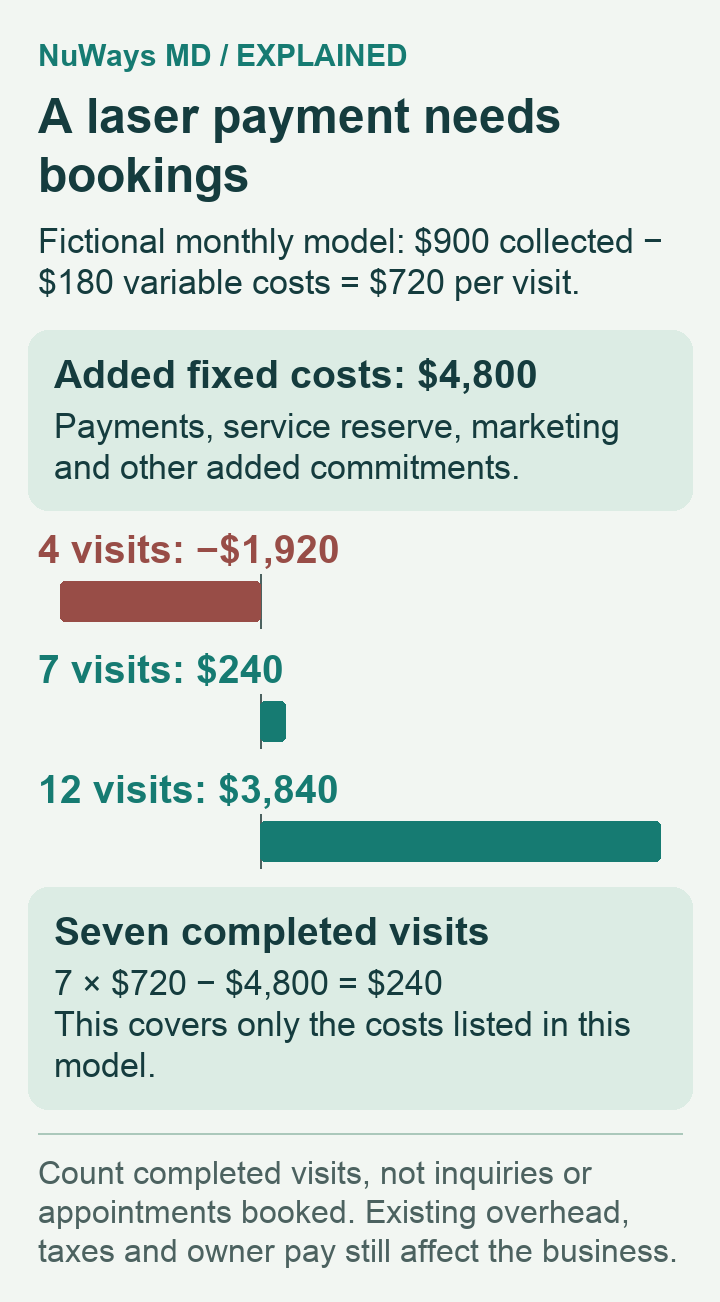
The narrow break-even point is $4,800 ÷ $720 = 6.67, rounded up to 7 completed appointments. That does not mean the whole practice is profitable at seven. It means these listed incremental costs are covered in this example.
What if bookings are slower, or you discount more?
If only 80% of bookings become completed appointments, seven completions require at least nine bookings in this simplified planning model. If your average collection falls to $750 while variable cost stays at $180, contribution becomes $570. The threshold rises to nine completed appointments, or twelve bookings at that same assumed completion rate.
At twelve completed visits, an unexpected $2,000 repair reduces the example’s $3,840 contribution to $1,840 before the excluded costs. A month with no completed visits still carries the $4,800 commitments if they continue unchanged. This is why cash reserves matter even when the normal-month calculation looks attractive. If you are opening a practice, carry this payment into the 12-month med spa startup cash-flow model so opening delays, owner pay and the rest of your commitments stay visible.
What changes when you sell packages?
Cash received and services still owed are different measures. A fictional $2,400 three-visit package brings in $2,400 upfront, but two future visits remain after the first appointment. Set aside the resources to deliver them. Do not count the full receipt as first-visit profitability and then treat later redemptions as free capacity.
Use the ROI calculator to explore financing and ramp-up, and the practice capacity and growth model to test rooms and staffing. Enter your own supported assumptions; these figures are deliberately invented so the calculation can be inspected.
Turn the demonstration into an evidence check
Ask the rep to demonstrate the service you expect to sell, using the exact quoted configuration. Have your clinical lead evaluate the treatment and your manager time the workflow. A demonstration is a feasibility check, not proof of long-term outcomes or demand.
- Name the target service. Identify the patient concern, relevant skin characteristics, expected recovery and intended operator.
- Review the supporting evidence. Separate device labeling, published clinical research, expert opinion and manufacturer marketing. Check the studied settings, patient group and follow-up, rather than transferring a result from another platform.
- Record the whole appointment. Include preparation, numbing, treatment, turnover and follow-up work.
- Write down each paid item. Document which tips, consumables, comfort accessories, training and service items are included.
- Speak to relevant owners. Ask about service response, canceled appointments and the time needed to establish demand. A reference practice selected by a seller remains a selected example.
- Review the slower case before signing. Test fewer completions, a lower collected price and a delay before opening. Have the clinical and financial leads review their respective assumptions.
A well-photographed case does not show average results, the complication rate or the acquisition cost of that patient. Comparative clinical claims need comparative evidence. Our manufacturer links explain specifications, not a head-to-head verdict.
When delaying the purchase may be the stronger decision
Pause if you cannot identify who will deliver and support the service, if cash flow relies on an untested advertising promise, or if the proposed appointments would displace more valuable existing work. You can first improve conversion from current consultations, organize a demand audit or strengthen clinical readiness.
Renting or sharing a platform can reduce an upfront commitment, but compare minimums, transport, scheduling, insurance, maintenance and the cost per treatment. It is an alternative contract to evaluate, not a risk-free trial.
Bring the decision into focus
Tell Darryl what you want to offer or bring a quote you would like help reviewing. NuWays MD can help organize the business questions and missing costs. Your request does not authorize sharing your details with a manufacturer.
Help me compare my equipment options →Frequently asked questions
Is CO2 a better investment than a non-ablative laser?
Only in a particular practice context. A higher treatment price may come with a different candidate pool, longer room use and more follow-up. Compare contribution per completed service, your capacity and demonstrated demand, alongside the clinical team’s assessment of appropriate use.
Does a machine with no expensive treatment tips have better margins?
It may reduce one variable cost. Service, labor, marketing, downtime and utilization can outweigh that saving. Run the same ownership model for each proposal rather than deciding from a single disposable price.
Can a solo NP or RN buy and operate one?
Ownership, medical oversight and permission to perform a procedure are separate questions that depend on jurisdiction and role. The seller’s willingness to sell a machine is not authorization to use it. Verify the intended arrangement with the appropriate regulators, insurer and qualified advisers before making a financial commitment.
How should I compare used and new systems?
Request serial-specific support and inspection information, remaining obligations, included accessories and written transfer terms. Compare the supported, installed cost and realistic downtime exposure, not only the listing amount.
Should I keep an older machine when adding a new one?
Only if its role is clear. Compare its remaining payments, service needs, booked demand and space use. An older unit can provide useful capacity or backup, but duplication can also split demand across two sets of costs.
Sources and editorial notes
Specifications and sources checked September 27, 2026. The platform comparison uses the manufacturer and distributor materials below. Clinical and workplace references explain the context in which the business questions arise.
Device descriptions and configurations
- Cartessa: DEKA Tetra PRO: platform description, emission modes and the CoolPeel treatment offering.
- Lumenis: AcuPulse: CO2 platform capabilities and configuration context.
- Lumenis: UltraPulse family: named fractional applications and platform-family distinctions.
- Sciton: Contour TRL and ProFractional brochure: full-field and fractional erbium resurfacing options.
- Fotona: SP line: Er:YAG and Nd:YAG technologies and available application components.
- Fraxel: FTX 1550/1927 brochure: the system’s two non-ablative fractional wavelengths.
- Candela: Frax Pro brochure: 1550 nm and 1940 nm technologies and handpiece configuration.
- Sciton: HALO TRIBRID brochure: the stated three-wavelength configuration.
Dated equipment-price observations
- Array Medical: 2017 AcuPulse: seller asking price, listed accessories and short warranty.
- The Laser Source: JOULE Erbium: preowned configuration and advertised price. Neither listing is an independent inspection or a vendor recommendation.
- Solta: Fraxel FTX launch: identifies the 2025 platform generation.
Treatment and workplace context
- American Society for Dermatologic Surgery: non-ablative laser rejuvenation: the treatment category and its general expectations.
- DermNet: fractional laser treatment: fractional treatment terminology and the distinction between ablative and non-ablative approaches.
- Mayo Clinic: laser resurfacing: preparation, recovery and risks that affect the operating workflow.
- OSHA: laser and electrosurgery plume: plume hazards and control considerations. This overview does not replace device-specific instructions or applicable local requirements.
How this buying guide was prepared
Manufacturer documents support descriptions of technology and configuration. They are not independent head-to-head evidence of better outcomes, fewer complications or higher profitability. We have not performed hands-on comparative testing or collected comparable written new-device quotes for these systems. The exact US labeling, current availability and quoted configuration need to be checked for the proposed purchase.
The business model, diagram and package examples are original fictional illustrations. They show the stated assumptions and excluded costs so owners can repeat the calculations. They are not market averages, forecasts, clinical protocols or individualized financial advice.
NuWays MD is an educational publication, not a medical provider. Clinical review of the treatment-related statements remains pending. NuWays MD has no equipment-vendor referral agreements at this time. Editorial and commercial standards.