Dermal Fillers: Types, Results, Risks and What to Expect
Dermal fillers can add lip fullness, restore selected areas of lost facial volume and soften some folds. They do not relax muscles like Botox, and adding more volume will not solve every wrinkle or sagging concern. A good consultation starts with the change you want, then asks whether an injectable can realistically create it.
This guide explains the main filler materials, familiar brands, how results develop and the safety questions worth asking before your first appointment. If your immediate concern is a reaction after treatment, go straight to the warning signs below.
Editorial details
The quick answer
What do fillers change?
Volume, contour and selected folds. Skin texture, muscle movement and significant sagging may need another approach.
Is the result immediate?
Hyaluronic acid gels add volume immediately, but swelling affects the early appearance. Collagen-stimulating products develop more gradually.
Are they all reversible?
No. Hyaluronic acid can often be reduced with an enzyme, but removal has limits and risks. Other materials are harder to remove.
What matters most?
The exact product, treatment area, your anatomy and a qualified clinician with a clear complication plan.
Already had filler? Know the urgent warning signs
Get immediate medical attention for unusual or escalating pain, skin turning pale, gray or blue, or changes in vision after filler. Call 911 for vision loss, stroke symptoms or trouble breathing. Tell the emergency team you recently had filler and contact the treating clinician immediately. Do not wait for a routine follow-up or try to massage away a possible circulation problem. These are among the warning signs identified by the FDA.
Ordinary bruising can also change color. What matters is the full picture, including pain, progression and the pattern of skin changes. A photograph or internet checklist cannot reliably distinguish them. Increasing warmth, spreading redness, drainage, fever or a new painful lump also warrants prompt assessment.
How do dermal fillers work?
A filler is an injected material placed to change the shape or fullness of tissue. Most people considering a first lip or facial treatment are discussing a hyaluronic acid, or HA, gel. HA occurs naturally in the body, but injectable gels are manufactured and modified to last longer. They are different from the HA serum in a skincare routine.
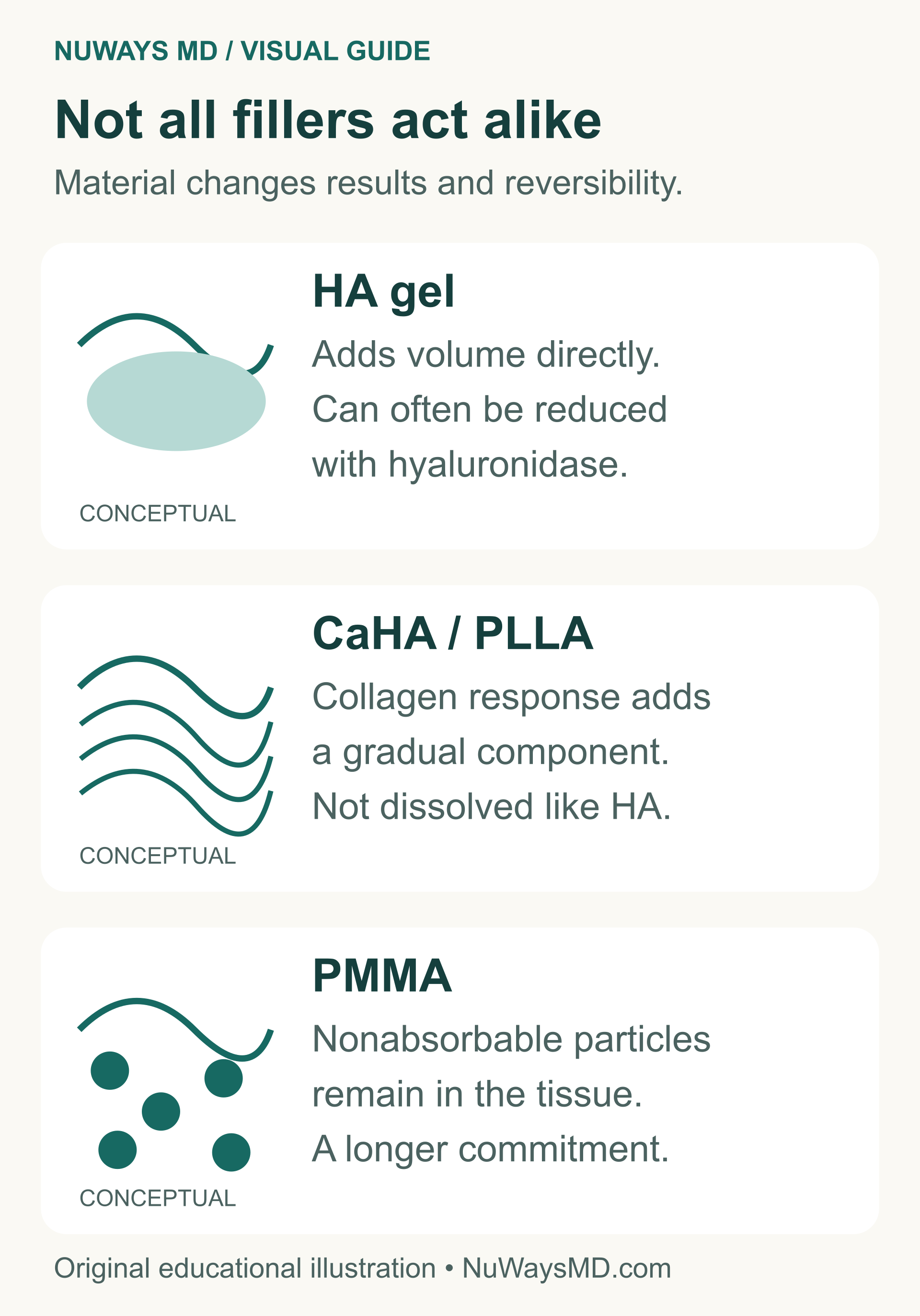
Other products use particles that stimulate the body’s collagen response. Some provide immediate filling as well; others require a series of visits before their gradual effect becomes apparent. A long-lasting result can be useful, but it also means committing to a material that is less easily adjusted.
Fillers, Botox and a “liquid facelift” are different things
Botox reduces selected muscle activity. Fillers add volume or support. A “liquid facelift” is a marketing name for an injectable plan, not a standardized procedure or the equivalent of surgery. Ask which products and areas the phrase includes. Our Botox vs. fillers comparison explains the difference concern by concern.
Types of dermal fillers and brands you may hear
Brand names describe product families, not a single interchangeable gel. Juvéderm Voluma and Juvéderm Volbella, for example, have different properties and approved uses. The table below is an orientation to the materials, not a ranking.
| Material | Familiar examples | How the result develops | What to understand before choosing |
|---|---|---|---|
| Hyaluronic acid (HA) | Juvéderm, Restylane, RHA Collection, Belotero Balance, Revanesse | Added volume is visible immediately; swelling settles afterward | Products differ in firmness, flexibility and approved area. Hyaluronidase can break down HA, but adjustment is a medical procedure. |
| Calcium hydroxylapatite (CaHA) | Radiesse, Radiesse (+) | Initial filling plus a collagen response | It is not dissolved by hyaluronidase. The product and preparation affect its purpose. |
| Poly-L-lactic acid (PLLA) | Sculptra | Gradual collagen-related improvement over a planned treatment series | Immediate post-injection fullness does not represent the final result. Budget for the full proposed series. |
| Polymethylmethacrylate (PMMA) in a collagen carrier | Bellafill | A long-lasting, nonabsorbable component remains | This is a greater commitment. Allergy assessment and the exact indication matter; removal can be difficult. |
The FDA’s material overview distinguishes these categories. Specific labeling, rather than a brand’s popularity, establishes its approved uses. Sculptra’s instructions and Radiesse’s product explanation describe their different mechanisms.
FDA approval applies to a product, area and population
An approved filler is not automatically approved for every part of the face. Current examples include Voluma XC for specified cheek, chin and temple indications, Restylane Kysse for lips and upper-lip lines, and RHA 3 for lip augmentation in adults 22 and older. See the Voluma labeling, Kysse patient information and FDA RHA 3 approval.
Ask whether the proposed use is on-label or off-label, what evidence supports it and what alternatives exist. Off-label use does not by itself tell you whether a treatment is appropriate, but it deserves an explicit discussion. Nose and forehead filler deserve particular caution because of vascular anatomy and the seriousness of possible complications. Needle-free “hyaluron pens” are not an approved substitute for professional injections.
What can filler improve, and what is a poor fit?
| What you notice | Where filler may help | What could change the decision |
|---|---|---|
| Lips that you want fuller or more defined | A suitable HA lip product can add fullness or refine contour | Existing filler, asymmetry, swelling tendency and your preferred amount of change |
| Flattening through the cheeks or a hollowed area | Selected volume restoration may improve contour | Significant loose skin, persistent swelling or a different cause of the hollow |
| Chin projection or an uneven jaw contour | A suitable product can change selected contours | Filler adds material. It does not remove fat or replace treatment for a bite problem. |
| A fold from the nose toward the mouth | Selected fillers can soften a fold | Facial movement and surrounding anatomy affect the result; erasing every fold is not a realistic goal. |
| A shadow beneath the eyes | Carefully selected patients may benefit from an approved product | Pigmentation, bags and fluid-related puffiness can look like hollowness but need a different assessment. |
| Fine surface lines, roughness or sun damage | Filler may address a limited component | Skincare, resurfacing or another treatment may better match the main concern. |
Some under-eye products have specific FDA approvals, including Volbella XC for under-eye hollows. That does not make every dark circle a filler problem. This is a useful example of why seeing the face in person matters more than selecting a syringe from a menu.
For lines caused mainly by expression, start with our Botox beginner guide. For texture and etched lines, compare the options in fine lines and wrinkles and laser resurfacing.
What makes a result look natural?
A natural-looking plan preserves features you recognize and addresses a specific concern without adding unnecessary volume. It is not defined by a particular brand, a social-media technique or a fixed number of syringes.
Take photographs that show what you like, but explain the feature rather than asking for another person’s face: “I would like a little more upper-lip definition” or “This hollow is what bothers me in normal lighting.” Discuss what you want to keep as well as what you want to change. Ask to see healed results on people with comparable anatomy, photographed in consistent light and expressions.
An incremental plan can leave time to assess the result before adding more. The important question is not whether a full syringe sounds large or small. It is whether the proposed amount and placement make sense for your tissues and goal. You can decline treatment or stop after a consultation.
What happens at the appointment, and does it hurt?
A consultation should include your medical history, earlier filler, medications, allergies, examination and photographs. Bring the product names, dates and locations of previous injections if you know them. “I had something several years ago” is worth mentioning, even if you believe it has worn off.
The clinician cleans the skin and discusses numbing. Depending on the area and product, that may involve topical anesthetic, lidocaine within the filler or another local anesthetic. Expect brief pinches, pressure and sometimes stinging. Lips can be especially sensitive. Numbing improves comfort but does not make every injection painless.
A needle or a blunt-tipped cannula may be used. Neither makes blood-vessel injury impossible. You should be able to tell the clinician about unexpected pain or visual symptoms immediately. Before leaving, obtain written aftercare, an urgent contact number and a record of the product used. The AAD’s filler FAQs outline the appointment and common early reactions.
How long do dermal fillers last?
Think in terms of a product, area and measured result, not one lifespan for all fillers. A lip treatment and a cheek treatment can have very different timelines. Swelling, a visible cosmetic benefit and the presence of remaining material are three different things.
| Example | What the evidence measures | How to use the information |
|---|---|---|
| Restylane Kysse in the lips | Its patient brochure reports a one-point lip-fullness improvement in 60% of assessed participants at 12 months; touch-ups were permitted | A study result is not a promise that your preferred appearance lasts a year. |
| Voluma XC in the cheeks | Product studies follow cheek-volume improvement over an extended period, including two-year follow-up | Do not apply a cheek result to the lips or another Juvéderm product. |
| Sculptra | Gradual improvement after a treatment series, with manufacturer information describing results lasting up to two years | Count the initial series, time to develop results and later reassessment separately. |
A systematic review of six cheek-filler trials involving 579 people found no significant differences in aesthetic-improvement scores between the studied HA products at one, three and six months. Its product selection was limited and included products outside ordinary US menus. It cannot identify a universally “best” US filler.
A separate 2024 MRI study of 33 people detected midface HA at least two years after injection in all participants. This small, selected sample does not establish everyone’s filler lifespan or mean that the visible result stays unchanged. It does support an important consultation question: Do I need more volume, or should we assess what is already there? Automatic top-ups based only on the calendar can miss that distinction.
Recovery: swelling, bruising and follow-up
You may feel ready to work quickly while still having visible swelling or bruising. Those are separate definitions of downtime. Avoid scheduling a first treatment immediately before an important event.
Follow the written instructions for your specific product. As one example, Volbella’s patient labeling recommends minimizing strenuous exercise and extensive sun or heat during the first 24 hours; common local reactions generally lasted two weeks or less in its trial. Other products and treatment areas can take longer to settle.
Use the recommended gentle care, avoid repeatedly pressing on the area and do not start a massage routine unless your clinician specifically instructs it. Some collagen-stimulating treatments have their own aftercare. For a more detailed daily timeline, makeup, food and exercise guidance, see lip filler recovery.
Filler risks beyond ordinary swelling
Blood-vessel blockage is uncommon but potentially devastating, with possible skin injury, blindness or stroke. Other complications include infection, persistent swelling, palpable or visible lumps, migration and delayed inflammatory reactions. Problems can arise after the initial recovery period, including months later. The FDA’s 2025 dermal-filler safety review discusses the limits of available safety data as well as serious complications.
This is why “minimally invasive” should not mean casual treatment. A useful safety discussion includes how the office recognizes an emergency, what treatment and escalation it can provide, and who will respond after hours. A low price, a cannula or a highly experienced injector does not eliminate risk.
Can filler be dissolved if you dislike it?
Hyaluronidase is an enzyme clinicians use off-label to break down HA filler. It does not dissolve CaHA, PLLA or PMMA in the same way. Dissolving can require more than one visit and can cause reactions, including allergy. It cannot promise an exact return to the previous appearance or reversal of an established injury. The ASDS task-force recommendations emphasize identifying the cause of a lump or inflammatory reaction before selecting treatment.
If you dislike an uncomplicated early appearance, arrange an assessment after the clinician’s settling interval. If you have warning signs, seek help immediately. These are different situations.
Who should postpone treatment or get a closer assessment?
Tell the clinician about active infection or irritated skin, cold sores, severe allergies, bleeding disorders, immune-suppressing treatment, pregnancy or breastfeeding, and all prior fillers. Product-specific contraindications differ. Safety during pregnancy and breastfeeding has not been established for the commonly discussed products here, so elective treatment is generally deferred.
Bring a complete medication and supplement list. Blood thinners and some pain medicines can affect bruising, but do not stop a prescribed medicine to prepare for a cosmetic appointment without the prescriber’s advice. Discuss upcoming dental work, recent illness and other facial procedures so the clinician can plan timing. There is no single internet waiting period that fits every situation.
How much should you budget?
A useful quote names the product, proposed amount, treatment goal and what the fee covers. “One area” and “one syringe” are not interchangeable. Some syringes contain different volumes, and Sculptra is commonly quoted by the vial.
Our dermal filler cost guide compares published menus in South Florida, Manhattan, the Los Angeles area, Lancaster and Spokane. It also shows how consultation fees, deposits and extra product change two fictional quotes. Use that research to understand a proposal, not to choose an amount of filler yourself.
Your first-consultation checklist
- What part of my concern can filler realistically improve, and what will remain?
- Which exact product are you proposing, and is this area an approved use?
- What alternative, including doing nothing, would you consider?
- What does the proposed amount aim to achieve? Can we reassess before adding more?
- Who performs treatment, and how can I verify their license and relevant training?
- What is your plan for a suspected blood-vessel complication or an after-hours concern?
- What does follow-up include? What would additional filler or dissolving cost?
Use our guide to choosing an injector or med spa for license checks, consultation questions and how to assess before-and-after photographs.
Frequently asked questions
Will my face become worse if I stop getting filler?
You can stop. The underlying aging process continues, and the change from an augmented appearance back toward less fullness can feel noticeable. That does not establish that stopping caused accelerated aging. Residual material, previous treatment and your tissues affect what happens next; an assessment is more useful than an automatic refill.
Can filler migrate?
Yes. Material can appear outside the intended area, but not every bump or early change is migration. Swelling, placement, product and tissue changes may look similar. Have persistent fullness or an unwanted border examined before adding more or requesting dissolving.
Is filler safe for darker skin tones?
Skin tone alone does not rule out filler. Ask for experience with people who share your skin characteristics and concerns, including pigment changes after inflammation. Skin color changes from a complication can be harder to judge in photographs; pain and progression also matter.
Are “baby filler” and “facial balancing” special products?
Usually they describe a style or scope of treatment. Ask for the actual product, areas, quantities and total fee. A subtle goal can still involve a medical procedure with meaningful risks.
Can I use skincare instead?
Skincare can improve hydration, some fine lines and sun protection. It cannot reproduce the same structural volume change. If dryness or surface texture is your main concern, that difference may be a reason to start with skincare rather than injections.
Sources and editorial notes
Sources checked September 28, 2026. Prepared by NuWays MD Editorial; edited by Darryl H. Clinical review is pending. This is educational research, not a personal treatment recommendation. We have not tested or ranked fillers, and no brand paid for inclusion. The material diagram is an original conceptual illustration, not an injection map.
Safety, materials and treatment planning
- FDA: dermal fillers and approved materials: general risks, warning signs and material categories. Specific current product labeling takes precedence for individual approved areas.
- FDA: 2025 advisory-panel executive summary: broader safety questions and evidence limitations.
- AAD: filler FAQs: appointment expectations and common recovery reactions.
- ASDS: prevention and treatment of filler adverse events: complication assessment and treatment limitations. Some recommendations rely on observational evidence and expert consensus.
Product-specific evidence
- Voluma XC instructions: approved cheek, chin and temple indications, precautions and clinical studies.
- Restylane Kysse patient brochure: lip study outcomes and precautions.
- FDA RHA 3 lip approval: age and treatment indication.
- Volbella lip patient information and under-eye patient information: distinct uses and aftercare.
- Sculptra instructions, Sculptra treatment overview and Radiesse mechanism: material-specific expectations. Manufacturer information establishes labeled uses; marketing alone does not establish comparative superiority.
Research beyond the product menu
- Elrosasy and colleagues, cheek-filler systematic review: six randomized trials, with limited products and follow-up. It does not rank every US brand.
- Master and colleagues, 2024 MRI study: residual midface HA in a selected sample of 33 people. Detectable material is not the same outcome as a maintained cosmetic result.
Get new Botox and filler guides by email
Compare treatment options, understand prices and prepare questions for your consultation. Choose your email topics on the next page.
Get Botox and filler updates →Free. Unsubscribe anytime. Your signup isn’t shared with clinics or vendors.