Fine Lines and Wrinkles: What Causes Them and Which Treatments Can Help?
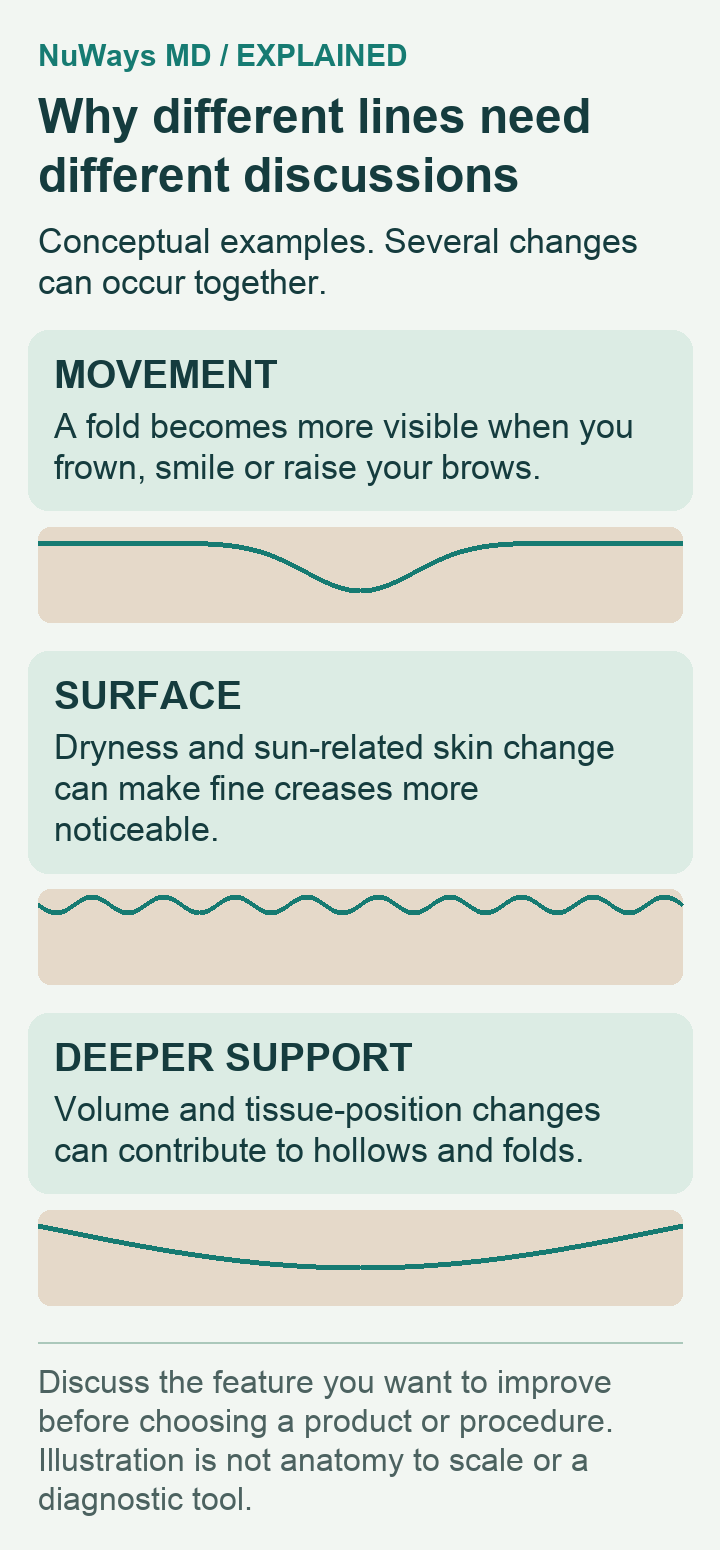
Fine lines and wrinkles can come from several changes happening together: repeated facial movement, sun damage, drier skin and changes in the support beneath the surface. That is why a moisturizer, Botox, filler and a resurfacing treatment can all be discussed for an aging face while doing very different jobs.
You do not have to decide on a procedure before seeking advice. Start with what you notice, when you see it and how much it bothers you. This guide explains the options, what they cannot do and how to choose a sensible next step without feeling you need to treat every line.
Editorial details
What are you noticing?
Lines mainly when you smile, frown or raise your brows
Muscle movement may be an important part of the appearance. Wrinkle-relaxing injections are one possible discussion.
Fine creases, dryness or a rougher surface
Moisture, sun exposure and skin texture deserve attention. Skincare and selected resurfacing approaches have different roles.
A crease that remains when your face is relaxed
An established line may involve more than movement. The depth and surrounding skin affect the treatment discussion.
A deeper fold, hollow or looser contour
Changes in volume and support may matter. Adding volume, resurfacing and surgery address different features.
These descriptions help you explain your concern. They cannot diagnose its cause or determine a treatment from a photograph.
Why do fine lines and wrinkles develop?
Skin changes with age, and ultraviolet exposure accelerates visible aging. Collagen and elastin help support the skin; changes in that support affect its firmness and ability to return after movement. Repeated expressions fold the skin, while dryness can make fine surface lines more noticeable. Smoking and environmental exposure can contribute too. Mayo Clinic: wrinkle causes.
A wrinkle can therefore have more than one contributor. For example, reducing the movement that makes a forehead line deeper may help, while an established crease remains visible at rest. Improving hydration may soften a dry, finely lined appearance without changing a deeper fold. The treatment needs to fit the feature you actually want to improve.
Fine lines, dynamic wrinkles and static wrinkles
Fine lines usually describes shallow visible creases. Dynamic wrinkles become apparent with movement. Static wrinkles remain visible when the face is relaxed. These are useful descriptions, not mutually exclusive diagnoses: a line can become more pronounced with expression and still be present at rest.
Wrinkles also differ from flat brown or red marks and from indented acne scars. If the concern is mainly color or pits left by acne, our skin texture and acne-scar guide gives a more relevant starting point.
Can skincare actually improve wrinkles?
Yes, within limits. A routine can improve hydration, reduce further sun damage and help some visible signs of photoaging. It does not reproduce the muscle-relaxing effect of an injection, replace missing facial volume or remove excess skin.
Start with sun protection and a tolerable moisturizer
The American Academy of Dermatology recommends broad-spectrum sunscreen with SPF 30 or higher and emphasizes moisturizing. Moisturizer traps water in the skin and can make some fine lines less visible. Sunscreen helps limit further sun damage; it does not immediately erase existing wrinkles. AAD: wrinkle remedies.
Choose a routine you can use consistently rather than buying several strong products at once. If your skin is stinging, flaking or inflamed, adding more “anti-aging” steps may make the surface look and feel worse. Our sunscreen buying guide explains the label and practical fit without treating the most expensive bottle as the best choice.
Retinol and prescription retinoids: what is the difference?
Retinoids are a family of vitamin A-related ingredients. Retinol is one commonly found in over-the-counter products; tretinoin is a prescription retinoid. They should not be compared by the percentage printed on the package alone. The ingredient, formulation and your ability to tolerate it matter. Our retinol and retinoid buying guide compares ingredient types, disclosed strengths, formulas and bottle costs.
Retinoids can help some fine wrinkles and signs of sun damage, but irritation is a real tradeoff. Introduce products according to their directions and the clinician’s advice; stronger or more frequent use is not automatically a better plan. Retinoids should be avoided during pregnancy. Discuss pregnancy plans, breastfeeding, eczema, rosacea or persistent sensitivity before selecting an active treatment. AAD: retinoid or retinol; AAD pregnancy skincare.
What does the research show?
A systematic review of randomized trials found evidence that topical tretinoin improves signs of photoaging, including wrinkles. The studies differed in concentration, formulation, duration and comparison treatment. That supports a role for tretinoin, but it does not establish that every retinol serum produces the same result or that a cream will remove a deep fold. Sitohang and colleagues, 2022 systematic review.
Expect a skincare trial to be assessed over time, rather than judging it after a few applications. Earlier softness from moisturizing and slower changes from an active ingredient are different outcomes. If a product remains irritating, contact the prescribing clinician or a dermatologist rather than pushing through in pursuit of a faster result.
Does vitamin C help fine lines?
Topical vitamin C may help some signs of sun-related aging, including fine wrinkles and uneven pigment. A 2023 systematic review included seven publications with 139 volunteers and found encouraging results, but the studies used different formulas and protocols. It is a reasonable ingredient to consider once your basic routine is comfortable. The research does not tell us that every vitamin C serum works equally well or that a higher percentage is the best purchase.
Are peptide serums worth adding?
Peptides are short chains of amino acids used in many different formulas. “Contains peptides” is too broad to predict a visible result. A review of oral and topical peptide trials combines different ingredients and delivery methods; findings from a swallowed supplement cannot establish what a face serum will do. Look for evidence on the finished product and whether its improvement matters to you. A peptide moisturizer may fit your routine, but it does not need to displace sunscreen or a better-supported treatment.
Can LED masks or microcurrent devices improve wrinkles?
Red-light LED devices are intended to affect cellular processes using light, rather than remove skin. The AAD describes possible subtle improvements in fine lines and texture, with uncertainty around home-device effectiveness. Expect repeated use, not a one-time lift. Follow the specific device’s eye-protection instructions, and discuss light sensitivity or photosensitizing medicines before starting.
Microcurrent devices use electrical stimulation rather than light. Published facial-rejuvenation research is limited and device-specific. A 2024 review of home beauty devices found small studies and short follow-up, including only one trial in its microcurrent category. That is a thin basis for promises about every retail device or lasting wrinkle removal.
Before spending, check the exact model’s evidence, required weekly time, replacement gels or accessories, contraindications and return policy. An immediate contour change in an advertisement does not tell you how long it lasts. We have not tested these devices and do not recommend a particular model here.
Botox, filler, microneedling or laser: which does what?
The table is a guide to the conversation, not a treatment selector. A clinician may identify overlapping concerns and propose a sequence. You can ask which part is most important and what would happen if you did only that part.
| Approach | What it may help address | What it does not reliably replace | Main tradeoffs to understand |
|---|---|---|---|
| Moisturizer, sunscreen and selected skincare | Dry-looking fine lines and aspects of sun-related skin change | Muscle relaxation, volume replacement or removal of excess skin | Consistency, irritation from active ingredients and gradual results |
| Botulinum toxin, including Botox and Dysport | Lines influenced by selected muscle movements | Surface renewal or filling a hollow; an established crease may remain | Temporary effect, injections, possible asymmetry or drooping and repeat costs |
| Dermal filler | Selected volume loss and folds when the product and location are appropriate | A facelift or a general cure for all facial lines | Swelling, lumps and rare but serious blood-vessel complications |
| Standard microneedling | Selected texture concerns and wrinkles, depending on the device and use | Major lifting or the same action as a muscle-relaxing injection | Several sessions may be needed; irritation, pigment changes and infection risks require discussion |
| Chemical peels or laser resurfacing | Surface texture and selected sun-related changes or wrinkles | Replacement of lost volume or correction of significant sagging | Recovery varies substantially with the procedure; pigment changes and scarring can occur |
| Surgical assessment | More substantial loose skin or structural changes in an appropriate candidate | An obligation to have surgery or a guarantee of a particular appearance | Surgery, recovery, cost and a different risk profile |
Treatment context: AAD botulinum toxin, FDA dermal fillers, FDA microneedling, AAD chemical peels and ASDS wrinkle treatments.
When might Botox or Dysport help?
Botulinum toxin temporarily reduces activity in selected muscles. If your main concern is a line that becomes pronounced when you frown or raise your eyebrows, that mechanism may be relevant. The aim and amount of movement to retain should be part of the consultation, rather than assuming that complete immobility is the goal.
A deeply established line may soften without disappearing. If it remains after movement has reduced, that does not automatically mean more toxin is the answer. The remaining feature may need a different discussion. Effects are temporary, so compare the initial quote with the cost of any future treatments you choose. AAD overview.
Our Botox beginner guide covers the appointment and how results develop. Botox versus Dysport explains brand differences, and Botox costs helps interpret the product, units, areas and follow-up on your quote. Do not use an online unit example to choose your own dose.
When do fillers or a discussion about facial support make sense?
Our dermal filler guide explains HA gels, collagen-stimulating products, result timelines and consultation questions. If you are deciding between injections, Botox vs. fillers compares movement, volume and the concerns that need another approach.
Some deeper folds and hollows involve changes beneath the skin rather than a surface line alone. Fillers add volume for particular uses, but filling every visible crease can fail to address the overall cause of the appearance. The assessment should explain where volume is being proposed and why.
Fillers have their own risks. Accidental injection into a blood vessel can cause tissue death, blindness or stroke, and some complications may be permanent. This is why relevant anatomy knowledge, product selection and a plan for complications matter. A reversible-sounding sales description should not be interpreted as “risk-free.” FDA filler guidance.
If loose skin or structural change is the main concern, a surgical consultation can clarify the limits of less invasive options. You can seek that opinion without agreeing to surgery. It may also help you avoid buying repeated procedures that cannot deliver the amount of change you want. ASDS: wrinkles.
When are microneedling, peels or resurfacing worth discussing?
These approaches focus more on skin quality and texture than on reducing an expression. Their intensity and expected recovery differ, so the important question is what the proposed treatment can reasonably improve at a level of disruption you can accept.
Standard microneedling may be discussed for certain wrinkles and texture concerns. The evidence and authorized uses are device-specific. RF microneedling adds heat and a separate risk profile; it should not be treated as an automatic next step when regular microneedling sounds too gentle. Our guides explain how standard microneedling works and RF microneedling benefits and risks. For a side-by-side decision, compare standard versus RF microneedling. The FDA describes reported serious complications in its RF microneedling safety communication.
Chemical peels vary in depth. A light peel and a deep peel are different commitments, even though both are called a peel. Clarify the agent, purpose, healing expectations and suitability for your skin. AAD: chemical peels.
Laser resurfacing includes both ablative treatments that remove tissue and non-ablative approaches. Fractional describes a treatment pattern, not a guarantee of minimal recovery. Non-ablative procedures may offer more gradual improvement with a lighter recovery, while a more involved ablative plan can require wound care. Skin-color changes and scarring remain important considerations. ASDS: non-ablative rejuvenation; Mayo Clinic: laser resurfacing.
Our laser resurfacing guide explains CO2, erbium, fractional treatments and recovery in detail. It is particularly useful if someone has suggested a brand name without explaining the actual procedure.
Three everyday situations, with different next questions
“My forehead creases when I lift my eyebrows.”
A useful question is how much of the concern comes from movement and how much remains at rest. Discuss the change you want while preserving an expression you are comfortable with. Starting with a skincare-only promise to erase all movement lines would leave that mechanism unexplained.
“My skin suddenly looks finely lined and feels tight after new products.”
Product irritation or dryness deserves attention before escalating to procedures. Take the product names and timing to a clinician if the problem persists. A newly uncomfortable surface should not automatically be interpreted as sudden permanent aging.
“The fold beside my mouth stays even when I relax.”
Ask whether the visible change involves surface texture, volume, tissue position or a combination. A recommendation should explain what can improve and what would remain. You do not need to agree to a whole-face package to have that discussion.
These are fictional observations for preparing a consultation, not diagnoses. New pain, a rash, persistent irritation or a changing skin lesion needs a medical assessment rather than treatment as a routine cosmetic wrinkle.
How long should you wait to judge the result?
The answer depends on what you are using and what you are measuring. Do not compare an immediate hydrated appearance, the settling of an injection result and gradual skin remodeling as if they were the same timeline.
| Stage | A useful way to assess it |
|---|---|
| Before starting | Identify one or two features you want to improve. Take an ordinary photograph in repeatable lighting and note whether the line appears at rest, with movement or both. |
| Early after treatment | Follow the recovery instructions. Swelling, redness or temporary smoothness may not represent the settled result. |
| At the agreed review | Compare the same expression, angle and lighting. Ask which changes reflect the intended effect and whether more time is needed. |
| Before paying for another step | Decide whether the improvement matters to you, whether the burdens were acceptable and what the next step is expected to add. |
A clinician should give you a review interval appropriate to the actual procedure. A skincare product should have realistic directions and expectations. There is no single “collagen timeline” that turns all of these options into one predictable schedule.
How to keep the plan affordable and manageable
Start with the concern that matters most to you. Separate routine skincare costs, the initial procedure and any ongoing treatment you may later choose. An expensive combination is not automatically more appropriate than one well-explained first step.
If a clinic proposes several treatments, request an itemized plan: the purpose of each step, its expected contribution, the sequence and the cost of stopping after the first part. Ask what changes if you choose less downtime, a smaller budget or no maintenance.
The microneedling cost guide, Botox cost guide and treatment budget worksheet can help with the numbers. For the person delivering the care, use how to choose an aesthetic provider.
Make the consultation about your priorities
Keep your questions and reading in one research plan. Start with the feature you want to understand; you do not need to choose a treatment first.
Save my treatment questions →Frequently asked questions
Can wrinkles go away completely?
Some fine lines become less visible with hydration or treatment. A complete disappearance of every line is not a realistic promise for everyone. Discuss a specific feature and degree of improvement rather than an age-reversal claim.
Do I need Botox as soon as I notice a line?
No. Seeing a line is not a medical requirement for treatment. Your goals, anatomy, preferences and willingness to repeat a temporary procedure matter more than a marketing deadline. Sun protection and an appropriate routine remain useful whether or not you choose injections.
Can drinking more water replace moisturizer?
Adequate hydration supports general health, but drinking extra water should not be presented as a proven way to erase established wrinkles. Dry-feeling skin may need attention to products, the skin barrier or an underlying condition, not simply more water.
Is retinol the same as tretinoin?
No. They belong to the retinoid family but are different ingredients. Results from prescription tretinoin trials cannot automatically be assigned to every retinol product. Tolerability and the formulation matter as well as the name.
What are the alternatives to Botox?
The best alternative depends on the line. For dryness or fine sun-related lines, start with moisturizer, sunscreen and a suitable active ingredient. For texture, discuss microneedling, peels or resurfacing if you want more change. None acts on facial movement in the same way as Botox. Switching to Dysport still means a botulinum toxin treatment. You can also choose to keep normal expression lines; treatment is optional.
What about lines under the eyes?
The eyelid area is delicate, and apparent lines can overlap with dryness, puffiness, shadows or loose skin. An assessment should identify the concern before discussing a procedure. Do not assume that an injectable or resurfacing option used elsewhere on the face is appropriate close to the eyes.
Sources and editorial notes
Sources checked September 27, 2026. This guide uses professional patient guidance, FDA safety information and the research reviews identified below. Each source supports a particular explanation, rather than a ranking of treatments or skincare products.
Skin aging, skincare and retinoid evidence
- Mayo Clinic: wrinkle symptoms and causes: age-related change, ultraviolet exposure and other contributors to wrinkles.
- American Academy of Dermatology: wrinkle remedies: sun protection, moisturizing and practical skincare expectations.
- AAD: retinoid or retinol: ingredient distinctions, irritation and suitability considerations.
- AAD: skincare during pregnancy: pregnancy-related ingredient precautions.
- Sitohang and colleagues, 2022: topical tretinoin for photoaging: a systematic review of seven randomized trials. Formulations, comparison treatments and outcomes differed; these findings cannot be assigned to every retail retinol product.
- Correia and Magina, 2023: topical vitamin C systematic review: seven publications, with varied formulas and protocols; supports cautious expectations for photoaging.
- Oral and topical peptides: systematic review: different delivery methods must be distinguished when interpreting findings.
- AAD: red-light therapy: home-device expectations and precautions.
- 2024 review: home beauty devices for facial rejuvenation: limited device-specific evidence, including the small microcurrent literature.
Procedure options and their limits
- AAD: botulinum toxin overview: muscle-related wrinkle treatment and its temporary effect.
- FDA: dermal fillers: approved-use context and risks, including serious blood-vessel complications.
- FDA: microneedling devices: device-specific uses and safety considerations.
- FDA: RF microneedling safety communication: reports of serious complications with certain RF microneedling uses.
- AAD: chemical peels overview: differences in peel depth and treatment purpose.
- American Society for Dermatologic Surgery: wrinkles: the range of treatment approaches discussed for different wrinkle concerns.
- ASDS: non-ablative laser rejuvenation: general expectations for the non-ablative treatment category.
- Mayo Clinic: laser resurfacing: preparation, recovery and risks of resurfacing procedures.
Interpreting the comparisons
The table compares what treatments are intended to address. It is not a head-to-head trial or evidence that the options produce equivalent improvements. The original illustration is conceptual, and the three everyday observations are fictional examples for preparing a consultation. They are not diagnostic tools or before-and-after results.
NuWays MD is an educational publication, not a medical provider. This guide is not medical advice. Independent clinical review remains pending. How we prepare and update guides · Commercial disclosures.