How to Choose Sunscreen: Face, Outdoor Use, Mineral Options and Value
A sunscreen can have an excellent label and still be the wrong purchase if you dislike wearing it, cannot match its tint or save it for special occasions because it costs too much. Start with broad-spectrum SPF 30 or higher, then choose for the way you will actually use it: an everyday face routine, a sweaty afternoon, or a mineral formula you can comfortably reapply.
This guide compares five products using their published labels, package sizes and dated prices. It also explains the decisions a product list cannot make for you, including white cast, sensitivity, makeup compatibility and how much protection an application really provides.
Editorial details
A useful sunscreen choice starts with your day
Everyday face
Broad-spectrum SPF 30 or higher in a texture and price you can use generously. Choose water resistance when sweating or swimming is likely.
Outdoor activity
Check the actual 40- or 80-minute water-resistance label. Bring enough for reapplication and use clothing and shade too.
Dark spots or melasma
Consider a wearable tint containing iron oxides. Shade match matters; one tint does not suit every skin tone.
Sensitive skin
A fragrance-free mineral formula is one option to investigate. The whole formula still matters, and a label cannot guarantee tolerance.
What should you look for on a sunscreen label?
Broad spectrum means protection against both UVA and UVB. SPF describes protection against sunburn under test conditions. It does not tell you how many hours you can stay outside. The American Academy of Dermatology recommends SPF 30 or higher; a higher number does not remove the need to apply enough or reapply. AAD label guide, FDA explanation of SPF.
Water resistant for 80 minutes is useful information for a pool day. It does not mean waterproof, all-day protection or permission to skip reapplication after toweling. A face moisturizer with SPF and no water-resistance claim belongs in a different comparison from a swimming sunscreen.
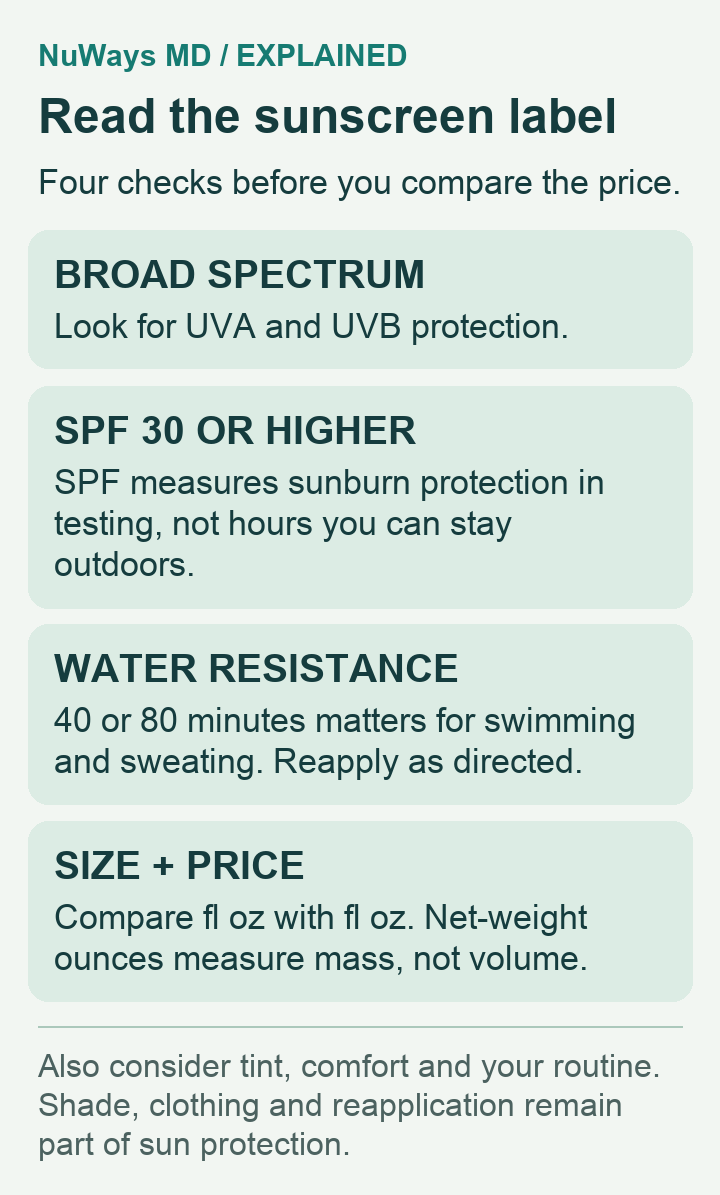
Words such as “sport,” “sensitive” and “reef safe” do not have standardized FDA definitions. Read the Drug Facts, directions and ingredient list rather than choosing from those words alone. AAD label guide.
Which sunscreen fits your routine?
| Your situation | Useful features | The tradeoff to check |
|---|---|---|
| Mostly an everyday face routine | Comfortable finish, suitable shade if tinted, sufficient quantity for regular use | A tiny premium bottle may discourage generous application. A non-water-resistant moisturizer is not a swimming substitute. |
| Outdoor work, running or a beach day | Broad spectrum, higher SPF option, labeled water resistance, a practical bottle size | Sweat, towel drying and time outdoors still require reapplication. Keep a second bottle where you need it. |
| Makeup most days | A sunscreen that forms an even layer underneath your actual products | Pilling or an unwanted finish cannot be reliably predicted from an ingredient list. Test the combination before an important event. |
| Dark spots or melasma | Tinted sunscreen containing iron oxides, plus shade and a hat | A tint that looks gray, orange or too light may be hard to wear at the necessary amount. Not every tinted product has the same visible-light performance. |
| Easily irritated skin | Fragrance-free options; consider mineral active ingredients and a simpler routine | Mineral does not mean allergy-proof. Stinging can involve the inactive ingredients or already-irritated skin. |
| Family body coverage on a budget | Price per comparable package quantity and a formula people will use | The lowest bottle price may buy much less product. Premium facial features may add little value on arms and legs. |
For melasma, the AAD specifically recommends tinted sunscreen with iron oxide because visible light can contribute to worsening pigment. That does not establish that every tint treats melasma or that sunscreen replaces an individual treatment plan. If your main concern is a lingering mark, pore appearance or a depression in the skin, our skin texture and acne scar guide explains why those lead to different discussions. AAD melasma care.
Five sunscreens compared by label, size and price
Prices checked September 27, 2026. These are U.S. one-time purchase list or displayed regular prices, before shipping and tax. Coupons, subscription discounts and temporary sale prices are excluded. These links are source links, not affiliate links. We have not performed hands-on wear tests, laboratory SPF testing or a head-to-head clinical comparison.
| Product and possible use | Published protection | Verified package | Price used | Price for the same quantity |
|---|---|---|---|---|
| CeraVe Ultra-Light Moisturizing Lotion SPF 30: everyday face moisturizer | Broad spectrum SPF 30; manufacturer directs swimmers to a water-resistant sunscreen | 1.7 fl oz | $19.99 | $11.76 per fl oz |
| La Roche-Posay Anthelios Melt-In Milk SPF 60: face and body outdoors | Broad spectrum SPF 60; 80-minute water resistance | 150 mL | $37.99 | $7.49 per U.S. fl oz, using the 150 mL volume |
| Black Girl Sunscreen SPF 30, original unscented: a face/body option marketed for avoiding white cast | Broad spectrum SPF 30; 80-minute water resistance | 3 fl oz | $15.99 | $5.33 per fl oz |
| Blue Lizard Sensitive Mineral SPF 50: larger mineral face/body option | Broad spectrum SPF 50; 80-minute water resistance | 5 fl oz | $15.99 | $3.20 per fl oz |
| EltaMD UV Physical SPF 41: tinted mineral example | Broad spectrum SPF 41; 40-minute water resistance | Net weight 3 oz / 85 g | $48.00 | $56.47 per 100 g; not comparable to the volume figures above |
Product identity and availability: the EltaMD SPF 41 listing was available at $48 when rechecked September 27, 2026. Stock and prices can change. A similarly named SPF 40 product has its own label; check the exact formula and size before comparing.
Price sources: CeraVe at Ulta, La Roche-Posay, 150 mL selection, Black Girl Sunscreen at Target, Blue Lizard at Target, EltaMD.
Use the individual product summaries below for prices and key label details without scrolling across the table. Prices help you budget; wear, tint and comfort still depend on your skin and routine. Four of these packages can be normalized by volume. EltaMD states net weight, and grams cannot be converted to milliliters without the product’s density.
What makes each option worth considering?
CeraVe Ultra-Light SPF 30: for a simple everyday face routine
Price and label snapshot: $19.99 for 1.7 fl oz. $11.76 per fl oz. No water-resistance claim in this comparison. Prices checked September 27, 2026.
Its published positioning is a moisturizer for normal-to-oily skin with a matte finish. It uses non-mineral sunscreen filters and is fragrance-free. Consider it when combining moisturizing and SPF could make your morning routine easier. Limitation: its directions point you to a water-resistant sunscreen for swimming or sweating. Matte appearance on your skin and behavior under foundation remain untested by us. Manufacturer label and directions.
Anthelios Melt-In Milk SPF 60: for one face-and-body bottle
Price and label snapshot: $37.99 for 150 mL, approximately 5.07 US fl oz. $7.49 per fl oz. Water resistant for 80 minutes. Prices checked September 27, 2026.
The 150 mL size, SPF 60 and 80-minute water-resistance claim make this a candidate for outdoor use. Its active filters are avobenzone, homosalate, octisalate and octocrylene. Limitation: the larger total purchase price may matter even when the unit price is lower than a small face bottle. The manufacturer’s texture descriptions are not our wear-test findings. Manufacturer specifications.
Black Girl Sunscreen SPF 30: for someone concerned about white cast
Price and label snapshot: $15.99 for 3 fl oz. $5.33 per fl oz. Water resistant for 80 minutes. Prices checked September 27, 2026.
The original unscented formula uses non-mineral active filters and is marketed with a sheer finish for darker skin tones. It includes moisturizing oils and has an 80-minute water-resistance claim. Limitation: “no white cast” is the manufacturer’s claim, not a result of testing on our readers. Someone wanting a dry, matte feel should assess the finish before buying several bottles. Check that you are selecting the original formula rather than another product in the range. Manufacturer information.
Blue Lizard Sensitive Mineral SPF 50: for mineral coverage at a lower unit price
Price and label snapshot: $15.99 for 5 fl oz. $3.20 per fl oz. Water resistant for 80 minutes. Prices checked September 27, 2026.
Its published active ingredients are zinc oxide and titanium dioxide. The larger bottle and 80-minute water-resistance claim make it worth considering for mineral face-and-body coverage. Limitation: an untinted mineral formula may leave a visible cast, particularly on deeper skin tones. We have not compared its spreadability or finish with the other options. Manufacturer information.
EltaMD UV Physical SPF 41: for understanding tinted mineral tradeoffs
Price and label snapshot: $48 for net weight 3 oz / 85 g. $56.47 per 100 g. Water resistant for 40 minutes. Prices checked September 27, 2026.
The cited formula contains zinc oxide, titanium dioxide and iron oxides, with a light tint and 40-minute water resistance. The verified package is 85 grams, not 85 milliliters. Limitations: shade suitability, the higher price and shorter labeled water-resistance time. A suitable tint can be useful, but paying more does not guarantee a match or makeup compatibility. Manufacturer specifications.
Is mineral sunscreen better than chemical sunscreen?
Both can provide effective protection when the finished product meets the relevant labeling requirements and you use it correctly. Mineral active ingredients are zinc oxide and titanium dioxide. Products commonly called chemical sunscreens use other UV filters; hybrids combine the two types. Mineral filters absorb much of the UV they attenuate, in addition to reflection/scattering. The “mineral only reflects, chemical only absorbs” explanation is too simplistic. Cole and colleagues, optical study.
A more useful buying question is: Which complete formula can I wear at the right amount without irritation or a finish that makes me avoid it? An ingredient category cannot settle that. For example, moving from a stinging non-mineral formula to a fragrance-free mineral one may be worth discussing, but changing categories and adding three new skincare products simultaneously makes it harder to identify what helped.
A 2026 label update: FDA added bemotrizinol as a permitted sunscreen active ingredient in June 2026. Older claims that every U.S. non-mineral sunscreen uses the same long-standing selection of filters are becoming outdated. That change does not make the five established products above obsolete or independently establish a new product as superior. FDA sunscreen information.
How do you apply and reapply sunscreen with makeup?
Use a full sunscreen layer according to its directions, then apply makeup without deliberately thinning or mixing that layer. SPF values do not add together: SPF 30 moisturizer plus SPF 20 foundation does not become SPF 50. Makeup is often applied for its appearance, which may be much less than the amount needed to achieve its tested SPF. AAD sunscreen FAQs.
For outdoor exposure, plan to reapply at least every two hours and follow the bottle’s shorter swimming, sweating and towel-drying directions. Sunscreen does not replace shade, a hat or protective clothing. FDA advises applying before exposure and covering easily missed sites such as ears, the neck and hands. FDA application guidance.
Makeup makes that inconvenient, but it does not change the need. Consider a lighter makeup day for prolonged outdoor activity, or plan a clean reapplication break. Do not assume a quick dusting of SPF powder provides the same coverage as a full application of your labeled sunscreen. Test your actual routine at home: apply the amount you intend to use, let the layer settle, add your usual makeup and check for pilling or separation. This is a practical compatibility check, not an SPF test.
How much sunscreen are you really buying?
A $16 bottle may be better value than a $20 bottle, or it may contain half as much. Divide the price by the labeled quantity, using the same unit for both products. In this comparison, $15.99 ÷ 5 fl oz = $3.20 per fl oz, while $19.99 ÷ 1.7 fl oz = $11.76 per fl oz.
As a fictional budget example, suppose your household uses 10 fluid ounces over a particular period. At those unit prices, product spending would be about $32 versus $118. That is an arithmetic comparison, not a recommended amount, duration or assumption that the formulas are interchangeable. Your exposed area, activity and reapplications determine use.
The most expensive sunscreen is not automatically the most protective. A practical approach can be a face formula you enjoy and a larger water-resistant bottle for body use. Keep an eye on the expiration date and storage: FDA recommends protecting bottles from excessive heat and direct sun. FDA storage guidance.
What if sunscreen stings or you just had a treatment?
Stop using a product that causes a persistent reaction and obtain advice if irritation continues. Labels such as fragrance-free, sensitive or non-comedogenic narrow a search; they do not guarantee that your skin will tolerate a product. A clinician can help distinguish irritation from allergy or an underlying skin problem. AAD sunscreen FAQs.
Freshly treated skin is a separate situation. Do not put an ordinary sunscreen on broken skin or decide that “mineral” makes immediate application appropriate after every procedure. Your treating clinician should tell you when to resume it and how to protect your skin meanwhile. Our microneedling recovery guide and laser resurfacing guide explain why recovery instructions vary. FDA sunscreen labeling.
How we selected and compared these products
We selected examples for everyday facial use, outdoor face/body coverage, white-cast concerns, larger mineral packages and tinted mineral use. We required identifiable U.S. product labels and verifiable sizes and prices. We compared protection claims, water resistance, formula type, tint, package quantity and unit cost. These are examples for different needs, not an exhaustive list or a numbered ranking.
We used manufacturer information for formulation and directions, and identified the retailer whenever it supplied the price. Where listings differ, use the Drug Facts on the actual package and verify that the size and formulation match. CeraVe and La Roche-Posay share a parent company; their inclusion is not independent evidence that one corporate product range performs better.
What this comparison does not establish: how each product feels across skin tones, whether it pills under a specific foundation, whether it causes breakouts, or whether its real-world protection exceeds a competitor’s. We have not tested those outcomes and have not assigned performance scores. This page currently uses ordinary source links. Any future affiliate links will be disclosed where they appear; payment would not justify an unsupported recommendation. Read our commercial disclosures and editorial standards.
Build a routine you understand.
Use the sunscreen label and your daily routine to narrow the choice. Our skincare collection explains what to look for before adding another product.
Choosing a retinoid too? Compare ingredients, formulas and the cost of the product you will actually use in our retinol and retinoid buying guide.
Explore skincare guides →Frequently asked questions
Is SPF 50 better than SPF 30?
It offers greater protection against sunburn under the test conditions, but neither provides complete protection. Adequate application, reapplication and other sun protection remain necessary. Choose broad spectrum too; the SPF number alone does not describe the whole protection profile. FDA SPF explanation.
Do deeper skin tones need sunscreen?
Yes. Everyone can experience UV damage, and sun exposure can worsen unwanted pigment changes. A product you can apply without an unwanted cast is useful. For melasma or persistent dark spots, discuss a tinted option with iron oxides rather than assuming a clear sunscreen addresses visible light equally. AAD sunscreen FAQs, AAD melasma care.
Does moisturizer with SPF count?
It can, if it meets your protection needs and you apply enough as directed. Check broad-spectrum protection, SPF and water resistance rather than assuming the word moisturizer either disqualifies it or makes reapplication unnecessary.
Can sunscreen replace wrinkle treatments?
It helps protect against additional sun damage; it does not erase every established line or restore lost facial volume. Our fine lines and wrinkles guide separates prevention, surface changes and treatment goals.
Should I buy sunscreen from an unfamiliar marketplace seller?
Prefer a retailer or seller whose sourcing you can verify, and inspect the product name, seal, expiration date and Drug Facts. An unusually low price is not enough to establish authenticity. Keep the packaging if the delivered formula differs from the listing.
Sources and editorial notes
Prepared by NuWays MD. Sources and prices checked September 27, 2026. This is a published-specification buying guide, not a hands-on product test or personalized medical advice. NuWays MD is an educational publication, not a medical provider. Clinical review has not been completed.
- Label interpretation: AAD sunscreen labels and FDA SPF. These explain protection terminology; they do not rank our selected products.
- Filter mechanism: Cole and colleagues, 2016 measured absorption and scattering by mineral filters. It does not compare the finished products selected here.
- Use and precautions: FDA sunscreen information, FDA labeling guidance, AAD FAQs and AAD melasma care.
- Product evidence: Manufacturer labels are linked beside each product. Retailer observations used for pricing are linked beneath the comparison. Price, stock, packaging and formulation can change independently.
- Calculations and visual: Unit prices are rounded to cents. The La Roche-Posay conversion uses 29.5735 mL per U.S. fluid ounce. The labeled-weight product is kept separate. The illustrated label is a fictional teaching example, not a product endorsement.
- Editorial limits: No supplied samples, wear-test results or independent SPF measurements are represented here. Our selection framework and arithmetic are editorial analysis; manufacturer finish and suitability claims remain attributed.