Retinol and Retinoid Buying Guide: Types, Strengths, Formulas and Cost
Retinol and retinal are common cosmetic choices for fine lines and uneven texture; adapalene 0.1% is an OTC acne medicine in the US. This guide compares nine products from $8.10 to $66, explains what their percentages mean and shows how to compare a prescription route without confusing a monthly estimate with the amount billed.
Editorial details
The quick answer
First cosmetic retinoid
AAD suggests the least-intense formula, introduced every other night and built up slowly. Follow any gentler product-specific instructions.
Acne treatment
Adapalene 0.1% has an OTC acne indication for ages 12+. Results can take up to three months.
Bottle budget
Nine examples: $8.10–$66 before tax and shipping. The lowest-price example was out of stock when checked.
Main label trap
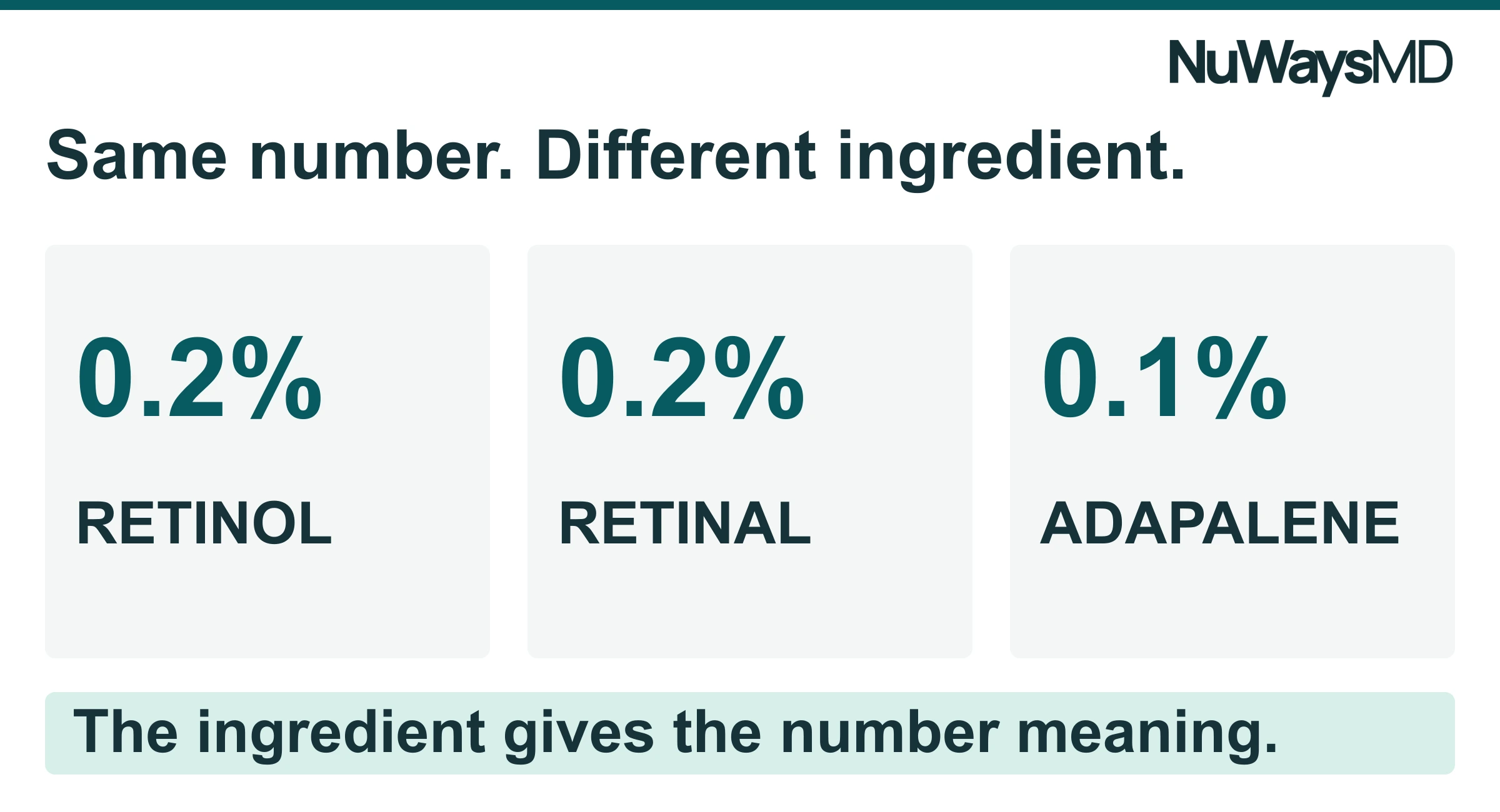
0.2% retinol and 0.2% retinal are different ingredients. A complex percentage can describe a mixture.
A good first purchase is one that fits your concern and that you can use comfortably. Here is how to read the label, weigh the evidence, compare the whole bottle and avoid paying for strength or claims you do not need.
Retinol, retinal and retinoids: what is the difference?
Retinoid is the family name; retinol is one member. The family includes cosmetic ingredients and prescription medicines. The American Academy of Dermatology discusses retinol for concerns such as mild texture changes and uneven tone, while recommending a more individualized discussion for sensitive skin and other conditions. AAD: retinoid or retinol?
| Name on the label | What you are comparing | Buying implication |
|---|---|---|
| Retinol | A vitamin A ingredient commonly used in cosmetic serums and creams | Look for the actual retinol concentration when disclosed, then consider the whole formula |
| Retinal or retinaldehyde | Another vitamin A ingredient, closer to retinoic acid in the conversion pathway | A smaller percentage is not automatically weaker than a larger retinol percentage |
| Retinyl esters | Ingredients such as retinyl palmitate | Look for evidence for the named ingredient and finished formula |
| HPR / Granactive Retinoid | Hydroxypinacolone retinoate, sold in proprietary formulations | A blend percentage is not interchangeable with a retinol percentage; see the label explanation below |
| Adapalene | A retinoid medicine; 0.1% gel is available OTC in the US for acne | Read Drug Facts, not just cosmetic claims about smooth skin |
| Tretinoin | Prescription retinoic acid, available in different strengths and vehicles | Discuss the diagnosis, formulation, directions and follow-up with the prescriber |
| A branded “retinoid complex” | A blend whose headline percentage may refer to the mixture | Ask which retinoid is present and whether its actual concentration is disclosed |
The ingredient pathway is useful background, but it is not a conversion calculator for the strength or speed of finished products. Formulation and study design matter. Review of topical retinoids, adapalene Drug Facts
Choose the job before choosing the bottle
Fine lines, texture and uneven tone
Look for evidence that matches the concern. A study measuring fine wrinkles is not automatically evidence for acne control, and an improvement in surface texture is not the same thing as a treatment for deeper scars or loss of volume. Prescription tretinoin has a substantial photoaging evidence base, but that does not make a prescription the right starting point for every shopper. Systematic review of tretinoin for photoaging
Keep expectations proportionate. If your main question is a crease, texture change or discoloration, compare what skincare can reasonably address with the options in our treatment comparison guide. Decide what improvement would be useful before spending on progressively stronger serums. Our guides to fine lines and wrinkles and uneven texture and acne scars explain why different concerns may call for different approaches.
Acne and post-acne marks are different targets
Adapalene 0.1% gel has an OTC acne indication for ages 12 and older. Its label describes once-daily use and notes that results can take up to three months. It is not just another retinol serum with a smaller number. Adapalene label
A cosmetic product marketed for the appearance of post-acne marks is making a different promise from a medicine intended to treat acne. Persistent or scarring acne deserves a clinical plan rather than repeated cosmetic purchases. AAD: acne treatment
When the decision should start with your clinician
Pregnancy or plans to become pregnant, breastfeeding, eczema, rosacea, significant irritation and an upcoming procedure all change the discussion. Get advice suited to those circumstances before choosing a product. The safety section below explains the distinctions rather than treating every situation as the same prohibition.
What the research supports, and what it does not
There is real evidence behind topical retinoids. The weakness in many buying guides is the jump from “this ingredient was studied” to “this retail bottle delivers that result.” These examples show why the missing details matter.
| Study or evidence source | What was actually tested | What it supports | What it cannot establish |
|---|---|---|---|
| Kafi et al., 2007 | 0.4% retinol lotion on the arms of 36 older adults, mean age 87, for 24 weeks | Improvement in fine wrinkling compared with the lotion vehicle | That every face serum, strength or age group will have the same result |
| Retinal trial, 2018 | 0.05% and 0.1% retinal creams in 40 Korean women over three months | Improvements in texture and hydration in both groups | A general claim that doubling retinal gives twice the benefit; the trial had no retinoid-free comparison group |
| Tretinoin systematic review, 2022 | Randomized studies of topical tretinoin for photoaging | A clinical evidence base for several signs of photoaging | That tretinoin and cosmetic retinol percentages are interchangeable |
| Adapalene comparison, 2018 | 0.3% adapalene versus 0.05% tretinoin for photoaging over 24 weeks | A comparison of those studied formulations | That OTC 0.1% adapalene has the same photoaging evidence as the 0.3% formula |
Use the retail product as directed, even when a study used a different schedule. A paper’s concentration, vehicle, application schedule and population belong together when interpreting its result.
“Clinically tested” needs a second question
Ask what was measured, whether there was a comparison group and whether the finished product was tested. A consumer survey saying skin “felt smoother” is a different result from a blinded assessment of wrinkles. An ingredient study can help explain a formula’s rationale without proving a brand’s complete advertising claim.
We have not conducted a head-to-head trial or hands-on wear test of the products below. The comparisons concern disclosed ingredients, package information, directions and observed prices. They are not laboratory stability tests or rankings of clinical effectiveness.
How to compare strengths without being misled
Compare like with like first. A disclosed 0.05% retinal and 0.2% retinal refer to concentrations of the same named ingredient, but differences in the complete formula can still affect use. Comparing either directly with 0.2% retinol is a different problem.
The number of conversion steps cannot calculate an equivalent retail dose or how many weeks sooner your skin will change. Reviews describe several retinoids and vehicles; they do not supply a universal retail conversion chart. Comparative review
Three practical label checks help:
- Name the ingredient. Is it retinol, retinal, adapalene, tretinoin or a blend?
- Identify what the percentage describes. Pure named ingredient, encapsulated mixture or proprietary complex?
- Read the intended use and directions. Cosmetic texture support and labeled acne treatment are different decisions.
An undisclosed percentage limits concentration comparisons; it leaves effectiveness unresolved. Compare a premium product by its formula, evidence and directions rather than its price or “medical grade” label.
What does “Granactive Retinoid 2%” mean?
Read it as a branded retinoid formulation, not as 2% retinol. The Ordinary’s current Granactive Retinoid 2% Emulsion ingredient list includes both hydroxypinacolone retinoate (HPR) and retinol. Its retail page does not give separate percentages for those two ingredients, so we do not assign either a guessed concentration. It also specifies refrigeration and use within three months of opening. The Ordinary: current formula and directions
For comparison, a study of tretinoin or plain retinol cannot validate this finished formula. A claim about a proprietary blend needs evidence for that blend and intended outcome.
Product comparison: formula, size and actual cost
US prices checked October 4, 2026. Prices exclude shipping and tax and can vary by seller, location and promotion. We selected these examples to illustrate different buying decisions, not to award a universal “best retinoid” title. Links go to official brand information or identified retailers and are not affiliate links in this guide.
| Product | Disclosed retinoid | Package | Observed US price | Unit cost |
|---|---|---|---|---|
| The Ordinary Retinol 0.2% in Squalane | 0.2% retinol | 30 mL | $8.10, brand; out of stock | $2.70 per 10 mL |
| The Ordinary Granactive Retinoid 2% Emulsion | HPR plus retinol; individual % undisclosed | 30 mL | $12.10, US brand store | $4.03 per 10 mL |
| Geek & Gorgeous A-Game 5 | 0.05% retinal | 30 mL | $14.90, US brand store | $4.97 per 10 mL |
| The Ordinary Retinal 0.2% Emulsion | 0.2% retinal | 15 mL | $14.90, US brand store | $9.93 per 10 mL |
| CeraVe Resurfacing Retinol Serum | Retinol; % undisclosed | 1 fl oz | $16.49 at Target | $16.49 per fl oz |
| Differin Gel | 0.1% adapalene | 15 g | $13.49 at Target | $8.99 per 10 g |
| La Roche-Posay Retinol B3 Serum | Retinol; % undisclosed | 1 fl oz | $44.99 at Target | $44.99 per fl oz |
| Paula’s Choice Clinical 0.3% Retinol + 2% Bakuchiol | 0.3% retinol plus 2% bakuchiol | 1 fl oz | $65, US brand store, one-time purchase | $65 per fl oz |
| Medik8 Crystal Retinal 3 | 0.03% retinal | 30 mL | $66, US brand store, one-time purchase | $22.00 per 10 mL |
Price per 10 mL is bottle price ÷ labeled milliliters × 10, rounded to cents; the same calculation uses grams for the Differin tube. CeraVe, La Roche-Posay and Paula’s Choice are shown per fluid ounce as listed. Read the unit alongside the price: the CeraVe, La Roche-Posay, Paula’s Choice and Differin rows are not per 10 mL, and grams cannot be treated as milliliters. These amounts compare package spending, not equivalent treatment doses.
The Ordinary Retinol 0.2% in Squalane
Worth comparing if: you want a clearly disclosed retinol concentration and a low bottle price. The formula is water-free and based in squalane, which is a meaningful texture distinction when comparing it with an emulsion.
What to check first: the brand says to refrigerate after opening and use within three months. A 30 mL bottle may not be the economical choice it appears if you will use only a small portion before that limit. It was listed out of stock during this check; verify availability rather than relying on a marketplace substitute.
Check the formula and availability ↗︎The Ordinary Granactive Retinoid 2% Emulsion
Worth comparing if: you are considering an HPR-containing emulsion and want to compare its actual ingredient list and bottle cost with the other options here.
What to check first: the name’s 2% is not a disclosed 2% retinol concentration. The formula contains both HPR and retinol, with individual percentages undisclosed. Its refrigeration and three-month use limit matter when estimating usable value.
Check the Granactive formula ↗︎Geek & Gorgeous A-Game 5
Worth comparing if: you want a disclosed retinal concentration in a light emulsion. The US page lists 0.05% retinal, a 30 mL bottle and a six-month period after opening.
What to check first: the brand’s suggested retinol-strength comparison is not a validated equivalence for your skin. Compare the ingredient and formula directly. We have not tested its feel, tolerance or stability, and the price excludes any shipping charge.
Check A-Game 5 details ↗︎The Ordinary Retinal 0.2% Emulsion
Worth comparing if: you already use retinoids and are reviewing a more concentrated retinal option with a clinician or within the brand’s directions. The official page positions this product for experienced users, not as the automatic next purchase for a beginner.
What to check first: $14.90 buys 15 mL here, versus 30 mL for A-Game 5. The per-volume difference does not establish relative value or effectiveness because the concentrations and formulas differ. The brand specifies nighttime use and gradual introduction.
Check the retinal directions ↗︎CeraVe Resurfacing Retinol Serum
Worth comparing if: the appearance of post-acne marks is your concern and you want to inspect a formula combining encapsulated retinol with ingredients such as niacinamide and ceramides.
What to check first: the official US page checked does not disclose a retinol percentage. We do not fill that gap with percentages repeated by other websites. Encapsulation is a formulation feature, not a guarantee of no irritation. Target’s 1 fl oz listing showed $16.49, while CeraVe’s own page displayed $21.99. The $5.50 difference shows why checking the same size at another seller can matter more than moving to a different formula.
Read CeraVe’s formula details ↗︎Differin Gel 0.1% adapalene
Worth comparing if: you are evaluating an OTC acne medicine. Read the Drug Facts warnings and directions for the actual package; this is a different purchase from a cosmetic retinol serum.
What to check first: our $13.49 observation is for Target’s 15 g tube. Retailer offers can involve different sizes or bundles. Compare price per gram and the intended use separately. We have not substituted results from a 0.3% adapalene study for this 0.1% product.
Read Differin product information ↗︎La Roche-Posay Retinol B3 Serum
Worth comparing if: you prefer a widely available serum combining retinol with niacinamide and want to compare its formula with the lower-priced options above.
What to check first: the US brand page lists fragrance and does not specify a retinol percentage. “Suitable for sensitive skin” is the brand’s positioning, not a promise that your skin will tolerate it. The US brand listing and Target both showed $44.99; Target labels its bottle 1 fl oz. Subscription promotions are excluded from this comparison.
Check Retinol B3 details ↗︎Paula’s Choice Clinical 0.3% Retinol + 2% Bakuchiol
Worth comparing if: you want a clearly named retinol-and-bakuchiol combination. The US full-size listing is 1 fl oz at $65 for a one-time purchase.
What to check first: this contains retinol, so “bakuchiol” in its name does not make it a substitute for someone avoiding retinoids. The combined 2% and 0.3% figures describe different ingredients. The small bakuchiol-versus-retinol study discussed below did not test this retail combination.
Check the combination formula ↗︎Medik8 Crystal Retinal 3
Worth comparing if: you want a disclosed 0.03% retinal option and clear gradual-introduction instructions. The selected US strength-3 variant was $66 for a one-time purchase; compare the variant, not just the range’s starting price.
What to check first: the brand’s prominent finished-product clinical figures refer to Crystal Retinal 6, not strength 3. Its “11 times faster” statement cites laboratory retinoid-metabolism research, not a trial showing your wrinkles improve eleven times sooner. Those distinctions matter more than the premium price.
Check Crystal Retinal 3 ↗︎What does prescription tretinoin cost?
Compare medicine + consultation + delivery + refill terms. A pharmacy tube and a telehealth subscription can have different formulas, quantities and services. Ask for the exact strength, cream or gel, grams, one-time price, expected refill charge and any consultation fee before comparing them with a cosmetic serum.
A current telehealth example is Nurx’s anti-aging service: its page lists $90 for a 45 g tube of tretinoin cream, presented as a three-month supply, plus a $30 initial consultation and a $3 support fee in a month when an order is processed. Shipping is listed as free. That makes an illustrative first order $123, if one consultation and one processing fee apply, rather than the $30 monthly medication headline. Confirm the prescribed strength, tube size, refill terms and final charge; the page contains older 20 g product illustrations alongside its 45 g price labels. Nurx: products, prices and fees
The same page lists a compounded multi-ingredient cream separately. A compound containing tretinoin is a different product from a generic tretinoin tube, and the compound itself is not FDA approved. Compare like with like.
For an existing prescription, request a pharmacy quote for the same ingredient, strength, vehicle and tube size. Compare the cash total with your covered price and any applicable discount. A low advertised “from” price without those details is not a matched comparison, and a prescription decision should not be made from price alone.
The cost people miss: how much of the bottle you use
The lowest price per milliliter is useful only if you can use the product as directed within its usable life. A beginner adding a cosmetic retinoid gradually may not empty the same bottle as someone using it regularly across a larger area. There is no honest universal “cost per use” without a measured amount and an actual usage pattern.
Fictional value example: a $30 bottle contains 30 mL, so its shelf price is $1 per mL. If you use only 10 mL before discarding it according to its directions, the amount you actually used cost $3 per mL. That does not mean you should apply extra product to avoid waste. It means bottle size and after-opening instructions belong in the buying decision.
Keep the first routine small enough to evaluate. Buying a retinoid, an exfoliating acid, a new cleanser and a new treatment all at once makes it harder to identify what helped or caused a problem. An expensive unused bottle has no practical advantage over an affordable product that suits your routine.
Starting safely: the label matters more than a universal schedule
For a first cosmetic retinoid, choose a gentle formula and start gradually. AAD guidance suggests the least-intense option every other night, building up slowly. Follow the product’s instructions if it calls for an even slower introduction. Use moisturizer and daytime sun protection. If your skin is already inflamed, very dry or reactive, seek advice before starting. AAD retinoid guidance
Do not apply a generic cosmetic schedule to a prescription medicine. Follow the prescriber or Drug Facts label, and ask for help if you cannot tolerate it. The adapalene label warns that applying more than directed will not produce faster results and may increase irritation. Adapalene label
| Situation | Useful response |
|---|---|
| Mild dryness after starting | Check the amount, frequency and other irritating products; ask about adjusting the routine |
| Persistent burning, marked swelling or a significant rash | Stop the product and obtain medical advice rather than treating discomfort as proof it works |
| Acne seems worse in the first weeks of OTC adapalene | Its Drug Facts label says early worsening can occur and advises continuing as directed unless irritation becomes severe; allow up to three months for results |
| Several new products were started together | Bring the full list to the review, not just the newest bottle |
For darker skin tones, AAD warns that irritation can lead to dark marks, or post-inflammatory hyperpigmentation. Slow introduction and moisturizer are especially useful; peeling is a reason to review tolerance, not a goal to chase. AAD guidance
If an OTC adapalene product causes severe irritation or symptoms of an allergic reaction, follow its warnings and seek appropriate medical care. Drug Facts
Sunscreen is part of the routine, not an optional upgrade
Sun protection remains important whether or not you use a retinoid. AAD guidance pairs retinoid use with daytime sun protection. Our sunscreen buying guide compares labels, package sizes and costs so the supporting routine does not depend on an expensive or confusing purchase. AAD
Pregnancy, breastfeeding and treatment preparation
Avoid topical retinoids during pregnancy, and discuss plans to become pregnant with your clinician. If you used one before realizing you were pregnant, stop and ask your obstetric clinician for individualized advice; topical exposure is not the same as taking oral isotretinoin. MotherToBaby explains the lower absorption of topical tretinoin and why avoidance is still advised. MotherToBaby: topical tretinoin
Breastfeeding is a separate assessment. MotherToBaby notes that topical tretinoin has not been studied during breastfeeding and advises a clinician discussion; small expected absorption does not make every product or use pattern automatically appropriate. Do not rely solely on a brand’s “breastfeeding-safe” badge. MotherToBaby
What about waxing, laser, peels or microneedling?
Tell the treatment provider the exact product, concentration and application area before a procedure. The adapalene label specifically warns against waxing treated skin. Do not generalize a single clinic’s “stop for X days” instruction to every retinoid and procedure. Adapalene label Planning microneedling? See our microneedling recovery guide for the skincare restart questions to bring to your provider.
Ask for written stop-and-restart instructions suited to your product and treatment. Our laser resurfacing guide and microneedling guide can help you prepare questions, but your treating clinician should determine the timing.
Newer post-procedure research does not establish a universal restart date. A 2025 randomized split-face study involved 66 people after selected cosmetic procedures and assessed a cream combining retinaldehyde, niacinamide and haritaki extract after the skin’s surface had healed. Improvements with that finished formula cannot be assigned to retinal alone or transferred to every serum. Pierre Fabre funded the study, and authors disclosed company employment or honoraria. One participant withdrew because of a reaction attributed to the test product. Monteil and colleagues, 2025
Frequently asked questions
Is retinal better than retinol?
Not for every person or product. They are different ingredients, and finished formulas, tolerability and goals matter. The available studies do not establish a universal retail strength conversion or a guarantee that one is always faster. Comparative review
What retinol percentage should a beginner buy?
Choose the least-intense cosmetic formula you can use comfortably, and introduce it slowly. AAD suggests every other night initially; some brands specify less frequent use. There is no validated percentage that makes different retinol, retinal and prescription formulas equivalent. Follow acne-drug or prescription directions separately.
Is 0.2% retinal the same as 0.2% retinol?
No. The number describes the concentration of a different ingredient. Our table keeps those names visible precisely because the matching percentages are easy to misread.
Can I use retinol and adapalene together?
Keep one retinoid in your routine unless your clinician gives you a specific combined plan. Adding cosmetic retinol to adapalene increases complexity and potential irritation; bring your full product list before making that change.
Do I need to peel for retinol to work?
No. Peeling and irritation are not a required success measure. Review whether the product is tolerable and whether your original concern is improving over an appropriate period, rather than trying to produce visible shedding. AAD guidance
How long before deciding it is not working?
Use an outcome and timeframe appropriate to the product. The OTC adapalene label allows up to three months to see results; the retinol and retinal studies discussed here assessed outcomes over several months. Those are not guarantees for every bottle or a reason to tolerate a significant reaction. Adapalene label, retinol trial, retinal trial
Does an expensive or “medical-grade” retinol work better?
A price or marketing category does not answer that. Compare the formula’s disclosure, evidence, instructions, usable lifespan and suitability. This guide does not rank products by prestige or assume the lowest bottle price gives the lowest real cost.
Is bakuchiol a retinoid, and is it safer?
Bakuchiol is a different ingredient, not a retinoid. In a small 12-week randomized trial of 44 people, 0.5% bakuchiol twice daily and 0.5% retinol once daily both improved wrinkles and pigmentation; retinol users reported more scaling and stinging. Different application frequencies and the small sample limit a claim that the ingredients are interchangeable. Dhaliwal and colleagues
That trial did not establish safety in pregnancy. Ask your obstetric clinician about any proposed alternative, and check whether a “bakuchiol” product also contains retinol, as the Paula’s Choice example does.
Can retinol replace sunscreen?
No. They have different jobs. Keep sun protection in the routine; compare practical options in our sunscreen guide.
Sources and editorial notes
Research and US product information checked October 4, 2026. Independent clinical review is pending. No hands-on product testing, laboratory analysis or independent verification of manufacturers’ cosmetic performance claims was performed. Listed prices are observations, not permanent offers. The unused-product calculation is fictional and is not a suggested application amount.
- AAD: retinoid or retinol? and acne treatment. Consumer guidance and the distinction between cosmetic concerns and acne care.
- Kafi et al., 2007. Vehicle-controlled 0.4% retinol study on older adults’ arms, not a trial of the retail products compared here.
- 2018 retinaldehyde trial. Forty women, two concentrations and no retinoid-free arm.
- 2022 tretinoin systematic review and 2024 comparative review. Ingredient-level evidence with varying formulations and endpoints.
- Monteil et al., 2025, post-procedure retinaldehyde combination cream. A manufacturer-funded finished-formula study, not a restart instruction for other products.
- Target listings for CeraVe, 1 fl oz and Differin, 15 g. Dated retailer price observations, not national fixed prices or clinical evidence.
- 2018 adapalene 0.3% versus tretinoin 0.05% trial. Do not apply its findings directly to OTC adapalene 0.1%.
- DailyMed: adapalene 0.1% Drug Facts. Indication, warnings and directions.
- Bakuchiol trial, 2019. A small comparison using different application frequencies, not pregnancy-safety evidence.
- Nurx pricing and fees. One service example, not a national pharmacy price.
- MotherToBaby: topical tretinoin. Pregnancy and breastfeeding context.
- Official product pages are linked in the individual comparison cards. Each was used for its own formulation, package, directions and price information, not as independent proof of superiority.