Microneedling Recovery: A Day-by-Day Guide to Washing, Makeup, Exercise and Skincare
After microneedling, your skin may feel warm, tight and sensitive, then become dry or flaky as it settles. Most people have a few days of visible recovery, although redness or a darker appearance can last longer. Looking ready for work and being ready for retinol, a sweaty workout or another procedure are different milestones.
Here is what common recovery looks like, how to plan everyday activities and which changes deserve medical attention. This guide mainly covers professional microneedling without radiofrequency. If you had Morpheus8 or another RF treatment, use the separate RF discussion below and the instructions for your procedure.
Editorial details
The recovery questions people need answered first
How long will I look red?
Often a few days. AAD guidance describes visible reactions lasting a few days to a week; treatment intensity and your skin change the timeline.
Makeup tomorrow?
The AAD advises waiting at least 24 hours. Longer restrictions apply if your instructions or skin condition call for them.
Can I work out?
Plan for a pause. SkinPen Precision Elite labeling says to avoid sweaty exercise for the first 72 hours.
When should I call?
Increasing pain, spreading redness, pus, blisters or a worsening rash need assessment rather than more skincare.
If you are worried right now: contact the treating clinician promptly for a reaction that is worsening, feels unexpectedly painful or does not match your instructions. Trouble breathing, throat swelling or rapidly developing facial swelling warrants emergency care. You do not need to wait for a particular recovery day to ask for help.
Why does skin feel different after microneedling?
Microneedling makes controlled punctures in the skin. The early response can include temporary inflammation and sensitivity while the surface recovers; the intended improvement in texture develops over a longer period. A face that looks smoother from early swelling is not the final result.
The FDA lists dryness, roughness, tightness, redness, itching, peeling, bruising and crusting among possible effects. Their presence alone does not tell you how successful treatment will be. More redness or more peeling is not a goal to chase.
For an explanation of what treatment can improve, including the difference between fine lines and acne scars, see our microneedling guide. Here, the practical question is how to care for the skin you have today.
Microneedling recovery timeline: the first week and beyond
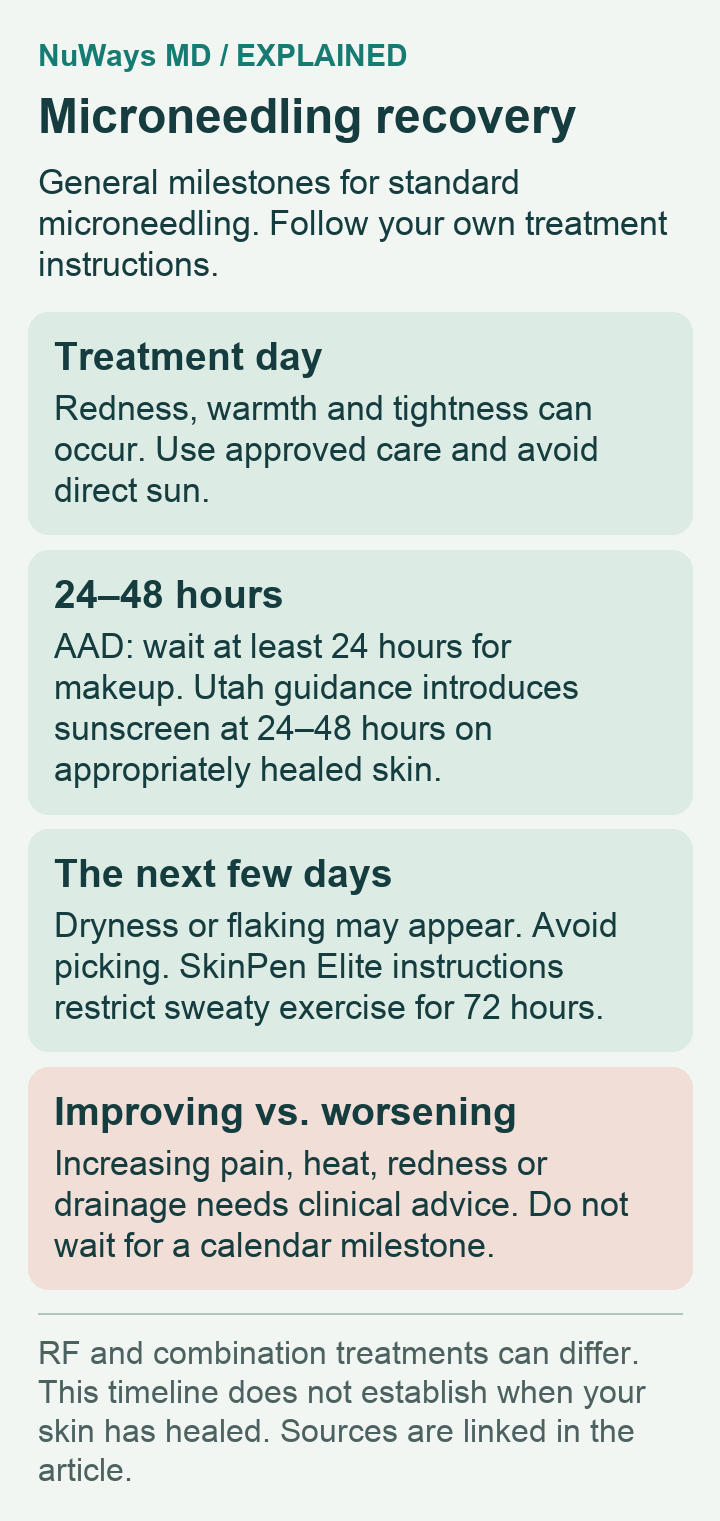
These are overlapping planning windows, not deadlines your skin must meet. The American Academy of Dermatology describes a few days to a week for common reactions; Cleveland Clinic describes redness and swelling lasting up to five days for some people.
| Time after treatment | What you may notice | What matters most |
|---|---|---|
| Treatment day | Warmth, sensitivity, redness or a darker appearance; pinpoint bleeding may have occurred during treatment | Use only the immediate aftercare provided or approved for your procedure. Avoid rubbing, picking and adding your usual active products. |
| First 24 hours | Tightness or tenderness; visible change may still be obvious | Keep makeup off. Know when your clinic wants you to begin cleansing and sunscreen rather than assuming every product can go on immediately. |
| Days 2–3 | Redness may be fading; dryness or rough texture may become more noticeable | Keep the routine gentle. A better appearance does not override exercise or product restrictions. |
| Days 4–7 | Many people look more settled, but some still have dryness, flaking or color change | Resume products gradually under the aftercare plan. Persistent or worsening symptoms deserve follow-up. |
| Following weeks and months | Treatment effects can continue developing after visible recovery | Compare progress at the planned review. Do not judge acne-scar remodeling from a next-morning selfie. |
Why did my friend recover in one day?
Treatment area, needle penetration, the number of passes, products used, skin condition and individual healing can differ. A light facial treatment and more intensive scar treatment should not be given the same recovery promise. Combined procedures introduce another variable.
Skin color also affects what inflammation looks like. On darker skin, changes may be less visibly pink and more noticeable as warmth, swelling or a deeper color. Monitor symptoms and the direction of change rather than looking only for bright redness.
When can I wash, moisturize, wear makeup and exercise?
The table separates published timing examples from practical precautions. Follow any more restrictive instructions you received, especially after RF, a combined treatment, a reaction or treatment over a larger area.
| Activity | Timing and practical approach | Why it matters |
|---|---|---|
| Washing your face | University of Utah Health’s SkinPen aftercare starts gentle cleansing at 24 hours, with lukewarm water. Follow your own first-wash timing; avoid cleansing brushes and vigorous scrubbing. | Rubbing and harsh cleansers can aggravate sensitive skin. |
| Moisturizer or recovery gel | Use the product and start time in your aftercare plan. A familiar fragrance-free moisturizer may be suitable later, but do not substitute a new serum for an immediate recovery product. | A product tolerated on intact skin can sting after treatment. |
| Sunscreen | Use shade and a hat immediately. University of Utah Health places sunscreen SPF 50+ in its 24–48-hour aftercare window. Follow a longer wait if your clinician instructs it; ordinary sunscreen should stay off broken or weeping skin. | The skin needs sun protection while irritated, but products must suit its stage of healing. |
| Makeup | Wait at least 24 hours, the AAD benchmark, and longer if instructed or the skin is still raw or irritated. Use clean applicators. | Covering redness does not mean the surface is ready for cosmetics. |
| Exercise, sauna and hot yoga | SkinPen Precision Elite labeling specifies 72 hours without sweaty exercise. Keep heat-heavy activities on hold during early recovery. | Heat and perspiration can worsen discomfort and irritation. |
| Swimming or soaking | Utah’s instructions prohibit swimming for at least 24 hours. That is a minimum in one protocol, not permission to enter a pool with irritated or unhealed skin. | Immersion and shared water are different from a brief, gentle cleanse. |
| Retinol, acids and low-pH vitamin C | Utah advises avoiding active skincare for at least 48 hours. Restart only when permitted and tolerated, which may be later. | Exfoliating or irritating products can make recovery harder. |
| Shaving the treated area | Wait until skin is comfortable and your aftercare plan permits it. Avoid shaving over tender, crusted or broken areas. | A razor adds friction to skin that is already recovering. |
Timing sources: University of Utah Health aftercare, AAD guidance and SkinPen Precision Elite patient labeling, section 8. They do not provide one universal protocol. For example, Utah’s exercise minimum is shorter than SkinPen Elite’s 72-hour instruction; a general article should not shorten the instructions supplied for your device.
When can sunscreen go back on?
For standard microneedling, 24–48 hours is a useful published reference, not permission to ignore the skin in front of you. University of Utah Health’s aftercare includes SPF 50+ in that window. If your instructions allow sunscreen and the skin is intact, use the recommended gentle formula. If it is still raw, oozing or unusually painful, contact the clinic before applying ordinary skincare. “Mineral” does not make a product suitable for an open wound.
Until you can apply sunscreen, plan to stay out of direct sun and use shade and a hat. Once healed, our sunscreen buying guide explains broad-spectrum protection, tint and water resistance. RF microneedling and combination procedures can require different instructions.
What if the clinic is closed and I have no instructions?
Keep the routine simple while you obtain them: avoid makeup, exfoliation, new active products, picking and strenuous heat-producing activity. Use the recovery product already supplied as directed. If you need medical advice about significant symptoms, seek care rather than experimenting with products until the office reopens.
Flaking, itching and tiny bumps: what should you do?
Dryness and light peeling can occur as the skin settles. Let loose flakes come away naturally. Pulling them off, using a scrub or adding an acid to speed the process can irritate the area. More exfoliation will not make collagen appear sooner.
Mild itching can accompany dryness, but itching that intensifies, a spreading rash or new swelling should not automatically be labeled normal healing. The SkinPen patient labeling specifically identifies increasing warmth, redness, itching or pus as reasons to contact the clinician.
New bumps are not proof of a beneficial “purge.” They could have several explanations, including irritation or a reaction to something applied. Avoid squeezing them or starting an acne treatment on your own; send clear photos and a list of products to the treating office if they persist or worsen.
A cool compress may help discomfort when permitted by your clinician. Do not apply ice directly to the skin or use extreme cooling. Cleveland Clinic discusses cooling for post-treatment irritation, but it is not a substitute for assessment of a developing complication.
When can I restart retinol, vitamin C and exfoliating acids?
Recently treated skin may sting with products you normally tolerate, especially acidic vitamin C, retinoids and exfoliating acids. Set those aside for the recovery period specified by your clinician. A bland moisturizer and an exfoliating serum have very different jobs.
Before leaving treatment, write down the restart plan for the products you actually use. When your clinician allows them back, introduce them one at a time so you can recognize a problem. If ordinary cleansing or approved moisturizer still stings, do not use a calendar date as a reason to force an active product back into the routine. Need help identifying what is in your bottle? Our retinol and retinoid buying guide explains retinol, retinal and acne-drug labels; your treatment provider should set the restart timing.
Do not stop or change prescribed medication without the prescriber’s guidance. And do not add an at-home roller between appointments to “maintain” the result. That creates another exposure rather than giving the treated skin time to recover.
What changes after RF microneedling or Morpheus8?
RF microneedling adds heat delivered through the needles. Recovery depends on the device, applicator, area and treatment performed; a needles-only timeline cannot establish when your particular RF treatment has healed.
The FDA’s October 2025 safety communication describes reports of burns, scarring, fat loss and nerve damage with certain uses. Blistering, persistent significant pain, new weakness or an unexpected contour change deserves clinical assessment. These should not be dismissed as necessary steps toward tightening.
Our RF microneedling guide explains the added energy and risks, while the Morpheus8 guide addresses that branded treatment. If you are deciding between the procedures, start with the microneedling versus RF comparison.
Planning around work, travel, weddings and photos
Returning to a desk job can be possible before visible redness has faded. An outdoor job, swimming vacation or job requiring prolonged contact with protective gear raises different recovery questions. Tell the clinic about those conditions before scheduling.
For a wedding or other important event, avoid making your first treatment a last-minute appointment. As a conservative planning choice, leave a buffer beyond the expected recovery window and agree on it with the clinician. There is no day on which an article can guarantee your skin will be camera-ready. If the event is only a few days away and you do not know how you respond, postponing is often the more practical scheduling decision.
Three fictional recovery situations
“It is day two and I look flaky.”
If discomfort is easing and the skin is simply dry, stay with gentle aftercare and leave flakes alone. Do not use a peel to prepare for makeup. New pain, spreading redness or discharge changes the next step.
“I feel fine after 24 hours. Can I train?”
Feeling better is encouraging, but it does not cancel the device instructions. If your plan says 72 hours without sweaty exercise, keep that interval even if redness has faded.
“My face is hotter and more painful today.”
A worsening pattern deserves a call and photographs for the treating clinician. Do not wait until the end of a seven-day timeline or add products to hide it.
When should you seek medical attention?
Contact the treating clinician promptly for increasing redness, warmth or pain; pus or drainage; blisters; a spreading rash; or symptoms that are unexpectedly persistent. Fever or feeling unwell alongside a worsening skin reaction also warrants medical evaluation. A new cold-sore-like eruption should be reported, because microneedling can reactivate herpes in susceptible people.
Seek urgent or emergency care for severe symptoms, including trouble breathing, throat swelling or rapidly increasing facial swelling. Photographs can help document changes but cannot rule out a complication remotely.
When you call, give the treatment date, device if known, areas treated, when the change began and every product used afterward. A well-lit photo taken without filters is more useful than a verbal description of “a bit worse.” Our provider-selection guide explains why the clinical aftercare contact should be clear before treatment.
A simple recovery note to keep with your plan
Record these six items before the appointment, then update them if instructions change:
- Procedure and device, including whether RF or another treatment is being added.
- Approved products and the first time you can wash, use sunscreen and wear makeup.
- Exercise, swimming and sun-exposure restrictions.
- Restart dates or conditions for each active skincare product.
- What to expect and the number to call during and after office hours.
- Your follow-up date and how to send photographs securely if needed.
Keep your recovery plan close.
Save the topic and your consultation questions in your research plan. Add the instructions your own clinician gives you; this guide cannot replace them.
Save my microneedling recovery questions →Frequently asked questions
Is no peeling a sign that microneedling did not work?
No. Visible peeling is not a required outcome or a measure of collagen change. Review progress at the planned follow-up rather than trying to produce a stronger reaction.
Can I wear mineral makeup sooner than regular makeup?
The word mineral does not make makeup sterile or override the waiting period. The AAD’s general benchmark is at least 24 hours, with longer restrictions when needed. The condition of your skin still matters.
Is sunscreen alone enough for a beach day after treatment?
No. Early aftercare includes avoiding sun exposure, and a beach day adds heat, sweat, water and repeated exposure. Arrange treatment around the trip rather than expecting a high SPF to remove those concerns.
Will PRP or an expensive recovery serum eliminate downtime?
Do not assume that. Ask what evidence supports the specific combination and what restrictions still apply. The FDA has not authorized microneedling devices to deliver PRP, cosmetics or medications into the skin; device authorization alone does not validate an add-on.
When should I book the next treatment?
Use the clinician’s plan and your actual recovery, not the point at which redness disappears. Treatment spacing serves a different purpose from the first few days of aftercare. See microneedling costs and packages before prepaying for dates you may need to change.
Sources and editorial notes
Sources checked September 27, 2026. Clinical review pending. NuWays MD provides education, not medical care or individual medical advice. Contact your treating clinician about symptoms or instructions for your procedure.
- American Academy of Dermatology: microneedling: general recovery range, appearance across skin tones and the 24-hour makeup benchmark.
- Cleveland Clinic: microneedling: redness/swelling, dry or flaky skin, cooling and the distinction between recovery and later results.
- University of Utah Health: microneedling aftercare: one clinical program’s cleansing, makeup, swimming and active-product instructions. These examples are not a universal device protocol.
- SkinPen Precision Elite patient labeling, September 2024: device-specific 72-hour exercise/sun restriction and symptoms needing follow-up.
- FDA: microneedling devices: possible adverse effects and the limits of device authorization for product delivery.
- FDA: RF microneedling safety communication: October 15, 2025 reports of serious complications with certain RF uses; these risks should not be inferred from a standard microneedling recovery chart.
The timeline graphic and three observation examples are original educational material. The examples are fictional and do not diagnose a reader’s symptoms. Timing guidance varies between sources because the procedure and aftercare protocol matter. We have not performed a clinical trial or independently tested recovery products. See our editorial standards.