INJECTABLES / KYBELLA GUIDE
Kybella for a Double Chin: Cost, Results, Side Effects and How Many Sessions
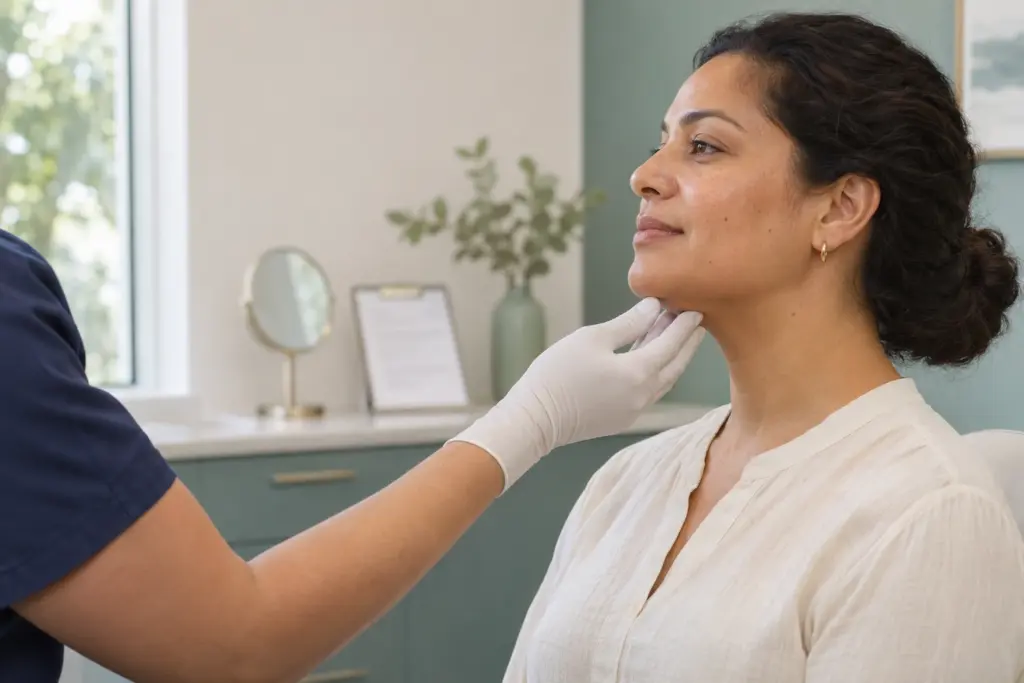
Kybella is an FDA-approved injection that destroys fat cells, and it is approved for one place: under the chin. Here is who it suits, how many sessions and vials it usually takes, what the swelling is really like, what the trials showed and what a full plan costs.
See if it fits you ↓Editorial details
Kybella (deoxycholic acid) is a prescription injection that destroys fat cells under the chin. In its two FDA trials, about 2 in 3 Kybella patients improved by at least one grade on both their own and their provider’s rating, against about 1 in 5 on placebo. It works gradually over sessions at least a month apart, and most people swell, especially after the first. It is approved for moderate to severe fullness from fat under the chin and suits fat you can pinch in front of the neck muscle; if you also have very loose skin or prominent neck bands, the label warns that reducing the fat may leave an undesirable result. In our arithmetic at four practices’ posted prices, plans of 4 to 6 sessions at trial-like vial counts come to about $6,500 to $15,200, or more if you need more vials.
What is Kybella, and how does it work?
Kybella is a synthetic copy of deoxycholic acid, a bile acid your body makes from cholesterol. Injected into fat, it breaks open the walls of fat cells, and your body clears the debris over the following weeks. The prescribing information calls it a cytolytic drug, meaning it destroys cells, which is why it is only injected into fat (Kybella label, section 12).
Cell breakdown starts within a day, followed by a few days of inflammation: the swelling people notice, which has largely settled by about a month. Tissue studies suggest new collagen forms as the fat shrinks (Humphrey et al., 2021).
The FDA approved Kybella in 2015 for adults with moderate to severe fullness from fat under the chin, called submental fat. It is sold as Belkyra in Canada, Europe and Australia, and the label says a healthcare provider should give it (Kybella label; Humphrey et al., 2021). The FDA has also approved a generic deoxycholic acid injection; Kybella and that generic are the only drugs it has approved for fullness under the chin (FDA safety communication, September 2026).
Only under the chin. Kybella is not approved anywhere else, such as the jowls, belly or arms. Its September 2026 label warns that serious problems have been reported after use elsewhere, including blurred or reduced vision when injected near the eyes, nerve or muscle injury and lumps that may not go away. The FDA has counted 129 reports of side effects after use outside the chin since 2015, some of them serious (Kybella label, section 5.5; FDA safety communication, September 2026).
Who is a good candidate for Kybella, and who should skip it?
Kybella suits adults with moderate to severe fullness from fat they can pinch, sitting between the skin and the thin neck muscle. The trials enrolled people aged 19 to 65 with a body mass index of 40 or less and excluded anyone with too much loose skin (Kybella label, section 14).
Fat, loose skin or neck bands?
Kybella only treats the first. You can have more than one, which is why a provider should look before you book.
Soft fat you can pinch
A noticeable, rounded pad of fat under the chin, in front of the thin neck muscle (dotted line), with skin that is not very loose.
Kybella may fitVery loose skin
Skin that hangs or folds more than it bulges. The label warns that reducing fat under very loose skin may leave an undesirable result.
Ask about skin tightening or a neck liftVertical neck bands
Cords that run down the front of the neck and stand out more when you tense it. They are muscle, not fat, and if they are prominent the label gives the same warning.
Ask about Botox for neck bandsKybella may fit if
- Your chin fullness is soft fat you can pinch, and your skin is not very loose
- You can plan for swelling after each session, usually for about a week and a half
- You can commit to several sessions a month or more apart, and to the cost of each
- You are an adult with moderate to severe fullness, the group the FDA approved it for
Look at other options first if
- Your neck skin is very loose (the label says “excessive skin laxity”), or you have prominent vertical neck bands. The label warns that reducing the fat may then give an “aesthetically undesirable outcome”
- Your fullness may come from something other than fat. The label tells providers to rule out an enlarged thyroid or swollen lymph nodes first
- Most of the fat sits under the neck muscle, where Kybella is not injected
- You hope to lose weight overall. Kybella treats one small area
Do not have Kybella if you have an infection where it would be injected. Tell your provider first if you have ever had trouble swallowing (the label says to avoid Kybella), have a bleeding problem or take a blood thinner (more bruising), have had surgery or a cosmetic treatment on your chin or neck (scar tissue can change where it is safe to inject), or are pregnant or breastfeeding (it has not been studied). It is not for anyone under 18 (Kybella label, sections 2.2, 4, 5 and 8).
The trials also excluded anyone who had ever had chin-fat reduction, or fillers, lasers, radiofrequency treatment or peels in the area within a year, or Botox there within 6 months, so the results do not cover those groups. Participants were 85% women and 87% White, with an average age of 49, and about a third had darker skin (Fitzpatrick types IV to VI); too few were 65 or older to tell whether they respond differently, and the trial reports we read did not give results for men separately (Dayan et al., 2018; Kybella label).
How many Kybella sessions and vials do you need?
Most people in the trials improved within 2 to 4 sessions, spaced at least a month apart, and up to 6 are allowed. A session uses up to five 2 mL vials; trial sessions averaged a little under three vials’ worth, and because leftover product is discarded, that means opening three, or four at an average first session. The amount depends on how much fat you have and how far you want to go, so ask how a partly used vial is billed (Kybella label, sections 2.1, 2.3 and 16; Dayan et al., 2018).
What the trials show. By the provider’s rating, about half of Kybella patients had improved one grade after 2 sessions and about 7 in 10 after 4. Later sessions used less product as the fat shrank: 6.4 mL on average at the first and 4.4 mL by the sixth. Most patients (59%) still had all six, but trial doctors aimed for a two-grade change and patients did not pay, so people may stop sooner in practice. One grade may or may not be the change you want, so agree on a goal at the start (Dayan et al., 2018; Kybella label, section 14).
What the appointment is like. Your provider checks that the fullness is fat you can pinch, marks the area with a 1 cm grid and may use ice or numbing cream, then gives up to 50 small injections under the chin (Kybella label, section 2.3). Practices describe the injections as taking up to about 15 to 20 minutes (VIP Aesthetic Center; Skin Pharm). Expect soreness: pain was reported by 70% of Kybella patients in the trials, against 32% with placebo (Kybella label, Table 1).
What one Kybella session looks like
Durations are medians among trial patients who had each reaction. The first session is usually the most swollen.
- Treatment dayIce or numbing, a marked 1 cm grid, then up to 50 small injections under the chin. Swelling, soreness and numbness start within hours.
- First 1 to 2 weeksSwelling is the most common reaction and typically lasted about 10 days in the trials; bruising about 9 days and pain about a week.
- Weeks 2 to 6Numbness can linger: it lasted a median of 43 days. A firm feeling under the skin lasted a median of about 4 weeks.
- 1 month or laterNext session, if enough fat remains. Later sessions usually use less product, and reactions become less common and milder.
- 12 weeks after the last sessionWhen the trials judged the final result.
After a session. The label does not set aftercare rules, so ask for your provider’s written instructions and an after-hours number. Plan for a swollen, tender chin for a week or two, especially after the first session, and numbness that often lasts about six weeks, sometimes past your next session. Wait at least a month between sessions. The warning signs that need a same-day call are listed under side effects below.
Kybella results: what the trials showed and how long they last
About 2 in 3 people treated with Kybella improved by at least one grade on the trials’ chin-fat scale, by both their own and their provider’s rating, against about 1 in 5 on placebo. A bigger, two-grade change was less common: 13% and 19% in the two trials, against almost none on placebo. Results were judged 12 weeks after the last session (Kybella label, Table 2).
How many people improved in the two FDA trials
Share of each group whose chin fat improved on the trials’ 0 to 4 scale on both the provider’s and the patient’s rating, 12 weeks after the last session. Bars are drawn to 100% of each group.
The scale runs from 0 (no fullness) to 4 (extreme), and everyone started at moderate or severe, so one grade is a step such as severe to moderate. MRI scans showed a more modest picture: 43% of Kybella patients scanned had at least 10% less fat under the chin, against 5% on placebo (Kybella label).
Is Kybella permanent? For most people who respond, the result lasts. Kybella destroys the treated fat cells, and in a 3-year follow-up about 8 in 10 Kybella patients whose provider rated them improved were still improved at year 3, though some placebo patients’ ratings held up too, so not all of it is the drug. Only about 1 in 5 of the original Kybella patients took part, satisfied patients may have been more likely to join, and the study used ratings, not scans. Kybella does not stop you from gaining fat in the area (Humphrey et al., 2021).
Does it make the skin sag? Not on average: skin firmness was unchanged or better in 93% of Kybella patients and 91% on placebo. People with very loose skin were not included, so this does not show how very loose skin responds (Dayan et al., 2018).
Kybella’s original maker sponsored these studies, which is usual for drug approval trials; the headline results above are the FDA-reviewed figures in the label.
Kybella before and after: what results look like
Expect a gradual, moderate change in your profile, not a new jawline overnight. The fat shrinks over several sessions, so a photo taken a few weeks after one session shows only part of the result; the trials judged results 12 weeks after the last session (Kybella label, section 14).
The published trial photos show what that can mean. The authors of a pooled analysis chose three responders as examples. All three were women who started with moderate fullness and no loose skin, and each was rated 12 weeks after her last session (Dayan et al., 2018, Figures 5 to 7).
- Age 36: 2 sessions, 10.6 mL in total (at least 6 vials, since leftover product in each opened vial is thrown away). The provider’s rating went from moderate to absent; her own rating improved one grade.
- Age 39: 3 sessions, 10.8 mL in total (at least 6 vials). The same ratings: moderate to absent by the provider, one grade better by her own.
- Age 22: 4 sessions, 23.2 mL in total (at least 12 vials). Two grades better on both ratings. She also lost weight, which changes a profile too.
“Absent” is the best score on the provider’s five-point scale, and all three reached it, a two-grade change; it describes how the area looked, not proof that all the fat was gone. The authors present these as representative photos of responders. In the trials, only 16% of Kybella patients improved two grades on both their own and the provider’s rating, as the third woman did, so treat these as what is possible, not typical. View the original trial photographs (Figures 5 to 7: front and side views, before and 12 weeks after the last session).
How to judge a before-and-after photo
- The same angle in both photos, ideally from the side as well as the front
- The same lighting, distance and head position: tilting the chin up or down changes how full the area looks
- How many sessions and vials it took, and how long after the last session the photo was taken
- Whether the person’s weight changed, or they had other treatments in between
- Whether the photos are of the provider’s own patients, and whether most of their results look like this or only the best ones
Studies standardize these on purpose: the CoolSculpting under-chin study photographed everyone in the same seated position with five cameras (Kilmer et al., 2016). A practice gallery does not have to, so ask.
Kybella side effects, swelling and recovery
Nearly everyone has a reaction where Kybella was injected: in the trials, 96% did, against 81% with placebo injections. Swelling, pain, numbness and firmness are expected because the drug works by causing inflammation in the fat. The table shows how often each reaction happened with Kybella and with placebo injections, so you can see which were much more common with the drug (Kybella label, Table 1; Dayan et al., 2018).
| Reaction | Kybella | Placebo | Median duration |
|---|---|---|---|
| Swelling | 87% | 43% | 10 to 11 days |
| Bruising | 72% | 70% | 9 days |
| Pain | 70% | 32% | 7 days |
| Numbness | 66% | 6% | 43 days |
| Redness | 27% | 18% | 3 days |
| Firmness under the skin | 23% | 3% | 28 days |
| Tingling | 14% | 4% | 10 days |
| Small lumps (nodules) | 13% | 3% | 23 days |
| Itching | 12% | 6% | 7 days |
Percentages: pooled FDA trials, 513 people on Kybella and 506 on placebo (Kybella label, Table 1). Median duration: among Kybella patients who had each reaction (Dayan et al., 2018). Some lumps and masses may not go away and may need medical treatment; see “Less common but serious” below.
Some reactions last longer than a month: numbness did in 42% of Kybella patients, swelling in 20%, pain in 16% and firmness in 13% (Kybella label, section 6.1). Reactions were most common after the first session and became less frequent and milder after later ones (Dayan et al., 2018).
Other reactions were less common but more frequent than with placebo: headache (8% vs 4%), a tight feeling in the skin (5% vs 1%), a sore throat (3% vs 1%), a rise in blood pressure (3% vs 1%) and nausea (2% vs 1%). Fainting or nearly fainting was also reported. About 7% of Kybella patients stopped treatment because of side effects, against 1% on placebo (Kybella label, section 6.1; Dayan et al., 2018).
How much downtime to expect. In a 12-month study of 165 people, 13% missed work and about a third skipped social plans in the week after their first session; after later sessions, 2% to 6% missed work and 10% to 16% skipped social plans (Beer et al., 2019). Swelling lasted more than a month in 20% of trial patients (Kybella label), so if an event matters to you, leave well over a month after your first session and do not schedule a later session in the weeks before it.
Less common but serious. These were reported in the trials or after approval:
- An uneven smile from injury to the nerve that moves the lower lip: 4% of Kybella patients against under 1% with placebo. Every case in the trials resolved on its own, after a median of 44 days, but one took 298 days.
- Trouble swallowing: 2% against under 1%, usually while the area was swollen. Cases resolved, after a median of 3 days but up to 81 days.
- Hair loss in the treated area, which matters for beards. In the trials it was rare and about as common with placebo (0.4% vs 0.6%), and it lasted a median of about 5 months when it occurred. It can persist, and the label says to consider pausing treatment until it resolves.
- Since approval: injury to a blood vessel when the drug is injected into one by accident, scarring, allergic reactions such as a rash, hives or itching, and numbness or tingling in the mouth.
- Open sores, tissue death, lumps or masses, and infection, including abscesses that needed IV antibiotics and drainage. Some lumps may not go away and may need medical treatment. Injections placed too shallow, into the skin, can cause sores and tissue death. The label says to stop Kybella if any of these four develop. How often they occur outside the trials is not known, but the FDA counted 117 reports of lumps or masses that had not gone away after deoxycholic acid injections, under the chin or elsewhere, present for an average of about 5 months when reported.
Sources: Kybella label, sections 5 and 6; Dayan et al., 2018; FDA safety communication, September 2026.
Call your provider the same day if your smile becomes uneven or your lower face feels weak, if swallowing is difficult or getting worse, or if you notice spreading redness, increasing pain, an open sore, drainage or a new lump. These are the warning signs the label asks patients to report (Kybella label, section 17 and Patient Information). Trouble breathing is an emergency: call 911.
How much does Kybella cost?
Posted prices ranged from $575 to $1,000 for one vial at four practices on November 24, 2026. Your total is the vials opened at each session, added up across every session. Two of the four charge less per vial when you buy several, so a one-vial price can be a poor guide to a full session.
| Practice | Posted price |
|---|---|
| Viva Day Spa + Med SpaAustin, Dallas and Round Rock, TX; Atlanta | $575 per vial 2 vials $1,150; 3 vials $1,725 |
| Evolve Med SpaLocations in NJ, NY, MD and PA | 1 vial $650 2 vials $1,100; 3 vials $1,497; 4 vials $1,996 |
| InjectCo9 locations in Texas | $799 per vial 2 vials $1,598; 3 vials $2,397 |
| Skin PharmChicago | 1 vial $1,000 2 vials $1,200; 3 vials $1,800; 4 vials $2,400 |
Standard posted prices, checked November 24, 2026. Viva’s multi-vial totals are our arithmetic; InjectCo posts its own. We assume a multi-vial price applies to the vials used at one session; ask the practice. Two plastic surgery practices did not post prices. InjectCo also lists Kybella for body areas; the label says it is not approved or recommended outside the chin (see “Only under the chin”).
What a full plan costs. These are our arithmetic at the posted prices, in the order Evolve, Viva, Skin Pharm and InjectCo, not quotes. Two sessions of 2 vials each, far below the trial average: $2,200, $2,300, $2,400 and $3,196. Four sessions at 4, 3, 3 and 3 vials (13 vials): $6,487, $7,475, $7,800 and $10,387. All 6 sessions, as 59% of trial patients had, at 4 vials then 3 (19 vials, in line with the trials’ averages of 6.4 mL at the first session and 4.4 mL at the sixth): $9,481, $10,925, $11,400 and $15,181. The label allows up to 5 vials a session, so a plan can cost more (Kybella label, sections 2.1 and 14).
Prices vary with the provider and the city, and a lower price per vial does not tell you how many vials a practice will use. Compare quotes on the total for the whole plan, and ask each practice:
- How many vials it expects to use at the first session, and over the whole plan
- Whether a partly used vial is billed as a full one
- Whether the price includes numbing and a follow-up visit
- Whether you must prepay a package of vials, and what happens to unused vials if you stop early: a refund, a credit, a transfer or an expiration date. One menu we checked is offering a free fourth vial with three prepaid vials through November 30, 2026; prepaying commits you before you know how many vials you will need, and treatment has to stop if certain side effects develop
Kybella is a cosmetic treatment, and InjectCo’s page, for one, says insurance does not cover it. For a cost estimate across several quotes, use the treatment cost calculator, or compare with other treatments on our treatment costs page.
Kybella vs. CoolSculpting, chin lipo and other options
No study has compared Kybella head-to-head with CoolSculpting or liposuction, so the choice depends on what is causing your double chin, how much fat there is and how much downtime and cost you can accept.
| Option | How it works and what to expect | Best for |
|---|---|---|
| Kybella | An injected drug destroys fat cells over up to 6 sessions a month or more apart, with swelling after each, especially the first. Tested in two placebo-controlled trials of 1,022 adults. | Moderate to severe pinchable fat in front of the neck muscle, with skin that is not very loose and no prominent neck bands |
| CoolSculpting (CoolMini applicator) | Controlled cooling destroys fat cells; FDA cleared for under the chin. Its main study had 60 people and no comparison group: almost all had 2 sessions, and the fat layer was about 20% thinner on ultrasound. It measured different things from the Kybella trials, so the results cannot be compared directly. | People who prefer no injections and have fat the applicator can draw in |
| Chin or neck liposuction | A surgical procedure that removes fat in one visit, with a surgical recovery. | People who want one procedure rather than a series; a surgeon can say whether your fat suits it |
| Treatments for loose skin or neck bands | Kybella reduces fat but does not lift skin. Vertical neck bands are a muscle issue, and Botox Cosmetic is FDA-approved to treat them; loose skin may need skin tightening or a neck lift. | When skin or muscle, not fat, causes most of the fullness |
Sources: Kybella label; Kilmer et al., 2016 (CoolSculpting submental trial); Humphrey et al., 2021; Botox Cosmetic label (neck bands).
If neck bands are what bother you, our Botox guide explains the approved dose for them. If you are comparing providers, how to choose a provider covers what to check.
Fat-dissolving shots that are not Kybella. The FDA has warned about unapproved fat-dissolving injections sold online and at some clinics under names such as Aqualyx, Lipodissolve, Lipo Lab and Kabelline, often a mix of phosphatidylcholine and sodium deoxycholate (PC/DC). It has received reports of permanent scars, serious infections, skin deformities and painful knots, urged people not to buy these products online and repeated the warning in September 2026 (NBC News on the FDA warning, 2023; FDA safety communication). Ask which product you are getting: genuine Kybella vials carry a hologram (Kybella label, section 16), and an approved generic deoxycholic acid injection is labeled differently.
Questions to ask before you book Kybella
A good consultation starts by deciding whether your fullness is fat at all. Bring these questions:
- Is my double chin mostly fat in front of the neck muscle, or is loose skin, a neck band or something else part of it?
- How many vials do you expect at the first session and over the whole plan, and how do you bill a partly used vial?
- How many Kybella treatments have you done, and how do you avoid the nerve near the jawline?
- Will you open genuine Kybella vials in front of me?
- What should I do, and who do I call, if my smile becomes uneven, swallowing gets hard or a lump appears?
- Could my past treatments in this area, or my medicines, change whether Kybella is safe for me?
Kybella FAQs
Is Kybella permanent?
It is long-lasting for most people who respond, though it has been followed for 3 years, not for life. Kybella destroys the treated fat cells, and in a follow-up of about 1 in 5 of the original trial patients, about 8 in 10 of those whose provider rated them improved were still improved at year 3. It does not stop you from gaining fat in the area.
Is Kybella worth it?
It can be if your double chin is mainly pinchable fat, your skin is not very loose, you have no prominent neck bands and you are ready for several sessions with swelling after each. About 2 in 3 Kybella patients in the trials improved by at least one grade on both ratings, against 1 in 5 on placebo; in a smaller follow-up that people chose to join, about 8 in 10 provider-rated improvements held at 3 years, as did about 2 in 3 among placebo patients who had improved. Cost depends mostly on vials. In our arithmetic at four practices, a light plan of 2 sessions with 2 vials each, far below the trial average, is about $2,200 to $3,200, and all 6 sessions (19 vials) about $9,500 to $15,200, or more if you need more vials. Ask for a written quote.
How far apart are Kybella sessions?
At least a month apart, the label says; the trials scheduled them about every 4 weeks. Up to 6 sessions are allowed, and your provider should check how much fat is left before each one.
How long does Kybella swelling last?
Swelling typically lasted about 10 days after a session in the trials, and 20% of people had swelling lasting more than 30 days. The first session usually causes the most swelling; later sessions use less product.
How many vials of Kybella do I need?
The label allows up to five 2 mL vials a session. Trial sessions averaged 5.4 mL, a little under three vials’ worth, and first sessions 6.4 mL; because leftovers are discarded, that means opening three vials at an average session and four at an average first session. A whole trial plan averaged 25.3 mL, at least 13 vials and more with leftovers, so our fuller cost examples use 13 to 19. Your provider decides at each session, based on the fat left and your goals.
Does Kybella hurt?
Usually some. Pain at the injection site was reported by 70% of Kybella patients, against 32% with placebo, and typically lasted about a week. Ice, numbing cream or injected numbing medicine can be used during treatment.
How soon will I see Kybella results?
Change is gradual. By the provider’s rating, 52% of Kybella patients in the trials had improved by at least one grade after 2 sessions and 72% after 4, and the final result was judged 12 weeks after the last session.
Can Kybella be used on the jowls, stomach or other areas?
It is not approved anywhere except under the chin. In September 2026 the label added a warning about serious reactions after use elsewhere, including vision problems near the eyes, nerve or muscle injury and lumps that may not resolve.
Can Kybella affect the thyroid?
Thyroid problems are not among the label’s side effects, but the label tells providers to rule out an enlarged thyroid first, because it can look like a double chin. A 3-year follow-up noted one case each of an underactive thyroid and low thyroid hormone, classed as treatment related and both first reported in the original trials, without saying whether those patients had Kybella or placebo; no new treatment-related problems of any kind began during follow-up.
Is Kybella or CoolSculpting better for a double chin?
They have not been compared head-to-head. Kybella has two large placebo-controlled trials; CoolSculpting’s under-chin clearance rests on an open-label study of 60 people with different measures and no comparison group. In that study almost everyone had 2 sessions; Kybella allows up to 6, and swelling is common, especially after the first.
Does Kybella tighten skin?
It is not a skin-tightening treatment. In the trials, skin firmness was unchanged or better in 93% of Kybella patients and 91% on placebo, and people with very loose skin were not included.
Is Kybella covered by insurance?
Generally no. It is used to change appearance, and at least one practice we checked, InjectCo, says insurance does not cover it.
Sources and editorial notes
Sources checked November 24, 2026. Clinical review pending. Sources include the current FDA prescribing information for Kybella (revised September 2026), the FDA’s September 2026 safety communication, the two US approval trials and their pooled and long-term analyses, an open-label safety study, the CoolSculpting under-chin trial, the Botox Cosmetic prescribing information, reporting on the FDA’s 2023 warning about unapproved fat-dissolving injections and posted practice menus. Studies available only as abstracts are labeled.
Prices are posted standard prices; we did not contact the practices, and none paid to be listed. The fat, skin and neck-band diagram, session timeline and trial chart are original NuWays MD graphics. How we prepare and update guides.
View all 18 sources
Prescribing information and regulators
- Kybella (deoxycholic acid) prescribing information and Patient Information, DailyMed, revised September 2026. Indication (moderate to severe submental fat in adults; not approved elsewhere); dosing (0.2 mL injections 1 cm apart, up to 10 mL and 50 injections per session, up to 6 sessions at least 1 month apart); screening for other causes such as an enlarged thyroid; warnings on nerve injury, trouble swallowing, bruising, hair loss, sores, tissue death, lumps and infection, and the new warning on use outside the chin; side-effect rates vs placebo; trial results; hologram on genuine vials.
- NBC News: FDA warns against unapproved fat-dissolving spa treatments, December 21, 2023. Reports the FDA warning: unapproved injections sold as Aqualyx, Lipodissolve, Lipo Lab and Kabelline, often containing phosphatidylcholine and sodium deoxycholate; reports of permanent scars, serious infections, skin deformities, cysts and painful knots; at that time the FDA had approved one fat-dissolving injection, Kybella. We could not open the FDA’s own 2023 page, which blocks automated reading.
- FDA Drug Safety Communication, September 15, 2026: added Kybella warnings. New warning on use outside the chin and on nodules and masses that may not resolve; a generic deoxycholic acid injection is also FDA-approved, and Kybella and that generic are the only drugs approved for submental fullness; 129 adverse-event cases after use outside the chin since 2015 and 117 cases of unresolved nodules or masses; urges people not to use unapproved injection lipolysis products. Read through an automated fetch; fda.gov blocks our browser.
Kybella trials
- Jones et al., REFINE-1, Dermatol Surg 2016 (abstract). 506 adults; one-grade improvement on both ratings 70.0% vs 18.6%; uneven smile from nerve injury in 4.3% of Kybella patients, mostly mild and temporary. Sponsored by Kythera.
- Humphrey et al., REFINE-2, J Am Acad Dermatol 2016 (abstract). 516 adults; one-grade improvement 66.5% vs 22.2%, two-grade 18.6% vs 3.0%; follow-up 44 weeks. Sponsored by Kythera.
- Dayan et al., Aesthet Surg J 2018: results by session, pooled REFINE trials. Average 5.4 mL and a median of 27 injections per session; 52% improved after 2 sessions and 72% after 4 (provider rating); 59% had all 6 and 19% stopped early from satisfaction or too little fat; median durations of each side effect; skin firmness unchanged or better in 93% vs 91%; total of 25.3 mL on average across all sessions; notes that trial patients did not pay for the drug.
- Humphrey et al., Aesthet Surg J 2021: 3-year follow-up of the REFINE trials. 224 trial patients enrolled (113 Kybella), including 95 Kybella patients rated improved by the provider at 12 weeks; improvement kept by 86.4%, 90.6% and 82.4% of Kybella responders (about 85 to 90 assessed) at years 1, 2 and 3 vs 56.8%, 73.8% and 65.0% of placebo responders (46 provider-rated at 12 weeks); 15 sites, planned about 200; possible self-selection; no scans; no new treatment-related side effects; carried-over treatment-related cases of underactive thyroid and low T3, one patient each, group not stated.
- Beer et al., J Drugs Dermatol 2019 (abstract). Open-label study of 165 adults followed 12 months: 13.3% missed work and 33.9% missed social or leisure activities in the week after the first session; 2.4% to 6.0% missed work and 10.0% to 15.7% missed social or leisure activities after later sessions.
Alternatives
- Kilmer et al., Lasers Surg Med 2016: CoolSculpting for fat under the chin. Open-label, non-randomized study of 60 people, 59 with 2 treatments 6 weeks apart; mean fat-layer reduction 2.0 mm on ultrasound in 57 (about 20%); 83% satisfied, with free treatment; no serious device-related events; the basis of FDA clearance for the chin.
- Botox Cosmetic (onabotulinumtoxinA) prescribing information, DailyMed, revised October 2024. Approved for temporary improvement of moderate to severe platysma bands (vertical neck bands) caused by platysma muscle activity, as well as frown lines, crow’s feet and forehead lines. Cited here for neck bands only.
Prices
- NuWays MD price check, November 24, 2026: posted standard Kybella prices at Viva Day Spa + Med Spa, Evolve Med Spa, InjectCo and Skin Pharm (Chicago). Nazarian Plastic Surgery and PERK Plastic Surgery did not post prices. Promotions are not used, except Viva’s November vial offer, mentioned once as an example.
- Appointment length: VIP Aesthetic Center (“about 15 to 20 minutes”) and Skin Pharm (“no more than 15 minutes”) Kybella pages, checked November 24, 2026.