LASER HAIR REMOVAL / SKIN OF COLOR
Laser Hair Removal for Dark Skin: Safe Options, Risks and Results
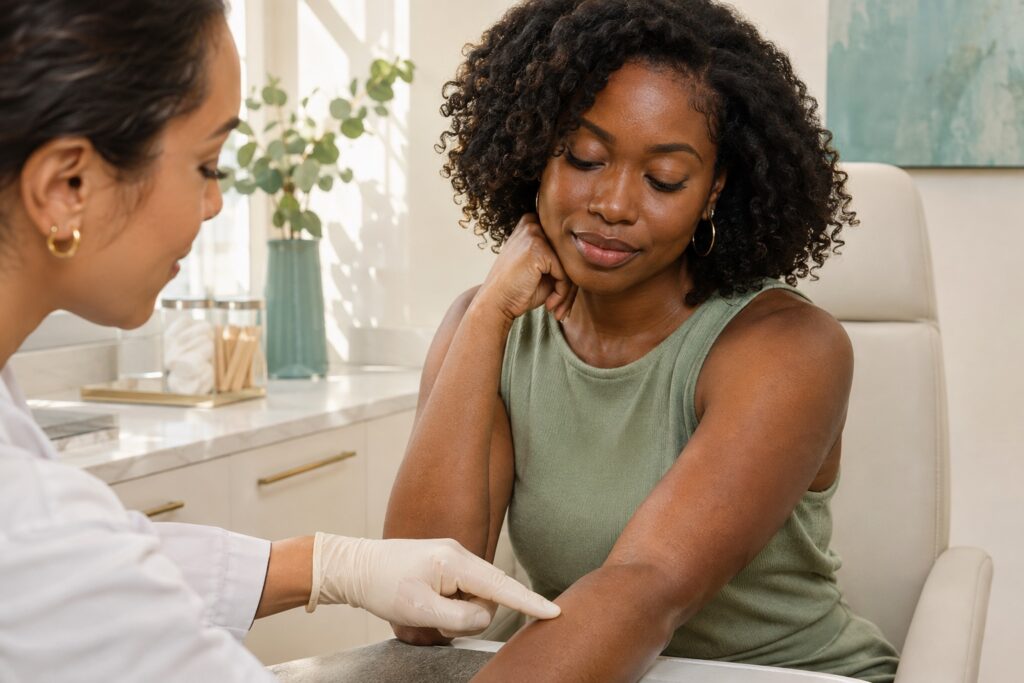
Laser hair removal for dark skin can reduce coarse, dark hair and make shaving less frequent. The useful question is which device and treatment plan suit your skin, rather than whether a clinic advertises “all skin tones.”
Here is how to compare Nd:YAG, diode and IPL, recognize the limits of home devices, and leave a consultation with a clear plan for results, costs and follow-up.
Editorial details
NuWays MD is independent and reader-supported. When you buy through links on our site, we may earn a commission. As an Amazon Associate we earn from qualifying purchases. Learn more.
What is the best laser hair removal option for dark skin?
Long-pulsed Nd:YAG at 1064 nm is usually the first technology to discuss for deeply pigmented skin. The Skin of Color Society identifies it as a suitable option for darker skin; diode and alexandrite require a more individual assessment. Compare the wavelengths.
Hair-removal light heats pigment in the hair, but pigment in the surrounding skin can absorb energy too. Longer wavelengths help manage that competition. Ads that say a laser “bypasses your skin” oversimplify it: the aim is to damage the follicle while limiting injury to the skin around it. Why darker skin needs a tailored approach.
Usually discussed first
Long-pulsed Nd:YAG · 1064 nm
A well-established starting point for darker phototypes. Ask whether the proposed treatment uses this wavelength and how the provider protects the skin during each pulse. The machine’s name alone is not the treatment plan.
A possible option
Diode · often around 800–810 nm
A possible option with appropriate equipment, settings and cooling. The Endocrine Society includes long-pulsed diode alongside Nd:YAG for women of color seeking hair reduction. Read the recommendation.
Needs extra care
Alexandrite · 755 nm
Used for hair reduction, but suitability needs particular care as skin pigmentation increases. If it is proposed for you, ask why it fits your treatment area and what evidence supports that choice.
Not a laser
IPL · a range of wavelengths
IPL is intense pulsed light, not a laser. Some professional systems have been studied in darker skin, but that does not establish that a home handset is suitable. Check the home-device distinction ↓
Skin type is a starting point, not a diagnosis. Fitzpatrick types IV, V and VI describe patterns of pigmentation and response to sunlight. They are not a substitute for examining your treatment area, recent tanning and previous skin reactions. About the Fitzpatrick scale.
What do studies show about results and pigment risks?
Research supports treating darker skin, but it does not identify one result or risk percentage for everyone. These studies help explain why the choice of device matters and why a clinic should set expectations for your area and hair.
The broader comparison
A 2020 systematic review included 12 comparative trials in Fitzpatrick types III–VI. Nd:YAG had lower odds of post-inflammatory hyperpigmentation than IPL in the pooled comparison. Overall treatment outcomes across technologies were broadly similar.
The limit: the review combines different skin types, devices and protocols. It does not prove that every laser is equally suitable for the deepest skin tones. Read the review.
A direct Nd:YAG vs. IPL trial
In a 2012 split-underarm trial, 39 of 50 women with types IV–VI completed five treatments. Six months after the last session, hair counts had fallen 79.4% with Nd:YAG versus 54.4% with IPL. Nd:YAG caused more pain and inflammation; reported adverse effects were temporary.
The limit: this was one underarm study using particular devices. It does not predict your facial results or test a home handset. Read the trial.
Newer research adds nuance. A 2026 comparison in 12 completers with skin types IV–V found hair reduction with both Nd:YAG and alexandrite after four underarm sessions; only redness was reported. Its small size, short follow-up and nonrandom assignment of sides prevent a broad claim of equal safety, especially for type VI. Read the study and limitations.
Can dark skin have facial, bikini or Brazilian laser hair removal?
Yes, these areas can be considered, but each needs its own assessment. Coarse hair, fine facial fuzz and a darker bikini area are different treatment decisions. Ask the provider to examine every area you intend to include, not just a patch on your arm.
Face, chin and PCOS
For facial hair, discuss whether the hair is a worthwhile laser target and whether hormonal growth needs medical assessment. The Endocrine Society specifically warns Mediterranean and Middle Eastern women with facial hirsutism about increased hair growth after photoepilation and suggests considering electrolysis or topical treatment instead. This is not a rule against laser for every person with dark skin. Hirsutism guideline.
Our facial laser guide covers area selection; paradoxical hypertrichosis explains unwanted increased growth. For hormonal regrowth, see laser hair removal for PCOS.
Underarms, bikini and Brazilian treatments
Define the boundaries before booking: “bikini” and “Brazilian” are package names, not a map of the exact skin being treated. Ask which external areas are included, which are excluded, and how the plan changes where the skin is more pigmented. A home device’s permitted bikini area may be much narrower than a clinic’s service. Why suitability can differ by body area.
Ingrown hairs and razor bumps
Reducing the hairs that repeatedly grow inward can improve shaving-related bumps. UCSF notes that inflamed, bumpy skin from ingrown hairs often improves after laser hair removal. Existing dark marks may still need separate care, and persistent or painful bumps should be assessed rather than assumed to be ordinary ingrowns. UCSF treatment overview.
Is at-home laser hair removal safe for dark skin?
Only consider a device if its exact instructions include your skin tone, hair color and treatment area. Most home hair-removal devices use IPL rather than a laser. A clinic’s Nd:YAG results cannot establish the safety of an IPL handset, and “safe for brown skin” can mean different things across products.
- Braun Silk·expert Pro 5: Braun’s skin-tone guidance includes type V but excludes type VI. Check the chart and instructions for the actual model and body area. Braun suitability guidance. If your skin tone and the area you plan to treat are both within that chart, check the Braun Pro 5 at Amazon .
- Philips Lumea: its support guidance excludes dark brown to dark skin tones and says suitability can vary across the body. It directs readers to their model’s manual. Philips suitability guidance.
If a device refuses to flash, do not defeat its skin-tone sensor or try to make the skin appear lighter. A setting that feels comfortable is not proof that treatment is appropriate. If the manufacturer’s instructions are unclear, get an answer about your exact model before using it.
See at-home IPL vs. professional laser for the wider comparison. When light-based treatment does not fit, electrolysis vs. laser explains another option, including for hair with too little pigment.
How do you choose a laser provider for Black or brown skin?
Look for experience treating your skin tone and a clear explanation of the proposed plan. The AAD recommends a board-certified dermatologist and specifically advises asking about experience with your skin coloring. AAD consultation questions. To check a license and spot red flags, see how to choose a med spa, injector or laser clinic.
- “What exact device and wavelength will you use on me?” Write down the answer. “Medical grade,” a platform brand or “triple wavelength” does not answer which treatment you will receive.
- “What experience do you have with this skin tone and body area?” Ask for relevant results, including how complications were handled. A photo gallery is useful context, not a guarantee.
- “How will you protect the surrounding skin?” Ask about cooling, assessment and whether a test spot would help. If one is used, ask when it will be reviewed before a full session.
- “Who reviews a burn or pigment change?” Get a contact route, expected response time and written aftercare.
- “When will we judge progress?” Agree what will be compared: shaving frequency, hair density, photos and your skin’s response.
- “What happens if I need to stop?” Read package expiration, refund, cancellation and maintenance terms before paying.
A test spot can help assess response and guide treatment, but it is not a guarantee against a later reaction. Published laser-care guidance describes it as a clinical decision rather than a universal requirement. Guideline discussion of test patches.
How many sessions will you need, and what should you budget?
Expect a series of treatments and possible maintenance, rather than one permanent fix. Mayo Clinic describes 4–8 treatments as a general expectation. That is not a validated session count for every person with dark skin. Typical number of treatments.
The Skin of Color Society describes initial spacing of about 4–6 weeks, followed by adjustment to regrowth. Your body area and response can change the interval. Skin tone alone does not justify a promise that everyone needs exactly six, eight or ten visits. Sessions and maintenance.
During the series, track whether hair is returning less densely and whether you need to shave less often. Hair can remain visible before it sheds; our laser shedding timeline explains that stage. If progress stalls, request a review before automatically purchasing another package.
Compare the complete quote
There is no useful single price for “dark-skin laser.” Ask for a quote for the exact area, the proposed treatment plan and maintenance. Our laser hair removal cost guide and calculator let you compare published menus and estimate a complete budget without treating one clinic’s price as a national average.
- Are the consultation and any test spot included?
- Does the package cover every area you discussed?
- What do additional visits and touch-ups cost?
- What happens to unused appointments if the treatment is unsuitable or needs to pause?
A lower price per visit is not necessarily a lower total cost. The useful comparison is a suitable plan with clear review points and terms you can live with.
How should you prepare, and which skin changes need a call?
Avoid tanning, preserve the hair roots and give the provider your full skin and medication history. UCSF advises waiting for a natural or self-tanner tan to fade, avoiding root-removing methods before treatment, and using shaving as directed. Follow the treating practice’s timing. Preparation guidance.
Mention previous burns, raised scars, pigment changes, herpes outbreaks and all medicines, including isotretinoin. Do not stop a prescription yourself to qualify for treatment. What to disclose at consultation.
Before the appointment
Ask when to shave and which products to leave off the area. Tell the practice about new tanning, irritation or a medication change before the session, even if your first visit went well. Bring any earlier treatment records and photos of reactions.
After the appointment
Use gentle cleansing and follow the written care plan. Avoid picking or rubbing the area; protect it from sunlight. UCSF recommends broad-spectrum SPF 30 or higher. Ask when you can resume exercise, heat exposure and your usual skincare. Recovery guidance.
Frequently asked questions
Does laser hair removal work on Black skin?
Yes. Dark skin is compatible with laser hair reduction when the hair, device and treatment plan are suitable. Long-pulsed Nd:YAG is a well-established option, and provider experience matters as much as having that option available.
Is Nd:YAG the same as IPL?
No. Nd:YAG is a laser; IPL delivers a broader range of light wavelengths. Evidence for a professional Nd:YAG treatment does not transfer to a home IPL device.
Is diode laser safe for brown skin?
It can be an option with appropriate equipment, settings and cooling. Ask how the proposed diode treatment fits your exact skin tone and area rather than treating every diode device as equivalent.
Can laser hair removal leave dark or white spots?
Yes. Post-inflammatory hyperpigmentation means darkening; hypopigmentation means loss of pigment. These are risks to discuss and report, not proof that treatment is working.
Does laser hair removal hurt more on dark skin?
Skin color alone does not predict how much it will hurt. Device, treatment area, hair and cooling matter; the direct trial above found more pain with Nd:YAG than IPL. Tell your provider about excessive pain rather than assuming a stronger sensation means a better result.
Can I get laser if I have a tan?
Tell the practice and postpone until it assesses you. A recent tan changes the treatment conditions; having naturally dark skin and having newly tanned skin are not interchangeable.
Will laser remove blonde, gray or white hair on dark skin?
These hairs usually lack enough target pigment for reliable laser removal. Ask about electrolysis instead of buying a laser package on the assumption that darker skin makes pale hair respond.
Does laser hair removal lighten dark skin?
Hair reduction should not be sold as a skin-lightening treatment. Reducing shaving-related bumps may improve the appearance of the area, but new pale patches after treatment need review.
Sources and editorial notes
Sources checked November 10, 2026. Clinical review pending. We compared professional guidance, original study reports and current manufacturer suitability information. Study findings apply to the tested patients, areas and devices; this guide does not prescribe laser settings or replace an individual assessment. The cover is an editorial illustration, not a patient result.
How we review evidence · Disclosures
View all 13 sources
- Skin of Color Society: laser hair removal; Wavelength options, treatment spacing and signs to report.
- American Academy of Dermatology: laser FAQs; Treatment experience, adverse effects and maintenance.
- American Academy of Dermatology: preparation; Provider questions, medical history and tanning precautions.
- Mayo Clinic: laser hair removal; Typical number of treatments, pigment risks and recovery; updated July 21, 2026.
- UCSF Health: laser hair removal; Ingrown hairs, preparation and aftercare.
- Dorgham and Dorgham, 2020 systematic review; Twelve comparative trials in skin types III–VI; pooled outcomes do not establish equal suitability for every phototype.
- Ismail, 2012 randomized split-underarm trial; Fifty women enrolled, 39 completed; five treatments and six-month follow-up. Assessor-blinded, within-patient comparison.
- Chandrashekar and colleagues, 2026 comparison; Twelve completers with types IV–V; short follow-up and nonrandom side allocation. No financial support reported; one author is on the journal’s editorial board.
- Endocrine Society: hirsutism guideline; Long-wavelength treatment with cooling, facial risk and alternatives.
- DermNet: Fitzpatrick skin phototype; What the classification measures.
- IJDVL: laser and IPL hair-reduction guidelines; Older professional guidance used for the limited point about individualized test-patch decisions.
- Braun: device suitability by skin tone; Manufacturer guidance on Pro 5 and the exclusion of type VI; not independent comparative evidence.
- Philips: Lumea skin-tone and hair-color suitability; Manufacturer exclusions and differences between body areas; verify the exact model’s instructions.