HAIR & SCALP / TREATMENT COMPARISON
Minoxidil Foam vs. Liquid: Results, Cost and Irritation
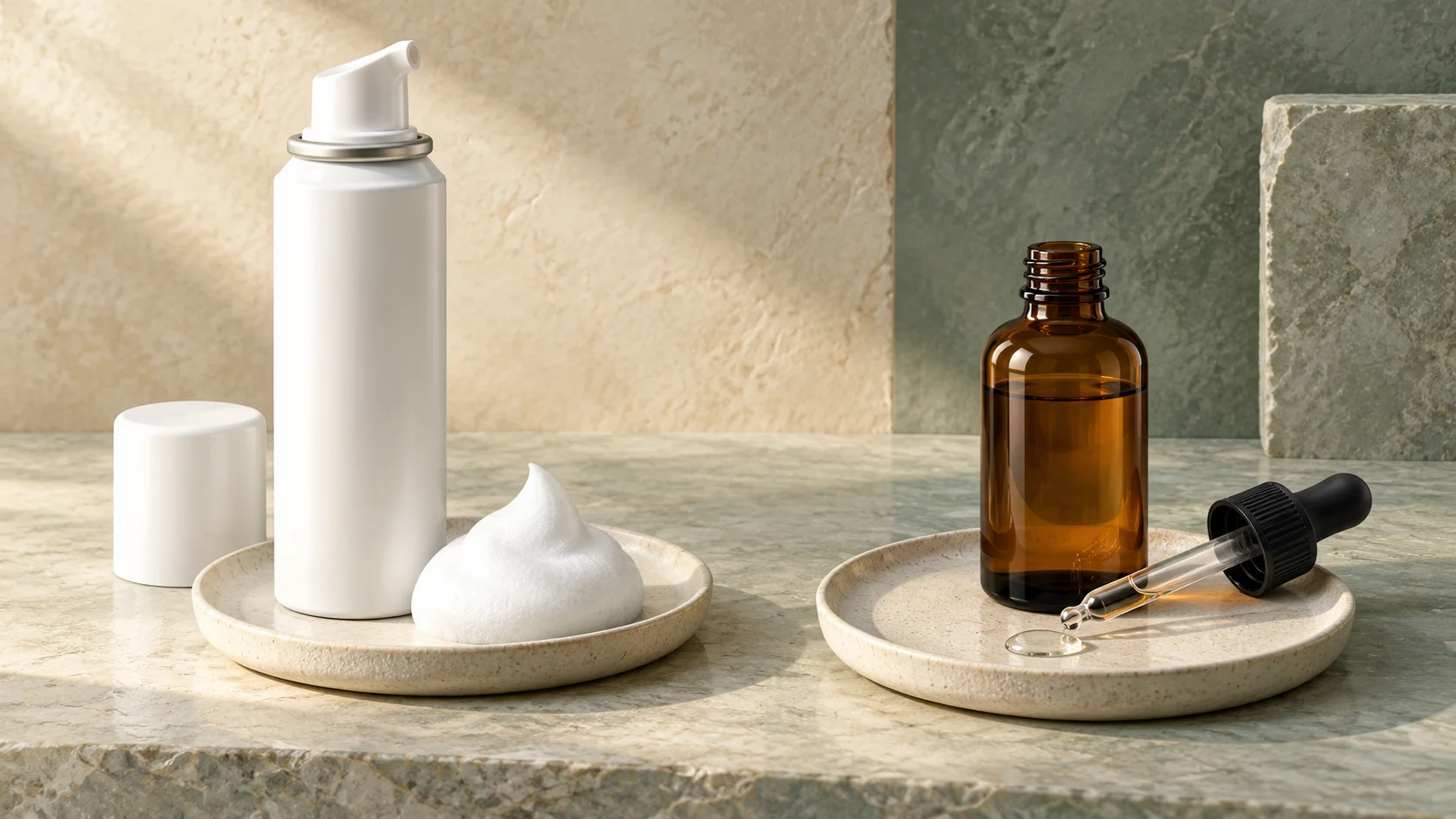
Foam and liquid put the same active ingredient on your scalp. The harder choice is finding the product you can use correctly, tolerate and afford over time. That means looking beyond “5%” on the front of the box.
Editorial details
Our take
Foam can be easier to tolerate if a solution’s propylene glycol irritates your scalp. Liquid often costs less, and its dropper can help with scalp application. Neither is a universal winner for regrowth. Compare the actual label: women’s 5% foam is once daily, while women’s 2% solution and the men’s products reviewed here are twice daily.
Get the free minoxidil worksheet →NuWays MD is independent and reader-supported. When you buy through links on our site, we may earn a commission. As an Amazon Associate we earn from qualifying purchases. Learn more.
Which format fits your situation?
| Your priority | Start by comparing | What could change the choice |
|---|---|---|
| Avoiding propylene glycol | A foam whose ingredient list does not contain it | Minoxidil itself or other ingredients can still cause a reaction. A painful or inflamed scalp needs assessment. |
| Keeping the ongoing bill down | Generic liquid in the appropriate labeled strength | Compare cost per month, not the bottle price. A women’s foam can has a different labeled supply from a men’s can. |
| Fitting treatment around long or dense hair | How a dropper or foam reaches your scalp when you part your hair | Product left mostly on hair is not the intended application. Neither format is automatically best for every hairstyle. |
| A once-daily OTC routine for women | Women’s 5% foam | This does not make every minoxidil product once daily. Follow its own directions. |
| Choosing by effectiveness alone | Evidence for the exact strength and schedule | Similar study averages do not prove that every foam and solution are interchangeable. |
Before choosing, make sure you know why you are losing hair. OTC labels warn against self-treating sudden or patchy loss, an unknown cause or a red, inflamed or painful scalp. Read the pregnancy and breastfeeding warnings and ask a provider before use if you have heart disease. Review these precautions in the medication label before choosing a pack.
The label differences that matter
“Liquid” usually means topical solution. “Foam” is an aerosol formulation that melts on contact with skin. Rogaine is a brand name; generic products also contain minoxidil. Products can differ in their inactive ingredients, so the carton is more useful than a blanket brand-versus-generic claim.
The table below summarizes common U.S. OTC directions. Follow your prescribed regimen if your provider has given you different instructions.
| U.S. product type | Labeled amount and frequency | Typical labeled pack supply |
|---|---|---|
| Women’s 5% foam | Half a capful once daily | One 60 g can: two months |
| Women’s 2% solution | 1 mL twice daily | One 60 mL bottle: one month |
| Men’s 5% foam | Half a capful twice daily | One 60 g can: one month |
| Men’s 5% solution | 1 mL twice daily | One 60 mL bottle: one month |
Sources: women’s foam, women’s solution Drug Facts, men’s foam and men’s solution. Check your own pack because directions and formulations can vary by country and product.
The supply in two cans depends on the product’s labeled schedule. A trial comparing women’s once-daily 5% foam with twice-daily 2% solution also answers a different question from comparing men’s 5% products.
Does foam work as well as liquid?
Both have clinical evidence, but “equally effective” is too broad without naming the comparison. The best-known direct trials in women compare 5% foam once daily with 2% solution twice daily. They change the concentration, frequency and vehicle together.
What the direct trials found
| Study | What was compared | What to take from it |
|---|---|---|
| 2011 randomized trial, 113 women, 24 weeks | 5% foam once daily vs. 2% solution twice daily | Foam met the study’s noninferiority test. It also had better reported local tolerability and less interference with hairstyling. Participants could tell which format they were using. |
| 2016 phase III trial, 322 women, 52 weeks; primary comparison at week 24 | The same two regimens | Average hair-count gains were close, but foam did not meet the trial’s prespecified noninferiority criterion. |
The 2011 trial supports foam as a practical option for women, including its styling advantages in that study.
WHAT THE LARGER WOMEN’S TRIAL FOUND
Similar average gains. A statistical limit that matters.
In the larger 2016 trial, the estimated difference was small, but the confidence interval extended beyond the study’s allowed margin for calling foam noninferior. That is not proof that liquid works better. It means the planned statistical test did not establish the intended conclusion. The chart’s nearly equal bars cannot tell the whole story by themselves.
For your decision, the useful question is whether the exact regimen is appropriate and sustainable. The format alone cannot predict who will respond. If you are weighing a supplement instead, our Nutrafol-versus-minoxidil comparison addresses that separate treatment choice.
Irritation: why foam can help, and why it sometimes does not
Many standard solutions use alcohol, propylene glycol and water to carry minoxidil. The Rogaine foam labels we reviewed omit propylene glycol, but still contain alcohol and other ingredients. Propylene-glycol-free is not the same as alcohol-free or allergy-free.
The distinction matters if a solution leaves you itchy or uncomfortable. A provider may consider a formulation change, but first they need to distinguish simple irritation, contact allergy and a separate scalp condition. A review of patch-test-confirmed minoxidil allergy found reactions to both the active ingredient and vehicle ingredients. Its selected cases cannot tell us how often the average user develops an allergy.
Flakes are not automatically dandruff
Residue, dry irritated skin, allergic dermatitis and dandruff can look similar to a user. Changing the bottle or adding a medicated shampoo without identifying the issue can obscure what is happening. Stop and seek advice when the label tells you to, including for scalp irritation or redness.
Shedding is a different question
Early shedding can occur with minoxidil itself. It is not a reason to assume that a liquid vehicle is damaging follicles, and foam is not an established way to prevent it. Our minoxidil-shedding guide separates the label’s follow-up instructions from longer study observation windows, with a worksheet for recording the timeline.
Application, drying and styling
The best format on paper can be a poor fit at seven in the morning. Before committing to a multi-month pack, consider where the product needs to go, when it can dry and whether you can follow that schedule consistently.
Getting it onto the scalp
A dropper can help place solution along a part, although the liquid can run. Foam can be placed in small portions after parting the hair, although some may remain on the hair if you do not expose the scalp.
Use the labeled measuring method. A mound of foam and a dropperful are not interchangeable units. The men’s foam leaflet also notes that warm skin can melt the foam, which can affect handling.
Leaving time before bed, washing and styling
Apply to the scalp as directed and allow the product to dry before bed or contact with other people. Check the leaflet’s washing interval; the men’s solution instructions advise leaving it on for about four hours before washing and allowing two to four hours to dry before bed.
The women’s foam patient booklet says to let it dry before styling aids and before bed. Its advice about chemical hair treatments is worth reading if you color, perm or relax your hair, particularly when the scalp is already sensitive.
If you repeatedly miss applications because the routine does not fit, discuss that openly. Do not compensate with larger doses or silently change a twice-daily product to once daily based on another product’s label.
What foam and liquid cost over a year
To compare formats without mixing brand premiums into the answer, we checked four up&up generic packs at Target on October 19, 2026. These dated examples show how pack size and dosing affect the ongoing bill.
12 MONTHS AT THE LABELED SCHEDULE
The foam premium depends on the regimen
| Generic pack checked | Listed pack price | Labeled supply | Cost for 12 months |
|---|---|---|---|
| Men’s 5% solution, three 60 mL bottles | $21.99 | 3 months | $87.96: four packs |
| Men’s 5% foam, three 60 g cans | $34.99 | 3 months | $139.96: four packs |
| Women’s 2% solution, three 60 mL bottles | $21.99 | 3 months | $87.96: four packs |
| Women’s 5% foam, two 60 g cans | $34.99 | 4 months | $104.97: three packs |
At these prices, the foam premium is $52 a year for the men’s comparison and $17.01 a year for the women’s comparison. The women’s products differ in concentration and labeled frequency, so this is a budget comparison of two OTC regimens, not a controlled comparison of identical doses.
The arithmetic uses whole packs for twelve months at the labeled schedule. It excludes tax, shipping, promotions and wasted product, and assumes the price does not change. The effective monthly costs are about $7.33 for either solution, $11.66 for men’s foam and $8.75 for women’s foam. We calculated annual totals from pack prices, not rounded monthly figures.
Compare the ongoing commitment, not just the first order
A lower introductory price can hide a different refill price. Check auto-renewal, shipping and the cancellation process before treating a subscription as cheaper. If a product is hard for you to use, the smallest sensible initial purchase may be more useful than the lowest unit price on a year’s supply. For exact pack prices, the first six months of spending, and separate prescription costs, use our minoxidil cost guide.
The generic cards above link to the same Target products priced here. The separate Rogaine links open branded foam on Amazon; check those listings for their current prices and pack sizes.
Switching formats without guessing
Write down the current product’s strength and directions alongside the proposed replacement. If both the concentration and the schedule change, this is more than a texture swap. A pharmacist or provider can help you compare the actual labels and any prescribed regimen.
There is no established universal overlap, taper or “reset” schedule for switching foam and solution. If you are switching because of a reaction, address that first. Do not layer products to make up for a missed dose or assume that using both is more effective.
Finally, separate the question of format from the question of stopping treatment. Minoxidil generally needs continued use to maintain the growth it supports. If cost, side effects or the daily routine make that unrealistic, ask about alternatives before buying another large pack.
Considering a botanical alternative? Our rosemary oil vs. minoxidil guide explains what the direct trial tested and what to consider before replacing an effective routine.
If you are considering a device as an addition, our red light therapy and laser-cap comparison explains the combination research, treatment routines and buying terms to discuss with your provider.
Frequently asked questions
Is minoxidil foam more effective than liquid?
The evidence does not establish one universal winner. Direct studies use different strengths, schedules and populations. The larger women’s trial had similar average gains but did not meet its planned noninferiority criterion; neither “foam wins” nor “proven identical” accurately summarizes that result.
Does liquid absorb better?
Claims about absorption need to name a specific formulation and study. More absorption into the bloodstream is not the goal of scalp treatment. The direct clinical comparisons do not establish a universal regrowth advantage for liquid based on absorption alone.
Is foam better for a sensitive scalp?
It may help if the problem is an ingredient absent from that foam, such as propylene glycol. It can still cause irritation or allergy. A red, painful or inflamed scalp should be assessed rather than used as a reason to keep testing new products.
Does minoxidil foam contain alcohol?
The common U.S. Rogaine foam labels we reviewed do. Their lack of propylene glycol does not make them alcohol-free. Read the complete inactive-ingredient list on the specific product.
Can women use men’s 5% minoxidil?
The same percentage does not make labeled directions interchangeable. Women’s 5% foam is labeled once daily; men’s 5% foam is twice daily, and men’s 5% solution has its own restrictions. Ask a pharmacist or provider about any use outside the product’s label instead of copying the men’s schedule.
Is once-daily minoxidil enough?
It is the labeled schedule for women’s 5% foam. It is not the labeled schedule for all products. If your provider prescribed a different regimen, clarify it with them rather than switching based on a comparison table.
Is a generic as good as Rogaine?
An FDA-approved generic is expected to meet the agency’s standards for its reference medicine. That does not make every seller or compounded blend equivalent, or mean every product feels identical. Check the active ingredient, strength, dosage form, directions and seller. The FDA explains what generic approval establishes.
Does foam prevent the initial shed?
No reliable evidence establishes foam as a way to prevent minoxidil-related shedding. The active ingredient is still minoxidil. Use the follow-up instructions in your product leaflet and discuss continuing or severe loss with a provider.
Which is better for a receding hairline?
The men’s OTC labels reviewed here specify the top or vertex of the scalp and do not label the products for frontal baldness or a receding hairline. A provider can discuss the cause and any treatment outside that labeling. Choosing foam instead of liquid does not change this distinction.
Can I use either one on my beard?
The OTC products discussed here are labeled for the scalp, not beard growth. This guide does not provide a beard-use regimen. A different application area changes the question, even when social-media examples use the same bottle.
Can I use foam in the morning and liquid at night?
Do not create a combined schedule from different labels. It can make the total amount and ingredient exposure unclear. Ask your provider or pharmacist how to handle the specific products and your reason for combining them.
Is either format safe around pets?
Neither should be accessible to pets. Prevent direct contact and contamination of surfaces or bedding, and contact a veterinarian promptly after suspected exposure. Foam is not a pet-safe substitute for liquid.
How we compared the products
We checked U.S. labels, direct comparative studies and dated retail packs rather than ranking products from star ratings. This is a researched comparison, not a hands-on texture test or a clinical trial. We did not measure absorption, scalp coverage or individual regrowth. Clinical review is pending.
The central evidence limitation is that the strongest women’s comparisons change concentration and frequency along with format. Our cost comparison therefore names the regimen and pack size explicitly. Sources and prices were checked October 19, 2026. Evidence note updated October 20, 2026. Read our editorial standards and commercial disclosures.
View all 15 sources
Sources and what they support
- Blume-Peytavi and colleagues, 2011: 113-woman randomized comparison, including tolerability and styling outcomes.
- Blume-Peytavi and colleagues, 2016 and trial registration NCT01145625: 322-woman comparison and its prespecified noninferiority question.
- Randomized men’s formulation report, 2026: limited-confidence comparison with inconsistent participant reporting and no demonstrated equivalence between formats.
- Women’s Rogaine foam, men’s Rogaine foam and men’s generic solution: directions, ingredients, supply and warnings.
- Women’s foam patient booklet: drying, styling and chemical-treatment guidance.
- Contact-allergy systematic review: active ingredient and vehicle as possible allergens, not an estimate of general-user risk.
- Target’s men’s solution, men’s foam, women’s solution and women’s foam: dated pack-price and supply examples, not clinical outcome evidence.
- AAD: Minoxidil and pets and FDA: Generic drug facts: household safety and the meaning of generic approval.