EQUIPMENT BUYING GUIDE · ALMA LASERS
Alma Soprano Titanium: Price, Trio Applicators, SHR and FDA Clearance
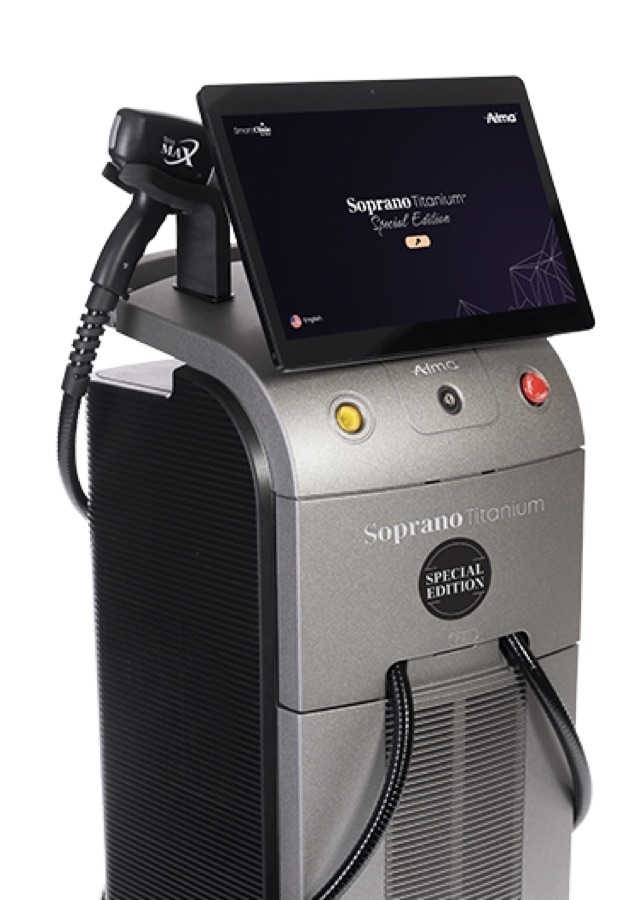
The Alma Soprano Titanium laser is Alma’s diode hair removal platform, built around SHR in-motion treatment and a Trio applicator that fires 755, 810 and 1064 nm together. Alma doesn’t publish a price. Here is what each applicator is for, what the FDA filings say about temporary and permanent reduction, what the studies show, including in darker skin, and what to get in writing before you buy.
Document-based buying analysis, informed by Darryl’s 9+ years in the industry. Not sponsored; NuWays MD has no commercial arrangement with Alma Lasers. Disclosures.
OUR TAKE
Soprano Titanium is Alma’s diode laser platform for hair removal, built around SHR, a technique that heats the follicle gradually with many low-energy pulses while the applicator keeps moving. Its flagship applicator, the Trio, fires 755, 810 and 1064 nm together through a 2 or 4 cm² window, and Alma’s current version, the Special Edition of Soprano Titanium, adds a Trio MAX applicator that Alma says is up to 20% faster in SHR in-motion mode at high fluence. Comfort and large-area speed are the selling points.
The FDA filings say something buyers should hear before the demo: the Trio’s SHR mode is listed for temporary hair reduction, and the permanent-reduction indication sits with the separate 810 nm and 755 nm applicators. The Trio’s own study in Alma’s 2022 filing counted hair only 3 months after treatment, 42.7% fewer hairs in 30 people, too soon to show permanent reduction as the FDA defines it. That isn’t evidence the Trio works poorly; it means the wording differs by applicator, which matters for your ads and consent forms. Alma doesn’t publish a price, and we found no federal purchase of a Soprano. See the price breakdown.
Strengths
- SHR in motion: low-energy, high-repetition pulses
- Three wavelengths in one 4 cm² Trio applicator
- Separate 810 nm and 755 nm applicators with permanent-reduction wording
- Studied in skin types I to VI, including V and VI
Watch for
- Trio’s SHR mode listed for temporary hair reduction
- No federal purchase to benchmark a quote
- Short follow-up in the published studies
- No FDA filing found under the Special Edition name
How much does a Soprano Titanium cost?
PRICE CHECK · NOVEMBER 20, 2026
- New
- Not published by Alma. Quotes depend on the generation and which of the six applicators are included.
- Government orders
- None found for Soprano. One 2026 VA order from Alma for unnamed “laser equipment,” $130,500, can’t be attributed to any model.
- Context
- Other systems’ federal orders: GentleMax Pro Plus median $107,495; LightSheer Desire $99,707. Not Soprano prices.
- Patient prices
- See the visit examples in our laser hair removal machines guide.
With no public price, compare Soprano quotes applicator by applicator. Alma sells six applicators for the Special Edition, and a quote that leaves out the 810 nm or 755 nm applicator also leaves out the applicators carrying the permanent-reduction indication. We searched federal award records for Soprano and found none; one 2026 VA purchase from Alma Lasers for $130,500 is described only as “laser equipment.”
| Quote item | Why it changes the cost | A comparable answer includes |
|---|---|---|
| Generation | Alma sells the Special Edition of Soprano Titanium alongside the Soprano ICE Platinum and ICE Special Edition. | The model by name, software version and the 510(k) on the unit |
| Applicators | Trio 2 cm², Trio 4 cm², Trio MAX, Speed 810, Alex 755 and a facial tip may be quoted separately or in bundles; ask. | Every applicator by name, and the price of any left out |
| Applicator life | Diode applicators wear, so treat replacements as a cost to price up front. | Rated life or pulse count, replacement price and warranty coverage |
| Smart Clinic and software | Alma markets a cloud tool for tracking performance and ROI. | Whether it’s included, and any subscription fee |
| Service after warranty | Applicators and the cooling system need support. | Annual price from year two, coverage, response time and loaners |
Is a used Soprano cheaper?
The asking price is lower, but the full cost may not be. Older Soprano generations, such as the ICE with separate 1 cm² applicators, are a different machine from a Titanium. In Darryl’s experience owning and managing a med spa, a used system can need a manufacturer recertification or inspection fee before the maker will service it. Get the generation, applicator pulse counts and Alma’s service terms for the serial number in writing.
Soprano Titanium applicators and SHR
Alma’s SHR technique builds heat in the follicle gradually, with many low-energy pulses at a high repetition rate, while continuous contact cooling protects the skin. Alma offers three ways to use it: SHR in motion over large areas, SHR Stack (stationary, multiple pulses) for small areas such as the face and bikini line, and HR classic, a single stationary pulse. HR carries a hair indication only on the 810 nm and 755 nm applicators; the filing lists the Trio’s HR mode for vascular lesions.
| Applicator | Wavelengths and spot | What Alma positions it for |
|---|---|---|
| Trio MAX | 755, 810 and 1064 nm; 4 cm² | Large areas; Alma says up to 20% faster than its earlier Soprano Titanium, in SHR in-motion mode at high fluence |
| Trio 4 cm² | 755, 810 and 1064 nm; 4 cm² | Large areas such as legs and backs |
| Trio 2 cm² | 755, 810 and 1064 nm; 2 cm² | Smaller areas: neck, face, underarms and bikini line |
| Speed 810 | 810 nm; 2 cm² | A single-wavelength diode applicator |
| Alex 755 | 755 nm; spot size not stated | Light and fine hair on skin types I to V |
| Facial tip | Adapter | Hard-to-reach areas such as ears and nostrils |
From Alma’s Special Edition of Soprano Titanium page, read November 20, 2026. Alma calls the Special Edition the sixth Soprano generation: the earlier Soprano ICE used three separate 1 cm² applicators, the ICE Platinum introduced the Trio (2 cm² in Alma’s account; Alma’s 2022 FDA filing describes the earlier Trio as 1 cm²), and the Titanium added 4 cm².
The low-energy approach shows in the numbers. A published Soprano Titanium study treated hair at 7 to 9 J/cm² with 9 to 10 pulses a second on 2 or 4 cm² spots (Akerman and colleagues), while one 22-patient alexandrite series, removing hair from forehead skin used to rebuild the nose, stamped an 18 mm spot at 14 to 18 J/cm² (Yen and colleagues). The trade-off is technique: in-motion treatment depends on the provider covering the area evenly with enough passes.
Alma also calls the Special Edition “the fastest hair removal treatment on the market,” citing validation by Sapio Research, whose method Alma doesn’t publish, so treat it as a marketing claim and time a full-leg treatment yourself in the demo.
MAKE THE QUOTES COMPARABLE
Compare applicator bundles, not just consoles.
Put a Soprano Titanium quote next to a GentleMax Pro Plus or LightSheer quote: applicators, service after year one and financing, side by side.
Free, works in your browser, no account needed.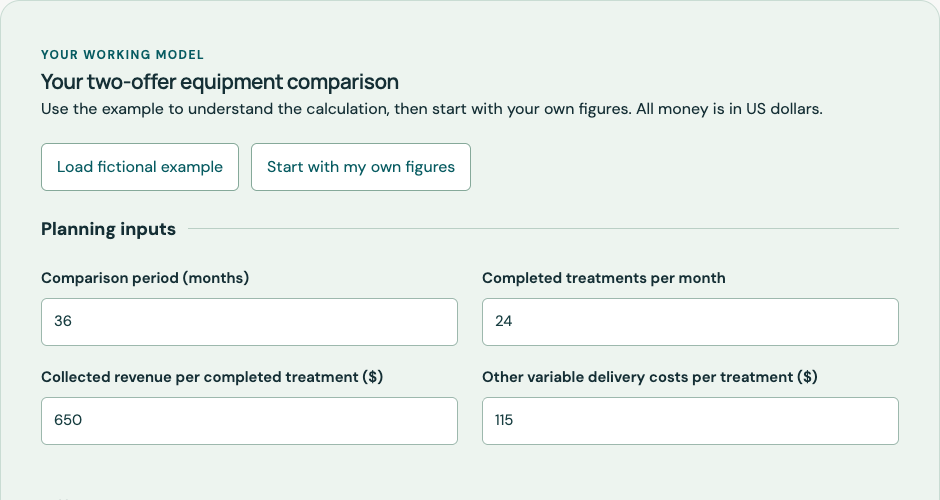
What is the Soprano Titanium FDA cleared for?
The FDA cleared “The Alma Soprano Titanium” through two 510(k)s: K222064 on October 12, 2022, and K230371 on February 22, 2023. A 510(k) clearance means the FDA found it substantially equivalent to devices already sold; it isn’t a ranking. The indications are written per applicator and per mode, and they differ.
| Applicator and mode | Hair indication | Skin types on the label |
|---|---|---|
| Trio module, SHR mode | TemporaryTemporary hair reduction | Not stated on this line |
| Trio module, HR mode | No hair wordingDermatology procedures requiring coagulation, including benign vascular lesions | Not stated |
| 810 nm applicator, HR and SHR | PermanentPermanent reduction in hair regrowth | I to VI, including tanned skin |
| 755 nm applicator, HR and SHR | PermanentPermanent reduction in hair regrowth | I to VI, including tanned skin |
From the indications in K230371, read November 20, 2026. The filings also list an NIR applicator for topical heating. “Permanent reduction” means a long-term, stable reduction in the number of hairs regrowing at 6, 9 and 12 months after a treatment regime, not that every hair is gone.
What this means in practice: if you sell packages on the Trio and describe them as permanent hair reduction, your wording goes beyond what the filing lists for that applicator. The filing’s wording is permanent hair reduction for the 810 nm and 755 nm applicators and temporary hair reduction for the Trio’s SHR mode; have your medical director and counsel approve how you describe each to patients. Choose the applicator for the patient: we found no study comparing the Trio’s results with the 810 nm or 755 nm applicators’. Alma’s own article says firing the three wavelengths together creates “optimal conditions for permanent hair reduction,” so check that wording with the rep before you repeat it. Ask Alma’s rep in writing which 510(k) and indication covers each applicator in your quote, including the Trio MAX and the Special Edition, since we found no filing under those names.
The label and Alma’s marketing also differ on the Alex 755 applicator: the filing lists it for skin types I to VI, while Alma’s page positions it for skin types I to V. The label lists the skin types the FDA cleared; Alma recommends a narrower range for this applicator, so ask the trainer which applicator to use for type VI.
What does the research show for Soprano Titanium?
The published Soprano studies are small, short and mostly uncontrolled, but they include people with skin types V and VI.
Gold and colleagues, 2023: 36 people, four Trio sessions, no comparison group.
| Study and what it tested | What it found | Read it with |
|---|---|---|
| Alma filing study, 2022Trio in SHR mode, underarms and bikini, 30 people (K222064) | 42.7% fewer hairs 3 months after four treatments; no serious adverse events | Alma-sponsored, single-arm; supported the temporary hair reduction wording |
| Gold, 2023Soprano Titanium Trio, underarms and bikini, 36 people, skin types I to VI | 41.5% (underarms) and 48.1% (bikini) fewer hairs 3 months after four sessions; 45.5% in types I to IV and 40.3% in V and VI; no serious adverse events | No comparison group; 3 months is short of the FDA’s 6 to 12 month measure. Its design (two sites, four sessions six weeks apart, three blinded evaluators) matches Alma’s filing study, so it may report the same study; we couldn’t read its funding statement |
| Naranjo García, 2022Three-wavelength applicator in motion, backs, chests and abdomens, 22 men, mostly skin type III | 75.6% fewer hairs 3 months after four sessions | Single group, mostly light skin, 3 months; Alma cites it for Soprano, and its lead author appears in Alma’s testimonials |
| Akerman, 2020Soprano Titanium, 11 men, skin types III to V | Physician improvement score 3.4 of 4; satisfaction 4.8 of 5; no adverse events | Retrospective; a rating scale, not hair counts; 4 to 6 months of follow-up |
| Raj Kirit, 2021Soprano ICE Platinum, 25 people, skin types IV and V | Most treated areas rated good or excellent by physician score | Single center; a rating scale, not hair counts |
Results as each paper reports them. We found no published randomized trial comparing Soprano Titanium with another laser.
Two other findings are worth knowing. In one clinic’s review of 7,381 laser hair removal patients, paradoxical hypertrichosis (hair growing thicker near a treated area) appeared in 0.34%, and 24 of the 25 cases followed alexandrite treatment, which made up 70% of its treatments, rather than diode SHR (Inoue and colleagues). That is one clinic’s pattern, and a larger 2021 meta-analysis found no effect of device type (Snast and colleagues), so it doesn’t prove SHR is safer. And the broader evidence in darker skin finds results from lasers and intense pulsed light broadly similar overall; compared with IPL, alexandrite did better on hair counts, diode didn’t differ significantly, and Nd:YAG caused less hyperpigmentation (Dorgham and Dorgham).
How many visits pay for a Soprano Titanium?
With no public price, use your quote. In the worked example in our laser hair removal machines guide, each $100,000 financed over five years at 10% APR costs about $2,125 a month: about 14.4 full-leg visits at $250, or 37.3 underarm visits at $100, after assumed provider time, supplies, card fees and the cost of finding the patient.
PER $100,000 FINANCED
$2,125
A month over 60 months at 10% APR
FULL-LEG VISITS A MONTH
14.4
At $147.50 left each; illustrative
IF A FULL LEG TAKES 45 MINUTES
$217
Left per laser hour, against $148 at 60 minutes
Illustrative: 100% financed, no fees, before tax, installation, service and applicator replacement. Visit prices are Central Minnesota Dermatology’s single-visit prices and times are another practice’s stated ranges; the costs are our assumptions. Packages lower the per-visit price: at that practice’s six-visit prices ($500 underarms, $1,400 full legs), the same payment takes about 52 underarm or 16 full-leg visits a month if each visit carries the same costs. Covering the payment isn’t breaking even: rent, other staff and your own pay come on top. Not a quote or a forecast.
Soprano’s case rests on speed and comfort on large areas. If the Trio MAX really trims a full-leg visit, that shows up as more visits per laser hour, so time one in the demo and put the number in your plan.
What should you compare with Soprano Titanium?
Price one other diode and one alexandrite and Nd:YAG system, so you can see what in-motion SHR and the Trio cost you. For another blended diode, see our InMode Triton guide.
Alexandrite + Nd:YAG
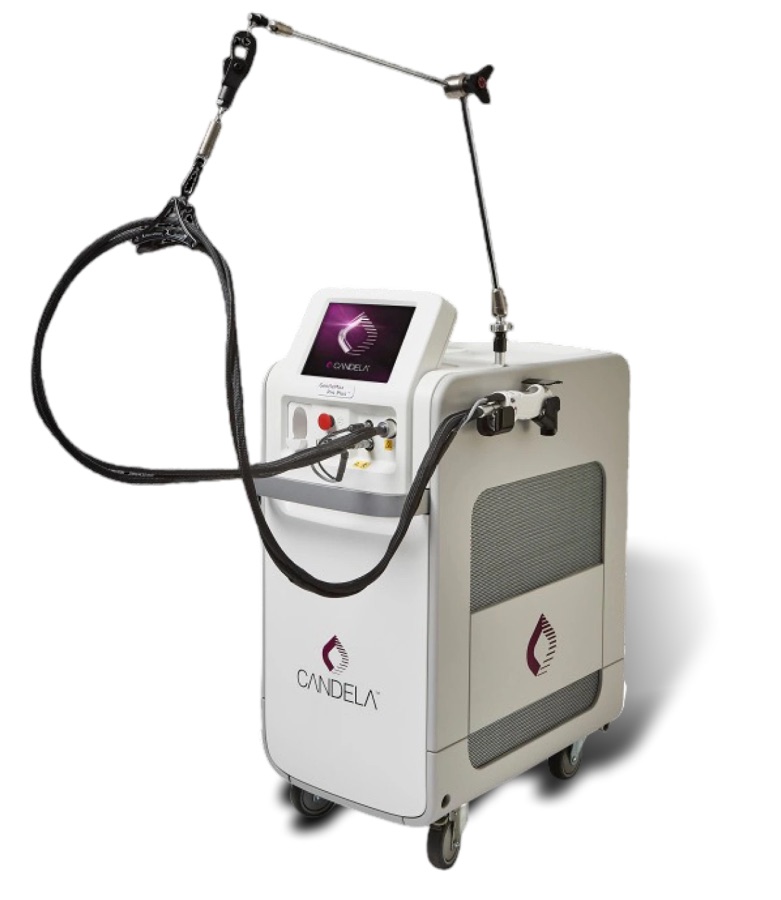
Candela GentleMax Pro Plus
Candela; FDA cleared May 2020 (K201111)
Both wavelengths cleared for permanent reduction, stamping spots to 26 mm, cryogen cooling or an air-cooled option. Federal orders ran $92,982 to $123,082; the lowest may exclude the large-spot kit, which buyers ordered separately for $24,725.
Vacuum diode
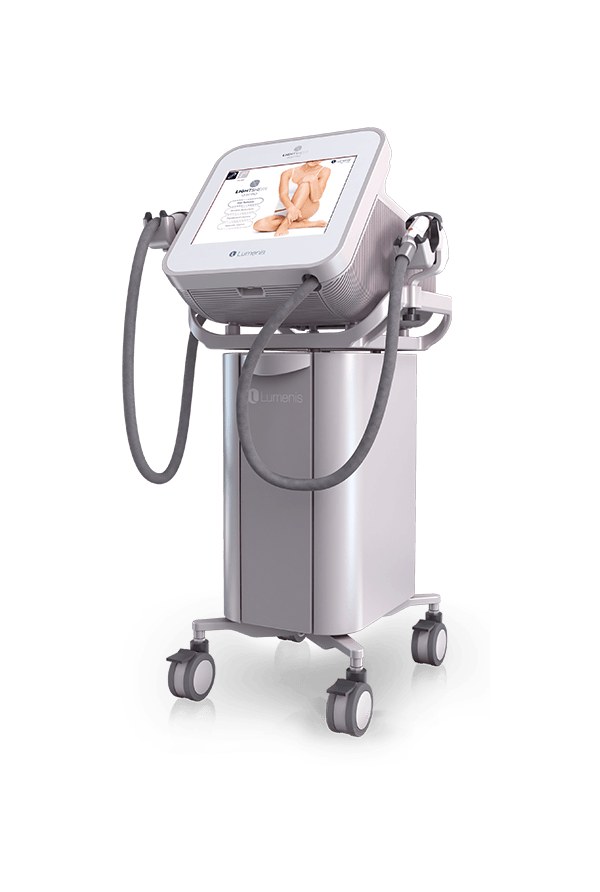
Lumenis LightSheer
Lumenis; 2017 family filing (K170179) for the Desire line; none under the QUATTRO name
A different route to comfort: a 22 x 35 mm vacuum handpiece at low fluence, with 805 nm and 1060 nm handpieces cleared for permanent reduction.
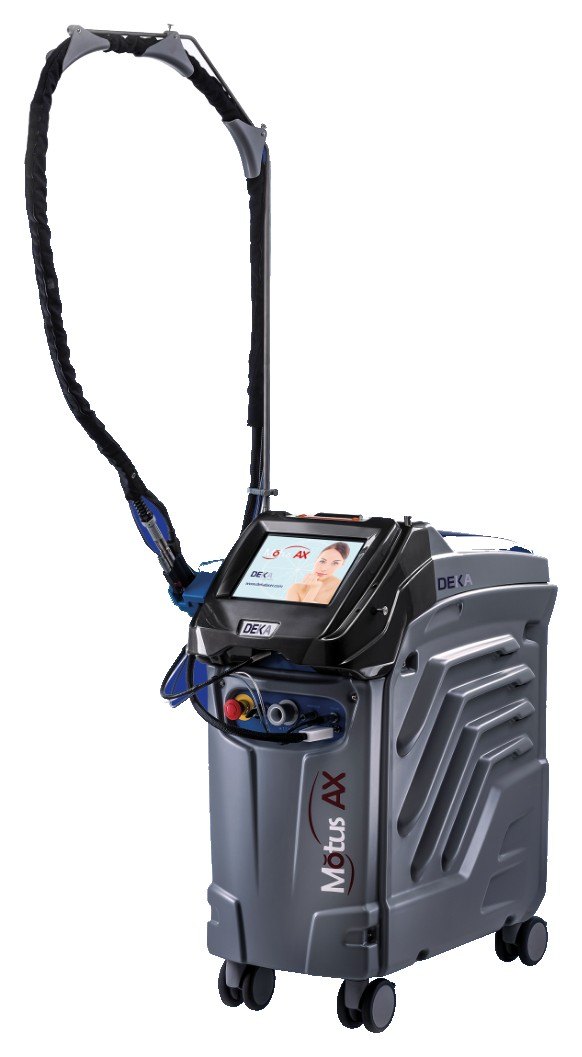
Alexandrite in motion (Moveo)
DEKA Motus AX and PRO
DEKA; Motus AX 2017, MOTUS PRO 2024
In-motion treatment with an alexandrite laser; in one randomized split-body pilot, Moveo scored 1.5 for pain against 4.2 for standard pulses, with lower average hair reduction that the authors called not significant.
Images: Candela, Lumenis, DEKA. Compare all eight systems in our laser hair removal machines guide.
What should the demo and written quote prove?
- The exact system: Special Edition or an earlier Titanium, every applicator by name, and the 510(k) and hair indication for each applicator in writing.
- A timed full-leg treatment: SHR in motion with the Trio MAX or Trio 4 cm², by the person who will treat your patients, with the number of passes they use.
- Darker skin: settings and test spots on your darkest skin types, and which applicator Alma’s trainer would use.
- Applicator life: rated pulses or hours for each applicator, replacement prices and what the warranty covers.
- Service after the warranty: the annual price from year two, response time and loaner applicators.
- Software and resale: any Smart Clinic fee, and whether service and software transfer if you sell.
Ask for references from practices with a patient mix like yours. Already bought one? Our paid consulting covers device launches.
Soprano Titanium buying questions
How much does a Soprano Titanium cost?
As of November 2026, Alma doesn’t publish a price, and we found no federal purchase of a Soprano. Applicators can be quoted separately or in bundles, so ask for every applicator by name. For context only, federal buyers paid a median of $107,495 for Candela’s GentleMax Pro Plus.
How many Soprano Titanium sessions does laser hair removal take?
Alma’s FAQ says results are typically seen after 6 to 8 sessions, depending on skin and hair type. The published Soprano studies used four to six sessions, and most measured results 3 to 6 months later, so plan packages, and follow-up visits, around your own results.
What is the difference between Soprano ICE Platinum and Soprano Titanium?
Alma’s comparison article says both fire 755, 810 and 1064 nm together through a Trio applicator. The ICE Platinum’s Trio is 2 cm²; the Titanium adds a 4 cm² Trio that Alma says treats large areas in about half the time, a maker claim to time in the demo. Alma calls the Special Edition of Soprano Titanium, launched in 2024, the sixth Soprano generation. Ask which FDA clearance covers any ICE Platinum you’re quoted, since the filings we read are for the Titanium.
Is Soprano Titanium laser hair removal permanent?
The FDA wording depends on the applicator; we found no study showing that results differ by applicator. The FDA filings list the Trio’s SHR mode for temporary hair reduction and the 810 nm and 755 nm applicators for permanent reduction in hair regrowth. “Permanent” in FDA terms means fewer hairs regrowing at 6, 9 and 12 months after treatment, not that every hair is gone.
What is SHR on the Soprano?
SHR is Alma’s technique of heating the follicle gradually with many low-energy pulses at a high repetition rate, usually with the applicator moving, under continuous contact cooling. Alma also offers SHR Stack for small areas and a single-pulse HR mode.
What is the Special Edition of Soprano Titanium?
Alma’s current Soprano Titanium, which it calls the sixth Soprano generation, with a Trio MAX applicator that Alma says is up to 20% faster in SHR in-motion mode at high fluence. We found no FDA filing under the Special Edition name; ask which clearance covers it.
Is Soprano Titanium good for dark skin?
It has been studied in darker skin: in a 36-person study of the Trio, hair counts in the treated areas of the 20 people with skin types V and VI fell by 40.3% on average at 3 months, against 45.5% for the 16 with types I to IV. The study was short and had no comparison group. The 810 nm (2 cm²) and 755 nm applicators are FDA cleared for skin types I to VI, though Alma positions its Alex 755 applicator for types I to V. The Titanium’s only 1064 nm source, the wavelength generally considered better suited to dark skin (Ross and Domankevitz), is inside the Trio, whose SHR mode is listed for temporary reduction; Alma’s filing says the Titanium doesn’t support the separate 1064 nm applicator of earlier Sopranos.
Soprano Titanium or GentleMax Pro Plus: which should a practice buy?
We found no published trial comparing them. Soprano offers in-motion diode treatment and a three-wavelength applicator; the GentleMax Pro Plus offers alexandrite and Nd:YAG stamping, both cleared for permanent reduction, and a federal price record. Our GentleMax Pro Plus vs. Soprano Titanium comparison goes deeper.
Sources and editorial notes
Last updated November 21, 2026. FDA wording, federal records and maker claims were checked November 20, 2026. Prepared by Darryl, drawing on 9+ years of med spa experience (he owned and managed a practice for 7+ years, then helped build another), with source-based research. Clinical review pending. Darryl hasn’t owned a Soprano; his hands-on hair removal experience is with a handpiece on an Alma Harmony XL Pro, a different Alma platform. Payment examples are illustrative. NuWays MD is an education and referral resource, not a medical provider. This guide is general business education based on public records, not legal, regulatory or medical advice: confirm indications and advertising wording with the manufacturer and your own counsel, and treatment settings with your medical director. Product names are trademarks of their makers.
View all 22 sources
- FDA K230371: The Alma Soprano Titanium (2023): indications by applicator and mode: Trio SHR for temporary hair reduction, Trio HR for coagulation, and the 810 nm and 755 nm applicators for permanent reduction on skin types I to VI.
- FDA K222064: The Alma Soprano Titanium (2022): the earlier clearance under the same name, with Alma’s sponsored 30-person Trio study (42.7% fewer hairs at 3 months) and the Trio’s spot-size history.
- FDA: Premarket notification 510(k): what a 510(k) clearance is.
- Alma: Special Edition of Soprano Titanium: SHR in motion, SHR Stack and HR classic; ICE Plus cooling; the six applicators; the 20% speed claim and its conditions; the Sapio Research “fastest” claim; Smart Clinic.
- Alma: Comparing Soprano laser devices: the generations, with the Special Edition as the sixth.
- USAspending: VA order 36C24826P1259: Alma Lasers, “laser equipment,” $130,500, September 2026; device not named. Searches for Soprano found no purchase.
- Gold, Weiss and Biron, Journal of Cosmetic Dermatology, 2023: Soprano Titanium in skin types I to VI. Free abstract on PubMed.
- Naranjo García and colleagues, Journal of Cosmetic Dermatology, 2022: a three-wavelength in-motion applicator on the backs, chests and abdomens of 22 men. Free abstract on PubMed.
- Ross and Domankevitz, Lasers in Surgery and Medicine, 2021: a randomized study of a Candela blended 755/1064 nm prototype in 36 people; its introduction describes 1064 nm as optimized for dark skin and 755 nm as not ideal for darker skin; one author is a Candela employee. Free abstract on PubMed.
- Akerman and colleagues, Journal of Drugs in Dermatology, 2020: Soprano Titanium in 11 men; 7 to 9 J/cm², 9 to 10 Hz. Free abstract on PubMed.
- Raj Kirit and colleagues, Journal of Cosmetic Dermatology, 2021: Soprano ICE Platinum in skin types IV and V. Free abstract on PubMed.
- Inoue and colleagues, Aesthetic Surgery Journal, 2024: paradoxical hypertrichosis by device type in one clinic. Free abstract on PubMed.
- Bonan, Troiano and Verdelli, Dermatologic Therapy, 2020: the Moveo pilot, for the Motus alternative. Free abstract on PubMed.
- Snast and colleagues, American Journal of Clinical Dermatology, 2021: paradoxical hypertrichosis meta-analysis. Free abstract on PubMed.
- Dorgham and Dorgham, JEADV, 2020: lasers and IPL in skin types III to VI. Free abstract on PubMed.
- Yen and colleagues, Lasers in Medical Science, 2020: 755 nm alexandrite at 18 mm and 14 to 18 J/cm², removing hair from forehead flaps in 22 patients; a fluence reference. Free abstract on PubMed.
- USAspending: DLA order SPE2D524F512T: GentleMax Pro Plus, $123,082.13, September 2024, the highest of 16 Pro Plus orders from March 2023 to May 2026 (median $107,494.63), for context.
- USAspending: DLA orders SPE2D523F159A and SPE2D523F159B: a $93,519.63 GentleMax Pro Plus and a separate $24,725 GentleMax large spot option kit, both June 26, 2023.
- USAspending: DLA order SPE2D621F4DS8: LightSheer Desire, $99,707.21, July 2021, for context.
- Central Minnesota Dermatology: the $100 underarm and $250 full-leg single-visit prices in the example, from a menu headed “DiolazeXL Laser Hair Reduction”; read November 21, 2026.
- Skin Works, Torrance, California: the stated treatment times (underarms 10 to 15 minutes, full legs 45 to 60) used in the example.
- NuWays MD: Laser hair removal machines: the full worked example and the other systems’ records. It also backs the facts on this page’s comparison cards; each system’s own guide lists its sources in full.
Useful next reads
BEFORE YOU SIGN
Know what your laser quote leaves out.
Get the free practice decision kit: a quote-review checklist that goes past the sticker price, plus the planning questions and tools owners use before they commit.
Free. No account needed. Your request isn’t shared with clinics or vendors.THE KIT INCLUDES
- A quote-review checklist that goes beyond the sticker price
- Opening, software and capacity planning questions
- Direct links to the editable planning tools