EQUIPMENT BUYING GUIDE · MERZ AESTHETICS
Ultherapy PRIME: Price, Transducers and FDA Clearance
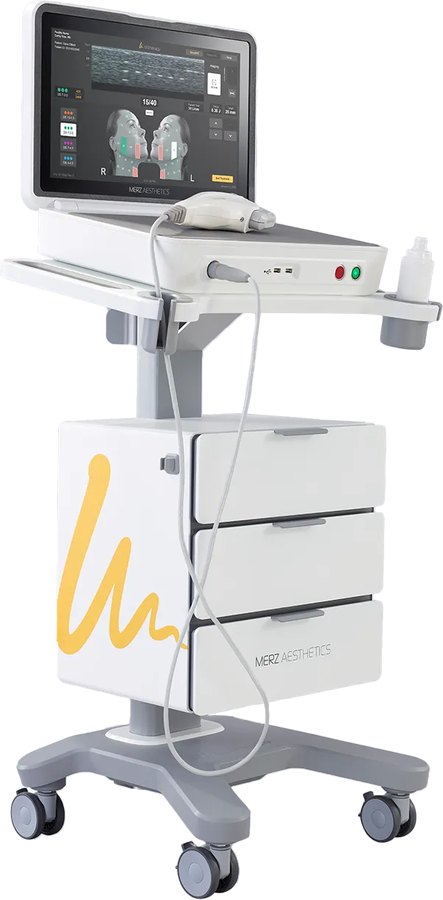
Ultherapy PRIME is Merz Aesthetics’ current console for the Ulthera System, the microfocused ultrasound device with real-time imaging that treats at 1.5, 3.0 and 4.5 mm. Merz doesn’t publish a price, and we found no federal purchase. Here is what PRIME changed and what it didn’t, how the transducers are used up, what the FDA clearance covers, what patients pay, what the research and the labeling say about risks, and what to get in writing.
Document-based buying analysis, informed by Darryl’s 9+ years in the industry; no hands-on test of this device. Not sponsored; NuWays MD has no commercial arrangement with Merz Aesthetics. Disclosures.
See price and transducer costs ↓PRIME vs. the older console ↓
OUR TAKE
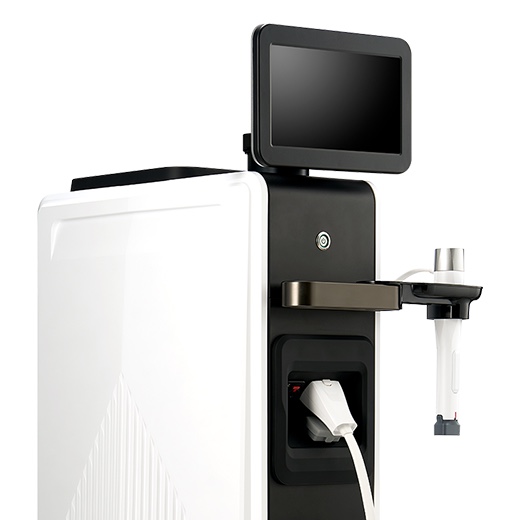
Ultherapy PRIME is the current console for Merz Aesthetics’ Ulthera System, which focuses ultrasound into rows of small heated points at 1.5, 3.0 or 4.5 mm while showing the tissue on screen. The PRIME console was cleared in February 2024 with “identical ultrasound signal energy and ultrasound treatment guidelines” to the older console. What changed is the console and its software: an 18.5-inch screen in place of a 15-inch one, a newer operating system and, in the 2025 Model 2.1, Wi-Fi and a treatment-planning mode called SEE.PLAN.TREAT. The newer body indications were cleared on the PRIME consoles.
Its FDA wording runs from the brow to the knees: lift the eyebrow, lift lax tissue under the chin and on the neck, improve décolleté lines and, since 2025 and 2026, improve the appearance of skin laxity on the abdomen, arms and knees. Treatments use transducers that serve many treatments until their lines run out or they reach their expiration date, with a 12-month shelf life in Ulthera’s 2012 and 2018 FDA filings (ask how much remains on delivery), and the system won’t treat without its USB access key. Merz doesn’t publish a price, and we found no federal purchase. See the price breakdown.
Strengths
- Lift wording for the brow, under the chin and the neck
- Real-time imaging to 8 mm to check coupling and depth
- Body uses for the abdomen, arms and knees
- A large published record, including a 2025 meta-analysis of 42 microfocused ultrasound studies
Watch for
- Transducers that expire and have a fixed line capacity
- Never on the eyelids or inside the orbital rim
- Reports of fat loss and nerve effects after clearance
- PRIME didn’t change the energy, so it isn’t a new treatment
- Lower satisfaction on the body than on the face in the research
How much does an Ultherapy PRIME machine cost?
PRICE CHECK · NOVEMBER 21, 2026
- New
- Not published by Merz. Quotes depend on the console, the transducers included, training and service.
- Government orders
- None found for Ultherapy or Ulthera on USAspending; Merz’s federal orders are for injectables such as Radiesse and Prolaryn.
- Per treatment
- Treatment lines from transducers with a fixed capacity and an expiration date, plus ultrasound gel; Merz doesn’t publish transducer prices or capacities.
- What patients pay
- Full face $2,060 and face and neck $3,090 at one California practice; $3,200 full face at one in Manhattan; face and neck $4,000 to $6,500 at one in Chicago.
Your cost per treatment is the share of each transducer’s lines that a treatment uses. The console shows each transducer’s “treatment lines remaining/total treatment line capacity,” and a full face uses several transducers at different depths. Merz’s instructions don’t state the capacity, and transducers carry an expiration date after which they “should not be used,” so unused lines on an expired transducer are lost. Ulthera’s FDA filings list a 12-month transducer shelf life (extended from 6 months in 2012). Ask Merz for the capacity and price of each transducer, how many lines its face and neck guidelines call for and how many months of shelf life remain on delivery. Ultrasound gel is required and isn’t supplied with the system.
| Quote item | Why it changes the cost | A comparable answer includes |
|---|---|---|
| Transducers | Each one is used up line by line and expires | Price and line capacity for each of the six transducers, and the shelf life at delivery |
| Lines per treatment | Merz’s presets recommend a line count for each region | Lines for a full face, a face and neck and the décolleté, by transducer |
| Access key | No treatment without the USB key | Who owns the key, replacement cost and what happens on resale |
| Console model | PRIME and PRIME Model 2.1 differ in connectivity and planning tools | The model and software version quoted |
| Service after warranty | The system has no user-serviceable parts | Annual price from year two, repair time and loaner terms |
The three menus we found range from $2,060 for a full face to $6,500 for face and neck, the high end of a consultation range. Radiance Laser and Cosmetic Center in Pasadena lists a full face at $2,060, face and neck at $3,090 and chest at $995; Trifecta Med Spa in Manhattan lists $3,200 for a full face; and The Geldner Center in Chicago quotes $4,000 to $6,500 for face and neck, priced at consultation.
Before you sign, test the quote against your bookings: the skin tightening machines guide shows how many treatments cover a financing payment at different consumable costs, and our equipment ownership costs guide works through a quiet calendar month.
What is the difference between Ultherapy PRIME and the older Ultherapy?
The console, screen and software changed; the ultrasound energy and treatment guidelines did not. Merz’s FDA filing for the PRIME console says it shares “identical ultrasound signal energy and ultrasound treatment guidelines” with the predicate console, and the changes were to its design, its graphics and hardware for current standards and end-of-life parts.
| Feature | Older console (K180623) | PRIME (K233996) and Model 2.1 (K250418) |
|---|---|---|
| Screen | 15 inches, 1024 x 768 | 18.5 inches, 1920 x 1080 |
| Weight | 22 lb (10 kg) | 27 lb or less (12.2 kg) |
| Operating system | Windows XP | Windows 10 |
| Treatment modes | Not listed in the filings | Amplify; Model 2.1 adds SEE.PLAN.TREAT planning |
| Imaging colors | Not listed in the filings | Black and white; Model 2.1 adds bone and twilight color maps |
| Connectivity | Not listed in the filings | None at launch; Model 2.1 adds a USB Wi-Fi adapter |
| Access key | USB access key | CrypKey USB key; Model 2.1 uses a Wibu USB key |
| Indications cleared on it | Brow, under the chin and neck, décolleté | Adds abdomen and arms (2025, PRIME console) and knees (2026, Model 2.1) |
| Ultrasound energy | Identical, per the PRIME filing | |
From FDA 510(k)s K180623, K233996, K243035, K250418 and K260618, read November 21, 2026.
So an older console delivers the same energy for the face, neck and décolleté, but the abdomen, arm and knee indications were cleared on the PRIME console and its later software: the 2025 body filing names the PRIME console as its predicate, and the 2026 knee filing names Model 2.1. Ask Merz in writing which indications your console and software version carry. Merz markets PRIME’s “35% larger screen” and clearer imaging as aids to targeting. If you’re weighing an upgrade, ask what the trade-in is worth and whether your existing transducers work on PRIME. One single-clinic survey of patients in Bangkok reported less pain, redness and swelling after PRIME than after the older console (Panithaporn, 2025), but treatment wasn’t blinded, so treat it as a question for Merz and your demo rather than a proven difference.
Ultherapy transducers: depths and energy
Six DeepSEE transducers cover three depths; two have a narrower patient contact footprint.
| Transducer | Frequency | Depth | Energy per point, levels 1 to 4 |
|---|---|---|---|
| DS 4-4.5UT-2 | 4 MHz | 4.5 mm | 0.75 to 1.20 J |
| DS 7-4.5UT-3 | 7 MHz | 4.5 mm | 0.66 to 1.05 J |
| DS 7-3.0 and 3.0NUT-1, UT-1N narrow | 7 MHz | 3.0 mm | 0.25 to 0.45 J |
| DS 10-1.5 and 1.5NUT-4, UT-4N narrow | 10 MHz | 1.5 mm | 0.15 to 0.25 J |
From Merz’s 2026 Ulthera System instructions for use. Points are spaced 1.5 mm apart by default (1 to 5 mm), in lines 5 to 25 mm long; imaging reaches 8 mm.
The presets set the line count by region and the default energy level, and the user can adjust energy. Two details affect results and cost. In Merz’s décolleté trial, the results were achieved at Level 4 for the 7-3.0 and 4-4.5 transducers and Level 3 for the 10-1.5, and Merz notes that changing energy “may impact efficacy.” And body areas are treated through a “User Regions” function rather than a preset: the lower abdomen guideline, for example, is 19 squares of 2.5 x 2.5 cm with 20 lines per square on each of three transducers, about 1,140 recommended lines in all.
MAKE THE QUOTES COMPARABLE
Ultherapy, Sofwave or Thermage? Compare the quotes.
Line up an Ultherapy PRIME quote with a Sofwave or Thermage FLX quote: console, cost per treatment, service after year one and financing, side by side.
Free, works in your browser, no account needed.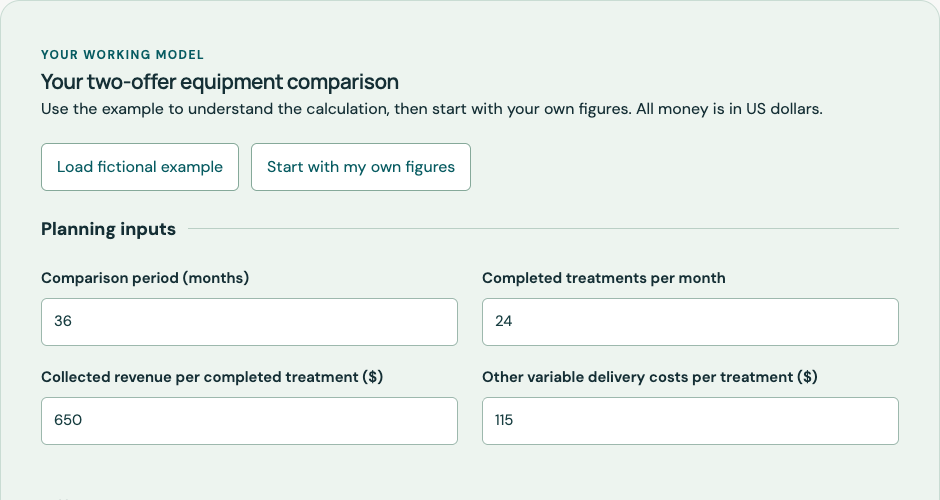
What is Ultherapy FDA cleared for?
As of the May 2026 clearance, the Ulthera System is cleared to lift the eyebrow, lift lax tissue under the chin and on the neck, improve lines and wrinkles of the décolleté and improve the appearance of skin laxity on the abdomen, arms and knees. Its intended use is “to achieve temporary changes in the physical appearance of the skin.” Merz’s instructions say it is for sale “by or on the order of a physician” and for use “only by properly trained physicians and properly trained persons under the supervision of such a trained physician.”
| Filing | What it added |
|---|---|
| DEN0800062009 | The original de novo authorization: eyebrow lift |
| K1217002012 | Lift of lax tissue under the chin and on the neck |
| K1225282012 | Transducer shelf life extended from 6 to 12 months |
| K1320282013 | DeepSEE imaging to 8 mm, to check coupling and depth |
| K1340322014 | Lines and wrinkles of the décolleté |
| K1806232018 | Updated console software; adds “which can also affect the appearance of lax tissue” to the neck wording |
| K2339962024 | The PRIME console |
| K2430352025 | Improving the appearance of skin laxity on the abdomen and the front and back of the arms, from 7 published studies with 167 people; cleared on the PRIME console |
| K2504182025 | PRIME Model 2.1: Wi-Fi and SEE.PLAN.TREAT |
| K2606182026 | Knees, from 3 published studies with 44 people, plus real-world data; cleared on PRIME Model 2.1 |
From the FDA 510(k) database and each summary, read November 21, 2026.
The body clearances rest on published studies rather than a new trial: Merz’s instructions note the individual studies “were not statistically powered,” with follow-up of one to six months (three to six for knees). The arm guidance also restricts treatment to the middle third of the upper arm and says safety and effectiveness aren’t established below a BMI of 17.8 or after massive weight loss; knee treatment is limited to the area just above the kneecap, not directly over it and not the sides or back of the knee, and not after any orthopedic knee procedure, including arthroplasty or arthroscopy with implants. If you plan to offer body treatments, cleared as improving the appearance of skin laxity, keep those limits in your screening and consent.
What does the research show for Ultherapy?
Ultherapy’s published record is extensive: in a 2025 meta-analysis of 42 microfocused ultrasound studies, most using the Ulthera System, investigators rated 89% of patients as showing some degree of improvement, and 84% of patients were satisfied, or 62% when “neutral” was an option.
| Study and what it tested | What it found | Read it with |
|---|---|---|
| Alam and colleagues, 201035 people, face and neck, prototype device | 86% judged to show a brow lift at 90 days by 3 blinded raters; average brow rise 1.7 mm | Single group; lower face not measured |
| Merz décolleté trial125 women enrolled, 54 evaluated | 36 of 54 (about 67%) improved on masked photo review at 180 days | The planned scale failed validation, so the endpoint was changed after the fact, with no pre-specified success criteria; 54 photo sets were excluded for quality; reviewers picked the wrong photo for 24% |
| Amiri and colleagues, 2025Meta-analysis of 42 microfocused ultrasound studies | 89% improved by investigator rating; satisfaction above 80% for the face and neck but 63% for other body areas; average pain 4.62 for the face and neck, 5.58 elsewhere | Funded by Merz; 7 of 12 authors receive Merz support; about a third of the face studies used other makers’ devices |
| Loyal and colleagues, 2026Head to head with Sofwave, upper arms, 14 women, randomized split-body | The authors concluded the parallel-beam device (Sofwave, per the trial registration) was as effective as MFU-V (Ultherapy) at 90 days, with no significant difference in pain and a shorter treatment time. A 2026 review reports mean crepiness-and-laxity improvements of 0.53 points with Sofwave and 0.88 with Ultherapy, with the change statistically significant only on the Ultherapy side | Very small, arms only, 90 days; too small to show equivalence; the review’s authors include two Jeisys employees; Sofwave Medical is listed as a collaborator in the trial registration; we read the abstract, not the full text |
| Alhaddad and colleagues, 2019Head to head with monopolar RF, face and upper neck, 20 women, randomized split-face | Both sides improved through 6 months, with no statistically significant difference in laxity scores, satisfaction or side effects | The abstract doesn’t name the RF device; too small to show the two are equivalent; a Merz-funded review reports that only the ultrasound side was still significantly improved on the upper neck at 6 months; we read the abstract, not the full text |
| Panithaporn, 2025Survey of 231 patients treated on both consoles and 92 treated first on PRIME, one Bangkok clinic | Less pain, redness and swelling reported after PRIME than after the older console, including among first-time PRIME patients | Single center, unblinded, no crossover design; the author notes a possible preference for the newer device; no conflicts declared |
| Humphrey and colleagues, 2025Review of adverse events, 506 people plus 106 FDA reports | Literature: mostly transient swelling, redness and pain. FDA reports: fat loss, nerve effects and scarring most often | FDA reports are unverified and can’t give rates |
Results as each source reports them; the décolleté trial is from Merz’s 2026 instructions for use. The studies differ in design, so their percentages can’t be compared.
What this means for your patients: results are gradual and usually subtle, measured in a millimeter or two of brow height in the original study. Merz’s claim that results “can last up to a year or more after just one session” is Merz’s; about 80% of the meta-analysis’s studies followed patients for 6 months or less. Set expectations accordingly and document them.
Ultherapy risks and contraindications
Merz contraindicates Ultherapy with open wounds or lesions or severe or cystic acne in the treatment area, active implants such as pacemakers or defibrillators, and metal implants in the treatment area. Merz says it should not be used on the eyes, on or over the eyelids or within the orbital rim, and that system components should be kept 6 inches (15 cm) from magnetically susceptible devices such as cochlear implants, neurostimulators, stents and shunts. Merz recommends avoiding the thyroid, major vessels and nerves, breast tissue and implants, and says the system hasn’t been evaluated over fillers or breast implants, in patients on anticoagulants, in pregnancy or breastfeeding, or in people with conditions including diabetes, autoimmune disease, epilepsy, herpes simplex and Bell’s palsy.
Side effects in the face and neck studies were mild and transient: redness for hours, swelling for up to 3 days, welting for up to a week, tenderness for up to 2 weeks and bruising. Nerve inflammation can cause temporary muscle weakness, numbness or tingling, resolving in 2 to 6 weeks, and burns that may scar can occur with incorrect technique, such as tilting the transducer, wrong line spacing or gel pockets. After clearance, voluntary reports have included burns or blisters, nodules, fat or volume loss, sagging or asymmetry, rash and itching, pigment change, scarring, numbness, paresthesia, nerve palsy, speech difficulty, headache and vision changes; Merz notes that they come from routine use and the wider microfocused ultrasound literature, that their frequency and cause can’t always be established, and that “nerve effects lasting for months have been described.” Compare your consent form with this list, not only the redness, and have your medical director and counsel review it.
What should you compare with Ultherapy PRIME?
Price the other ultrasound system with lift wording, and Thermage FLX if you also want to treat the eyelids.
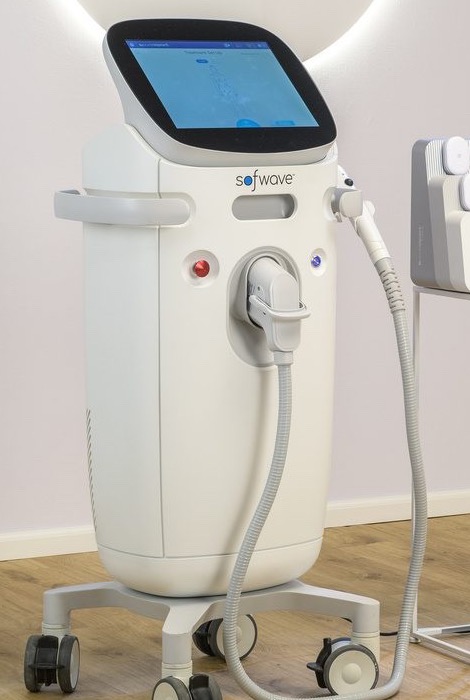
Parallel-beam ultrasound
Sofwave
Sofwave Medical; current filing 2025
Also cleared to lift the brow, under the chin and the neck, at one depth of about 1.5 mm with cooling; reusable applicators and pulses sold separately.
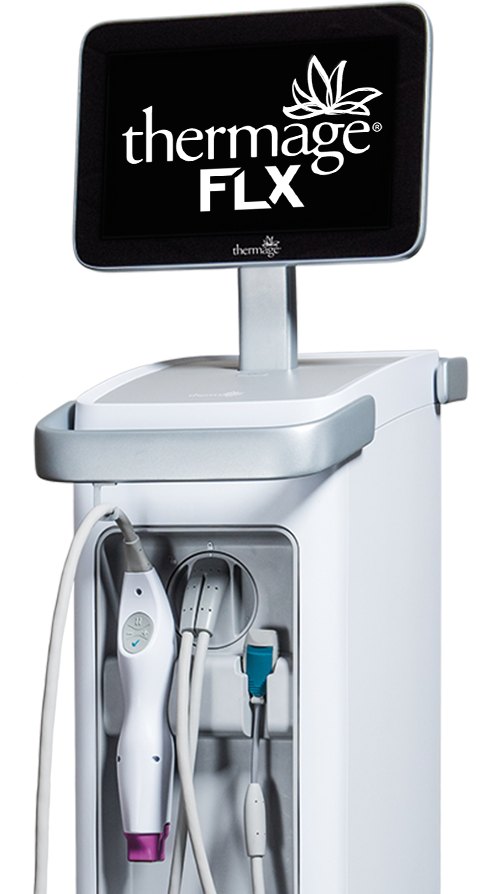
Monopolar RF, single-use tips
Thermage FLX
Solta Medical; cleared 2017
Cleared for wrinkles, including the eyelids, with a new tip each treatment; no lift wording.
Dual-frequency monopolar RF
XERF
Lutronic, sold by Cynosure Lutronic; cleared 2025
Marketed as tightening without numbing; cleared for electrocoagulation and hemostasis only.
Images: Sofwave Medical, Solta Medical, Cynosure Lutronic. Compare all five systems in our skin tightening machines guide.
What should the demo and written quote prove?
- Transducer economics: the price, line capacity and shelf life of each transducer, and the lines Merz’s guidelines use for a full face, a face and neck and the décolleté.
- A timed treatment: a full face and neck at the recommended energy levels, by the person who will treat your patients, with your comfort protocol.
- Imaging in your hands: have your provider run the imaging and confirm coupling and depth on a thin-skinned and a heavier patient.
- The console: PRIME or Model 2.1, the software version and the access key terms.
- Training: who Merz trains and for how long, and your counsel’s view of who may treat in your state.
- Service after the warranty: the annual price from year two, repair time and loaners.
Ask for references from practices with a patient mix like yours. Already bought one? Our paid consulting covers device launches.
Ultherapy PRIME buying questions
How much does an Ultherapy PRIME machine cost?
As of November 2026, Merz doesn’t publish a price for the console or the transducers, and we found no federal purchase of Ultherapy. Ask for an itemized quote with each transducer’s price, line capacity and shelf life, because the transducer lines are your cost per treatment.
Is Ultherapy PRIME better than the original Ultherapy?
Not in energy: the FDA filing for the PRIME console says it has identical ultrasound signal energy and treatment guidelines. PRIME adds a larger screen, a newer operating system and, in Model 2.1, Wi-Fi, color imaging maps and the SEE.PLAN.TREAT planning mode, and the abdomen, arm and knee indications were cleared on PRIME consoles, so ask Merz which indications an older console carries. A single-clinic, unblinded patient survey reported less pain, redness and swelling after PRIME.
How do Ultherapy transducers work, and do they expire?
Each transducer serves many treatments until its lines run out, and Merz’s instructions say to clean and disinfect it between patient uses; the console shows lines remaining and total capacity. Transducers also carry an expiration date, and Ulthera’s FDA filings list a 12-month shelf life; Merz says expired transducers should not be used. Merz doesn’t publish capacities or prices, so get them in writing.
What is Ultherapy FDA cleared for?
To lift the eyebrow, lift lax tissue under the chin and on the neck, improve lines and wrinkles of the décolleté, and improve the appearance of skin laxity on the abdomen, arms and knees (the knees added in May 2026). It is cleared, not approved.
Can Ultherapy treat the eyelids?
No. Merz’s instructions say it should not be used on the eyes, on or over the eyelids or inside the orbital rim. Thermage FLX is the system in our comparison whose clearance names the eyelids.
Is Ultherapy painful?
Patients report pain during treatment. A Merz-funded meta-analysis of microfocused ultrasound studies pooled an average pain score of 4.85 of 10 across 785 patients, which it called moderate, and higher on the body (5.58) than the face and neck (4.62); plan a comfort protocol with your medical director.
Ultherapy or Sofwave: which should a practice buy?
Both are ultrasound and both carry lift wording. One small randomized trial compared them: 14 women had Sofwave on one upper arm and Ultherapy on the other (Loyal and colleagues, 2026, with Sofwave Medical listed as a collaborator). The authors, whose abstract names the technologies rather than the brands, concluded Sofwave was as effective, with no significant difference in pain and a shorter treatment time; a 2026 review reports a larger laxity improvement on the Ultherapy side, statistically significant only there. With 14 women, the trial can’t show the two are equivalent. We found no face comparison. Ultherapy focuses energy at three depths with imaging and expiring transducers; Sofwave heats about 1.5 mm deep with cooling, reusable applicators and pulses. See our Sofwave guide.
Can I buy a used Ultherapy?
Ask Merz before you buy: whether it will service that serial number, sell transducers for it, and how the access key and software transfer; the console flags transducers that aren’t authorized. Check which indications that console and software version carry, since the body indications were cleared on PRIME consoles. Any transducers included may be near their expiration date or line limit, so check both.
Ultherapy PRIME or Thermage FLX: which should a practice buy?
Ultherapy is cleared to lift the brow, under the chin and the neck, and to improve the appearance of skin laxity on the abdomen, arms and knees, but not for the eyelids; Thermage FLX is cleared for wrinkles, including the eyelids, with a new tip each treatment. In a 2019 split-face trial of 20 women, Ultherapy-type ultrasound and monopolar RF, the technology Thermage uses, showed no statistically significant difference at 6 months; the trial was too small to show they are equivalent. See our Thermage FLX vs. Ultherapy PRIME comparison.
Ultherapy PRIME or XERF: which should a practice buy?
Ultherapy is focused ultrasound with FDA lift wording; XERF is radiofrequency cleared only for electrocoagulation and hemostasis. We found no study comparing them. See our XERF guide.
How long do Ultherapy results last?
Merz says results “can last up to a year or more after just one session.” In the Merz-funded 2025 meta-analysis, about 80% of the studies followed patients for 6 months or less, so evidence beyond 6 months is thinner than the claim.
Who can perform Ultherapy?
Merz’s instructions say the system is for use only by properly trained physicians and properly trained persons under a trained physician’s supervision, and it is sold on a physician’s order. How that applies in your state is a question for your counsel and medical director.
Sources and editorial notes
Last updated November 21, 2026. FDA records, Merz’s instructions and pages, practice menus and studies were checked November 21, 2026. Prepared by Darryl, drawing on 9+ years of med spa experience (he owned and managed a practice for 7+ years, then helped build another), with source-based research. Clinical review pending. Darryl has no hands-on experience with Ultherapy; his device experience includes an InMode EmpowerRF platform with Morpheus8 handpieces. NuWays MD is an education and referral resource, not a medical provider. This guide is general business education based on public records, not legal, regulatory or medical advice: confirm indications and advertising wording with Merz and your own counsel, and treatment settings with your medical director. Product names are trademarks of their makers.
View all 24 sources
- Merz: Ulthera System instructions for use (2026): indications, intended population, contraindications, precautions, side effects, postmarket events, transducers, energy levels, access key, body guidelines and the décolleté trial.
- FDA K260618: Ulthera System, knees (2026): knee indication from 3 studies with 44 people and real-world data.
- FDA K250418: Ulthera System PRIME Model 2.1 (2025): Wi-Fi, SEE.PLAN.TREAT, color maps; identical signal energy.
- FDA K243035: Ulthera System, body (2025): abdomen and arm laxity from 7 studies with 167 people.
- FDA K233996: Ulthera System PRIME console (2024): identical signal energy and guidelines; screen, weight and operating system changes.
- FDA K180623: Ulthera System (2018): the predicate console, its indications and a 12-month transducer shelf life.
- FDA K122528: Ulthera System (2012): transducer shelf life extended from 6 to 12 months.
- FDA K134032: Ulthera System, décolleté (2014), K132028: DeepSEE imaging (2013) and K121700: submental and neck (2012): the earlier indications.
- FDA De Novo DEN080006: Ulthera System (2009): the original authorization.
- FDA: Premarket notification 510(k): what a 510(k) clearance is.
- FDA Global Unique Device Identification Database: Ulthera transducers (the 2018 records list them as not single-use), the PRIME control unit and handpiece; searched November 21, 2026.
- Merz: Ultherapy PRIME for physicians and its imaging page: Merz’s depth, durability, “35% larger screen” and RF comparison claims.
- USAspending.gov: searched November 21, 2026 for Ultherapy, Ulthera and Merz; no device purchases found.
- Alam and colleagues, Journal of the American Academy of Dermatology, 2010: rater-blinded cohort of 35 people. Free abstract on PubMed.
- Amiri and colleagues, Aesthetic Surgery Journal, 2025: meta-analysis of 42 microfocused ultrasound studies, most with the Ulthera System, funded by Merz; satisfaction and pain by body region. Free full text on PubMed Central.
- Humphrey and colleagues, Dermatologic Surgery, 2025: systematic review of adverse events, including 106 FDA reports. Free abstract on PubMed.
- Loyal and colleagues, 2026: randomized, blinded split-body trial of Sofwave-type parallel-beam ultrasound and Ultherapy-type microfocused ultrasound on the upper arms, 14 women. Abstract on PubMed. The trial registration names Sofwave and Ultherapy and lists Sofwave Medical as a collaborator.
- Kumar and colleagues, Journal of Cosmetic Dermatology, 2026: systematic review of high-intensity ultrasound studies whose data table reports the Loyal trial’s scores by side; two authors work for Jeisys. Free full text on PubMed Central.
- Alhaddad and colleagues, 2019: randomized, evaluator-blind split-face trial of monopolar RF and microfocused ultrasound with visualization, 20 women, 6 months. Abstract on PubMed.
- Panithaporn, Journal of Cosmetic Dermatology, 2025: patient survey after Ultherapy PRIME and the older console at one clinic. Free full text on PubMed Central.
- Radiance Laser and Cosmetic Center, Pasadena, California: full face $2,060, face and neck $3,090, chest $995; read November 21, 2026.
- Trifecta Med Spa, Manhattan: $3,200 full face; read November 21, 2026.
- The Geldner Center, Chicago and Oak Brook: face and neck $4,000 to $6,500, priced at consultation; read November 21, 2026.
- NuWays MD: Skin tightening machines: the other systems’ records and the worked cost example; each system’s guide lists its sources in full.
Useful next reads
BEFORE YOU SIGN
Know what your equipment quote leaves out.
Get the free practice decision kit: a quote-review checklist that goes past the sticker price, plus the planning questions and tools owners use before they commit.
Free. No account needed. Your request isn’t shared with clinics or vendors.THE KIT INCLUDES
- A quote-review checklist that goes beyond the sticker price
- Opening, software and capacity planning questions
- Direct links to the editable planning tools