Skin-Tightening Machines: RF, Ultrasound and the Business Case for Your Practice
A skin-tightening machine can add a service for patients who want modest improvement in laxity without surgery. The investment becomes harder to justify when the marketing promises a facelift-like result, the patient actually needs a different treatment, or the business model leaves out expensive tips and slow booking months.
Before buying, connect the treatment to the business: who wants it, what improvement is realistic, who performs it and what remains after supplies and staff are paid. This guide explains RF and ultrasound systems, then tests their cost assumptions against a slower booking month.
Editorial details
Four things to understand before comparing quotes
RF or ultrasound
These use different forms of energy and delivery. Neither category is one uniform treatment.
Mild laxity or major excess skin
Patient selection shapes satisfaction. Noninvasive treatment cannot promise surgical removal or repositioning.
Per-session or treatment-series model
A higher-ticket visit and a lower-priced series use appointments, supplies and follow-up differently.
High disposable cost or low disposable cost
Compare contribution after supplies and staff time, not the treatment price or device payment alone.
What do skin-tightening machines actually do?
External radiofrequency and ultrasound systems deliver energy intended to create controlled tissue heating and stimulate a remodeling response. They do not all heat the same tissues or do so in the same pattern. Treatment effect depends on the specific device, anatomy, patient selection and technique.
The practical expectation is usually a degree of improvement in appropriately selected laxity or wrinkles, rather than removal of substantial excess skin. A patient bothered by hollowing, facial movement lines, pigment or a hanging skin fold may need a different discussion. A tightening machine should not become the default answer to every aging concern.
A systematic review of microfocused ultrasound found benefit in mildly to moderately lax facial skin, with variable protocols and limited longer-term evidence. Studies using improvement scales do not tell an owner that every patient will notice a large lift or return annually. That distinction belongs in both consultations and revenue projections.
External RF versus ultrasound: how the technologies differ
External radiofrequency
RF uses electrical energy to heat tissue. With monopolar RF, current travels from a treatment electrode through a return path. With bipolar RF, current passes between paired electrodes. The names describe how energy is delivered. Compare the actual treatment, cooling and monitoring features to understand what those designs mean for your team.
External applicators contact the skin without needles entering it. Temperature feedback, contact monitoring, cooling, treatment geometry and the operator’s technique all matter. A low-disposable-cost handpiece may still require substantial hands-on time over repeated visits.
Microfocused ultrasound with visualization
Microfocused ultrasound concentrates acoustic energy into defined treatment zones. Ultherapy PRIME combines treatment with ultrasound imaging so the clinician can see tissue during planning and delivery. Its transducers differ by treatment depth; imaging is a functional distinction when comparing a proposal with a generic “HIFU” machine. The manufacturer’s technical overview identifies the transducers and visualization capability.
HIFU is a broad term for high-intensity focused ultrasound. A low-priced device using that term should not inherit Ultherapy’s evidence, US indications or support simply because both use ultrasound. Compare the exact device and its labeling.
Other ultrasound approaches
Sofwave uses parallel ultrasound beams, with heating centered in the middle layer of the skin at about 1.5 mm according to the manufacturer. Ultherapy uses a different focused-ultrasound design with visualization. The depth is a treatment-design feature; match it to the intended anatomy and goal rather than using “deeper” as a quality score. See Sofwave’s US technical brochure.
| Approach | What the owner is buying | Operating implications | What it should not be assumed to replace |
|---|---|---|---|
| External monopolar RF | An energy system with area-specific tips and cooling | Tip cost, treatment coverage, comfort plan and substantial appointment time | Surgery for major laxity, or every other RF device’s results |
| External bipolar RF | Contact applicators, sometimes with hands-free options | Repeated visits may require more total room time; applicator replacement and staff supervision still matter | Needle RF, internal RF or guaranteed hands-free staffing savings |
| Microfocused ultrasound with visualization | Focused treatment plus imaging and compatible transducers | Imaging competency, line/transducer accounting and a realistic comfort plan | An unverified HIFU device or a surgical facelift |
| Parallel-beam ultrasound | A different ultrasound delivery design | Pulse/use economics, coverage, preparation and labeled treatment scope | Every indication or depth associated with another ultrasound platform |
Thermage, Ultherapy, Sofwave and Forma: which systems deserve a closer look?
These systems support different service models. Use the table to choose relevant demonstrations and quote questions; it is not a clinical ranking.
| System | Technology and scope to investigate | What to include in the demonstration | Ownership question |
|---|---|---|---|
| Thermage FLX | External monopolar RF with area-specific treatment tips | Exact tip, treatment area, patient comfort, full appointment time and follow-up | What is the tip price, usable pulse allowance and single-patient-use policy? Which cooling supplies and service costs are additional? |
| Ultherapy PRIME | Microfocused ultrasound with real-time visualization | Imaging workflow, treatment planning, transducer changes and comfort management | What transducers and treatment capacity are included, and how are replacement lines or transducers purchased? |
| Sofwave | Parallel-beam ultrasound for its specified US indications | Actual coverage, preparation, comfort measures and time from room entry to turnover | How are treatment uses priced? What is included in service, and what are the loaner conditions? |
| InMode Forma / Define configuration | External bipolar RF; Define may combine operator-administered and hands-free applications | Which applicators are included, who operates or monitors them and how visits fit the schedule | Are you paying for external RF only or also Morpheus8 and other applications? Are those services needed? |
Sources: Thermage, Ultherapy PRIME, Sofwave and InMode Define. Manufacturer claims about speed, comfort and results are not independent comparative testing.
Why the treatment tip deserves its own line in the quote
Thermage states that its tips deliver a specified number of pulses and cannot continue being used after treatment of a patient. A tip with pulses left is not an invitation to share it between patients. Ultherapy describes its transducers as multi-patient-use components, which is a different structure. Your accounting must follow the actual component’s instructions rather than assuming every technology uses a disposable cartridge in the same way.
Ask for the current written cost and use policy for your quoted system. Include expiration, minimum orders, shipping, damaged-tip credits, remaining capacity on used components and whether fees can change during the financing term. Do not build the investment case around an online seller’s unverified tip price.
Keep minimally invasive alternatives in a separate comparison
RF microneedling introduces needles and delivers heat in or under the skin. Internal RF systems, including RF-assisted procedures such as FaceTite, place a treatment component beneath the skin. These are different services from passing an external RF handpiece over intact skin.
They change patient preparation, infection-control requirements, anesthesia or comfort planning, clinical staffing, follow-up and complication management. A practice equipped for a noninvasive facial service should not assume it can add an invasive application merely because it fits the same console. InMode’s technology overview distinguishes external RF, RF-assisted lipolysis and fractional needle RF.
The FDA’s 2025 RF microneedling communication includes reports of serious complications with certain uses. That notice concerns needle RF and should not be presented as a complication rate for all external RF. Use the RF equipment buying guide when evaluating that separate service.
How strong is the evidence for skin tightening?
| Evidence | What it supports | What it does not settle |
|---|---|---|
| 2023 MFU meta-analysis, 13 studies and 477 participants | Measured and reported improvements after treatment, assessed at intervals including 90 and 180 days | A head-to-head ranking of every current ultrasound and RF platform, or guaranteed magnitude of lift |
| 2023 MFU systematic review, 16 studies | Improvement in selected mild/moderate laxity; objective measurements and subjective ratings do not describe the same outcome | Broad generalization to severe laxity, all demographics or indefinite durability |
| Systematic review of RF face/neck rejuvenation | Positive findings across several outcomes, with higher satisfaction among people seeking modest rejuvenation | That different RF systems, areas and protocols are interchangeable |
| 2024 MFU-V adverse-event review | Published studies and adverse-event reports identify different safety signals | The frequency of rare injury from spontaneous reports alone |
References: Ling and Zhao, Contini and colleagues, RF systematic review and MFU-V adverse-event review.
For a useful vendor evidence discussion, request the exact device generation, treated area, patient selection, comparison group, follow-up period and definition of improvement. Ask whether images were standardized and whether results were judged by patients, investigators or blinded reviewers. Also ask how many people had little improvement. An average score can hide that result.
“No downtime” also needs definition. Being able to return to daily activities does not mean treatment is painless or free of tenderness, swelling, bruising or other risk. The comfort and follow-up plan belongs in the service budget.
How much do skin-tightening machines cost?
A published used-system price is a useful reference, but the generation and ongoing supply costs can matter more than the initial discount. On September 27, 2026, MedPro Lasers’ Thermage inventory displayed these asking prices:
| Preowned model | Displayed asking price | What needs its own quote |
|---|---|---|
| Thermage FLX | $64,950 | Exact serial number/year, included tips and accessories, service history, warranty, delivery and training |
| Earlier Thermage CPT generation | $19,950 | Remaining support and parts access, compatible supplies, component condition and transfer requirements |
The $45,000 gap is between two generations from one seller, not evidence of equivalent capability at a discount. The inventory page does not establish a complete ready-to-treat package. Neither figure is a new-system quote, an independently inspected valuation or a market average.
For a new Thermage, Ultherapy PRIME, Sofwave or Forma configuration, get a written proposal that separates acquisition, treatment supplies and recurring service. New-system prices are not verified here. Use the dated used listings as reference points, then compare the exact hardware, training and support in your new-system proposal.
A worked skin-tightening business case
This fictional model isolates the effect of an expensive per-treatment supply. It is not a quote for Thermage, Ultherapy, Sofwave or InMode, and it does not compare their clinical value.
Assume the practice collects $1,500 per completed treatment, after discounts. An expensive tip/use allowance costs $450, other variable supplies cost $50, and added staff time costs $150. Contribution before fixed costs is:
$1,500 − $450 − $50 − $150 = $850 per completed treatment.
Monthly added fixed costs total $4,500: a $2,500 equipment payment, $1,500 incremental marketing and a $500 service reserve. These are assumptions to replace with your own figures.
| Completed treatments in a month | Collected treatment revenue | Contribution after variable costs | After $4,500 added fixed costs |
|---|---|---|---|
| 4 | $6,000 | $3,400 | −$1,100 |
| 6 | $9,000 | $5,100 | $600 |
| 10 | $15,000 | $8,500 | $4,000 |
The model first covers its listed added costs at six treatments, because $4,500 ÷ $850 = 5.29 and a partial treatment is not a completed booking. It still excludes existing rent, administrative overhead, taxes and owner compensation beyond the included treatment labor. The final column is not take-home profit.
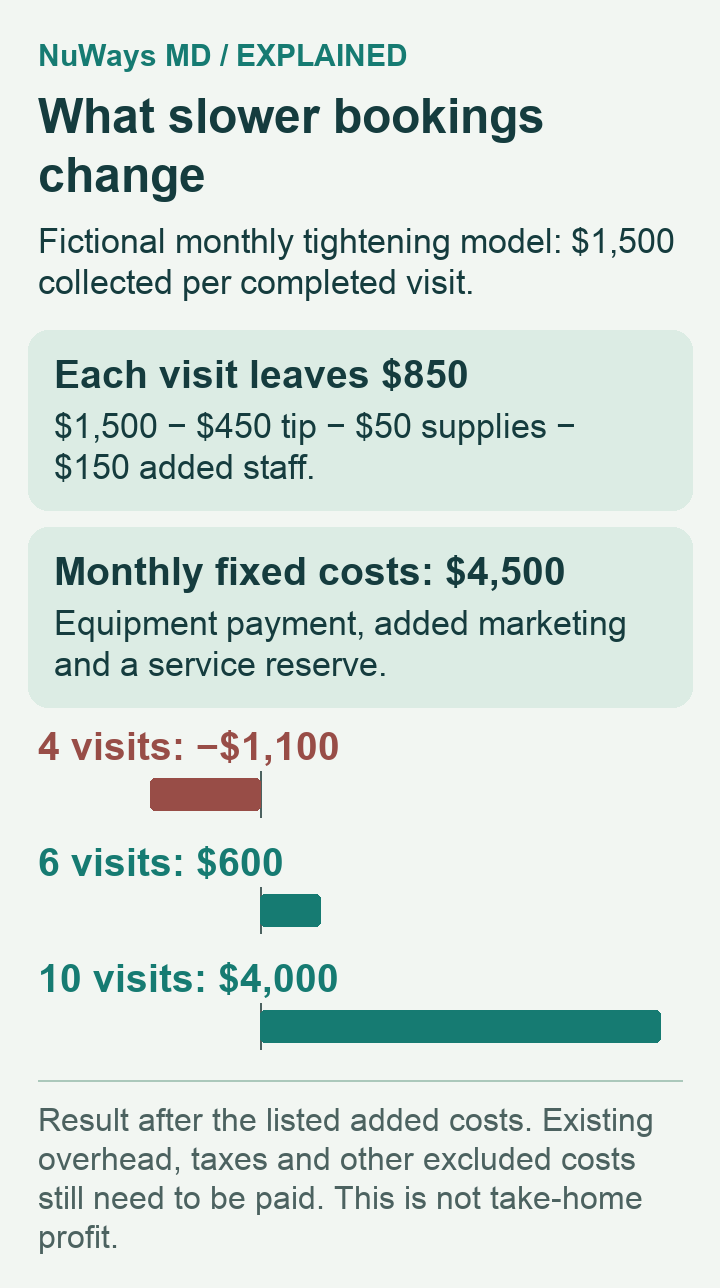
What happens if you forget the $450 supply?
Contribution appears to be $1,300 instead of $850. At four treatments, that incomplete model shows $700 left over, while the more complete model shows a $1,100 shortfall. A missing disposable changes the purchase decision even though the headline treatment price looks attractive.
Discounting has a similar effect. If collected price drops to $1,200 but the same $650 of variable costs remain, contribution falls to $550. Covering $4,500 then requires nine completed treatments, rather than six. That is why a promotion should be tested before it becomes the plan for making the payment.
Use the equipment ROI calculator for your assumptions and the ownership-cost guide for financing and expense boundaries. Unknown supply or service costs should stay unknown until quoted.
Repeated visits change capacity and cash flow
A lower per-visit price may still support a viable service, but a six-visit package occupies six appointments. Do not count the full package payment as new revenue again at each redemption, and do not spend prepaid cash as if no treatment obligations remain.
Fictional workflow comparison: one plan uses a 90-minute appointment; another uses six 30-minute appointments. The second consumes 180 booked minutes before additional consultation or administration. It could work well for a repeat-visit practice, but it is not automatically more efficient because each visit is short.
Likewise, a hands-free applicator does not imply unattended treatment or six simultaneous appointments. Establish supervision, emergency access, monitoring and cleaning requirements before estimating how many patients one staff member can support. The capacity-planning guide helps separate room availability from qualified staff time.
Treat maintenance as a possibility, not guaranteed recurring revenue
A manufacturer may describe maintenance or retreatment. Your forecast should separate new patients, patients returning for review and patients who actually choose and are suitable for another treatment. Annual rebooking assumptions need your own retention data. Patients can move, change budgets, be dissatisfied or no longer be appropriate candidates.
Which practice situations make a purchase more or less sensible?
A new solo practice
A device with a large payment and costly treatment supplies needs enough suitable demand before the first invoice arrives. Consider delaying if the plan depends on patients appearing solely because the machine is installed.
A busy nonsurgical practice
Use consultations and treatment records to identify an unmet need. Check whether staff and room time can absorb preparation, treatment and follow-up without displacing a service that already performs well.
A surgical practice
A noninvasive option can serve patients with different goals or tolerance for recovery. Preserve a clear clinical pathway for those who need surgical assessment instead of stretching the machine’s promise.
What should be in the final quote and launch plan?
- Exact console, model generation, software, included handpieces and treatment components.
- Current US indications and the clinical lead’s patient-selection plan.
- Tip, pulse, line or use fees; shipping; expiration; and damaged-component policies.
- Installation, electrical needs, training, refresher training and staff turnover costs.
- Warranty scope, exclusions, service renewal, loaner availability and realistic repair logistics.
- Full appointment duration, comfort-related costs, documentation and clinical follow-up ownership.
- A slow-month scenario using completed visits and collected revenue.
- A way to measure actual consultation conversion, outcomes, cancellations, supply usage and complaints after launch.
If a seller promises a rapid payback, ask to see the assumptions behind it. Compare them with your existing lead volume, conversion and staffing, then use the equipment quote comparison to normalize competing offers.
Make the purchase fit the practice.
Describe the service you want to add, or bring a quote. NuWays MD can help organize the operating and ownership questions before you commit. Manufacturer sharing requires separate permission.
Get help with my tightening equipment decision →Frequently asked questions
Which skin-tightening machine is best for a med spa?
There is no single winner across patient populations, treatment goals and budgets. The stronger purchase is the configuration your clinical team can use appropriately, for a service with sufficient demand and an affordable slow-month cost structure.
Is ultrasound better because it goes deeper?
Depth is not a stand-alone quality score. Different devices target different tissue zones. Patient anatomy, indications, delivery and operator competence matter, and deeper treatment is not automatically appropriate for a particular concern.
Can I describe these services as a nonsurgical facelift?
Be careful about the expectation that wording creates. Describe the specific improvement the treatment may offer and its limitations. A device should not be sold as producing surgical skin removal or repositioning when it does not.
Are there machines with no consumables?
Some systems have low or no per-patient proprietary disposables. They still incur staff time, supplies, cleaning, service and eventual component costs. Compare total treatment contribution and appointment time rather than one line item.
Should I count every consultation as a future treatment?
No. Some patients will be unsuitable, choose a different option or decide against treatment. Forecast completed paid treatments separately from inquiries and consultations, then track the actual conversion after launch.
Sources and editorial notes
Sources checked September 27, 2026. This is business-planning education, not treatment instruction, financial advice or a clinical endorsement. Independent clinical review has not been completed.
Device architecture and operating requirements
- Thermage product and tip information: external RF, area-specific tips and the manufacturer’s use policy. Advertised outcomes and timing are not an independent comparison.
- Ultherapy PRIME technical overview: visualization and multi-patient transducer architecture.
- Sofwave US brochure and provider FAQ: parallel-beam delivery, treatment planning and support descriptions. Confirm contract terms directly.
- InMode Define and technology FAQ: external Forma and hands-free applications versus needle and internal RF technologies.
Published equipment prices
- MedPro Lasers: Thermage inventory: FLX and earlier CPT asking prices checked September 27, 2026. Complete configurations and current transaction terms require a written quote.
Research and safety
- Ling and Zhao, 2023 MFU meta-analysis: 13 studies, 477 participants and time-specific improvement assessments.
- Contini and colleagues, 2023 MFU review: mild/moderate laxity, differing outcome measures and evidence limitations.
- RF face and neck systematic review: heterogeneous RF evidence and the importance of modest expectations.
- MFU-V adverse-event review: published adverse events and spontaneous reports. The latter cannot establish an incidence rate.
- FDA RF microneedling safety communication: risks reported with certain needle-RF uses, separate from the external-RF discussion.
The Thermage asking prices are dated seller observations. Dollar amounts in the worked business model, booking volumes and schedule comparisons are fictional examples. The chart is an original NuWays MD calculation, not manufacturer pricing or a prediction of profit. No manufacturer paid for placement, and listing a device does not establish a referral partnership. Read our editorial and commercial approach.