What Happens When You Stop Minoxidil?

Stopping minoxidil usually means gradually losing the hair growth the treatment was supporting. But forgetting one application, changing products and stopping a prescription tablet are different situations.
Whether the problem is scalp irritation, cost, an inconvenient routine or disappointing results, the next step starts with why you want to stop. Here is what the evidence says about shedding, timing and keeping your options open.
Editorial details
THE QUICK ANSWER
For pattern hair loss, minoxidil generally needs ongoing use to maintain its benefit. Topical product information warns that newly regrown hair will probably be lost within about three to four months after stopping. That describes treatment-supported regrowth, not every hair on your head. Topical minoxidil patient information.
A missed application does not call for a double dose. If you take oral minoxidil, ask your prescriber how to change or stop it. Do not use an online tapering schedule to manage side effects. Missed topical doses; oral medication guidance.
Chest symptoms, swelling or feeling faint? Read the safety guidance first ↓
What happens to your hair when you stop minoxidil?
Minoxidil helps some people regrow hair and maintain thickness, but it does not cure pattern hair loss. Once treatment stops, its benefit gradually wears off. A less full part or thinner-looking crown may become noticeable even if you never saw dramatic new growth while using it. American Academy of Dermatology treatment guidance.
The direct withdrawal evidence is small but useful. In a 1987 study, 10 men used topical minoxidil for at least four months. After they stopped, most of the additional nonvellus hairs (hairs beyond fine peach fuzz) recruited during treatment were lost. The counts were taken in a defined scalp area. Olsen and Weiner, 1987.
Think of the decision as a trade-off: what benefit is the treatment giving you, and what is it costing in money, time or side effects? You can decide a routine is no longer right for you without being promised that its results will last after it ends.
How long after stopping minoxidil does hair fall out?
The useful time frame is months, not an overnight loss of all your progress. The three-to-four-month estimate in topical labeling is a guide to losing regrowth, not a personal countdown to the first shed.
One missed dose and stopping treatment are different.
One missed application
Continue with the next scheduled topical dose. Do not add extra product to catch up.
The following weeks
The treatment benefit fades gradually. You may notice more shedding or less fullness; the timing varies from person to person.
About three to four months after stopping topical treatment
Product information says newly regrown hair will probably be lost by this point. Your visible change depends on your response and underlying hair loss.
If you record changes, use photos with the same lighting, part and angle. A dated set is more useful at a review than comparing a wet-hair shower photo with an older styled photo. Note when you stopped, why you stopped and any other medicines or health changes.
Can stopping minoxidil leave your hair worse than before?
Your original starting photo is not a guaranteed destination. Pattern hair loss can progress over time, including during the years you use treatment. Losing a treatment benefit later can therefore look different from simply returning to an old photograph. AAD: progression of female pattern hair loss.
In the small withdrawal study, four of the 10 men had hair counts below their original baseline after stopping. The study could not explain each man’s decline or establish that minoxidil permanently damaged the follicles. Study abstract.
Sudden patches, scalp pain or a major change in the pattern deserve a fresh assessment. Do not assume every later hair problem is a normal consequence of stopping.
Can you taper off minoxidil without losing hair?
Tapering has not been established as a way to keep minoxidil-supported regrowth after treatment ends. The label and dermatology guidance reviewed for this article emphasize continued treatment to maintain benefit. They do not provide a proven topical taper that makes the benefit permanent. AAD treatment guidance.
That is a different question from how to stop a prescription safely. An expert consensus on low-dose oral minoxidil recommends gradual discontinuation, but this is prescribing guidance, not evidence that tapering prevents hair loss. Your prescriber should set the plan around your dose, reason for treatment, symptoms and other medicines. Oral minoxidil expert consensus.
Does the reason you started minoxidil change the answer?
Yes. Long-term pattern hair loss and temporary shedding are not the same condition. Telogen effluvium can follow a trigger such as illness, major stress or childbirth; fullness may recover after the trigger resolves. Temporary shedding and another type of hair loss can also occur together. AAD: shedding versus hair loss.
If minoxidil was prescribed during a temporary shedding episode, ask whether that trigger has resolved and whether pattern hair loss is present too. Do not turn someone else’s successful stopping story into evidence that your own hair will behave the same way.
Over-the-counter minoxidil labeling advises against self-treating sudden or patchy loss, an unknown cause, or hair loss associated with childbirth. Those situations need a diagnosis rather than a trial-and-error stopping plan. Product warnings.
Want to stop? Start with the problem you are trying to solve.
“My scalp itches or burns.”
Stop using a topical product that causes scalp irritation and contact a provider. Ask what is causing the reaction before switching ingredients or applying another product to irritated skin. Our minoxidil and itchy scalp guide explains what to discuss. AAD guidance.
“The routine or cost is too much.”
Bring the exact product, refill cost and steps you keep missing to the discussion. Ask whether another appropriate formulation would solve the problem. Compare foam and liquid routines and ongoing minoxidil costs before paying for a replacement.
“I do not see results.”
Check how long you have used it and the review point on your own label. Results take months. For example, men’s 5% foam labeling says to stop and ask a doctor if there is no regrowth after four months. Do not assume a few weeks proves failure, or continue indefinitely without review. Men’s foam label.
“I am planning pregnancy.”
Discuss your hair-loss medicines before trying to conceive. AAD advises avoiding minoxidil during pregnancy, when planning pregnancy and while breastfeeding. Get instructions for your exact topical or oral product rather than following a generic online taper. AAD pregnancy guidance.
Starting treatment can also temporarily increase shedding. If that is your concern, read what to check when minoxidil causes shedding. It is a different question from losing regrowth after stopping.
When should you get medical help instead of waiting?
Do not continue treatment just to protect your hair.
Seek urgent medical attention for chest pain, trouble breathing or fainting. Rapid heartbeat, new swelling, unexplained weight gain or significant lightheadedness also need prompt medical advice. Topical product labeling says to stop use and ask a doctor for several of these symptoms; if you take tablets, contact the prescriber promptly for instructions. Topical safety information; oral safety information.
A gradual hair change can wait for a planned review. These symptoms should not wait for a hair appointment or an online response.
Also arrange an assessment for sudden or patchy loss, a painful or inflamed scalp, or a cause you have never had checked. Photograph the product label and bring a list of medicines and supplements, including any combination hair-loss formula.
Can you switch treatments or restart minoxidil later?
You can discuss another treatment, but a replacement should fit your diagnosis and reason for stopping. Changing from liquid to foam is not the same decision as changing to an oral prescription. Our oral versus topical minoxidil comparison explains the differences in routine, evidence and side effects. Buying a supplement or device does not establish that it will preserve the hair minoxidil was supporting.
Ask your provider what the new option is expected to do, whether there should be a transition and how you will judge the result. Some hair-loss plans combine treatments, but that is not proof that every combination keeps the same results when one component is removed. AAD: matching treatment to the cause. If finasteride is the proposed alternative, compare how finasteride and minoxidil differ before assuming one preserves the other’s benefit.
If you want to restart, explain why you stopped and what changed afterward. Do not restart on your own after a suspected serious reaction. Nor should you count on quickly recovering every lost gain: the response needs to be assessed over time, just as it did when you first started.
Make the next review useful.
- What is my diagnosis, and is more than one cause involved?
- Was this treatment regrowing hair, maintaining it, or not helping?
- Does my reason for stopping change what I should do today?
- If I switch, what is the exact plan and follow-up date?
- Which symptoms mean I should contact you sooner?
Bring a clearer picture to your hair-loss review.
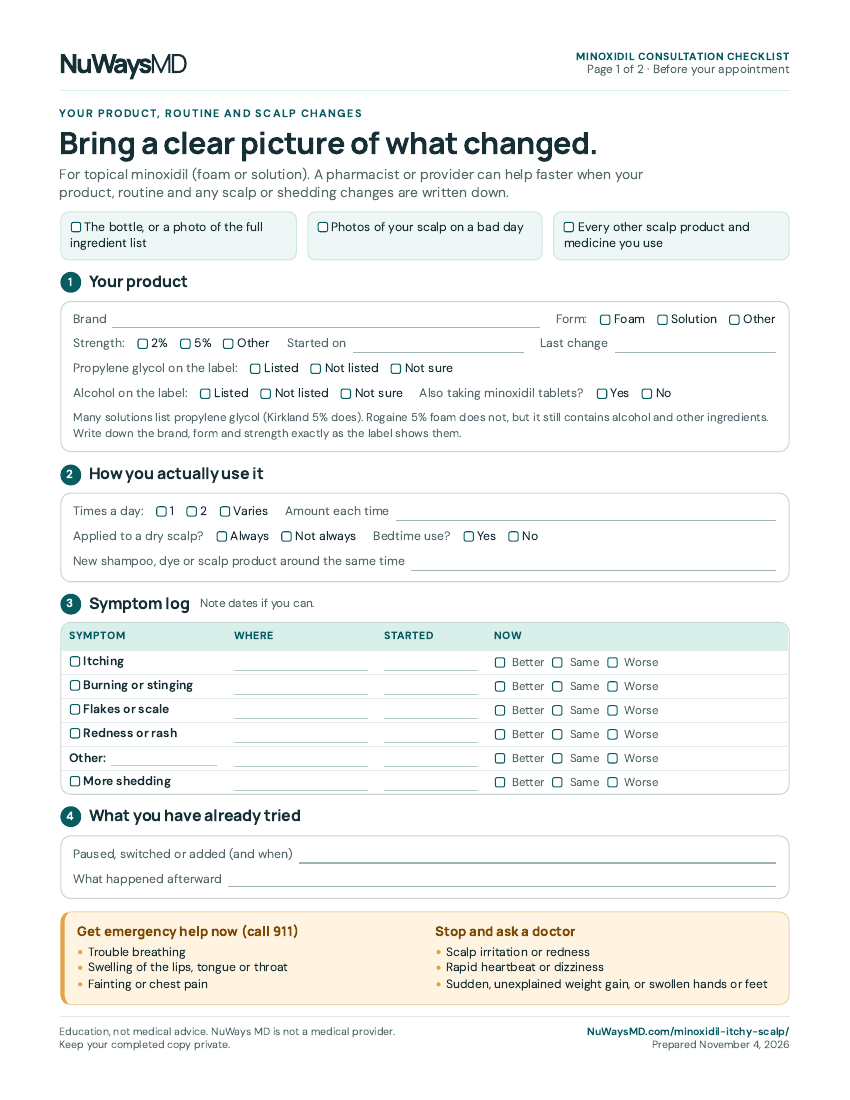
Use the minoxidil consultation checklist to record your product, symptoms and questions. Note your stopping date and reason on your own copy, and include any minoxidil tablets or combination prescriptions.
Email me the minoxidil checklist →
Free checklist and two-page PDF. Newsletter signup is optional. Keep your completed medical notes on your own copy.
Questions about stopping minoxidil
Will all my hair fall out if I stop minoxidil?
No. The expected loss is of treatment-supported regrowth, not all scalp hair. How much thinner your hair looks depends on your response and underlying condition. Sudden severe or patchy loss needs an assessment rather than an assumption that it is normal withdrawal.
What if I miss minoxidil for one day?
For topical minoxidil, skip the missed application and continue your regular schedule. Do not double the next dose. A missed day is not the same as deciding to discontinue treatment. Follow your own prescription instructions if you take tablets. Missed-dose guidance.
Can I take a week off minoxidil?
A week-long break is not guaranteed to preserve your results. If a break is needed for scalp symptoms, a procedure or another health concern, ask the treating provider for instructions. Do not make up missed applications with extra product.
What if I stop after only a few weeks?
A few weeks is generally too early to judge regrowth, and no reliable percentage predicts how much hair a short-term user will shed after stopping. Tell your provider how long you used it, especially if irritation or new symptoms made you stop.
Do I have to use minoxidil forever?
You are not obligated to keep using it. For ongoing pattern hair loss, maintaining its benefit generally requires continued treatment. The decision is whether that benefit is worth the routine and risks for you, and whether another suitable approach better fits your goals.
Does stopping oral minoxidil follow the same three-to-four-month timeline?
That often-quoted estimate comes from topical product information. Do not treat it as a precise forecast for oral therapy. Discuss both the stopping instructions and expected hair changes with the prescriber; tablet dosing should not be improvised from a topical guide.
Sources and editorial method
Sources checked November 6, 2026. This guide separates topical labeling, a small withdrawal study and expert advice about oral prescriptions. It does not present a tested tapering protocol. The cover is an editorial illustration; no patient result is shown.
How we review evidence · Disclosures
View all 10 sources
- DailyMed: 2% topical minoxidil patient information. Stopping, missed applications and product warnings. The three-to-four-month estimate concerns newly regrown hair.
- DailyMed: Cardinal Health 5% topical solution. The stopping estimate and missed-dose advice also appear in this men’s product leaflet.
- MedlinePlus: topical minoxidil. Missed doses, ongoing benefit and symptoms needing medical attention.
- DailyMed: men’s Rogaine 5% foam. Product-specific review timing and warnings; instructions are not identical for every minoxidil product.
- Olsen and Weiner, 1987: topical minoxidil withdrawal. Published abstract reviewed. Ten men; older 2% or 3% preparations. It does not establish outcomes for all users or test tapering.
- AAD: hair-loss diagnosis and treatment. Maintaining treatment benefit and choosing care by cause.
- AAD: female pattern hair loss. Progression, irritation, treatment expectations and pregnancy precautions.
- AAD: shedding versus hair loss. Temporary triggers and the possibility of overlapping conditions.
- MedlinePlus: oral minoxidil. Prescription safety and high-blood-pressure treatment. This is not a hair-loss dosing protocol.
- Indian expert consensus on low-dose oral minoxidil, 2023. Includes gradual discontinuation advice. Expert consensus, not a trial proving retained regrowth after stopping.