INJECTABLES / COLLAGEN STIMULATORS
Sculptra vs Radiesse: Cost, Results, How Long Each Lasts and Which Fits You
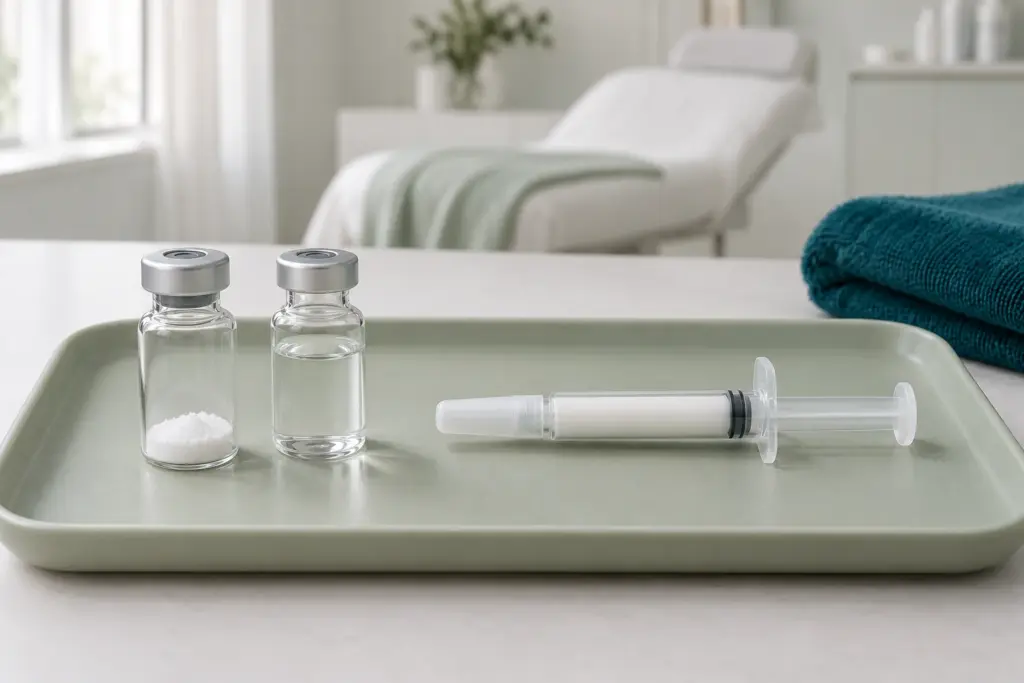
Sculptra and Radiesse are injectables that prompt your skin to build collagen, but they work on different clocks. Undiluted Radiesse adds volume at the visit, while Sculptra’s change builds over a series of visits. Here is how they compare on cost, results, how long they last and side effects, and how to tell which one fits your goal.
See which one fits you ↓Editorial details
The quick answer on Sculptra vs Radiesse
Main difference
Undiluted Radiesse adds volume at the visit; Sculptra builds results over weeks to months. Both work partly by prompting your skin to make collagen. Neither is better overall: the right one depends on the area, how fast you want a change and how many visits you can plan.
Cost
Posted prices we checked ran $550 to $1,000 per Sculptra vial and $600 to $1,100 per Radiesse syringe. Sculptra is usually a series, so compare the full plan. Price your plan.
How long it lasts
FDA’s filler page says the effects of Radiesse’s material last about 18 months and Sculptra’s may last up to 2 years. In Sculptra’s cheek trial, 76.9% of the people still followed at 24 months were rated at least one grade better on the trial’s wrinkle scale, with no treatment after their first series. No trial has compared the two.
Side effects
Bruising, swelling and tenderness are common. Lumps under the skin (nodules) are the specific problem to ask about. Neither one can be dissolved the way hyaluronic acid filler can, and both carry a rare but serious risk of a blocked blood vessel.
What is the difference between Sculptra and Radiesse?
They are different materials that deliver results on different timelines. Radiesse is calcium hydroxylapatite (CaHA): tiny spheres of a mineral that FDA describes as commonly found in teeth and bones, suspended in a gel. Merz, its maker, says restored volume is visible right after a standard Radiesse treatment and collagen builds over time. Diluted Radiesse, used for chest wrinkles, is a skin treatment given in three sessions. Sculptra is poly-L-lactic acid (PLLA), a biodegradable material also used in absorbable stitches. It comes as a powder that is mixed with sterile water before injection.
That difference shapes the first weeks. Sculptra’s labeling tells providers to warn patients that the area will look fully corrected at the end of the session because of the water, but that this swelling fades within several hours to a few days and the original look returns. The improvement then appears gradually over several weeks, and Sculptra is given as a series.
| Radiesse | Sculptra | |
|---|---|---|
| When you see a change | Undiluted: at the visit, according to its maker. Diluted for the chest: assessed after three sessions | Gradually, over several weeks after each session |
| Usual plan | One or more visits: trials allowed touch-ups, and chest treatment is three visits | A series: trials allowed up to four sessions, 3 to 4 weeks apart |
| How long FDA says effects last | About 18 months | Up to 2 years |
| Lips and eye area | Safety not established; lip use may cause nodules | Not for the red part of the lips; eye area not studied |
Sculptra or Radiesse: which one fits your goal?
Choose by area and timeline. We found no large trial comparing how the two change facial appearance. The comparisons we found were small: a 21-person randomized study of smile lines that reported gene activity in skin samples, and a five-person study in the arms that found no clinical difference. So the choice rests on what each product is approved and studied for, and how you want the change to arrive.
Radiesse may fit if
- You want added volume you can see at the visit, from undiluted Radiesse.
- Your goal is an approved Radiesse area: smile lines and folds, the jawline or the backs of the hands. For chest wrinkles, the approved option is diluted Radiesse in three sessions.
- You prefer fewer visits for an area like the jawline: its trial used one treatment plus an optional touch-up.
Sculptra may fit if
- You prefer a gradual change over several months.
- Your goal is softening smile lines or cheek wrinkles, which are among its approved uses.
- You can plan several visits 3 to 4 weeks apart, plus the massage at home.
When neither is the best choice
For the lips and under-eye hollows, both labels raise flags. Radiesse’s labeling says safety there has not been established and lip use may cause nodules. Sculptra’s labeling says not to inject the red part of the lips and notes published reports of more lumps after injections around the eyes. Hyaluronic acid fillers are FDA-approved for both areas and can be dissolved if needed, though dissolving cannot undo every complication. See our under-eye filler guide and lip filler guide.
Can you combine them?
Some providers use both, or add hyaluronic acid filler, in one plan. Radiesse’s labeling notes that its interactions with other implants have not been studied, so ask what each product adds and what the combined plan costs.
How much do Sculptra and Radiesse cost?
Posted prices we checked ran $550 to $1,000 per Sculptra vial at 12 practices and $600 to $1,100 per Radiesse syringe at 11. The low and high ends were PCH MedSpa and Tribeca Park Dermatology for Sculptra, and Trifecta Med Spa and Bravo MedSpa for Radiesse. The median prices were about $900 a vial and $850 a syringe. The American Society of Plastic Surgeons lists $901 as the average cost of non-hyaluronic acid fillers, the group both belong to. That national average does not say how many vials or syringes it covers.
Price the plan, not the vial
One vial or syringe is rarely the whole plan. In Sculptra’s 2023 cheek trial, people had an average of 3.6 sessions and about 54 mL injected in total. That is roughly six vials’ worth at the 9 mL mix used there, though the trial did not report how many vials were opened. Radiesse amounts depend on the area: the median first visit in the jawline trial used 1.8 mL per side, and the chest trial used one 1.5 mL syringe, diluted, at each of three visits.
Example plans with hypothetical amounts, at about $900 a vial and $850 a syringe:
- Sculptra, 3 vials over 2 to 3 visits: $2,700
- Sculptra, 6 vials over 3 to 4 visits, near the cheek-trial average amount injected: $5,400
- Radiesse for smile lines, about 2 syringes (based on 1.2 mL per fold in its trial): $1,700
- Radiesse for the jawline, 3 syringes, plus 2 more if a touch-up is needed: $2,550 to $4,250
- Radiesse for chest wrinkles, 3 syringes over 3 visits: $2,550
These are arithmetic on hypothetical amounts, not quotes. Your provider sets the amount after an assessment, and packages can lower the price per vial: Cosmetiq Medicine posts 3 Sculptra vials for $2,000, and Bravo MedSpa a 3-vial series for $2,550.
See the posted prices at all 12 practices
| Practice | Sculptra vial / Radiesse syringe |
|---|---|
| PCH MedSpa Corona del Mar, CA | $550 / $650 |
| Trifecta Med Spa New York, NY | $750 / $600 |
| Infinite Wellness Med Spa Pasadena, CA | $800 / $750 |
| Mountcastle Medical Spa Ashburn, VA | $800 / $750 |
| Cosmetiq Medicine Portland, OR | $850 / $850 |
| Pearl Med Spa Boca Raton, FL | $895 / $895 |
| Med & Spa Burr Ridge, IL | $900 / $850 |
| ELLEMES Medical Spa Sandy Springs, GA | $900 / $850 |
| Bravo MedSpa West Hartford, CT | $900 / $1,100 |
| Zeugma Medspa Miami, FL | $920 / $750 |
| Bolus Med Spa Elkridge, MD | $950 / $950 |
| Tribeca Park Dermatology New York, NY | $1,000 / priced per area |
Examples from posted menus, not a survey. Some are starting or standard prices, and PCH MedSpa lists Sculptra among its skin boosters. The two menus that named a Radiesse syringe size listed 1.5 mL. Tribeca Park Dermatology prices diluted Radiesse per area ($1,250), so it is not in the syringe range.
What should a Sculptra or Radiesse quote include?
- The product, and the number of vials or syringes at each visit.
- For Radiesse, the syringe size and whether it will be diluted.
- For Sculptra, how many visits are planned and how far apart.
- Whether a touch-up or follow-up review is included.
- Consultation, numbing and any other fees.
- What happens, and what it costs, if you develop a lump.
What is each one FDA-approved for?
Both are FDA-approved for smile lines and for facial fat loss in people with HIV. Beyond that, their approvals differ: Radiesse covers the backs of the hands, the jawline and chest wrinkles, and Sculptra covers cheek wrinkles. Using an approved product somewhere else is off-label, which means it is not FDA-approved for that use.
| FDA-approved use | Product and approval date |
|---|---|
| Moderate to severe facial wrinkles and folds, such as smile lines (nasolabial folds) | Radiesse, December 2006; Radiesse (+), with lidocaine, January 2015 |
| Shallow to deep smile-line contour deficiencies and other facial wrinkles, in people with a healthy immune system | Sculptra, July 2009 |
| Facial fat loss in people with HIV | Sculptra, August 2004; Radiesse, December 2006 |
| Fine lines and wrinkles in the cheek region, in people with a healthy immune system | Sculptra, April 2023 |
| Volume loss in the backs of the hands | Radiesse, June 2015 |
| Moderate to severe loss of jawline contour, in adults over 21 | Radiesse (+), September 2021 |
| Chest (décolleté) wrinkles, diluted 1 part Radiesse to 2 parts saline, age 22 and older | Radiesse, March 31, 2026 |
Sources: FDA summaries for Radiesse’s smile-line, hand, jawline and décolleté approvals and Sculptra’s smile-line and cheek approvals, with dates from FDA’s approval records.
The newest approval, from March 2026, covers diluted Radiesse for chest wrinkles. Practices often call diluted Radiesse “hyperdilute”; the approval covers a 1-to-2 mix for the chest only. In its trial, people had three treatments six weeks apart.
What about the buttocks, hips, neck and temples?
Those uses are off-label for both. FDA recommends against using any dermal filler to increase the size of the buttocks, and it lists the neck among filler uses it has not approved. Some practices still sell “non-surgical butt lift” packages: the ones we saw, at Trifecta Med Spa and Cosmetiq Medicine, ran 8 to 20 vials or syringes for $3,990 to $7,800. We list them so you can recognize the offer, not as a recommendation.
Results and how long each one lasts
FDA’s filler page says the effects of Radiesse’s material, calcium hydroxylapatite, last about 18 months and those of Sculptra’s, poly-L-lactic acid, may last up to 2 years. FDA also notes that Sculptra’s effects become apparent gradually, over several weeks. A 2026 systematic review of 14 studies reported Sculptra effects lasting up to 25 months and Radiesse results lasting 12 to 18 months.
What the first weeks look like
Undiluted Radiesse: its maker says added volume is visible right away. Sculptra: the area looks full from the mixing water, but that swelling fades within hours to a few days.
Bruising, redness and swelling are the usual reactions, and Radiesse’s labeling describes them as mostly lasting under 7 days. After Sculptra, the labeling recommends massaging the area for 5 minutes, 5 times a day, for 5 days.
Sculptra: more sessions, which the trials spaced 3 or 4 weeks apart, up to four in total. Radiesse: a touch-up if needed, or three visits six weeks apart for the chest.
Sculptra’s change builds gradually. The trials measured their main results 12 weeks to 13 months after treatment, and the longest follow-up ran about 2 years.
Sources: Merz’s Radiesse site, the Radiesse décolleté patient guide, Sculptra labeling and the FDA trial summaries below.
What each FDA trial found
- Radiesse, smile lines (2006). 117 adults had Radiesse in one fold and collagen filler in the other. At 6 months, 78.6% of Radiesse-treated folds were rated at least 1 point better than the collagen side.
- Radiesse, backs of the hands (2015). 75.3% of the immediate-treatment group (64 of 85) improved at 3 months, vs 3.4% of untreated controls (1 of 29). At 12 months, 15 of the 22 participants still assessed (68.2%) met that bar.
- Radiesse (+), jawline (2021). 75.6% of the treatment group (93 of 123) improved at 12 weeks, vs 8.8% of untreated controls (5 of 57). Of 113 people who had improved at 12 weeks and were checked at 48 weeks, 76 (67.3%) still had.
- Radiesse diluted, chest (2026). After three treatments, 71.2% of the treatment group improved at 24 weeks, vs 6.3% of untreated controls. With an optional retreatment allowed at week 36, 54 of 89 people assessed at 60 weeks (60.7%) were still rated improved.
- Sculptra, smile lines (2009). 233 adults had Sculptra or collagen filler in up to four sessions. Sculptra scored better than the collagen filler at 13 months, and the 106 people followed longer still showed improvement as a group at 19 and 25 months.
- Sculptra, cheek wrinkles (2023). 71.6% of treated participants assessed at 12 months (63 of 88) improved, vs 26.1% of untreated controls (12 of 46). At 24 months, 76.9% of those still followed (50 of 65) remained improved, with no further treatment.
These numbers are not a ranking. Each trial used its own rating scale, area, timepoint and comparison, and in most, “improved” meant at least one grade better than before treatment on that trial’s scale. Untreated groups matter too: in Sculptra’s cheek trial, 26.1% of people who had no treatment were also rated improved at 12 months. Sources: FDA summaries for smile lines, hands, jawline with its patient labeling, chest, and Sculptra’s smile-line and cheek trials.
Is either one permanent?
No. The body breaks both down over time. A 2024 review describes the material itself as usually lasting up to about 2 years in the body, and occasionally more than 5 years in individual people. That is how long the material can remain, not how long a visible result lasts.
Side effects and safety
Most reactions are short-lived bruising, swelling, tenderness or redness. The specific problem to know about is lumps under the skin. Here is what the trials and labels report for each product. The rates come from different trials, so they cannot be compared directly.
- Sculptra, cheek trial (2023). 20.6% of treated people (20 of 97) had a side effect related to treatment, most often bruising (11.3%). One person (1.0%) developed small nodules about 11 months after the first treatment, and another (1.0%) had two small lumps that went away after the study ended.
- Sculptra, earlier trial and follow-up study. In the 2009 smile-line trial, 17.2% of Sculptra patients had nodules or papules (small bumps under the skin) within 13 months, vs 12.8% of those given collagen filler. In a US follow-up study of 867 people described in the labeling, 28.4% of those treated developed them over three years, from 3.6% in chin creases to 27.0% in marionette lines. That study followed people longer than the trials, so its rate is not comparable with the trial rates on this page.
- Radiesse, jawline and chest trials. In the jawline trial, 26.3% of treated people (46 of 175) had a side effect related to treatment, and 10.9% had a lump at the injection site, recorded as an injection-site mass and counted whether or not it was judged related. In the chest trial, 11.7% had a treatment-related side effect, and 2.2% had an injection-site mass.
- Late lumps after Sculptra. The labeling says nodules have appeared from 1 to 2 months up to 14 months after the last injection. Some go away on their own or with steroid injections, some last up to 2 years, and large or stubborn ones have needed surgical removal.
- Radiesse shows on scans. It is visible on CT scans and may show on X-rays, so tell your radiologist. After chest treatment, the patient guide says it is unknown whether it shows on mammograms, ultrasound or MRI; in the trial, radiologists did not find it on mammograms or breast ultrasounds.
Rare but serious: a blocked blood vessel
Any filler can enter or press on a blood vessel and cut off blood flow. Radiesse’s labeling says the chance is very small, but the results can be serious and permanent, including vision problems, blindness, stroke and skin scarring. Sculptra’s labeling reports visual disturbances, including blindness, after injections into the temple, eye area or cheek. Ask how your provider would recognize and treat a blocked vessel.
Who should not have them
Both labels rule out people with severe allergies, including a history of anaphylaxis, or an allergy to an ingredient, including lidocaine when it is used. Sculptra also rules out people prone to keloids or raised scars, and Radiesse people with a bleeding disorder. Both say to wait until any skin infection or inflammation in the area has cleared. FDA says filler safety is unknown during pregnancy or breastfeeding and under age 22.
Can Sculptra or Radiesse be dissolved?
No. There is no established way to dissolve either one. Hyaluronidase, the enzyme used to break down hyaluronic acid filler, works on hyaluronic acid. Sculptra and Radiesse are different materials that the body breaks down slowly on its own, according to a 2024 review.
For Radiesse, sodium thiosulfate has been tried off-label. The same review says it can help break Radiesse down but acts slowly and does not help in an emergency, while a 2020 laboratory and animal study by Merz scientists found no breakdown and saw tissue damage and bleeding where it was injected. For Sculptra lumps, the labeling describes steroid injections and, in some cases, surgical removal.
That makes a cautious first visit sensible. Sculptra’s labeling tells providers to make only a limited correction at the first session. If being able to reverse the result matters most to you, ask whether a dissolvable hyaluronic acid filler suits your area, keeping in mind that dissolving cannot undo every complication.
Questions to ask before you choose
Bring these to your consultation. The answers show whether the plan fits your goal and what it will really cost.
- Which product do you recommend for my area, and is that use FDA-approved or off-label?
- How many vials or syringes, over how many visits, and what is the total?
- For Radiesse: what syringe size is priced, and will you dilute it?
- For Sculptra: how far apart are the sessions, and what massage should I do at home?
- Can I see photos of your patients 6 to 12 months after treatment, not only right after?
- If I get a lump or a blocked vessel, what will you do, and is follow-up care included?
For credentials and red flags, see our guide to choosing a provider.
Common questions about Sculptra vs Radiesse
Which is better, Sculptra or Radiesse?
Neither is better overall. Undiluted Radiesse suits people who want added volume at the visit in an approved area such as smile lines, the jawline or the hands; diluted Radiesse is the approved option for chest wrinkles. Sculptra suits people who prefer a gradual change over a series of visits. No large trial has compared how the two change facial appearance.
Is Sculptra a filler, and is Radiesse a biostimulator?
Both, in practice. FDA approves both as dermal fillers, and both are often called biostimulators or collagen stimulators because they prompt the body to make collagen. They are still different products, with different materials, timing and approved uses.
Does Sculptra last longer than Radiesse?
It may, but the two have not been compared head to head. FDA’s filler page says the effects of Sculptra’s material may last up to 2 years, and those of Radiesse’s about 18 months. The trials were not designed to compare the two, and how long results last varies by person and area.
Is Sculptra or Radiesse more expensive?
Per unit, posted prices overlap: $550 to $1,000 per Sculptra vial and $600 to $1,100 per Radiesse syringe at the practices we checked. Sculptra is usually given as a series, so compare the cost of the full plan.
Is Sculptra or Radiesse safer?
Neither has been shown to be safer. Both can cause bruising, swelling and lumps, both carry a rare but serious risk of a blocked blood vessel, and neither can be dissolved with hyaluronidase. Sculptra lumps can appear months later, and Radiesse shows on CT scans.
What is hyperdilute Radiesse?
Radiesse thinned with saline, which practices use to smooth skin rather than add volume. FDA approved a 1-to-2 dilution for chest wrinkles in March 2026; in its trial, after three treatments, 71.2% of the treatment group were rated improved at 24 weeks, vs 6.3% of untreated controls. Diluted use on the neck, arms or elsewhere is off-label.
Can Sculptra or Radiesse be used for a butt lift?
It is off-label for both, and FDA recommends against using any filler to increase the size of the buttocks. No FDA approval covers this use. The packages we saw used 8 to 20 vials or syringes and cost $3,990 to $7,800; we note them so you can recognize the offer, not as a recommendation.
Which is better for smile lines or jowls?
Both are FDA-approved for smile lines (nasolabial folds). For the jawline, Radiesse (+) has an FDA approval and Sculptra does not. Jowls are not a named use for either, so ask exactly where the product will go and why.
How many Sculptra vials or Radiesse syringes will I need?
It depends on the area and how much change you want. In Sculptra’s cheek trial, people averaged 3.6 sessions and about 54 mL injected, roughly six vials’ worth. In Radiesse’s jawline trial, the median first visit used 1.8 mL per side; at that amount, both sides would take 3.6 mL, which needs three 1.5 mL syringes.
Sources and editorial method
Sources checked November 17, 2026. Clinical review pending. We read the FDA approval records and summaries of safety and effectiveness for each Sculptra and Radiesse approval, the current patient and provider labeling, FDA consumer guidance, two recent reviews and research on reversing Radiesse. Prices come from 12 practice menus checked the same day.
Trial results are reported product by product and are not combined or ranked, because the trials used different areas, scales and timepoints. Practice prices are examples from posted menus, not a survey, and the example plans are arithmetic, not quotes.
View all 30 sources
- Sculptra cheek-wrinkle FDA summary (P030050/S039, approved April 25, 2023). Randomized trial of 149 adults (97 treated, 52 untreated): responders 71.6% vs 26.1% at 12 months and 76.9% of those followed at 24 months; 3.6 sessions and 54 mL on average; treatment-related side effects 20.6%.
- Sculptra labeling (2023 approval package). Indications, lip and eye-area warnings, early swelling and timing, the 5-minute massage routine, post-approval study nodule rates (28.4% over three years) and postmarket reports, including blindness after temple, eye-area or cheek injections.
- Sculptra Aesthetic smile-line FDA summary (P030050/S002, approved July 28, 2009). 233 adults, Sculptra vs collagen filler; 3.2 sessions on average; follow-up to 25 months; nodules or papules 17.2% vs 12.8%.
- Radiesse smile-line FDA summary (P050052, approved December 22, 2006). Split-face trial of 117 adults vs collagen filler: 78.6% of Radiesse folds rated better at 6 months; 1.2 mL per fold on average; CT and X-ray visibility study.
- Radiesse hand FDA summary (P050052/S049, approved June 4, 2015). Responders 75.3% vs 3.4% at 3 months; 68.2% (15 of 22 assessed) at 12 months.
- Radiesse (+) jawline FDA summary (P050052/S129, approved September 1, 2021). 180 randomized adults: responders 75.6% vs 8.8% at 12 weeks; median 1.8 mL per side at the first visit; treatment-related side effects 26.3%; injection-site mass 10.9%.
- Radiesse (+) patient labeling. Lip and eye-area cautions, CT and X-ray visibility, and the 48-week jawline follow-up (76 of 113 who had improved at 12 weeks).
- Radiesse décolleté FDA summary (P050052/S162, approved March 31, 2026). 152 adults; 1-to-2 dilution, three treatments: responders 71.2% vs 6.3% at 24 weeks, and 60.7% (54 of 89 assessed) at 60 weeks with retreatment allowed at week 36; treatment-related side effects 11.7%.
- Radiesse décolleté patient guide. Blood-vessel warning and urgent symptoms, breast-imaging notes, contraindications including bleeding disorders, and the age 22 limit.
- FDA: FDA-Approved Dermal Fillers (content current November 9, 2020). Materials; calcium hydroxylapatite effects about 18 months and visible on X-rays; poly-L-lactic acid effects apparent over weeks and up to 2 years.
- FDA: Dermal Fillers (Soft Tissue Fillers) (content current July 6, 2023). Recommends against filler to enlarge the buttocks or breasts; lists the neck and eye area among unapproved uses; safety unknown in pregnancy, breastfeeding and under 22.
- Ferreira and colleagues, Aesthetic Plastic Surgery, 2026. Systematic review of 14 studies: poly-L-lactic acid effects up to 25 months, calcium hydroxylapatite 12 to 18 months, mostly mild side effects.
- Review of filler breakdown, Journal of Cutaneous and Aesthetic Surgery, 2024. Hyaluronidase acts on hyaluronic acid; poly-L-lactic acid and calcium hydroxylapatite usually persist up to 2 years; sodium thiosulfate is slow and not for emergencies.
- Danysz and colleagues, Clinical, Cosmetic and Investigational Dermatology, 2020. Merz-funded laboratory and pig study: no breakdown of calcium hydroxylapatite with sodium thiosulfate; tissue damage and bleeding observed.
- Waibel and colleagues, Journal of Drugs in Dermatology, 2025. Randomized study of 21 people with smile lines that compared volume change and gene activity in skin samples after poly-L-lactic acid or calcium hydroxylapatite; its reported results are molecular and do not show that one product looks better.
- Mazzuco and colleagues, Journal of Cosmetic Dermatology, 2022. Five women had poly-L-lactic acid in one arm and calcium hydroxylapatite in the other; no clinical difference was found; not a facial study.
- American Society of Plastic Surgeons: dermal filler cost. Average fee of $901 for non-hyaluronic acid fillers, from its latest statistics; fee only.
- Merz Aesthetics: Radiesse patient site. Manufacturer statement that volume is visible immediately after treatment and collagen builds over time.
- PCH MedSpa, Corona del Mar, CA. Price menu: Sculptra $550 per vial, listed under skin boosters; Radiesse $650 per syringe with a physician.
- Trifecta Med Spa, New York, NY. Price list: Sculptra $750 per vial; Radiesse $600 per syringe; buttock packages of 10 and 20 Radiesse syringes for $3,990 and $7,800.
- Infinite Wellness Med Spa, Pasadena, CA. Price list: Sculptra $800 per vial or $1,500 for two; Radiesse $750 per syringe or $1,400 for two.
- Mountcastle Medical Spa, Ashburn, VA. Injectables pricing: Sculptra $800 per vial; Radiesse $750 per syringe.
- Cosmetiq Medicine, Portland, OR. Pricing page: Sculptra $850 for one vial, $1,400 for two, $2,000 for three; Radiesse and diluted Radiesse $850 a syringe; buttock packages of 8 to 12 vials or syringes for $5,200 to $6,900.
- Pearl Med Spa, Boca Raton, FL. Sculptra and Radiesse page: $895 per vial or syringe.
- Med & Spa, Burr Ridge, IL. Menu: Sculptra $900 per vial; Radiesse $850 per 1.5 mL syringe.
- ELLEMES Medical Spa, Sandy Springs, GA. Price list: Sculptra $900 per vial; Radiesse and diluted Radiesse $850 per syringe.
- Bravo MedSpa, West Hartford, CT. Sculptra $900 per vial or a 3-vial series for $2,550; Radiesse $1,100 per 1.5 mL syringe.
- Zeugma Medspa, Miami, FL. Sculptra $920 per vial; Radiesse $750 per syringe.
- Bolus Med Spa, Elkridge, MD. Standard pricing: Sculptra $950 per vial; Radiesse $950 per syringe.
- Tribeca Park Dermatology, New York, NY. Sculptra $1,000 per vial or $2,000 for two; diluted Radiesse $1,250 per area.