HAIR & SCALP / DEVICE REVIEW
iRestore Review: Does It Work, and Which Helmet Is Worth It?
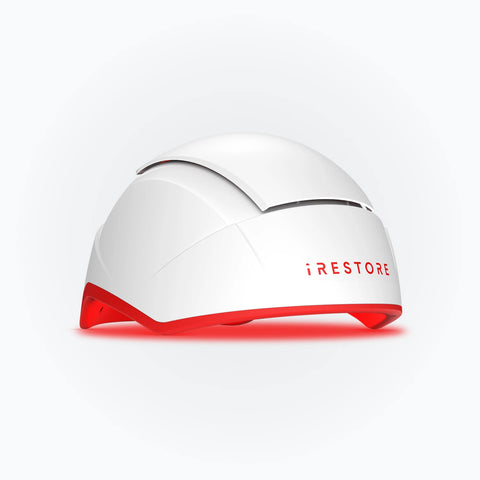
iRestore sells three red-light helmets, priced at $425 to $1,699 on its own store on November 22, 2026. We read its FDA records, the trials behind it, its own study, its manuals and return terms, and 40 recent customer reviews, to answer what its marketing skips: what was actually tested, and what a return costs.
Editorial details
NuWays MD is independent and reader-supported. When you buy through links on our site, we may earn a commission. As an Amazon Associate we earn from qualifying purchases. Learn more.
OUR TAKE
iRestore’s helmets use the same kind of red light that modestly increased hair counts in small, sham-controlled trials of pattern hair loss, but none of the three helmets on sale today was the device in those trials. They are cleared for pattern thinning in skin types I to IV, not for bald areas, and any result takes months of regular use.
For most people, we’d choose the Essential: it matches the tested wavelength and schedule at the lowest price. The Professional adds temple coverage for $374 more. The Elite costs the most and is furthest from the tested setup. Buy on irestorelaser.com if you want the 12-month guarantee, and know that any return costs 25% of the price.
Our iRestore picks at a glance
Best for most people goes to the least expensive helmet that matches the tested wavelength and schedule. That is our judgment, not a measured result: no study compares the three helmets, or shows that more diodes or more coverage grow more hair. Prices are what iRestore.com charged on November 22, 2026, not its higher “Total Value” figures (why).
iRestore.com prices checked Nov 22, 2026, during its Black Friday saleNo brand paid for placementPicked on evidence, coverage and priceHow we picked
iRestore Essential
The tested 655 nm light and 25-minute schedule at the lowest price.
- Covers the top, hairline and crown
- 2-year warranty; 12-month guarantee (25% fee) on iRestore.com orders
iRestore.com price
$425
iRestore.com, Nov 22 · “Total Value” $799
Every other dayiRestore Professional
The same light and schedule, plus temple coverage, for $374 more.
- Covers the hairline, temples and crown
- 2-year warranty; 12-month guarantee (25% fee) on iRestore.com orders
iRestore.com price
$799
iRestore.com, Nov 22 · “Total Value” $1,499
Every other dayOpens iRestore.com · Professional
Or check the price on Amazon ↗︎Read the full review ↓iRestore Elite
Daily 12-minute sessions, but an untested setup at the highest price.
- 500 lasers and LEDs at three wavelengths
- 3-year warranty; 12-month guarantee (25% fee) on iRestore.com orders
iRestore.com price
$1,699
iRestore.com, Nov 22 · “Total Value” $2,699
12 min dailyOpens iRestore.com · Elite
Or check the price on Amazon ↗︎Read the full review ↓Does iRestore work? What the trials actually showed
Red light from a helmet like iRestore’s increased hair counts more than a sham helmet in two published trials of adults with pattern hair loss, but those trials tested a different brand’s helmet. The device, called TOPHAT655 in the papers and sold as igrow, had 21 lasers and 30 LEDs at 655 nm. iRestore’s first FDA filing, in 2016, declared its helmet “IDENTICAL” to it in optics, electronics and treatment schedule (FDA K151662).
| Study and who completed it | Helmet users, 16 weeks | Sham users, 16 weeks |
|---|---|---|
| Women, igrow trial, 201424 helmet vs. 18 sham users | +48% (about +35 hairs per cm²) | +11% (about +8 hairs per cm²) |
| Men, igrow trial, 201322 helmet vs. 19 sham users | +67% | +28% |
| iRestore’s own study, 201720 helmet vs. 19 sham users; unpublished | +43% | +6% |
Average change in hair counts within a small, tattooed patch of thinning scalp (about 3 cm²), counted from photographs by a blinded evaluator. Hairs per cm² are our arithmetic from the women’s paper, shown for scale. iRestore’s study isn’t a published trial; see the next section.
Read the percentages as changes in one small patch, not as a share of people or a whole-head result. In the women’s trial, helmet users went from about 210 to 310 hairs in the 2.85 cm² test area, sham users from about 228 to 252 (Lanzafame and colleagues, 2014). The men’s trial reported a 39-point difference between groups, or 35 points after one sham user with an unusually large drop was set aside (Lanzafame and colleagues, 2013). Neither trial reported any side effects.
Who was in the trials, and who wasn’t
- Pattern hair loss only: men aged 18 to 48 with Norwood-Hamilton IIa to V, and women aged 18 to 60 with Ludwig-Savin I to II thinning.
- Lighter skin types: only Fitzpatrick skin types I to IV were enrolled, which is also the limit of every iRestore clearance.
- Sixteen weeks: the trials stopped at 16 weeks, so they show nothing about the second year or what happens if you stop.
- Funding: Apira Science, igrow’s maker, funded the women’s trial, and its lead author and Raymond Blanche disclosed ownership interests in the company. Mr. Blanche was later the consultant named on iRestore’s first two FDA filings and co-wrote iRestore’s own study.
The trials compared a helmet with a sham, not with minoxidil or finasteride, and we found no trial comparing iRestore with either medicine.
What iRestore’s “100%” and “43%” numbers mean
Both come from iRestore’s own 2017 study of 40 people, which wasn’t published in a journal and used an older helmet than the ones on sale today. iRestore’s product pages say “100% of users experienced an increase in hair count, with an average hair growth of 43.2% in terminal hairs after just 16 weeks,” and link to the study PDF. We read it and recalculated its table.
- Who was tested: 23 women and 17 men with pattern hair loss; 39 finished. The helmet group used “an actual commercial iRestore Hair Growth System currently sold internationally,” with 21 lasers and 30 LEDs, every other day for 16 weeks. The other group used a look-alike red incandescent light.
- “100% of users”: all 20 people in the helmet group gained terminal hairs in a 19.5 mm circle of scalp (about 3 cm²). So did 13 of the 19 people using the sham light.
- “43.2%”: the average of each helmet user’s percentage change. The middle person gained 36%, and gains ranged from 7% to 115%. The sham group averaged 6%. The study’s “overall incremental improvement of 37.52%” is the difference between those two averages in percentage points, not 37% more hair. In hairs, the helmet group gained about 21 per cm² (our arithmetic). It also started with fewer hairs than the sham group, an average of 168 against 219 in the counted area, and a lower starting count turns the same gain into a larger percentage.
- Who wrote it: Adam Bodian, a dermatologist who appears in iRestore’s product videos and co-wrote the 2013 igrow trial, and Raymond Blanche, the consultant named on iRestore’s first two FDA filings. The document lists no funding source or peer review, doesn’t describe how people were assigned to the two groups, and reports no statistical test, although it calls the result “significant.” We found no listing on PubMed.
The other headline claims, in brief:
- “Clinically proven”: the controlled evidence is the two igrow trials and iRestore’s unpublished study, all on 51-diode helmets at 650 to 655 nm. None tested the 120-diode Essential, the 282-diode Professional or the 500-diode Elite.
- “FDA-cleared”: accurate for all three. Clearance means the FDA found a device substantially equivalent to one already on the market for a stated use. It isn’t approval, and the FDA summaries for the Professional, the current Essential and the Elite list no clinical testing (K183417, K213094, K222081).
- “The most powerful hair growth device on the market” (Elite, 2,500 mW): output describes how much light the helmet emits, not how much hair grows. No study links higher output or more diodes to better results.
- “2,167 clinicians recently shared this with patients on FrontrowMD”: a badge on the Essential’s product page on November 22. It signals professional interest, not measured results.
- “iRESTORE benefits around 85% of our users”: from the Professional page’s FAQ, which adds that “individual results will vary.” iRestore doesn’t say how that was measured, so we can’t check it.
Which iRestore models the evidence actually covers
None of the three helmets on sale has been tested in a published trial. The Essential and Professional keep the tested 655 nm wavelength and 25-minute, every-other-day schedule, with more diodes. The Elite changes the wavelengths and the schedule.
| Model and price | Each session | Link to the evidence |
|---|---|---|
| Essential$425 on Nov 22 · 120 diodes (51 lasers, 69 LEDs) | 25 min, every other day | Tested wavelength and schedule655 nm like the trial helmet; cleared in 2021 on safety and equipment tests, no clinical data |
| Professional$799 on Nov 22 · 282 diodes (82 lasers, 200 LEDs) | 25 min, every other day | Tested wavelength and schedule655 nm; cleared in 2019 by comparison with the original iRestore, no clinical data |
| Elite$1,699 on Nov 22 · 500 diodes (300 lasers, 200 LEDs) | 12 min, daily | Different setup, no trialLasers at 655 and 680 nm, LEDs at 625 nm, per its manual; cleared in 2022 on safety and equipment tests, no clinical data |
Prices from iRestore.com on November 22, 2026, during its Black Friday sale. Specifications from iRestore’s product pages and manuals and FDA summaries K151662, K183417, K213094 and K222081.
Three things the table doesn’t show:
- Time a year. At 25 minutes every other day, the schedule in their manuals, the Essential and Professional take about 76 hours a year; at 12 minutes daily, the Elite takes about 73 (our arithmetic). The Elite’s sessions are shorter, but there are twice as many. The Essential and Professional product pages also say “3 times a week,” which would be about 65 hours; we use the manuals’ schedule because it matches the trials.
- Coverage. iRestore describes the Essential as covering the top of the scalp, hairline and crown, and the Professional and Elite as covering the hairline, temples and crown. More coverage matters if your thinning reaches the temples, but the evidence we reviewed has no temple-specific results: the women’s trial and iRestore’s study counted hair at the top or crown of the head, and the men’s trial abstract describes only a thinning “transition zone.” We also found no evidence that more coverage changes the result in areas both models reach.
- The first helmet is no longer sold. The 51-diode helmet that matched the trial device isn’t listed in iRestore’s US store. Its 2016 clearance relied on igrow’s trials, and the current Essential was cleared separately in 2021 by comparison with the Professional.
iRestore reviews: Essential, Professional and Elite
Choose the helmet you will wear on schedule for at least four months, then weigh coverage against price. All three are hands-free helmets that plug into an outlet during a session; a rechargeable battery pack is sold separately. Here they are in our order of preference.
Our pick · Best for most people
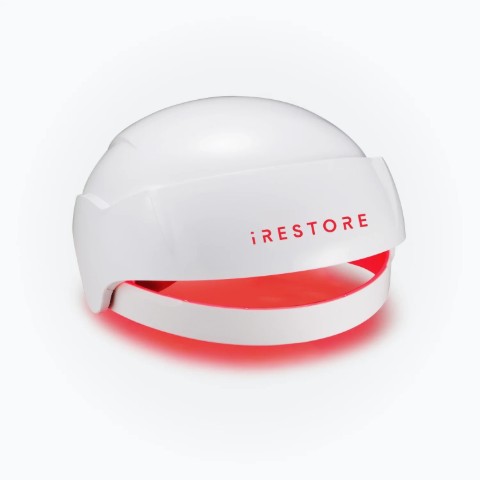
iRestore Essential
- Technology
- 51 lasers + 69 LEDs, 655 nm
- Session
- 25 minutes, every other day
- Coverage
- Top of scalp, hairline and crown
Why we like it
- Same 655 nm wavelength and schedule as the tested helmet
- The lowest price of the three: $374 less than the Professional on Nov 22
- Bought on iRestore.com, it keeps the 12-month guarantee
Watch for
- No trial of its own; cleared in 2021 on non-clinical tests
- iRestore doesn’t list temple coverage
- A return costs 25% of the price: $106.25 at the Nov 22 price
The current Essential has 51 lasers and 69 LEDs at 655 nm, more than the 21 lasers and 30 LEDs in the tested helmet, and the same 25-minute, every-other-day schedule. iRestore lists 600 mW of output and coverage for the top of the scalp, hairline and crown. It was cleared in 2021 by comparison with the Professional, using safety and equipment tests rather than a trial.
It is our pick for most people because it matches the tested wavelength and schedule as closely as the Professional does, at the lowest price. Choose the Professional instead if your thinning reaches the temples.
Our pick · For temple thinning
iRestore Professional
- Technology
- 82 lasers + 200 LEDs, 655 nm
- Session
- 25 minutes, every other day
- Coverage
- Hairline, temples and crown
Why we like it
- Same 655 nm wavelength and 25-minute, every-other-day schedule as the tested helmet
- Covers the hairline and temples; iRestore doesn’t list temple coverage for the Essential
- Two-year warranty
Watch for
- No trial of its own; cleared in 2019 by comparison, with no clinical data
- The evidence we reviewed has no temple-specific results, so the extra coverage is unproven
- Amazon orders don’t get iRestore’s 12-month guarantee
The Professional matches the tested helmet as closely as the Essential does: the same 655 nm red light and the same 25-minute, every-other-day schedule, with 82 lasers and 200 LEDs where the tested helmet had 21 and 30. iRestore lists 1,410 mW of output and coverage for the hairline, temples and crown. Its FDA clearance relied on comparison with iRestore’s first helmet, not a new trial.
Its advantage is coverage. Choose it if your thinning reaches the temples, knowing that the studies we reviewed that name a counting site used the top or crown of the head, so they don’t show how much temple coverage adds. If your thinning is on top or at the crown, the Essential cost $374 less on November 22.
Shortest sessions · Most diodes
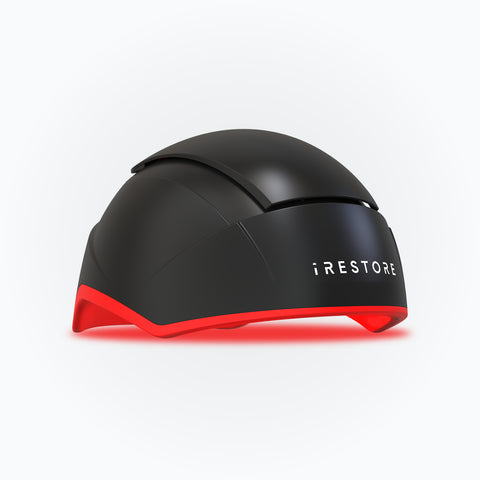
iRestore Elite
- Technology
- 300 lasers + 200 LEDs, 625 to 680 nm
- Session
- 12 minutes, daily
- Coverage
- Hairline, temples and crown
Why we like it
- The shortest sessions: 12 minutes
- The most diodes and output iRestore sells (500 diodes, 2,500 mW)
- 3-year warranty, a year longer than the others
Watch for
- Lasers at 655 and 680 nm, LEDs at 625 nm and a daily schedule: a setup no trial has tested
- Daily sessions add up to about 73 hours a year, close to the others’ 76
- The highest price, and a $424.75 fee if returned at the Nov 22 price
The Elite changes more than the diode count. Its manual and product page list 150 lasers at 655 nm, 150 at 680 nm and 200 LEDs at 625 nm (its 2022 FDA summary lists a different split), and it is used 12 minutes every day instead of 25 minutes every other day. iRestore calls it its most powerful device, at 2,500 mW. Its 2022 FDA clearance relied on safety and equipment tests compared with the Essential, and no trial has tested its wavelengths or schedule.
Choose it if shorter daily sessions are what will keep you consistent and the price matters less to you. Don’t choose it expecting more hair: no study shows that more diodes or more output grow more.
Does iRestore have side effects?
None were reported in the igrow trials or in iRestore’s study, but the manuals list several situations in which you shouldn’t use the helmet. Across those studies, 66 people used an active helmet, for 16 weeks; that is too few and too short to rule out uncommon problems. All three manuals say not to use it if:
- you have a condition that makes your skin sensitive to light, or take medicines that do (photosensitizing medications); ask your pharmacist if you aren’t sure;
- you have cancer, a tumor or skin disease on your scalp;
- you have sensitive skin or an allergy to its wavelengths, which the manuals say can cause itching or sunburn-like redness;
- you are under 18.
The manuals also warn that the Class 3R lasers can harm the retina if aimed at the eyes, so don’t look into them, and that you should stop if scalp itching or tingling lasts more than an hour after a session. Don’t use it on wet hair.
Skin types V and VI: every iRestore clearance and both igrow trials covered skin types I to IV only, so deeply pigmented brown or black skin falls outside what was studied and cleared. The American Academy of Dermatology advises talking with a dermatologist before using a red-light device if you have darker skin or a light-sensitive condition such as lupus.
Can you use iRestore every day?
Only the Elite. The Essential and Professional manuals say 25 minutes every other day, not more; the Elite manual says 12 minutes daily. After 16 weeks, the manuals say to keep using it “as frequently as needed to maintain the desired results” without exceeding that schedule.
What iRestore customers report
Recent reviews mostly praise ordering and customer service; few describe a hair result yet. On Trustpilot, iRestore had 1,397 reviews and a 3.7 TrustScore on November 22, with 59% five-star and 25% one-star reviews. That score covers the whole brand, including its face masks and body panels, not a particular helmet.
We read and coded the 40 most recent reviews (September 15 to November 13, 2026). Ten clearly reviewed a hair helmet:
| What the review described | Details |
|---|---|
| A hair result3 of 10 | All positive, but one also had iron and blood treatment for anemia, one used minoxidil, and one was just starting to notice results after about five months |
| Too early to judge4 of 10 | Three under a month of use, one with no time given; two noticed less shedding |
| No effect1 of 10 | Also objected to the 25% service fee and paying return shipping |
| A device failure2 of 10 | One wouldn’t power on (warranty refused without a receipt for a gift); one failed after its warranty ended |
Of the other 30 reviews, two mentioned a helmet in passing (one said it works, one said it didn’t for them), many praised ordering or customer service, several were about face masks or body panels, and one more objected to the restocking fee.
Reviews like these are self-reported and come from people motivated to write. Of the 40, 21 carried Trustpilot’s “Verified” label, which generally means the review came through a company invitation or was otherwise checked by Trustpilot; it doesn’t make a review typical. Read them as individual experiences worth checking against the terms, such as two buyers surprised by the return fee and one helmet that failed after its warranty ended, not as evidence of how much hair a helmet grows.
iRestore cost, returns and warranty
If you keep the helmet and it keeps working, the price you pay is the cost. If you return it under the 12-month guarantee, iRestore keeps 25% of what you paid. The guarantee covers only orders placed on irestorelaser.com, and you can return earlier than a year or within days 365 to 400; the difference is who pays return shipping.
About the “sale” prices: iRestore shows a higher “Total Value” beside each price ($799, $1,499 and $2,699) and says its savings claims “are not discounts from regular prices we charge”; it sets Total Value from competitors’ prices. When we checked on October 26, it was charging $799 for the Professional and $1,799 for the Elite, close to its November 22 prices. iRestore also offers to refund the difference if you find a lower advertised price on the same device within 30 days of purchase.
| Model | Price on Nov 22 | 25% fee | Refund |
|---|---|---|---|
| Essential | $425 | $106.25 | $318.75 |
| Professional | $799 | $199.75 | $599.25 |
| Elite | $1,699 | $424.75 | $1,274.25 |
Refund before tax and return shipping, for a device bought alone; our arithmetic from the policy’s 25% fee on the purchase price. If you pay a different price, the fee is a quarter of what you paid. Prices change often.
The fine print that changes the decision:
- Timing and shipping: every return needs an authorization (RMA) number, and you have 30 days to ship once it’s issued. Request it between day 365 and day 400 and iRestore pays return shipping on U.S. orders; return earlier and you pay it. The 25% fee applies either way (policy dated November 5, 2026, and iRestore’s help article).
- Sales tax: the policy says the refund is “less the Sales tax,” but iRestore’s help article says “sales tax is refunded.” Ask iRestore to confirm in writing before you count on either.
- Where you buy: Amazon and other retailers follow their own return policies, not iRestore’s guarantee, and iRestore’s warranty policy sends reseller buyers to the seller for warranty support.
- Changing your mind before it ships: cancelling an iRestore.com order costs a 10% fee, unless it hasn’t shipped within 5 business days or iRestore reports a stock delay, in which case cancelling is free. Once a tracking number exists, the order can’t be cancelled. Expedited shipping and shipping-protection charges aren’t refunded.
- One return per household, and bundles are refunded only in part, because consumables aren’t included.
- Older orders: the policy applies to purchases from November 5, 2026. Check the terms that applied on your order date.
Warranty and extras
The warranty is 2 years for the Essential and Professional and 3 years for the Elite; iRestore sells 2-year extensions ($199, $399 and $599 as separate items, $39, $49 and $99 when added on the product page on November 22). Extensions must be bought with the device. The warranty starts on delivery and covers defects, not wear and tear or accidents. The manuals say to validate it on iRestore’s website within 30 days of purchase and that it isn’t transferable, and claims need proof of purchase and photos or video of the problem. A rechargeable battery for cord-free use costs $99 for the Essential or Professional and $119 for the Elite on their own, or $79 and $99 added to a helmet on November 22. In the reviews we read, a helmet given as a gift was refused warranty service without a receipt, so keep proof of purchase. iRestore labels its helmets HSA and FSA eligible; confirm with your plan administrator before counting on it.
When to skip iRestore
An iRestore helmet is a poor buy in these situations, whatever the sale price.
- It may not be pattern hair loss. Patchy bald spots, sudden heavy shedding, a sore or scaly scalp, or hair loss with other symptoms needs an examination first. See telogen effluvium, hair thinning in women and hair loss in men.
- Your skin is type V or VI, or you have a light-sensitive condition or take light-sensitizing medicine; see side effects.
- The area is already bald. The clearances stop at Norwood V and Ludwig II, and the trials measured thinning areas, not bare scalp.
- You can’t keep the schedule. The trials ran 16 weeks of sessions every other day, and the manuals call for ongoing use to keep any result.
- You’re counting on getting your money back. Any return costs 25% of the price, you pay return shipping if you return before day 365, and the guarantee doesn’t cover Amazon orders.
iRestore vs. HairMax, minoxidil and finasteride
We found no trial comparing iRestore head to head with another device or with the hair-loss medicines. Here is how to think about each choice.
- HairMax: its published trials tested handheld combs, while iRestore’s evidence comes from helmets. Our HairMax vs. iRestore comparison lines up the models, and our HairMax review maps each one to its evidence.
- Minoxidil and finasteride: they have the longer evidence record. Minoxidil costs far less up front but is a daily habit for as long as you want the result; see minoxidil costs and finasteride vs. minoxidil.
- Combining a helmet with medicine: small randomized trials of other red-light helmets added to minoxidil reported some extra improvement, such as thicker hairs, over minoxidil alone (Liu and colleagues, 2021; Yang and colleagues, 2024). No trial has tested a current iRestore model with medicine, so how much one would add is unknown. Ask a dermatologist before combining treatments.
- Other light devices, including Capillus and Kiierr caps: our guide to red light therapy for hair loss compares five devices from four brands on evidence, weekly routine and return costs.
iRestore questions, answered
Does iRestore actually work?
Possibly, and modestly, but the evidence comes from a different helmet. In two sham-controlled trials of a helmet iRestore’s filing called identical to its first model, average hair counts in a small test patch rose 48% in women and 67% in men over 16 weeks, against 11% and 28% with a sham helmet; 42 women and 41 men finished. No current iRestore model has been tested in its own trial, and results varied widely between people.
How long does iRestore take to work?
Think in months. The trials measured results at 16 weeks. iRestore’s own timeline says to expect “no change or increased shedding of weak hairs” in the first three months and visible results at 6 to 12 months; that timeline is the company’s, not a trial result. Photograph the same area in the same light each month, and give it at least four months on schedule before judging.
Are iRestore before-and-after photos reliable?
Treat them as testimonials, not evidence. iRestore’s product pages show customer “before” and “during” photos chosen by the company, with captions such as “worked wonders in just 3 months.” Lighting, hair length, styling and camera angle can change how full hair looks. The trials instead counted hairs in a small tattooed patch photographed the same way at the start and at 16 weeks.
Do the results last if you stop?
Probably not. The manuals say to keep using the helmet to maintain results and warn that stopping “may result in the progression of hair loss.” The trials didn’t follow people after 16 weeks. Plan on ongoing use for as long as you want the result.
Is iRestore FDA approved?
No. All three current helmets are FDA cleared, a different process: the FDA found each substantially equivalent to an earlier device for promoting hair growth in pattern hair loss, for skin types I to IV. Their clearances list no clinical testing.
Essential vs. Professional vs. Elite: which should I buy?
For most people, we’d choose the Essential: it keeps the tested 655 nm wavelength and schedule at the lowest price. The Professional adds temple coverage for $374 more on November 22, though the evidence we reviewed has no temple-specific results. The Elite costs the most and changes the wavelengths and schedule, with no trial behind that setup. See our picks.
Are iRestore reviews real?
We can’t verify individual reviews. On Trustpilot, 21 of the 40 most recent carried a “Verified” label, which generally means a company invitation or a Trustpilot check, not that the review is typical, and the score covers all iRestore products, not one helmet. Treat ratings as signals about service and reliability, not proof of regrowth.
What is iRestore’s return policy?
iRestore.com orders get a 12-month money-back guarantee, but every return costs a 25% fee and needs an authorization number. Request it between day 365 and day 400 and iRestore pays return shipping on U.S. orders; return earlier and you pay it. One return is allowed per household, and its policy and help article disagree on whether sales tax is refunded. Amazon orders follow Amazon’s terms. See cost, returns and warranty.
Should I buy iRestore on Amazon?
Only if the Amazon seller’s return policy works for you. iRestore’s 12-month guarantee covers only irestorelaser.com orders, and a return there still costs 25% of the price. For warranty problems on an Amazon order, iRestore’s policy sends you to the seller. Keep your receipt either way.
iRestore vs. HairMax: which is better?
No study compares them. HairMax’s trials tested combs; iRestore’s evidence comes from helmets. The practical differences are the routine, coverage, price and return terms; see our HairMax vs. iRestore comparison.
Sources and editorial notes
Prepared for U.S. readers. NuWays MD read iRestore’s product listings, refund and warranty policies, its 2017 study document, the Essential, Professional and Elite manuals, the published trials and the FDA’s 510(k) summaries on November 22, 2026, and coded the 40 most recent Trustpilot reviews the same day. We have not tested any device, measured hair growth or evaluated comfort. Clinical review is pending.
Clinical evidence comes from the peer-reviewed papers; iRestore’s documents identify products, schedules and terms and are not independent proof of results. Recalculated study figures, hairs per cm², hours a year and refund amounts are our own arithmetic, shown so you can check them. Sale prices change; check the current price before buying.
See our editorial approach and commercial disclosures. Report a correction through Contact.
View all 15 sources
- Lanzafame and colleagues, Lasers in Surgery and Medicine, 2014. Randomized, double-blind, sham-controlled trial of the TOPHAT655 (igrow) helmet in 47 women (42 completed) for 16 weeks. Source of the women’s hair counts, population, side effects and funding by Apira Science.
- Lanzafame and colleagues, Lasers in Surgery and Medicine, 2013. The same design in 44 men (41 completed). Abstract on PubMed; full text not read.
- Bodian and Blanche, “Visible Red Light Laser and LED Sources to Grow Human Scalp Hair in Males and Females,” September 2017. iRestore’s unpublished study of 40 people, with its subject-level hair counts; source of the “100%” and “43.2%” claims, which we recalculated.
- FDA 510(k) summary K151662 (2016). The first iRestore helmet, 21 lasers and 30 LEDs, declared identical to igrow; no clinical data; schedule from igrow’s trials.
- FDA 510(k) summary K183417 (2019). iRestore Professional 282, 82 lasers and 200 LEDs; no clinical data; a 30-person label-comprehension test.
- FDA 510(k) summary K213094 (2021). The current ID-500 iRestore (Essential) at 655 nm, cleared against the Professional on non-clinical tests.
- FDA 510(k) summary K222081 (2022). ID-510 iRestore Elite: lists 300 lasers at 680 nm and 200 LEDs at 625 and 655 nm (the current manual lists lasers at 655 and 680 nm and LEDs at 625 nm), 12 minutes daily, 2,500 mW; non-clinical tests only. All four clearances cover skin types I to IV.
- iRestore product pages for the Essential, Professional and Elite. Prices, diode counts, output, coverage, schedules (including “3 times a week”), the results timeline, the “100%,” “43.2%,” “most powerful” and “85%” claims, the FrontrowMD badge, the “Total Value” explanation and the 30-day price match, checked November 22, 2026; manufacturer material. Late-October prices are from our October 26 check for our HairMax vs. iRestore comparison.
- iRestore refund policy, updated November 5, 2026. 12-month guarantee for website orders, earlier returns with customer-paid shipping, the day 365 to 400 prepaid-label window, 25% service fee, “less the Sales tax,” one return per household, bundle terms and the cancellation rules.
- iRestore help article: money-back guarantee and return windows, read November 22, 2026. Confirms earlier returns with customer-paid shipping and says “sales tax is refunded,” which conflicts with the policy.
- iRestore warranty policy. 2-year warranty for the Essential and Professional and 3 years for the Elite, starting on delivery; registration, extended-warranty and coverage terms, and reseller orders handled by the seller.
- iRestore user manuals for the Essential, Professional and Elite. Contraindications, eye and itching warnings, schedules, maintenance use, the Elite’s wavelength split and the 30-day warranty validation.
- iRestore on Trustpilot. 1,397 reviews and a 3.7 TrustScore on November 22, 2026; we coded the 40 most recent. Brand-level, self-reported reviews.
- Liu and colleagues, Lasers in Medical Science, 2021, and Yang and colleagues, Photodiagnosis and Photodynamic Therapy, 2024. Small randomized trials of other 650 to 655 nm helmets with minoxidil in women; abstracts read, full text not read. Used only to describe combination research, not iRestore results.
- American Academy of Dermatology: red light therapy. Independent overview of what red light therapy can and can’t do and safety precautions.