HAIR & SCALP / CAUSES AND TREATMENT
Hair Loss in Men: Causes, Early Signs and What Helps
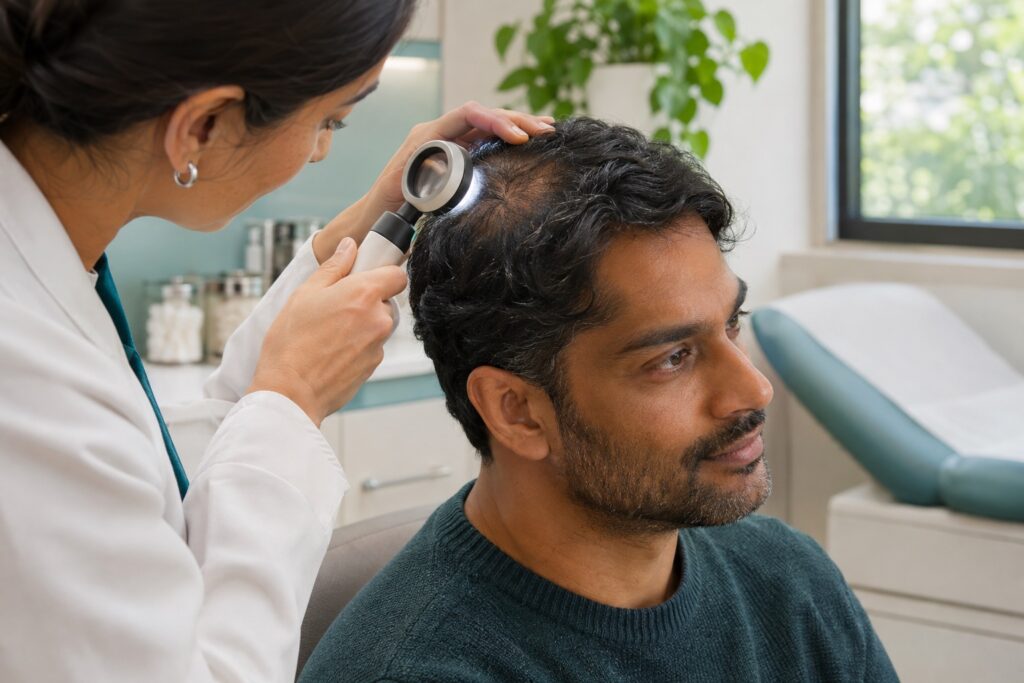
Hair loss in men often starts with a receding hairline or a thinner crown. A sudden increase in shedding, a round bare patch or a sore scalp can point somewhere else. Before choosing a product, work out which change you are seeing.
This guide helps you recognize the patterns, understand the treatments with useful evidence, and prepare for a review without turning every hair in the shower into a test.
Editorial details
What are the early signs of hair loss in men?
A hairline that keeps moving back, a crown that becomes more visible and finer hairs in the thinning areas are common early clues. Male pattern hair loss usually develops gradually, rather than leaving an entirely bare patch overnight. It can begin in the late teens or twenties. MedlinePlus; AAD.
- At the temples: compare the corners of the hairline over time, not with another person’s hairline.
- At the crown: look for a change in coverage around the natural whorl, using similar lighting.
- Across the top: hair may feel less substantial or become harder to style even before a bald area appears.
One photograph is a poor measuring tool: wet hair, a fresh haircut and overhead lighting can expose more scalp. If you want a baseline, take front, top and crown photos with dry hair in the same light. Repeating them about monthly is more useful than inspecting several times a day.
A “mature hairline” is not something a selfie can reliably distinguish from early progressive loss. The practical question is whether the hairline and density keep changing, and whether a scalp examination finds miniaturization. That means follicles producing progressively finer, shorter hairs. BAD explanation of pattern hair loss.
What causes hair loss in men?
Inherited pattern hair loss is the most common cause, but the distribution and speed of change help decide what else to investigate. These patterns are clues for an appointment, not a way to diagnose yourself.
Gradual temples or crown thinning
Male pattern hair loss, also called androgenetic alopecia, involves inherited sensitivity to dihydrotestosterone (DHT). Affected follicles gradually make smaller hairs. Genes can come from either side of the family; your maternal grandfather does not settle your future. Pattern hair loss.
Sudden shedding across the scalp
Telogen effluvium can follow illness, surgery, major stress, marked weight loss or a medication change. Shedding often starts around three months after a trigger, so think back beyond the week it became noticeable. Telogen effluvium guidance.
Distinct patches or beard gaps
Alopecia areata can produce smooth patches, including in the beard. Broken hairs, scaling or an inflamed patch raise other possibilities, including infection. A medicine for inherited thinning is not a substitute for identifying the cause. Patterns that need assessment.
Breakage, pulling or a sore scalp
Tight styles and repeated damage can break hair or contribute to loss. Pain, crusting, pustules or a shiny scar-like area need assessment because some inflammatory conditions can damage follicles permanently. Hair loss causes and symptoms.
More than one problem can be present. A shedding episode can make existing pattern thinning more obvious. If weight loss or a new weight-management medicine is part of the history, our GLP-1 and hair loss guide explains what to discuss without assuming the medicine is the only explanation.
Stress-related shedding often improves once the trigger settles or an underlying deficiency is addressed. BAD describes a shedding phase of about three to six months, with longer needed to recover volume; persistent shedding deserves reassessment. That is different from the ongoing course of inherited thinning. BAD guidance.
When should you see a dermatologist about hair loss?
Arrange a review if the cause is unclear, the loss is progressing or it is affecting how you feel. You do not have to wait until the thinning is severe to ask for help.
Tell the provider if the worry itself is disrupting sleep, social life or daily routines. Hair loss can matter even when it is not physically painful. Treatment goals can include feeling comfortable with your appearance, not only increasing hair counts.
How is male hair loss diagnosed, and do you need blood tests?
The history and scalp examination usually come first; blood tests are selected when there is a reason to look for another cause. A provider may examine hair thickness and the skin closely, perform a gentle pull test, or consider a biopsy when the diagnosis is uncertain. AAD diagnostic approach.
A receding hairline alone does not prove low testosterone, and a hormone result alone does not diagnose pattern hair loss. For diffuse shedding, symptoms or a relevant medical history, testing might investigate iron deficiency, thyroid disease or another suspected problem. Ask what each test would change in the plan. BAD guidance on testing.
Bring a short, useful history
- Timing: when you first noticed a change, where it began and whether it was gradual or sudden.
- The preceding months: illness, surgery, weight change, diet changes, stress and new or stopped medicines.
- What you use: prescriptions, supplements, scalp products and any testosterone or anabolic-steroid use. Bring names and labels.
- What matters to you: preserving the hairline, crown coverage, avoiding a particular side effect, keeping costs manageable or simplifying the routine.
Bring a few comparable photos rather than a daily shed-count spreadsheet. Ask whether there is one diagnosis or a combination, and what would make the provider reconsider it.
Which hair loss treatments for men actually help?
For confirmed male pattern hair loss, topical minoxidil and oral finasteride have established evidence and U.S. approvals. Procedures and devices can be useful options for selected people. Treating a different diagnosis, such as scalp infection or alopecia areata, requires a different plan. AAD treatment overview.
Topical minoxidil: a scalp treatment you keep using
Minoxidil can support growth without blocking DHT. Men’s 5% solution is an over-the-counter option labeled for the vertex, or top of the scalp, with twice-daily use. Its label does not cover a receding hairline; ask about that location rather than extending the instructions yourself. U.S. product label.
The main practical issue is whether the application fits your day and your scalp tolerates it. Compare minoxidil foam and liquid for the formulation details. More product or more frequent application will not make it work faster.
What the minoxidil trial showed
A 48-week randomized trial assigned 393 men to 5% solution, 2% solution or placebo twice daily. The 5% group did better on hair counts and coverage assessments, but had more itching and local irritation than the 2% group. This supports a specific treatment for pattern loss, not every serum sold for thinning. Olsen et al., 2002.
Finasteride: reducing the DHT signal
Finasteride 1 mg is a daily prescription tablet approved for male pattern hair loss. It reduces conversion of testosterone to DHT. The decision includes sexual and mood side effects, medical history and the commitment to ongoing treatment. Propecia prescribing information.
What the longer-term evidence showed
Two one-year trials randomized 1,553 men to finasteride or placebo; 1,215 entered extension studies lasting up to four additional years. Finasteride maintained improvement and slowed further loss compared with placebo. Not every participant completed five years, and the older study does not replace today’s safety information. Five-year trial report.
These studies were separate, so their participant counts and results are not a head-to-head score. Our finasteride vs. minoxidil comparison covers comparative evidence and what adding both may achieve.
Tablets and sprays need their own safety discussion
Oral minoxidil is prescribed off-label for hair loss in the U.S.; its approved indication is severe hypertension. Blood-pressure effects, swelling and other cardiovascular risks make it a prescribing decision, not simply a more convenient foam. See oral vs. topical minoxidil for the route-specific trial results. Oral minoxidil labeling.
Compounded topical finasteride is not FDA-approved in the U.S. Absorption and transfer to other people remain relevant even when a product is applied to the scalp. A spray is not automatically a risk-free version of the tablet. FDA safety alert.
Laser devices, PRP and hair transplantation
Devices and injections
Some low-level light devices and PRP treatment plans may help people with pattern loss, but they involve repeat use or visits. Compare the exact device evidence, maintenance, cost and the added benefit expected beyond your existing plan. Start with laser caps and light devices or PRP for hair loss. AAD overview. Our PRP vs. minoxidil comparison examines the direct trials and what adding injections may offer.
Hair transplantation
A transplant moves existing donor hairs; it does not create an unlimited supply or stop loss in the remaining untreated hair. Donor quality, the likely future pattern and a maintenance plan matter, especially for younger men. A consultation should address the years ahead, not just the hairline drawn today. AAD transplant guidance.
What side effects should you discuss before starting?
Choose the form and the follow-up plan together. Tell the prescriber about heart or blood-pressure problems, current medicines, sexual symptoms and a history of depression before a treatment is selected.
- Topical minoxidil: irritation can occur, and the label lists symptoms requiring stopping and medical advice. Our itchy scalp guide separates irritation from possible allergy.
- Finasteride: sexual side effects and depression are included in the safety information; persistent sexual symptoms after stopping have also been reported. Tell anyone interpreting a PSA blood test that you take finasteride.
- Handling finasteride: someone pregnant or who could be pregnant should not handle crushed or broken tablets. Compounded topical products add a transfer concern.
Finasteride label; topical minoxidil label; topical finasteride alert.
How long does hair loss treatment take to work?
Judge hair growth over months, while checking tolerability much sooner. Slowing further loss can be worthwhile even without a dramatic before-and-after change. Agree in advance how you will measure progress.
Before starting
Record the diagnosis, exact product and schedule. Take baseline photos and choose a follow-up date. Keep a copy of the label so that a routine review date never overrides a stop-use instruction.
The first weeks
Check application, missed doses and side effects. Some minoxidil users notice temporary shedding, but it is not proof the treatment is working. Follow the product’s advice and use our minoxidil shedding guide to prepare questions.
The first few months
Men’s Rogaine 5% solution says results may appear after two months, with some men needing four. It says to stop and ask a doctor if there is no regrowth at four months. Finasteride labeling says benefit generally requires at least three months. Rogaine label; finasteride label.
The longer-term review
Compare standardized photos, density and whether loss has stabilized. Your provider can decide whether a longer supervised trial or a different plan makes sense. AAD notes that visible minoxidil improvement can take six to twelve months; this does not cancel an earlier label-directed review. AAD expectations.
If there is little improvement, check the diagnosis, application, consistency and scalp health before buying several additions. If treatment is helping, ask what ongoing use will involve. Our guide to stopping minoxidil explains why changing medicines is not always a like-for-like swap.
What can you do day to day, and what should you budget for?
Choose a routine you can sustain, and compare the total ongoing cost rather than an introductory bottle price. Include prescriptions or consultations, refills, supplies and any planned maintenance visits. The minoxidil cost guide keeps dated prices and subscription details in one place.
Gentle hair care and a diet that meets your nutritional needs support a sensible plan. Avoid tight styles that pull, harsh treatment of an irritated scalp and unnecessary supplement stacking. Correcting a proven deficiency is different from assuming a hair vitamin treats inherited loss. AAD guidance on supplements.
A thickening shampoo or hair fibers can improve how hair looks without reversing follicle miniaturization. Concealers, a shorter haircut or a hair system can be reasonable choices on their own or alongside treatment. You do not owe anyone a medication regimen. AAD discussion of wigs and concealers.
Leave the appointment with three decisions
- What are we treating? Ask for the diagnosis and the reason the proposed treatment fits it.
- What counts as progress? Specify preservation, regrowth, comfort or appearance, and the photos or examination used to judge it.
- When do we change course? Record the review date, side effects that need earlier contact and the ongoing cost if it works.
Hair loss in men: common questions
Why am I losing hair in my twenties?
Inherited pattern hair loss can begin in the late teens or twenties. Your age does not rule out other causes, especially if shedding is sudden, patchy or accompanied by scalp symptoms. AAD.
Can male pattern baldness be reversed?
Treatment can slow the process and help some hair regrow, particularly when started early, but full restoration is unlikely and the benefit usually requires continued treatment. The realistic goal may be preserving coverage as well as regrowth. Treatment expectations.
Does hair loss mean my testosterone is too high?
No. Male pattern hair loss involves inherited follicle sensitivity to DHT, and the appearance of your hair is not a testosterone test. A provider decides whether hormone testing is relevant from the broader history and examination. BAD explanation.
Can stress cause hair loss in men?
Yes. Major stress or a physical illness can trigger diffuse shedding called telogen effluvium, often after a delay of around three months. Stress-related shedding and inherited thinning can need different plans, so a change in timing is useful information to bring to a review. BAD leaflet.
Does creatine cause hair loss?
A small 2025 randomized trial of creatine at 5 g daily found no significant difference from placebo in DHT or measured hair outcomes over 12 weeks. It recruited 45 men, with 38 completing the study, but its short duration cannot settle every question about years of use or individual susceptibility; new hair loss still deserves its own assessment. Read the trial.
Will a DHT-blocking shampoo or biotin replace treatment?
A shampoo’s marketing language does not establish the same benefit as an approved medicine. Biotin or other nutrients are most relevant when a deficiency needs correction, rather than as a default treatment for every man with thinning hair. AAD supplement guidance.
Can I use minoxidil for a receding hairline?
Men’s Rogaine 5% solution is labeled for the top of the scalp and specifically excludes frontal baldness or a receding hairline. Ask a qualified provider about your exact pattern rather than treating all scalp locations as the same labeled use. Product labeling.
Is it too late to treat a bald spot?
An examination is more useful than an age or bald-spot cutoff. The cause, remaining follicles, extent of thinning and, for transplantation, donor hair affect the options; scarring loss is a different problem that needs specialist assessment. Transplant assessment; Hair loss causes.
Sources and editorial notes
Sources checked November 9, 2026. We used U.S. labeling, primary trials and dermatology guidance to distinguish pattern hair loss from other causes. Trial results apply to the populations and treatments studied; this guide does not diagnose a reader or prescribe a regimen. Clinical review is pending.
The cover is an editorial illustration; no patient result is shown. Read how we review evidence and our disclosures.
View all 15 sources
- AAD: male pattern hair loss: Early onset, approved medicines, expectations and additional options.
- British Association of Dermatologists: male pattern hair loss: DHT-related follicle changes, inheritance and appearance.
- MedlinePlus: male pattern baldness: Typical pattern and findings suggesting another diagnosis.
- Mayo Clinic: hair loss symptoms and causes: Patchy loss, scalp disease, traction and scarring.
- British Association of Dermatologists: telogen effluvium: Triggers, delayed shedding, testing and recovery.
- AAD: diagnosis and treatment: Targeted investigation, supplements, procedures and camouflage.
- Men’s Rogaine 5% solution label: Labeled area, schedule, result checkpoints and stop-use advice.
- Propecia prescribing information: Indication, timing, sexual and mood adverse effects, PSA and handling precautions.
- Olsen et al., 2002: randomized minoxidil trial: 393 men; 48-week comparison of 5%, 2% and placebo.
- Finasteride study group, 2002: five-year follow-up: Initial randomized trials and extensions measuring maintenance and regrowth.
- Oral minoxidil prescribing information: Approved hypertension use and cardiovascular warnings.
- FDA: compounded topical finasteride alert: U.S. approval status, absorption and transfer risks.
- MHRA, May 2026: finasteride safety update: Action on psychiatric and sexual side effects.
- AAD: hair transplantation: Donor requirements, realistic outcomes and continued loss after surgery.
- Lak et al., 2025: creatine randomized trial: 12-week hormone and hair measurements; a limited-duration study.