HAIR & SCALP / TREATMENT COMPARISON
PRP vs. Minoxidil for Hair Loss: Results, Cost and Which to Choose
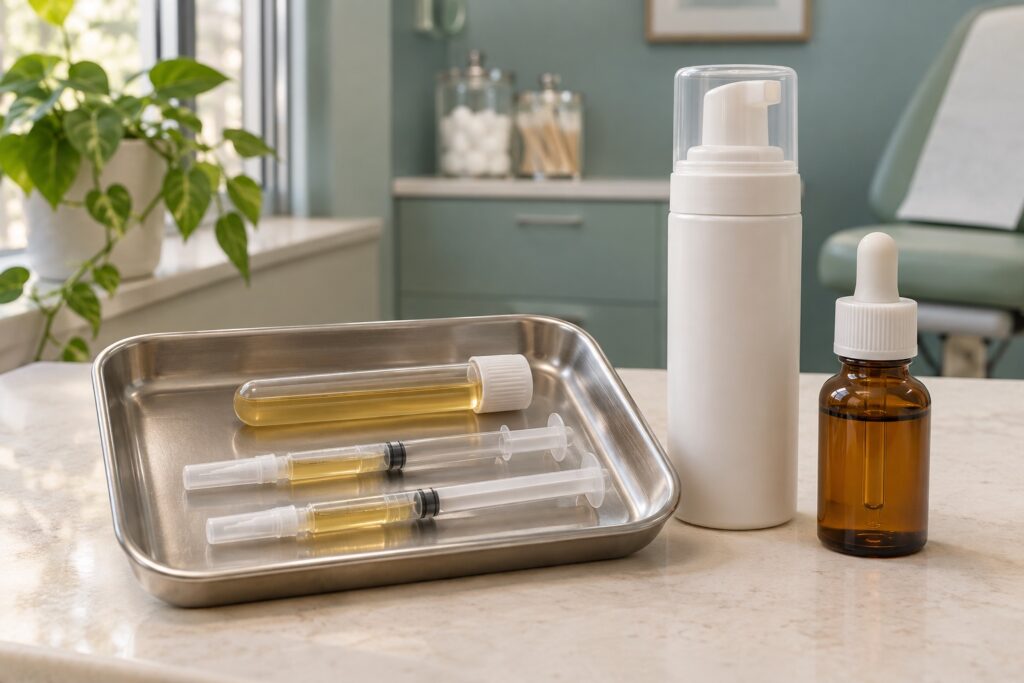
Choosing between PRP and minoxidil means choosing more than injections or a daily foam. You are weighing the chance of fuller hair against the cost, routine and treatment you may need to keep using.
This guide compares PRP scalp injections with topical minoxidil for pattern hair loss. If you already use minoxidil, the useful question is what PRP might add, rather than whether the more expensive option must work better.
Editorial details
PRP vs. minoxidil at a glance
| Decision | PRP | Minoxidil |
|---|---|---|
| What you use | Your own platelet-rich plasma, injected into the scalp | A medicine applied as foam or solution |
| Routine | Clinic visits; an initial series and possible maintenance | Daily use, with the schedule set by the product label |
| Main trade-off | Higher cost, needles and less standardized protocols | A continuing routine, scalp irritation or unwanted hair growth |
| U.S. status | PRP equipment clearance is not proof of an approved hair-regrowth treatment | Approved topical products are available without a prescription |
| Cost basis | Price the whole series, reviews and later injections | Price the actual number of months at the labeled schedule |
PRP is prepared from a blood sample using a centrifuge. It contains platelets and growth factors; it is not a hair transplant. Minoxidil supports hair growth while you keep using it. Neither treatment makes a diagnosis unnecessary. PRP explained; Topical minoxidil label.
“Minoxidil” can also mean a prescription tablet. Oral minoxidil is used off-label for hair loss and needs a separate safety assessment. See oral vs. topical minoxidil before applying this comparison to tablets.
Is PRP better than minoxidil for hair growth?
Current head-to-head evidence does not establish that PRP reliably grows more hair than topical minoxidil. Both can help pattern hair loss. Results vary with the person, the PRP preparation and what the study counts as improvement.
The larger comparison
A 2026 review combined 9 randomized trials involving 451 people. PRP did not show a clear advantage for hair density, terminal hair count or moderate-to-high regrowth. Satisfaction and a negative hair-pull test favored PRP. Read the review.
What that means: fewer hairs coming away during a pull test is different from visibly fuller coverage. A satisfaction result cannot substitute for a density result.
A direct trial in men
In a 2023 trial, 64 men were randomized to three monthly PRP sessions or 5% topical minoxidil for six months. At week 24, photographic response was 56% with minoxidil and 38% with PRP; the difference was not statistically significant. Read the trial.
What that means: this small study did not establish a winner. Those percentages describe participants meeting the study’s response criteria, not the percentage of hair each person regrew.
A small study in women
A randomized crossover pilot involving 20 women found that minoxidil improved more objective hair measures, while PRP improved several quality-of-life measures. Each treatment period lasted 12 weeks. Read the pilot study.
What that means: women’s results deserve their own discussion. A short pilot is useful evidence, but too small to settle the long-term choice.
Ask what a clinic means by a “success rate.” Less shedding, greater satisfaction, a higher hair count and a noticeable cosmetic improvement are different outcomes. Before-and-after photographs are more useful when lighting, hair length, styling and the photographed area match.
Can you use PRP and minoxidil together?
Yes. Combining PRP with topical minoxidil is a reasonable option to discuss, but the evidence does not make it an automatic upgrade for everyone. It adds appointments and expense to the daily routine.
A 2024 review of five randomized trials found better hair-density results with the combination. However, only one trial had a low risk of bias, certainty was low to very low, and one included treatment was platelet-rich fibrin (PRF), rather than conventional PRP. The findings do not tell us how much extra visible coverage a particular person will notice. Combination review and limitations.
A broader 2025 review reached a less certain result: its smaller pooled analysis of PRP plus minoxidil did not find a clear hair-density advantage over minoxidil alone. Different study selections and treatment methods help explain why reviews can disagree. 2025 review.
The practical test: agree on the extra benefit you are trying to achieve, the assessment date and the cost of continuing. If minoxidil already works well enough for your goals, adding injections is optional. If it causes symptoms, review those first instead of simply adding another treatment.
PRP also does not establish that you can stop minoxidil without losing its benefit. A combined-treatment study tests adding PRP, not whether PRP preserves hair after minoxidil withdrawal. See what happens when you stop minoxidil.
Should you try minoxidil or PRP first?
For many adults with confirmed pattern hair loss, topical minoxidil is a practical first discussion. PRP becomes more relevant when the routine, tolerability or remaining degree of thinning makes an additional option worth considering. Your diagnosis and preferences matter more than a generic ranking.
Minoxidil may fit when
- You want a lower-cost option you can use at home.
- You can follow a daily schedule and judge progress over months.
- Your scalp is healthy enough for application and the product label fits you.
Women’s 5% Rogaine foam is labeled once daily; men’s 5% solution is labeled twice daily. Choose the exact product and directions rather than assuming every “5%” product has the same routine. Women’s foam label; Men’s solution label.
PRP may fit when
- You have pattern hair loss confirmed by a qualified provider.
- You accept blood draws, scalp injections and the likely ongoing cost.
- You want to discuss an add-on, or cannot use topical minoxidil comfortably.
Ask how the proposed preparation and appointment schedule relate to the evidence. A treatment called PRP is not automatically identical to the PRP used in a trial. Protocol differences in the research.
If irritation is the obstacle, a different formulation may be an option after review. Foam without propylene glycol can help when that ingredient is the problem, but it does not remove the possibility of allergy to minoxidil itself. Our itchy-scalp guide explains the distinction, and foam vs. liquid compares the routines.
If loss is sudden, patchy, painful or associated with scalp inflammation, establish the cause before buying either option. PRP-versus-minoxidil trials mainly concern androgenetic alopecia, not every cause of shedding. Diagnosis and treatment guidance. For the broader picture, see hair loss in men or hair thinning in women.
How long do results take, and which lasts longer?
Both take months to assess, and neither is a one-time cure for pattern hair loss. PRP usually shifts the effort from daily application to repeat appointments; it does not remove maintenance.
A useful review plan
Agree on the diagnosis, target area and baseline photographs. Record current medicines and how long you have actually used them. Keep the same lighting and hairstyle for later comparisons.
Follow the product’s review instructions. Men’s 5% solution labeling says to stop and ask a doctor if there is no regrowth after four months; women’s 5% foam uses six months. Do not wait through significant symptoms just to reach a photo date. Men’s label; Women’s label.
AAD describes three monthly treatments, followed by maintenance about every three to six months. This is a commonly used pattern, not a universal prescription. Johns Hopkins notes scalp results may be most noticeable around six months. AAD; Johns Hopkins.
Compare the same scalp area and decide whether the change is meaningful to you. Ask whether to continue, modify the plan or investigate another explanation for limited progress.
Minoxidil needs continued use to maintain its regrowth benefit. PRP results also fade and may require repeat treatment. There is not enough comparative maintenance evidence to promise that one will keep your hair longer after you stop. Minoxidil label; PRP duration.
An early increase in shedding can occur with minoxidil; it is not proof that the treatment will work. Follow the product leaflet and use our minoxidil shedding guide to separate expected changes from reasons to contact a provider.
PRP vs. minoxidil cost: compare the first year and maintenance
Topical minoxidil usually costs much less. PRP adds a series of clinic treatments and possible repeat injections, so compare the full year rather than one bottle with one appointment.
Use the dated product observations in our minoxidil cost guide and the clinic menus in PRP hair-loss prices. Those pages keep the price details together; a clinic quote may include different visits, reviews or add-ons.
Price minoxidil by usable months
Check the formulation, labeled application schedule and how long the pack should last. Add recurring prescription or consultation fees only if your plan actually includes them. A subscription discount is useful only if you can cancel or change it on acceptable terms.
Price PRP as a continuing plan
Ask for the initial series, follow-up assessment and expected maintenance separately. Include travel, time away and any proposed combined treatment. Find out what happens to prepaid sessions if you stop or the provider recommends a different approach.
For a combined plan, add both costs. Ask yourself: “What visible improvement would make this extra spend worthwhile to me?” Put your actual quote in the treatment budget calculator rather than assuming a package will pay for itself by replacing medication.
Which is safer: PRP or minoxidil?
The risks are different. PRP involves a blood draw and injections; topical minoxidil can irritate the scalp and occasionally cause symptoms elsewhere in the body. “From your own blood” does not mean risk-free.
PRP commonly causes temporary soreness or bruising. Less common complications include infection, bleeding and tissue or nerve injury. Tell the provider about bleeding or platelet disorders, medicines that affect clotting and any scalp infection. Do not stop prescribed blood thinners on your own to make an appointment possible. PRP risks; Trial eligibility restrictions.
With topical minoxidil, irritation or unwanted facial hair can occur. A red, painful, inflamed or infected scalp needs assessment rather than another application. Tell your provider about heart disease, other medicines and pregnancy or breastfeeding. Label precautions; MedlinePlus drug guidance.
What should you ask before buying a PRP package?
Ask for a diagnosis, a measurable goal and a plan for deciding whether more treatment is worth it. A package price alone cannot answer those questions.
- What is causing my loss? Ask whether the examination supports pattern hair loss, another condition or more than one cause.
- What exactly is being injected? Confirm whether it is PRP, PRF or something else, how it is prepared and which evidence supports that protocol.
- What stays in my routine? Ask whether minoxidil continues and get written instructions for when to pause and restart it around each procedure.
- How will we judge progress? Agree on photos, the target area, the review date and what would count as a worthwhile change.
- What happens if I do not respond? Ask about reassessment, unused package sessions and the full maintenance cost before prepaying.
Take your bottle or a label photo, a list of medicines and supplements, previous scalp photographs and a realistic record of missed applications. If you have only used minoxidil intermittently, that is useful information, not a reason to feel embarrassed.
For men with pattern loss, ask whether a DHT-targeting treatment belongs in the discussion too. PRP is not a substitute for that conversation; our finasteride vs. minoxidil comparison explains the different roles.
PRP and minoxidil: common questions
Can PRP work without minoxidil?
Yes, some trials find improvement with PRP alone. That does not mean it will match a combined plan or remove the need for maintenance. Agree on a review point before paying for a long series of treatments. Comparative evidence.
Can I apply minoxidil immediately after PRP?
Ask the treating provider for a written restart time. The minoxidil label advises against use on an irritated or painful scalp, and a trial using both treatments does not establish a universal same-day application schedule. Product precautions.
Can I switch from minoxidil to PRP without shedding?
There is no reliable promise that PRP will prevent loss of minoxidil-supported hair after stopping. Discuss a transition plan before changing a working routine; adding PRP and replacing minoxidil are different decisions. See stopping minoxidil.
Is PRP better than minoxidil for women?
The limited direct evidence does not establish that. In a 20-woman pilot, minoxidil performed better on several objective hair measures, while PRP helped quality-of-life measures. The diagnosis, tolerability and time commitment still guide the choice. Women’s pilot trial.
Does PRP block DHT?
PRP is not an established DHT-blocking treatment. It is studied for its growth-factor effects; finasteride addresses DHT through a different mechanism. Ask which aspect of pattern hair loss each part of your plan is intended to treat. Mechanisms and comparative context.
Is PRP better than oral minoxidil?
The topical comparisons here cannot answer that question. Oral minoxidil is a different route with systemic risks and off-label hair-loss use; it requires a prescriber’s assessment. Start with our oral vs. topical comparison.
Is PRP for hair loss FDA-approved?
Do not confuse clearance of equipment used to prepare PRP with approval of a hair-regrowth claim. Ask exactly what was cleared and what evidence supports the proposed scalp treatment. Johns Hopkins describes PRP as investigational for most uses. Regulatory explanation.
Sources and editorial notes
Sources checked November 9, 2026. We prioritized direct randomized comparisons, systematic reviews and U.S. product labeling. The comparison concerns pattern hair loss; PRP preparations and study outcomes differ, and a short-term density change is not a guaranteed visible result. Clinical review is pending.
The cover is an editorial illustration of treatment formats. No patient result is shown. Read how we review evidence and our disclosures.
View all 10 sources
- Umar et al., 2026: PRP versus topical minoxidil: Nine randomized trials, 451 participants; comparison of hair measures, shedding and satisfaction.
- Balasundaram et al., 2023: randomized trial in men: 64 men randomized; three PRP sessions compared with six months of 5% topical minoxidil.
- Bruce et al., 2020: randomized crossover pilot in women: 20 participants; short treatment periods and separate objective and quality-of-life outcomes.
- Yao et al., 2024: adding PRP to topical minoxidil: Five trials, one using PRF; low-to-very-low certainty and limited evidence for the visible importance of density differences.
- 2025 systematic review of PRP for hair loss: Broader trial review with treatment subgroups and substantial protocol variation. The paper discloses employment of authors by BTI Biotechnology Institute.
- American Academy of Dermatology: diagnosis and treatment: Scalp assessment, treatment selection and commonly described PRP appointment schedules.
- Johns Hopkins Medicine: PRP injections: Preparation, risks, duration and the distinction between equipment clearance and treatment claims.
- DailyMed: Men’s Rogaine 5% solution: Directions, approved-use description, four-month review point and stop-use warnings.
- DailyMed: Women’s Rogaine 5% foam: Once-daily schedule, six-month review point and pregnancy and safety warnings.
- MedlinePlus: topical minoxidil: Use, precautions and symptoms that need medical advice.