How to Price Med Spa Services: Costs, Provider Time, Packages and Profit
A workable med spa price has to cover the treatment’s direct costs, the time and capacity it uses, and its share of running the practice. It also has to make sense to the patient. Copying a competitor’s menu answers only the last question, and often incompletely.
This guide gives owners and practice managers a repeatable pricing method, a fully worked example and a way to test discounts, packages and slower booking months. The numbers are fictional so you can replace them with your own costs without mistaking a vendor’s sales projection for a business plan.
Ready to work with your own numbers? Open the med spa service pricing calculator to test a price, promotion or package. You can load this guide’s fictional $300 example, then replace the assumptions with your own. No email is required.
Editorial details
The quick answer
Know your cost
Include supplies, actual paid labor, processing and follow-up, then account for fixed overhead.
Measure the constraint
Compare contribution per usable provider or room hour, not just revenue per appointment.
Test discounts
A 20% price cut can reduce contribution by much more than 20%.
Review real results
Use completed visits, collected prices and actual costs rather than a full calendar forecast.
Start with the service you actually deliver
Define the service before calculating its price. “Microneedling” might mean a face-only appointment or face and neck, with different devices, supplies, preparation and follow-up. A laser area can also cover different boundaries at different practices.
Create one record for each meaningful service variation. Write down the treatment area, typical appointment length, provider role, supplies, included review and optional extras. If two appointments consume substantially different resources, a single average can conceal which one supports the practice and which one loses money.
For injectables, distinguish the clinical treatment plan from the billing unit. A unit of one botulinum toxin product is not interchangeable with a unit of another. Different filler syringes can also contain different volumes. Those details belong in both the costing sheet and the patient explanation. See Botox costs and filler quote comparisons for the consumer-facing issues your team should explain clearly.
The operating perspective: Darryl H., NuWaysMD.com’s founder and editor, spent seven years as a med spa co-owner and practice manager. His responsibilities included scheduling, hiring, provider coordination, purchasing, software, marketing and the patient experience. That background informs the questions in this guide; the financial examples below are original illustrations, not the former practice’s private results or supplier deals.
Three checks from the practice-manager perspective
Darryl’s work included the front desk, provider coordination, purchasing and follow-up systems as well as ownership. Those responsibilities connect to three practical checks you can make in your own practice:
- Follow the entire appointment. Count intake, photographs, room preparation, documentation and follow-up. A 30-minute procedure can use more than 30 minutes of paid work.
- Compare purchasing with usable treatments. Record what is consumed or discarded, when supplies expire and how much cash is tied up in stock. A lower purchase price helps only if the usable cost and inventory commitment work for the practice.
- Check the promise across the team. The website, front desk, consultation and checkout should describe the same inclusions. Give staff a written policy for packages, touch-ups and refunds so exceptions do not silently change the collected price.
These are operating checks based on the responsibilities described above, not claims about the former practice’s margins or supplier agreements.
Build a treatment cost sheet
| Cost category | What to record | Common omission |
|---|---|---|
| Treatment supplies | Actual usable product, disposable tips, needles, syringes, numbing supplies and other single-use items | Dividing by theoretical capacity when opened stock, expiration or required disposal reduces usable treatments. |
| Provider labor | Paid preparation, treatment, documentation and follow-up time, with relevant employer costs | Counting only the minutes the device touches the patient. |
| Other staff time | Check-in, photography, room preparation, payment, checkout and required coordination | Treating front-desk and assistant time as unlimited. |
| Payment and financing | Your effective merchant or financing fee for the payment method used | Applying the lowest card rate to every financed transaction. |
| Patient acquisition | The cost of obtaining a new paying patient, measured separately from routine repeat visits | Assuming every lead books and every first-time patient returns. |
| Fixed overhead | Rent, committed payroll, insurance, software, management, service agreements and other recurring commitments | Leaving out an owner-manager’s compensation because the owner is temporarily not taking a paycheck. |
Use invoices and payroll data for costs you know. Label estimates so someone is responsible for replacing them. Record dates because product, payroll and payment fees change.
Decide which costs change when one more appointment is completed
A disposable tip is usually variable: another completed treatment uses another tip. A monthly lease payment is usually fixed within the period being modeled. Labor depends on your arrangement. A clinician paid per completed visit behaves differently from a salaried clinician whose shift is already committed.
Do not count the same payroll in both variable labor and fixed overhead. Equally, do not erase paid idle time because your model only recognizes completed appointments. A mixed staffing arrangement may need separate scheduled-hours and per-treatment components.
The SBA’s break-even framework separates fixed costs from variable costs. That distinction lets you test volume without rebuilding the entire budget.
A complete worked example: a $300 appointment
Consider a fictional service with a one-hour room slot. It requires 45 minutes of paid provider time across preparation, treatment and documentation. The remaining room time covers turnover and scheduling buffer. The labor arrangement in this example makes that $45 a variable cost; committed idle payroll is included in overhead.
| Item | Calculation | Amount |
|---|---|---|
| Treatment consumables | Actual supplies used | $70 |
| Provider labor | 45 minutes at a loaded $60 per hour | $45 |
| Other disposable supplies | Per completed visit | $5 |
| Payment fee | Illustrative 3% of $300 | $9 |
| Total variable cost | $70 + $45 + $5 + $9 | $129 |
| Contribution | $300 collected minus $129 variable cost | $171 |
Contribution is the money available for fixed costs and then profit. It is not the owner’s take-home pay. The clinic must still cover its fixed commitments from that $171. At one room-hour per visit, this service contributes $171 per occupied room-hour under the stated assumptions. Revenue per room-hour is $300. These are different measures: revenue is collected sales divided by time; contribution subtracts variable costs first. Use the same definition when comparing services or outside benchmarks.
Suppose the practice assigns this service line $6,000 of monthly fixed costs. This includes its share of rent, committed support and idle payroll, management compensation, software, insurance and fixed equipment expenses. It is a management model, not a tax profit-and-loss statement. Financing principal, taxes and unusual expenses may require a separate cash-flow view.
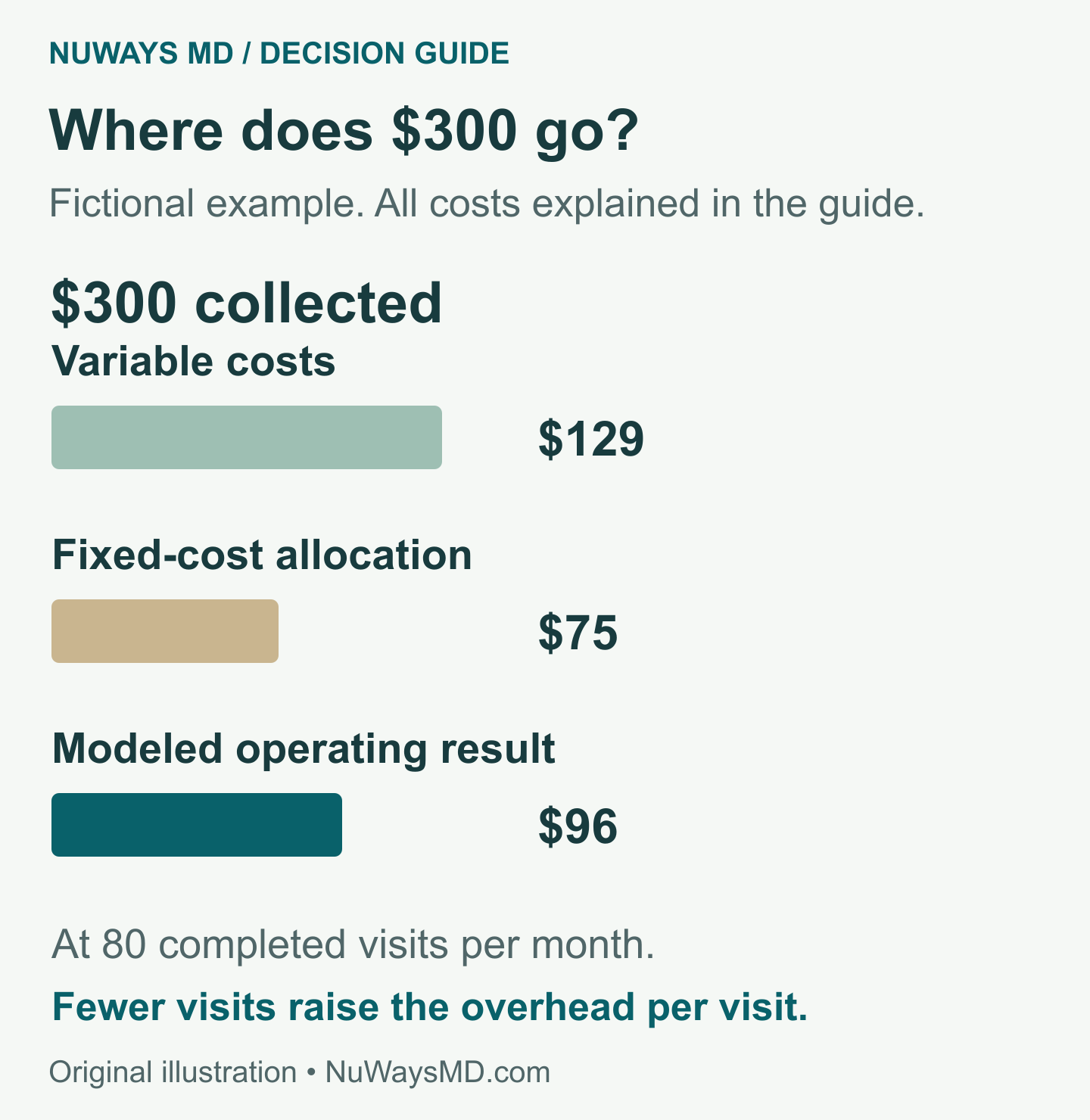
At 80 completed visits, the planned overhead allocation is $75 per visit. That gives a modeled operating result of $96 per visit: $300 minus $129 minus $75. At fewer visits, the allocation rises. The $75 figure is an assumption about volume, not a permanent feature of the service.
Find the minimum sustainable price, then choose the price
The arithmetic gives you a starting point. It does not tell you what patients will value or what your market will support.
For the example, costs before the percentage payment fee total $195: $120 in per-visit costs plus the planned $75 overhead allocation. To cover those costs with a 3% fee:
Break-even price at the planned volume = $195 ÷ (1 − 0.03) = $201.03.
To leave a 20% operating margin after those same costs and fee:
Price = $195 ÷ (1 − 0.03 − 0.20) = $253.25.
These are model outputs, not recommended med spa prices or industry margin targets. If expected visits fall or the service takes longer, recalculate. If the market will not support a sustainable price, consider a different service design, cost structure or offering rather than hiding the shortfall inside an optimistic booking assumption.
Margin is not markup
If something costs $100 and you add a 25% markup, its price is $125 and its margin is 20%. A 25% margin requires a $133.33 price before any additional percentage fee. Mixing the two can quietly underprice an entire menu.
Also distinguish gross margin, contribution margin and operating margin. A report that excludes rent and payroll cannot be compared with another practice’s figure that includes them. Ask what each percentage actually subtracts. OpenStax’s managerial accounting explanation provides the underlying contribution and break-even method.
What a discount really costs
A 20% promotion takes the example’s collected price from $300 to $240. The supplies and provider work do not become 20% cheaper. Only the percentage payment fee falls, from $9 to $7.20.
| Measure | Regular price | 20% discount |
|---|---|---|
| Collected price | $300 | $240 |
| Variable cost | $129 | $127.20 |
| Contribution per visit | $171 | $112.80 |
| Visits to cover $6,000 fixed costs | 36 | 54 |
The discount reduces contribution by 34%. It takes about 52% more completed visits to produce the same total contribution, assuming identical costs and capacity. Break-even visits are rounded up because the practice cannot complete part of an appointment.
This does not mean a promotion can never work. It means the owner needs a reason it will work: genuinely unused capacity, a measured acquisition cost, an appropriate repeat service and enough margin to support the offer. “We will make it up in volume” is incomplete until you calculate both the volume and the time available to deliver it.
Repeat the model with a slower month
| Completed visits | Revenue at $300 | Result after $6,000 fixed costs at $300 | Result after $6,000 fixed costs at $240 |
|---|---|---|---|
| 80 | $24,000 | $7,680 | $3,024 |
| 60 | $18,000 | $4,260 | $768 |
| 40 | $12,000 | $840 | −$1,488 |
| 35 | $10,500 | −$15 | −$2,052 |
The table uses the same service mix and cost assumptions in every row. It excludes taxes and exceptional costs. At 40 appointments, overhead is effectively $150 per visit, twice the allocation used in the original 80-visit price model. The discounted service now loses money in this model even though each appointment still makes a positive contribution.
Can the calendar support the price model?
Test provider time, room time, turnover and realistic completed bookings before using extra volume to justify a discount.
Check usable appointment capacity →Packages and memberships: price the obligation too
A package is future treatment time, not free cash
Three $300 visits sold at a 10% discount bring in $810, or $270 per visit. Under the worked example’s assumptions, contribution becomes $141.90 per visit after the 3% fee, or $425.70 for the package, compared with $513 at regular price. The discount costs $87.30 in contribution.
Receiving $810 today does not mean all of it is available to spend. The practice still owes the treatments. Track unredeemed visits, expiration terms, refunds and the capacity needed to provide the services. Have your accountant determine the appropriate revenue-recognition and liability treatment for your arrangements.
Do not build profitability around patients abandoning prepaid care. Model the package as if every included treatment will be used. If the economics depend on people failing to redeem, the price needs attention.
A membership needs a redemption model
List what the fee buys: account credit, included treatments, discounts, priority access or some combination. Then test active members using those benefits as written. Include the effect of member pricing on high-demand appointment times and the administrative work of cancellations, pauses and unused credits.
The clinic should be able to explain the terms plainly before enrollment. Clinical suitability still determines treatment. A subscription schedule does not establish how often someone should receive a procedure.
A worked membership example: $200 a month
Consider a separate, fictional membership that includes one eligible facial appointment per month. Model every included appointment being used. There are no banked dollar credits or additional discounts in this example. Assume $35 in product, $40 in variable provider labor and $5 in other supplies per appointment, a 3% fee on each membership payment, and a one-hour room slot including turnover.
At 60 paying members, monthly collections are $12,000. Delivering all 60 appointments costs $4,800; payment fees are $360. That leaves $6,840 contribution, or $114 per member, before fixed costs. If $6,000 of fixed monthly costs is assigned to this service line, the modeled result is $840, not $12,000 of profit.
| Monthly scenario | Collected membership fees | Contribution after fulfillment and payment fees | Result after $6,000 fixed costs | Room hours needed |
|---|---|---|---|---|
| 60 members, $80 delivery cost each | $12,000 | $6,840 | $840 | 60 |
| 45 members, $80 delivery cost each | $9,000 | $5,130 | −$870 | 45 |
| 60 members, delivery cost rises to $100 each | $12,000 | $5,640 | −$360 | 60 |
This simplified model assumes eligible members receive their appointments in the same month. Sixty members create a commitment for 60 room-hours, including the times members actually want. If those slots would otherwise sell at a higher contribution, account for that displacement. Extra member discounts, administration and financing fees need their own costs.
An account-credit membership works differently: money collected can remain an obligation until the credit is redeemed. Do not treat unused credits or skipped appointments as automatic profit. Track what the practice still owes and have the accounting and membership terms reviewed for your arrangement.
For a complete offer, compare banked credit, included treatments, tiers and annual billing in our med spa membership pricing guide. It follows the benefits through redemption and tests early use, accumulated balances and appointment capacity.
Keep financing fees visible in the model
Patient financing may cost the practice more than its usual card processing. Replacing the illustrative 3% fee with your actual contract rate can change the result substantially. Run the transaction through the appropriate fee assumption instead of treating the promotional payment option as free.
Choose the pricing format patients can understand
| Format | When it can be useful | What the patient needs to know |
|---|---|---|
| Per unit | Appropriate injectable services | Brand, estimated treatment quantity, what the final charge depends on and whether review is included. |
| Per syringe | Filler proposals | Product, syringe volume, treatment scope and what happens if the plan changes. |
| Per area | Laser and selected other services | Clear area boundaries, session count and which adjacent areas cost extra. |
| Per appointment | Defined facial, needling or other service | Included treatment, time, add-ons and follow-up. |
| Package | A clinically appropriate series | Total price, included visits, payment terms, expiration and refund arrangements. |
The clearest menu lets the front desk describe the price accurately without diagnosing, promising a particular dose or improvising discounts. Train staff on a short explanation and give clinical questions to the treating professional.
Review prices using actual performance
Use a monthly service report with completed visits, collected revenue after discounts and refunds, variable costs, paid time, contribution and repeat booking. Separate new patients from existing patients when evaluating acquisition spending.
For example, $900 of advertising that produces 30 inquiries and six new paying patients costs $150 per acquired patient, not $30. Compare that $150 with the first visit’s contribution and realistic subsequent behavior. Do not book hoped-for lifetime spending as if it has already happened.
Watch for these signals:
- A busy provider has low contribution because long appointments displace more sustainable work.
- Packages raise cash receipts while the backlog of owed appointments grows.
- Discounts become the usual collected price, making the published menu largely theoretical.
- Supply usage exceeds the costing sheet because of waste, repeats or a changed protocol.
- Follow-up and documentation take more paid time than the original appointment template allowed.
If the problem is a device payment or service agreement, use the equipment ROI calculator and quote-comparison guide. If the issue is opening costs and runway, use the startup cash model. Pricing, capacity and cash flow should tell a consistent story.
When and how to raise med spa prices
Review prices when supply or payroll costs change, a service takes more time, included follow-up expands, or the collected price no longer supports the required contribution. A consistently full schedule with a waiting list can justify reviewing positioning and capacity too. First check whether the problem is pricing, excessive discounting, wasted supplies or appointments running beyond their slots.
Test how much volume a price increase can lose
Using the original $300 service, a rise to $325 leaves $195.25 contribution after $120 of nonpercentage variable costs and a 3% fee. At $300, 80 visits produced $13,680 contribution. At $325, 71 completed visits produce $13,862.75, enough to exceed that contribution before the same fixed costs. Seventy visits produce $13,667.50, slightly less.
This is a sensitivity check, not a forecast that patients will accept the increase. It assumes unchanged treatment scope and costs. It shows the question to monitor: does actual contribution improve after changes in completed visits, cancellations and discounts?
Make the change clear to patients and staff
- Set the new price, included services and effective date in writing.
- Review outstanding quotes, prepaid packages and membership terms before deciding who receives the new rate. Do not silently change what an existing purchase includes.
- Update the website, booking system, front-desk reference and consultation materials together.
- Give patients advance notice with a short explanation and the exact new price. Avoid invented scarcity or claims that a higher fee guarantees a better result.
- Compare collected revenue, completed visits and contribution after the change. Track exceptions so unplanned discounts do not undo the decision.
For example: “Starting [date], our [defined service] will be $325. It includes [scope and follow-up]. Your existing prepaid package remains covered under its current terms.” Use that wording only when it accurately reflects your policy and agreements.
Your first pricing review: a practical worksheet
- Choose one frequently sold service and define its exact scope.
- Gather recent supply, payroll and payment-cost records.
- Measure preparation, appointment, documentation and turnover time.
- Separate per-visit costs from fixed monthly commitments without double counting.
- Compare regular, package, member and promotional collected prices.
- Test planned bookings, a slower month and a higher-cost scenario.
- Check what comparable local offers actually include.
- Set a price, document its assumptions and schedule the next review.
Do this well for a small set of core services before redesigning every line on the menu. A repeatable process is more useful than a beautifully formatted spreadsheet nobody can update.
Frequently asked questions
What profit margin should a med spa target?
There is no single percentage in this guide presented as an industry rule. Targets depend on service mix, staffing, fixed commitments and what the reported margin includes. Start with a clearly defined operating result and cash requirements, then test whether the target is achievable at realistic demand.
Should I price below competitors when opening?
Only after you know what the lower price costs and how long it is sustainable. An introductory offer should have a defined purpose, budget and end point. A new practice can also compete through clarity, appropriate care, reliable follow-up and a better experience rather than a permanent low-price position.
How do I account for my own work?
Include reasonable compensation for the work you perform, using the relevant clinical, management or administrative role. Otherwise the model can call the service profitable while relying on unpaid owner labor. Ask your accountant how that management view maps to your formal accounts.
Should the equipment payment be divided by treatments?
You can allocate it for planning, but label the expected completed volume. The payment stays due when bookings fall. Keep it in the fixed-cost model as well, and avoid counting it twice when calculating profit.
Is a high-revenue service always the best use of a room?
No. Compare contribution, appointment length, demand and the scarce resource. A larger ticket can produce less contribution per usable hour when it needs expensive supplies or occupies a provider and room for much longer.
Can the same price work for every payment method?
It can if the overall model supports the actual fee mix. Test merchant and patient-financing costs using your agreements. Any separate fee or payment policy also needs to follow applicable requirements and be clearly explained before payment.
Sources and editorial notes
Prepared for U.S. aesthetic practice owners and managers. Reviewed for source accuracy and arithmetic September 29, 2026. This is operational education, not individualized accounting, tax or legal advice.
All financial scenarios are fictional and fully stated. They are not national benchmarks, vendor return-on-investment promises or disclosures of private practice invoices. The 3% payment fee and $60 loaded hourly labor cost are illustration inputs. Replace them with your actual agreements and payroll costs.
- SBA: break-even analysis.
- OpenStax: contribution and break-even calculations.
- SBA: market research and competitive analysis: demand, local alternatives and comparable offers.
- Terri Ross, writing for AmSpa: pricing aesthetic services: an illustrative gross-margin example and operational pricing considerations, not a measured national margin target.
- BOTOX Cosmetic prescribing information: product units are not interchangeable with other botulinum toxin products.
Related price research is linked where used. No private supplier discounts or invoices were used. Read our professional editorial and commercial approach or send a correction through Contact.
Test your service price
Put the method to work with your own costs and completed visits. Compare up to three scenarios, see what a discount changes and export the assumptions and results.
Calculate my service price →Use your own costs. No signup required.