Med Spa Membership Pricing: Benefits, Treatment Credits and the Cost of Redemption
A med spa membership can make spending easier for patients and collections more predictable for your practice. The best starting point is one useful promise: set money aside toward a flexible treatment menu, or pay a clear monthly amount for a defined benefit. Choose the goal first: treatment margin, predictable collections, retention or growth across your menu. Match the benefits to your brand and delivery strengths, then build the economics around that job.
Editorial details
The quick answer
What does the fee buy?
Separate money saved toward treatment, included services and access to member prices. Each creates a different obligation.
Does $189 a month cover tox?
Yes. Three payments total $567 for the included three-area visit in this example. At an illustrative 60 units, that is $9.45 collected per unit. Your effective product cost, delivery model and growth goal determine what it earns. See the worked numbers.
How should you test profit?
Separate the product spread, contribution after delivery costs and return across the member relationship. A plan can earn directly, fill spare capacity or use a defined growth budget. Cost full use and measure the result against the goal.
Where should a beginner start?
Choose one clear promise. A $99–$149 banked-credit plan with a defined discount can suit a varied menu; an included visit can suit a focused routine. Match either to patient spending, your costs and available appointments. Start with these four steps.
This guide compares banked credits, included treatments, member pricing and points, then shows how to price, position and launch them. It combines our own 50-practice price research, firsthand operating experience and worked financial examples for solo startups, quieter practices and teams close to capacity.
1 / CHOOSE
Find the model that fits your practice
Goal, benefit structure and real examples.
Choose the business problem before the membership
Choose one primary goal you can measure. A membership can make a familiar treatment easier to budget, encourage a useful return routine, introduce patients to more of your services or fill appointments that would otherwise stay empty. The best structure depends on which of those jobs matters most to your practice. Compare the result with the business you would have had without the plan.
| Your main goal | Design worth considering | What would show it is working? |
|---|---|---|
| More predictable collections | A banked-credit plan matched to existing spending patterns | Successful collections alongside manageable unused balances, refunds and future delivery costs |
| Appropriate return visits | A clearly defined service plan with an individualized treatment schedule | Members receive suitable care, can book it and stay by choice |
| Fill unused capacity | A limited plan for services and appointment windows you can consistently offer | More completed visits in those windows and positive additional contribution |
| Increase patient lifetime value | Benefits that improve a useful ongoing relationship | More contribution over the relationship after delivery, acquisition and retention costs |
| Introduce another service or retail category | A specific, costed benefit relevant to the patient’s goals | Additional purchases with a positive margin, rather than a discount on purchases already likely |
For a startup, a membership is an offer to test with a real audience. It cannot replace demand, clinical suitability or a reliable booking experience. For an established practice, it changes an existing relationship, so compare the new economics with what those patients already spend.
Write a one-sentence brief: “We want to fill suitable Tuesday and Wednesday facial appointments with a plan that remains worthwhile when every included visit is used.” That gives you a better pricing starting point than copying a nearby practice’s $149 fee.
Start here if this is your first membership
Start with one plan for one recognizable group of patients. If your menu is varied and patients already return, a dollar-credit plan plus a carefully limited discount is a sensible first model to investigate. It is easy to explain: the payment becomes usable credit, and selected purchases receive member pricing. It still needs a cost test.
- Look at actual spending. Review a recent group of returning patients. Separate those who spend steadily from occasional visitors and very high spenders. Use aggregate figures, not patient names, in your planning sheet.
- Pick an affordable funding amount. A $99–$149 monthly credit is a candidate to test, not an industry prescription. At $99, the patient commits $1,188 over a year; at $149, $1,788. Match that commitment to care they already want and can reasonably use.
- Cost a short benefit list. Begin with the credit and one clearly defined discount or perk. Apply it to the eligible services and retail people are likely to choose, including the expensive mix.
- Pilot within your calendar. Set a capacity-based enrollment limit, explain the terms on one page and review use before adding VIP treatments or another tier.
If most of your relevant patients want the same recurring service, an included-treatment plan may be clearer than a wallet. If they visit infrequently, pay-per-visit pricing or a finite package may serve them better. The right first offer follows the relationship you can actually support.
Compare the membership models
Patients need to understand what remains after they pay: a dollar balance, a treatment entitlement, a discount or a reward. The word “credit” can mean any of these. Use the specific meaning in your offer and in the software that records it.
| Model | What the patient receives | Main advantage | Main tradeoff |
|---|---|---|---|
| Banked dollar credit | A stated amount paid toward eligible future purchases, often with member prices | Flexible budgeting across a varied treatment menu | Growing balances, variable redemption costs and discounts on existing spending |
| Included treatment | A defined service or a stated number of visits in a period | An easy-to-understand routine and a more predictable service mix | Provider time is owed even when the calendar gets busy |
| Focused treatment funding | Monthly payments toward a specific treatment budget or defined annual benefit | Spreads a larger purchase into smaller payments | “Already paid for” can mislead if the treatment costs more, payments fail or eligibility changes |
| Access-only membership | Eligibility for specified prices or benefits; treatment is paid separately | Less prepaid treatment to track | The fee must feel worthwhile while the discounts remain affordable |
| Service-credit menu | Credits exchangeable for a defined list of treatments | Choice within a controlled menu | One credit can cost the practice very different amounts depending on the service |
| Earned loyalty points | Rewards earned through qualifying spending or activity | Can recognize an existing relationship without another subscription | Rewards can overlap discounts and create a second balance to administer |
Try a model in the calculator: Banked credit · Included treatment · Credit + benefits · Member pricing. Each opens an editable starting example; use your own costs and benefit terms.
An annual payment or a monthly payment is a billing choice, not a separate benefit model. You can charge an access fee annually, sell a year of services upfront, or collect monthly installments under a one-year commitment. Explain which one you mean.
Banked credit: flexible, but the benefit is still owed
In a simple $150 wallet plan, each successful $150 payment adds $150 to the patient’s usable balance. Applying $300 at a later visit consumes two months of credit. It does not create another $300 of cash.
A discount makes that credit buy more of your menu. With a 15% member discount, $150 covers $176.47 of eligible regular-price services: $150 ÷ 0.85. The practice’s delivery cost depends on what those services are. A dollar redeemed on retail, a device treatment or injectables does not necessarily leave the same margin.
State whether a complimentary facial is in addition to the dollar balance or uses it. Those are different promises. Clear checkout language protects both the patient and your treatment budget.
Can a $99 or $149 beauty bank also make money?
Yes. The payment buys services whose delivery cost is lower than the amount collected. The discount rewards commitment, while the wallet gives patients a useful way to plan purchases across your menu. An included perk can strengthen the offer when its delivery cost fits the budget.
These fictional examples assume every dollar of monthly credit is redeemed against services with 10% member pricing. Delivery costs include the product and variable labor for that example’s service mix. Processing is 3%; fixed expenses remain separate.
| Monthly plan | Regular-menu value bought with the credit | Delivery cost plus perk reserve | Processing | Contribution before fixed costs |
|---|---|---|---|---|
| $99 credit with 10% off | $110.00 | $60.00 | $2.97 | $36.03 |
| $149 credit with 10% off | $165.56 | $90.00 | $4.47 | $54.53 |
| Same $149 credit plus an annual included perk | $165.56, plus the separate perk | $90.00 + $5.00 | $4.47 | $49.53 |
In the last row, the annual perk costs the practice $60 to deliver, so twelve collected months fund it at $5 a month. That is its delivery cost, not its advertised retail value. If it becomes available earlier, fund that timing explicitly. A richer tier can work; the job is to price the actual benefits and decide when they become available.
These are planning examples, not estimated industry margins. They show why the monthly fee alone cannot tell you whether the plan is profitable. The same wallet redeemed mainly on low-margin injectables will differ from one used across a profitable mix of facials, device treatments and retail. Compare member spending and contribution with what those same patients previously bought.
Included services: define the entitlement and the appointment
“One signature facial each month” is easier to explain than a list of interchangeable credits. Still define the service, appointment length, eligible providers, upgrades and what happens to an unused visit. If members may save visits, allow for catch-up demand later.
For medically directed treatments, the clinician determines suitability and timing. A monthly charge is not a direction to perform treatment monthly. Plan what happens when treatment should be postponed or is no longer appropriate.
Points: distinguish purchased value from earned rewards
If someone pays $100 and receives 100 points worth $1 each, you have mainly renamed a prepaid balance. The name does not eliminate the underlying obligation.
Earned rewards work differently. In a fictional program, earning two points per $1 spent, with 100 points redeemable for $1, creates a 2% face-value reward. A $500 qualifying purchase earns 1,000 points, worth $10. Your cost depends on how the $10 is used and whether that purchase would otherwise have happened at full price.
For service credits, test every permitted exchange. If one credit buys either a service costing you $45 or one costing $95, price the expensive mix as well as your hoped-for mix. Keep paid balances, included visits and promotional rewards in separate records so staff can explain them accurately.
What real med spa programs illustrate
What our 50-practice research already tells us
Our September 2026 Botox price check recorded a membership offer or member-price reference at 21 of 50 sampled practices across five metropolitan markets. That is 42% of this selected sample, not a national adoption estimate. It includes incomplete shop listings and member-price mentions, so it is not a set of 21 fully documented contracts. A blank observation means we did not record an offer in the inspected sources, not that the practice has none.
The useful finding is the variety. Some fees accumulate as money, some buy treatment entitlements, and others buy access to prices. A single average membership fee would combine different products. Here are selected examples from that research, with the listed details rechecked October 4, 2026.
| Practice and market in our sample | Selected public terms | What an owner can learn |
|---|---|---|
| Elase, Schaumburg | Brand membership page: $99 monthly banked credit with 10% off treatments/products, or $199 with 15% off. | Higher funding and a larger discount are two separate changes to cost. |
| Manhattan Medspa, New York | $169 monthly or $1,999 annually for its listed toxin plan. Monthly members receive their first wrinkle-relaxer service after month three; annual payers can access it immediately. | Benefit timing changes with payment timing. Neither version tells us the practice’s margin. |
Compare the other three research examples
| Practice and market in our sample | Selected public terms | What an owner can learn |
|---|---|---|
| Ever/Body, Williamsburg | $149, $249 and $349 monthly wallet tiers; advertised toxin discounts of 10%, 15% and 15%, respectively. | A higher tier need not mean an ever-deeper discount. Compare the whole benefit list and commitment. |
| Azala, Coconut Grove | $184 monthly / $2,208 annually for a plan advertising four toxin sessions a year. | Price an annual treatment promise over the full year. The short menu does not reveal acquisition costs or establish profit. |
| Skin by Lovely, Los Angeles-area sample | $350 annual membership, posted Botox member price of $15/unit and other benefits. | An annual access fee is different from an included-treatment plan. Treatment is still paid separately. |
These location labels identify the sampled practices; some linked program pages apply across a brand. Confirm local terms before making a comparison. This is a dated menu observation, not a recommendation of any practice.
Compare four more benefit structures
Four additional structures worth understanding
These additional examples were checked October 4, 2026 and are separate from the 50-practice sample. They help explain benefit design, rather than establish a recommended price range.
| Advertised program | Published price and selected benefits | Lesson for your design |
|---|---|---|
| OVME Maintain | $99 monthly credit toward eligible services, 15% off services and products, and additional perks. The page states a three-month minimum commitment. | A fee can fund the wallet while discounts create a separate economic cost. |
| Skin Laundry Prevent & Protect | $150 monthly for one Signature Laser Facial or one Resurfacing Facial, with member benefits. | A defined service choice is different from $150 to spend anywhere. |
| HH MedAesthetics VIP | $189 monthly plus a $299 startup fee and an initial one-year commitment. The advertised annual benefits include 120 Botox units and specified skin treatments. | First-year advertised dues and the startup fee total $2,567. Cost every included benefit across the year. |
| Perceptions Lips + Botox | $189 annually for access to benefits, including a posted $9.75 Botox unit price. | A low annual access fee does not mean treatment is included. |
No public menu above establishes profitability, retention or legal suitability for another practice. The lesson is to compare what the payment buys, when it can be used and what it costs you to deliver.
2 / COST
Work out what the promise costs
Delivery costs, the $189 tox example, unused credit and capacity.
Price the full cost of redemption
Redemption means using a benefit you have promised. The cost includes the supplies, treatment time and other resources needed to deliver it. A “free” benefit still consumes those resources.
Build a cost sheet for each eligible service before combining them. Include product, disposables, paid provider time, payment and platform fees, follow-up work and any incremental administration. Count your own treatment time even when you are the owner. The membership design worksheet gives you a printable place to record the promise and its costs. Our service-pricing guide explains how to handle labor and fixed costs without counting them twice.
Contribution is what remains after variable costs to help pay fixed expenses and profit. It is not take-home income. For planning a benefit package, also set an explicit allowance for the overhead and operating return it must support. The distinction follows standard managerial-accounting principles.
A complete $149 facial-membership example
This fictional offer includes one visit per month, fully used, occupying a 60-minute appointment including turnover. The provider is paid per visit. For this example only, the practice allocates $35 of fixed expenses to that room-hour. These are teaching assumptions, separate from the $200 example in our broader service-pricing guide, rather than recommended fees or industry costs.
| Monthly amount per member | Calculation | Dollars |
|---|---|---|
| Supplies and disposables | One included visit | $30.00 |
| Provider labor | Paid treatment and turnover time | $40.00 |
| Administration and costed benefits | Variable allowance | $8.00 |
| Processing | Illustrative 3% of $149 | $4.47 |
| Total modeled variable cost | $30 + $40 + $8 + $4.47 | $82.47 |
| Contribution before fixed expenses | $149 − $82.47 | $66.53 |
| Planning allowance for fixed expenses | Allocation, not an extra cash fee | $35.00 |
| Modeled operating remainder | $66.53 − $35 | $31.53 |
The contribution margin is 44.7%; the modeled remainder after that overhead allowance is 21.2% of the fee. Neither number establishes the practice’s net profit. Taxes, financing, acquisition spending and costs not included in the model still matter.
See the calculation for a different target return
Suppose you want a $50 remainder after the same $35 overhead allowance. The modeled fee would need to be about ($78 + $35 + $50) ÷ (1 − 0.03) = $168.04. Rounding up to $169 would leave $50.93 under these assumptions. Here $78 is the non-processing variable cost. Add actual per-transaction charges, software fees and any omitted costs before using the result.
What if members choose a more expensive benefit?
Keeping the same $149 fee, test the cost of benefits rather than assuming members choose the cheapest option.
| Scenario | Variable cost including 3% processing | Contribution | After the same $35 overhead allowance |
|---|---|---|---|
| Original benefit mix | $82.47 | $66.53 | $31.53 |
| Redemptions cost $20 more | $102.47 | $46.53 | $11.53 |
| Redemptions cost $40 more | $122.47 | $26.53 | −$8.47 |
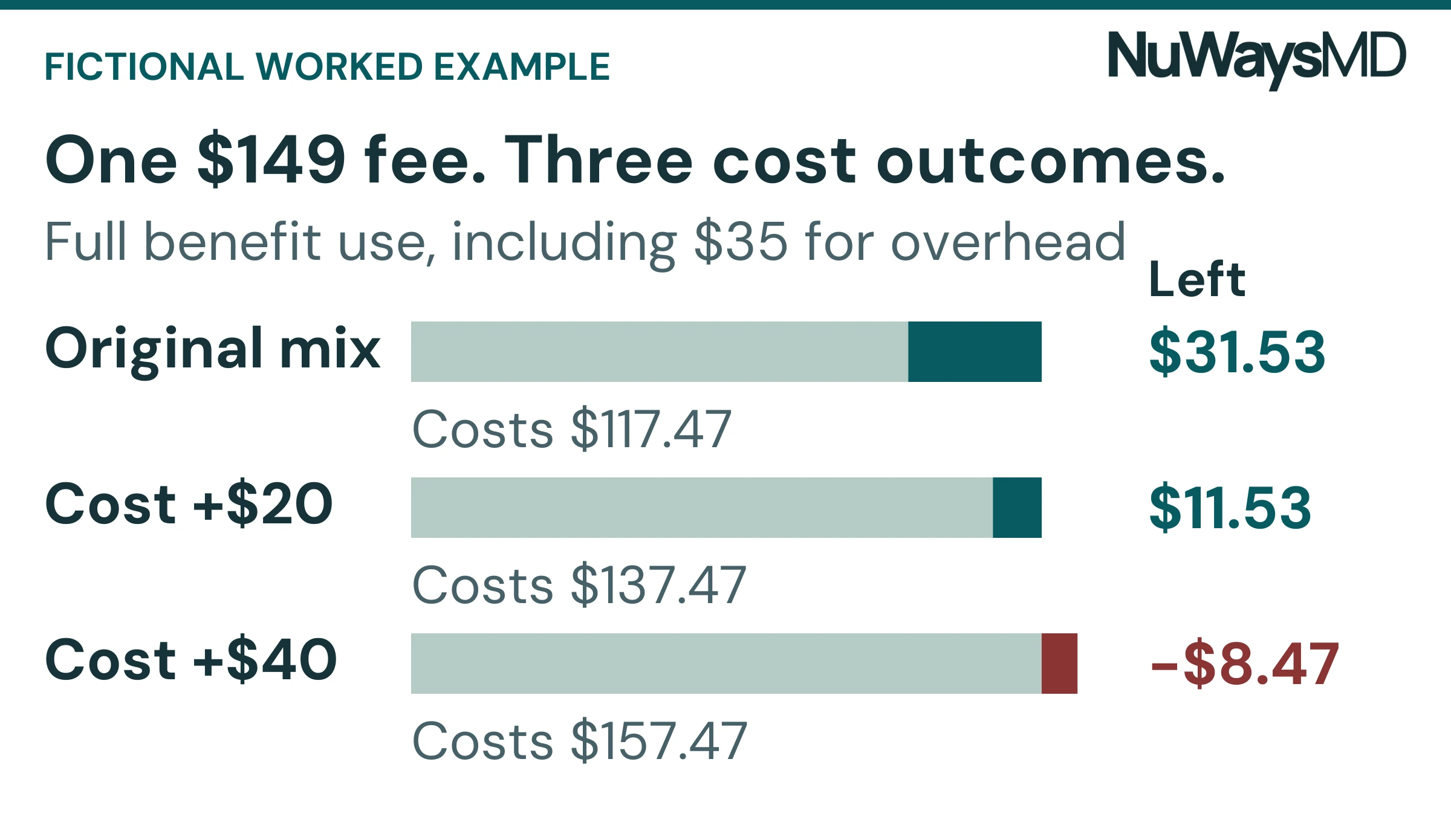
The useful decision is which lever serves your goal: improve purchasing, use spare capacity, adjust the benefit or price, or fund a measured growth offer. Each row still contributes toward existing fixed expenses. The final row misses the chosen overhead allocation, so it needs a closer look at capacity and the practice-wide return, rather than an automatic conclusion that another visit loses cash.
If clinicians are salaried, distinguish the cost of using currently spare paid time from the long-term cost of delivering the plan. A full schedule may require another hire. Keep salary in the model once, and test that staffing step separately.
Does $189 a month pay for tox every three months?
Yes. A $189 monthly plan can include one three-area treatment after three paid months, with no separate bill for that included benefit. The member has paid $567, and the practice has a repeat relationship to build on. This section models that included-treatment structure, independently of any particular commercial program.
At an illustrative 60 units of Botox Cosmetic, $567 works out to $9.45 collected per unit. If the practice’s effective product cost were $7.45 per unit, it would have a $2-per-unit spread, or $120 after product cost. That supports the business case before considering either better purchasing or additional services. Provider pay, processing and other delivery expenses come out of that spread.
The 60-unit quantity is a financial scenario, not a standard dose for three areas. Define the actual included areas and product in the offer, with suitability and treatment determined by the clinician. An appointment billed as a flat amount still needs an internal product-use record.
For a comparable visit normally priced at $720, the member pays $153 less, or 21.25%. The patient gets understandable pricing and a routine; the practice can earn from the treatment, continuity and relevant additional care. Use your real comparable price when advertising a saving.
One worked example: what remains from $567?
Start with the amount collected, subtract the product, then subtract the other costs of delivering the visit. What remains is contribution: money available toward fixed expenses and profit.
The table holds the illustrative Botox Cosmetic quantity at 60 units and varies only the acquisition cost. For the other visit costs, assume roughly $17 processing on the three payments, $40 provider pay and $20 supplies/administration: about $77 altogether. Replace these allowances with your own costs, including any follow-up work.
| Illustrative product cost per unit | Product cost for 60 units | Left after product | Approx. contribution after the other $77 of visit costs |
|---|---|---|---|
| $7.45 | $447 | $120 | $43 |
| $6.00 | $360 | $207 | $130 |
| $5.00 | $300 | $267 | $190 |
These are rounded planning examples, before fixed expenses and tax. The product costs are assumptions, not supplier quotes. Every $1 saved per unit adds $60 per completed visit here, which makes purchasing an important part of the business model.
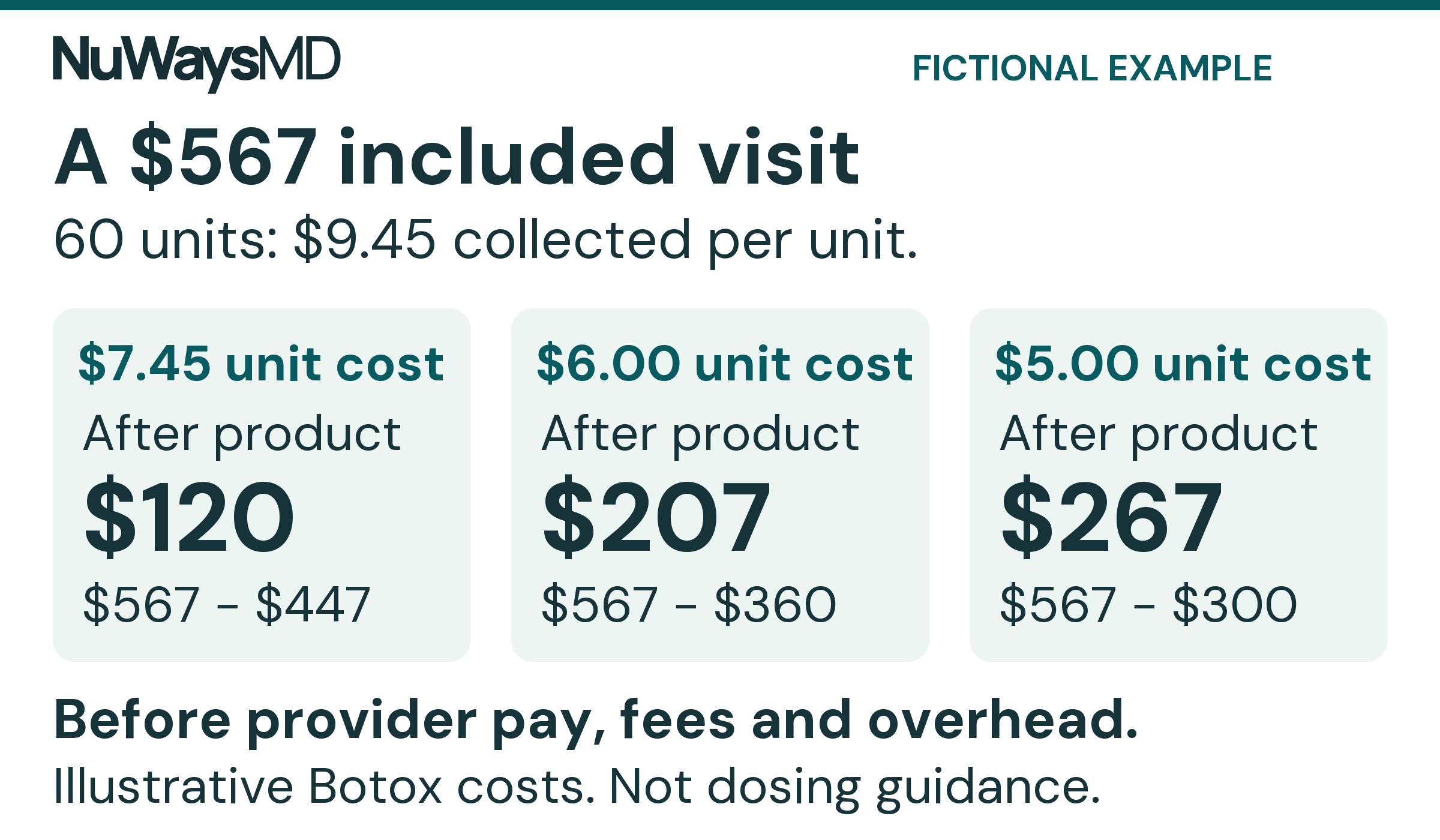
A short appointment can contribute meaningfully even at a lower member price. Compare the money left after visit costs with the complete appointment slot it uses. Include preparation, documentation, turnover and expected follow-up. A 15-minute treatment does not automatically create four completed, paying appointments every hour. The relevant question is whether this plan is a good use of the time you actually have available.
Use your effective purchasing cost
Your real product cost can reflect volume tiers, earned rebates, eligible reward product, shipping, program fees and unusable inventory. As a concrete example, Evolus’ published program terms list Jeuveau vial prices from $379 to $549 across purchase-volume tiers, and describe approved consolidated or national-account arrangements. Those are that manufacturer’s terms, not Botox prices. Its financial filing also documents rebates and product rewards.
For a small office, compare a direct account quote with eligible buying-group terms. For multiple locations, ask about approved consolidated or corporate terms. Compare the same product and realistic purchase volume, including fees, qualification periods and order requirements. Separate repeatable savings from a one-time introductory offer.
For planning, divide net acquisition spend by the usable units it buys. Include earned credits and eligible bonus product once. Count waste in either your usable-unit estimate or the visit’s product consumption, not both. Use written account terms and actual invoices to build the rate.
Some rewards compensate a practice for discounts given to patients. Evolus’ practice-reward terms, for example, require the qualifying patient discount. Record the lower patient receipts alongside the reward product, and check whether benefits can be combined with your membership. A training sample or a hoped-for future reward is not automatically usable membership inventory.
Botox Cosmetic, Xeomin, Jeuveau and Dysport need separate product-specific cost sheets. Compare the cost of the appropriate treatment, rather than applying another brand’s unit price to the same quantity. Botox Cosmetic’s prescribing information states that its units are not interchangeable with other botulinum toxin products. Name the actual product in the member offer.
Make the included benefit and any extra charges clear
Choose the promise before setting the price. These are different structures, and each can work:
| Structure | What the member understands | How the practice manages the cost |
|---|---|---|
| Defined three-area treatment included | The listed treatment is paid for once the stated payment and eligibility conditions are met. | Price the expected clinical use and variation across suitable members. Separately quote genuinely additional areas or services. |
| A stated number of units included | A specified quantity of the named product is included; additional units have a clearly stated member price. | State the allowance and extra-unit price before enrollment, then confirm the treatment cost before proceeding. |
| Banked dollar credit with member pricing | The balance is applied to a separately quoted treatment. | State the eligible prices and any amount payable beyond the balance. |
An internal unit budget is not an undisclosed cap on an included treatment. If you advertise the listed areas as fully covered, keep that promise. If the plan includes a unit allowance instead, make the allowance and extra charges prominent. Clinicians determine appropriate treatment; a budget must not become a reason to reduce clinically necessary care. Discuss eligibility and costs before enrollment and again before any additional treatment.
Fit the return to the practice’s capacity and goal
For a slot that would otherwise stay empty, the useful starting figure is contribution after the extra costs of the visit. Existing rent does not increase because one more member attends. If the clinician is salaried, count that salary once and distinguish spare paid time from overtime or an additional hire.
For the ongoing plan, check that the practice’s total contribution covers fixed expenses, owner compensation and growth. If you allocate overhead to visits, use a documented basis, such as the appropriate share of room or provider time, consistently across services. The hypothetical $35 room-hour in the facial example is not a rate to copy for your practice.
When appointments are scarce, compare the membership with the other work it would replace. A lower-margin visit may still support your relationship strategy, but that is a deliberate choice. These distinctions follow standard analysis of spare capacity and incremental costs. Your own costs and goal determine the return you need.
Make retention and additional services part of the plan
The treatment margin is one part of the model. A clear included benefit can give members a reason to return to a familiar team, reduce the need to shop for each appointment and create time to discuss their other concerns. Four planned visits offer repeated opportunities to earn trust and provide relevant care. Attendance and retention should be measured rather than assumed.
Use a normal review conversation: “How are you feeling about the result, and is there anything else you wanted help with?” When appropriate, discuss skincare, facials, laser or RF treatments, microneedling or another service the practice is qualified to provide. Offer a useful next step without making another purchase a condition of receiving the membership benefit.
Measure the additional contribution, after the extra treatment or product’s own costs. In a fictional quarter, 20% of members choosing an additional purchase that contributes $300 creates an average $60 per member for that quarter. It does not create $300 for every member. Separate new purchases from spending those patients would already have made, and from purchases paid with previously counted wallet credit.
Can the included treatment be a loss leader?
Yes, a deliberately funded offer can support patient acquisition or growth across the practice. Decide whether it is genuinely subsidized or simply has a smaller standalone margin than your usual price. A positive-contribution visit in otherwise empty time may already help the business before any additional purchase.
If the included visit really needs a subsidy after variable costs, set its budget and review period before launch. For example, a $40 subsidy per quarterly visit combined with the fictional $60 average additional contribution above leaves $20 per member per quarter, before acquisition spending and any additional fixed costs. If those extra purchases never happen, the practice funds the $40. Across four completed visits, the planned subsidy is $160 a member per year.
That can be a considered marketing investment. Track the whole joining group, including members who buy nothing else or leave, and compare the result with ordinary pricing and other acquisition options. Set an enrollment limit, a spending ceiling and a date to review the evidence. A busy practice should also cost the higher-contribution appointments it might displace.
The strategic choice is yours: earn mainly on the included treatment, earn a smaller margin while improving continuity, or fund a defined patient-development offer. Build the benefit, team conversation and measurement around the same goal.
A wallet uses the same payments differently
With $567 in dollar credit and a $660 eligible quote, the member pays another $93. A $480 quote leaves $87 of credit under the balance terms. A $567 quote uses it exactly. That can be a useful flexible plan, but its copy should say “credit toward treatment,” rather than promise a fully covered visit.
Set benefit timing before selling the plan
An annual promise can create delivery costs before installments arrive. In the historical VIP offer, $500 plus three $275 payments would collect $1,325; a full year would collect $3,800. We have no historical delivery-cost records, so these figures describe timing, not its actual profit.
There are three practical approaches:
| Approach | What it achieves | What still needs planning |
|---|---|---|
| Benefit available immediately, with a minimum commitment | Strong immediate appeal and an agreed payment schedule | Future installments can fail. Fund the early visit and define a fair exit process. |
| Benefit becomes available after stated payments | Aligns more collected cash with first use | Waiting reduces immediate appeal. Explain the date before enrollment. |
| Smaller benefits accrue progressively | Less of the annual promise becomes available at once | Track the balances and explain what happens if someone pauses or leaves. |
For the $189 included-treatment example, waiting for three successful payments means collecting the $567 before the first included visit. Immediate access asks the practice to fund that visit earlier. Either timing can be a deliberate choice if the cash, terms and member experience support it.
A six-month commitment schedules $1,134 in dues. It neither guarantees collection nor establishes that two visits are profitable. Assess successful payments, delivery costs and early exits together. The published Manhattan example above shows delayed eligibility in use; it is an observation, not a contract to copy.
Cash collected, unused credit and profit are different numbers
A strong launch can make the bank balance look healthy before many members have used their credit. The future work remains.
Here is a fictional group of 100 members, each paying $150 monthly. No one joins or leaves during the example, all payments succeed, there are no refunds, and every dollar paid becomes dollar credit. Redemption means the amount deducted from member balances, after any applicable member pricing.
| Month | Cash collected that month | Credit redeemed that month | Unused credit at month end |
|---|---|---|---|
| 1 | $15,000 | $6,000 | $9,000 |
| 2 | $15,000 | $10,500 | $13,500 |
| 3 | $15,000 | $18,000 | $10,500 |
| Three-month total | $45,000 | $34,500 | $10,500 still available |
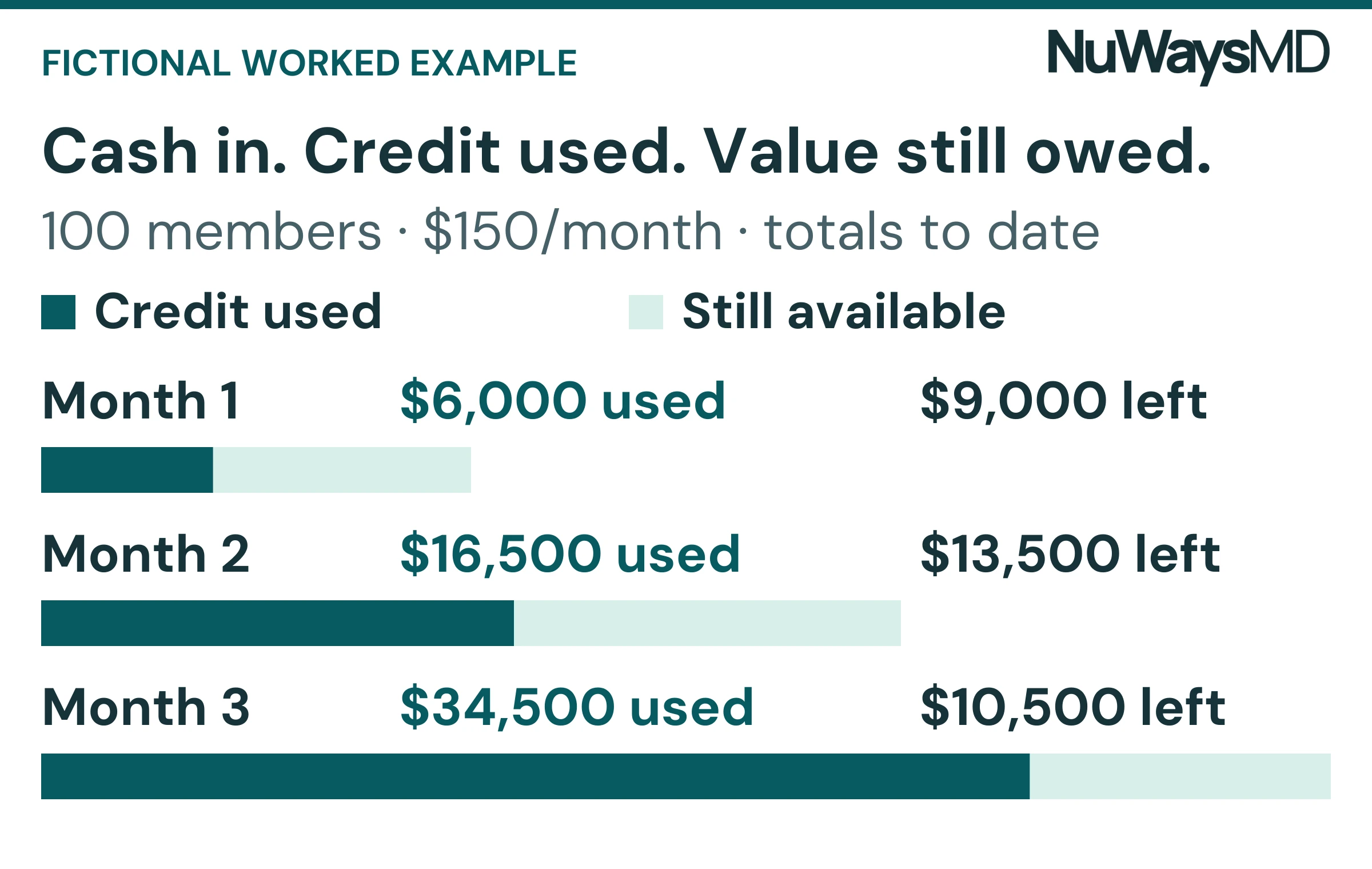
Month three’s redemptions exceed that month’s collections because members use earlier credit. That can be completely consistent with the promise. It becomes a problem when the practice has spent the cash without planning for the visits, products or refunds that remain.
Track cash collected, benefits used and benefits still owed separately. Do not count the original wallet payment and its later redemption as two sales. Under US revenue-recognition guidance, prepayment for future goods or services generally creates a contract liability until the relevant obligation is satisfied. Your accountant should determine the treatment for your contracts, accounting basis and tax reporting. A face-value member ledger is not automatically identical to the financial-statement liability where several benefits share one price. FASB revenue-recognition guidance (PDF), paragraphs 606-10-55-46 through 55-49.
Keep money available for the promise
If the $10,500 remaining credit is expected to require delivery costs equal to 45% of its face value, the modeled future delivery cost is $4,725. At 65%, it is $6,825. These illustrative percentages must come from the services members can actually choose.
That operating estimate is neither a legal reserve requirement nor a complete cash target. Refund exposure, fixed expenses, payment disputes and the timing of staff and supplier payments also matter. Work with your accountant on a cash cushion that covers the likely claims on the money.
Benefits that ultimately go unused are often called breakage. Fund full use through the plan’s own contribution or an explicit, affordable growth budget before assuming any benefit will go unused. An old balance is not automatically earned profit, and an expiration setting in software does not establish that the balance may legally expire.
Monthly or annual: compare the whole commitment
Monthly payments reduce the first payment but add repeated billing and failed-payment work. Annual prepayment improves near-term cash while concentrating the refund and delivery exposure. It also asks patients to commit before knowing how much they will use.
| Arrangement | Patient-facing explanation | Owner’s planning check |
|---|---|---|
| Month-to-month | The recurring price, billing date and cancellation process | Retention and the cost of providing value without a long commitment |
| Annual contract, billed monthly | The full initial commitment as well as each payment | Benefits delivered before cash arrives; pauses, missed payments and early termination |
| Annual prepaid | Total charged today, included year of benefits and renewal terms | Discount cost, outstanding obligations and remaining cash throughout the year |
In the fictional $149 service plan, twelve payments total $1,788. “Pay for 11 months, receive 12” costs $1,639 upfront: an 8.33% discount if the benefits are unchanged.
At full use, the model still incurs twelve months of non-processing variable costs: $78 × 12 = $936. With illustrative 3% processing and no fixed transaction fee, monthly billing leaves $798.36 of annual contribution. The annual offer leaves $653.83. After the same $420 annual overhead allowance, the remainders are $378.36 versus $233.83.
You collected sooner but gave up $144.53 of modeled annual contribution. That may be a deliberate tradeoff; price it explicitly. If an annual wallet offer issues less credit because the patient paid less, it is not the same comparison. If it issues full credit despite a discount, cost the full credit.
Can every member be charged on the first?
Some systems support a common billing date; others primarily bill from the enrollment anniversary or require adjustments. Confirm the capability in your actual setup. Stripe, for example, supports a billing-cycle anchor and explains how prorated first periods work. Stripe billing-cycle documentation.
Specify whether a partial first month creates partial credit, a full benefit or a later start. Charging a full fee at enrollment and another full fee a few days later is a surprise unless the benefit and billing terms clearly justify it.
A charge on the first is not a guaranteed bank deposit on the first. Settlement time, the payout schedule, bank processing and failed payments affect availability. Schedule payroll and supplier payments against usable funds, with a buffer. Stripe payout documentation.
Anniversary billing spreads work through the month. First-of-month billing simplifies a shared calendar but can concentrate declines, questions and benefit issuance. Choose the pattern your team can reconcile consistently.
Fit the offer to your practice’s stage and capacity
Being booked a week ahead does not tell you whether every provider, room and appointment window is full. Count usable slots in the service and time periods you intend to sell. The capacity-planning guide and worksheet help separate those constraints.
| Practice stage | A useful first move | Next two actions |
|---|---|---|
| Solo startup / few returning patients | Choose one service group and validate interest before selling many commitments. | Build costs from actual quotes; map clinician/room capacity and preserve opening cash. Use the startup-cost guide alongside the benefit model. |
| Open, with quiet booking periods | Identify the exact appointment windows and suitable services you want to fill. | Offer a small pilot to relevant returning patients; compare additional contribution with their previous purchases. Record why people decline. |
| Usually booked a week out | Identify which providers and windows still have dependable room. | Cap enrollment to those slots; monitor time to a suitable appointment before expanding benefits. |
| Very busy practice | Protect contribution per scarce appointment. A membership is optional. | Interview regular patients about convenience they value; test a tightly capped benefit without a blanket discount or an unfulfillable priority promise. |
| Growing team / multiple sites | Establish a shared benefit definition and a site-level cost sheet. | Assign balance reconciliation to a named role; pilot at one site and test cross-site redemption before expanding. |
For a new practice, early conversations can validate the concept without charging for benefits you are not ready to deliver. For a quieter practice, membership is one retention tool; it does not solve weak awareness or an offer people do not want. A full practice needs a different reason to launch than a practice trying to fill Tuesday afternoons.
Turn available time into an enrollment limit
Suppose you have 20 genuinely usable spare room-and-provider hours per month in the advertised windows. A benefit takes 60 minutes including turnover. Holding five of those hours back for schedule variation leaves 15 monthly benefit slots. At one visit per member, 15 members use those slots at full redemption.
If each member may redeem two visits in a catch-up month, those same 15 slots support only seven whole members at that stress level. You may instead expand capacity, stagger availability within fair terms or choose a benefit with different demand. A specific enrollment limit must follow the promise you actually make.
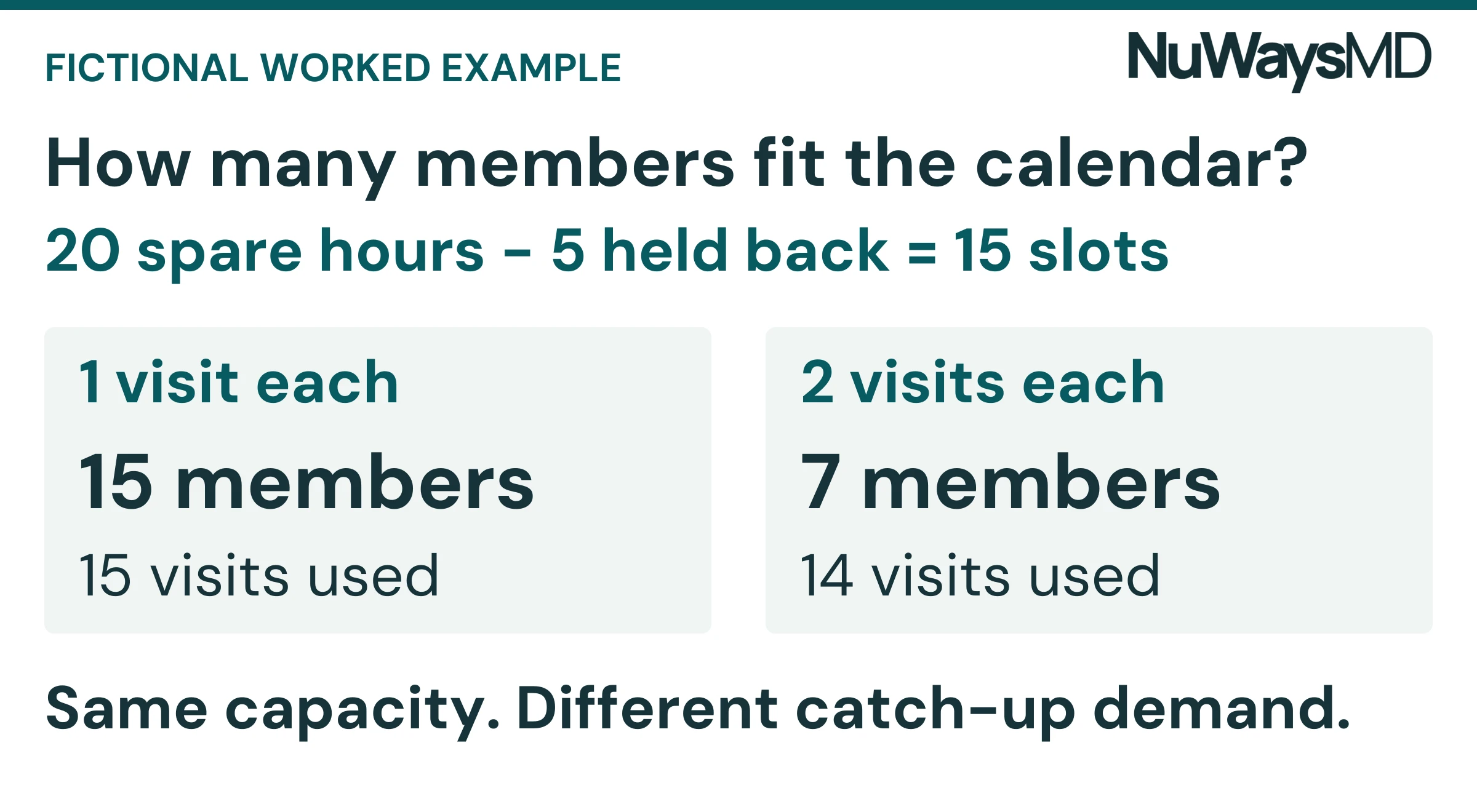
This is a planning example, not a recommended enrollment ratio. Also allow for existing obligations, provider leave, follow-ups and the appointment times patients prefer. A spare room without the right available clinician is not another saleable slot.
Are you adding business or discounting business you already had?
Consider a regular patient who currently completes six $180 visits a year. With $70 variable delivery cost per visit and 3% processing, those visits contribute $627.60 before fixed expenses.
Now suppose the patient joins the fictional $149 plan and uses all 12 included visits. Its annual contribution is $798.36. The increase is $170.76, but it takes six extra appointments, or $28.46 of additional contribution per extra slot.
That can be useful if those appointments would otherwise stay empty and the care is appropriate. If the six slots would instead sell at the ordinary price and contribute $104.60 each, the membership has a substantial opportunity cost. A bigger annual bill is not enough to establish that the program improves the business.
3 / LAUNCH
Build an offer your team can deliver
Benefits, branding, staff conversations, terms and a small pilot.
Choose benefits that patients value and the practice can deliver
Start with one anchor benefit people understand. Add supporting benefits only after each has a cost, an owner and a clear rule. The strongest offer may be a well-run, straightforward plan rather than a long list of nominal savings.
| Benefit | Why it may matter to a member | Cost or promise to check |
|---|---|---|
| Clear treatment balance and statements | Makes a larger future bill easier to plan | Accurate balances, reconciliation and post-cancellation handling |
| Defined included service | Makes the next eligible visit understandable | Full redemption cost and appointment capacity |
| A specific optional upgrade | Lets members try a relevant enhancement | Product, time, eligibility and whether the upgrade changes room turnover |
| Priority access to released appointments | Helps patients who value scheduling flexibility | An actual process and capacity; avoid guaranteeing unavailable appointments |
| Retail benefit | Supports an appropriate home routine | Product margin, manufacturer terms, stacking and purchases already likely |
| A scheduled planning conversation | Clarifies goals and the next steps | Staff or clinician time; never repackage essential care as an optional premium |
Check the discount on an ordinary existing purchase
In a separate fictional example, a $39 monthly access fee buys 15% off eligible purchases. If an existing patient’s normal monthly eligible spend is $300, the discount is $45. With 3% processing on all charges, the fee adds $37.83 after processing and the discount reduces net receipts by $43.65. The practice is $5.82 behind, before any extra perks or administrative cost, unless behavior changes enough to make up the difference.
Write the stacking rules before launch. Can member pricing combine with packages, manufacturer rewards, birthday benefits, a retail sale or a referral promotion? Confirm outside program terms as well as your own. Separately review patient-referral incentives and staff compensation with qualified counsel rather than assuming a rewards feature makes either permissible.
Make the offer recognizable as your brand
Lead with the relationship people want, then state how it works. A name should help the team explain the plan, not replace the explanation. These are illustrative names, not cleared trademarks.
| Positioning | Example name and message | Proof your operations must provide |
|---|---|---|
| Flexible treatment budgeting | Your Treatment Reserve: “Set aside $149 each month for the eligible care you choose.” | Accurate balances, clear eligible prices and a straightforward unused-credit policy |
| Simple maintenance | Your Maintenance Plan: “One monthly payment for the defined benefit below.” | Clear inclusions, individualized care and appointment access |
| Thoughtful skin routine | Skin Routine Membership: “Plan your eligible visits and home-care purchases together.” | Suitable benefit choices, product guidance and no pressure to buy an unnecessary service |
Use the same five facts on the website, handout and enrollment screen: price, benefit, limits, commitment and exit. Keep material terms readable beside the enrollment decision. Replace an inflated “$5,000 value” claim with the actual services someone would use and their ordinary prices.
Make the welcome experience part of the offer. Show the starting balance, first charge date, first eligible benefit and how to book. Assign one staff role to questions. A useful balance statement and reliable appointment access are more distinctive than another tier named Platinum.
Build tiers around different needs
Start with one plan unless there are clearly different groups to serve. If you add a tier, show what the extra payment changes. Two understandable tiers can be enough.
Consider a fictional lower tier with $99 monthly credit and a 10% discount, versus $149 credit and a 15% discount. On eligible regular-price purchases, those credits buy $110.00 and $175.29, respectively. The extra $50 cash therefore supports $65.29 more of the regular-price menu. Its delivery cost depends on what gets bought, and the larger discount can also apply to additional purchases beyond the wallet. Test those purchases too.
That is a useful upgrade only when it fits the patient’s existing or intended spending and the practice can afford it. Avoid automatically adding a large annual treatment: another $100 monthly brings $1,200 annually before fees, so a perk costing $1,500 to deliver already exceeds that increase.
Use launch perks that reinforce the promise
A founding-member offer can reward early feedback with a costed welcome benefit or a stated price period. Give it a real end date or capacity limit and explain renewal pricing. Avoid promising a permanently locked price without modeling future product and labor increases.
Birthday or anniversary benefits should be specific and affordable at full use. A two-person plan needs clear ownership of each person’s balance, separate clinical decisions and rules for one person leaving. Add these features because members value them and staff can administer them, not to fill a benefits grid.
Sell the membership at a useful moment
Offer it when you can connect the terms to a patient’s expressed goal and appropriate plan. A good time may be after assessment, at checkout when future care has been discussed, or during a voluntary planning conversation with an established patient. Staff should be able to recommend paying per visit when that is the better fit.
For a credit plan, lead with the useful choice: “If you would like to spread your treatment budget out, this plan puts $149 a month into your balance and gives you the listed member prices. We can compare it with paying per visit using the care you already have in mind.” Then show actual inclusions, commitment and cancellation terms before any authorization.
For an included-treatment plan: “This spreads the cost of the defined benefit across monthly payments, so you know what is covered at an eligible visit. Let’s confirm that the treatment, timing and appointment options fit you.” State any first-benefit waiting period plainly. “Already paid for” applies only when the benefit is included and payment conditions have been met.
Train the team on a repeatable conversation
- Ask permission: “Would it help to compare our membership with paying per visit?”
- Connect it to their goal: use the treatment plan and spending they have discussed, not the most expensive tier.
- Show one worked bill: the charge, credit or benefit used, and any amount still due. Include a missed-visit or cancellation example.
- Check understanding: ask what they expect their next payment and next eligible benefit to be.
- Let them choose: supply the written offer; keep ordinary pricing available.
Role-play an occasional visitor, a patient who needs to postpone treatment and a regular whose existing package is better value. Front-desk staff can explain commercial terms; clinicians make treatment decisions. Give staff an escalation route for questions instead of encouraging improvised promises. Evaluate accurate explanations and suitable enrollment, not just signup counts.
Answer objections without making cancellation the sales tactic
| Patient question | What the team should explain |
|---|---|
| “What if I miss a month?” | The actual rule for the unused visit or credit, with an example |
| “What if I need something different?” | Eligible alternatives, upgrade prices and the process when treatment is unsuitable |
| “Can I cancel?” | The initial term, cancellation method, final charge and handling of remaining benefits |
| “Will it save me money?” | Compare their plausible use with paying separately, including the membership fee |
| “Do I have to decide today?” | Give them the written offer and a way to return with questions |
Promote the offer through its own clear page, relevant service pages, an in-practice handout and follow-up the person has agreed to receive. Separate consent to recurring charges, marketing and treatment. Avoid making a clinician’s assessment contingent on buying a membership.
Retain members through useful follow-through
At enrollment, show how to find the balance and book. After payment, provide an understandable record. Ahead of an eligible visit, help the member find a suitable appointment. When a balance grows unused, ask whether timing, cost or the plan itself is the problem; offer the applicable pause or exit options.
Introduce other services through the patient’s expressed priorities. Ask whether they want to discuss an option, provide a separate quote and show the wallet balance that could apply. “Your balance can cover $300 of this” is more accurate than calling previously paid money free. Measure additional margin and satisfaction, not just the checkout total.
Keep requested account messages separate from promotional campaigns and follow applicable consent rules. An annual review can ask whether the plan still fits. Retention should come from a worthwhile relationship and delivered benefits, not obstacles to leaving.
Write the terms and test the software before enrollment
Your website, enrollment agreement and checkout system must describe the same offer. Have the final arrangement reviewed for the jurisdiction and business structure involved. Financial modeling does not determine medical eligibility, legal compliance or accounting treatment.
Terms that need an explicit answer
- Payment: amount, frequency, startup fees, minimum commitment, first charge and renewal notices.
- Benefits: dollar credit versus services versus rewards; eligible locations, providers, products and upgrades.
- Use: how benefits accrue, booking access, rollover, sharing, stacking and any valid restrictions.
- Changes: pauses, medical ineligibility, price changes, provider departure and practice closure.
- Exit: a clear cancellation method, effective date, final charge, refunds and remaining balances.
- Records: a confirmation the member can keep, terms accepted and a clear balance history.
Gift-card, prepaid-service and unclaimed-property rules can affect credits and unused funds. Federal rules distinguish some dollar-denominated balances from specific-service entitlements and promotional rewards; state rules can differ. Calling something “points” or “nonrefundable” does not settle its legal treatment. CFPB gift-card regulation. Aesthetic-practice attorneys also describe how membership structures can raise state-specific gift-card and prepaid-care issues. ByrdAdatto discussion.
For online recurring offers, the FTC identifies disclosure of material terms, express informed consent and a simple way to stop recurring charges as ROSCA requirements. FTC enforcement summary. The broader 2024 federal negative-option rule was vacated; the FTC opened a new rulemaking inquiry in March 2026. Do not rely on an old “click-to-cancel is now law everywhere” checklist. FTC March 2026 notice.
State requirements still apply. California’s attorney general, for example, describes strengthened renewal and online-cancellation requirements effective July 1, 2025. Easy cancellation is also a sensible service standard wherever you operate. California DOJ consumer alert.
Run a complete test purchase and redemption
Have your software vendor demonstrate the proposed plan with test records. Boulevard’s documentation separates account credits, service vouchers and discounts; it also identifies limitations for usage-based services. This is why a recurring-card charge alone does not demonstrate that the software can fulfill your offer. Boulevard membership setup.
Test a new enrollment, a normal renewal, a declined payment, a partial redemption, two accumulated benefits used together, a refund, a pause and a cancellation with credit remaining. Also test a provider change and an export of balances. Confirm when the clinician earns commission and what amount it uses; paying on dues and again on the same redemption can duplicate compensation.
Reconcile a sample from card charge to processor deposit, member balance, service delivery and accounting export. Staff should be able to show what happened without maintaining a second unofficial spreadsheet. Our med spa software comparison provides broader demo and migration questions.
Pilot the offer and measure what it adds
A practical four-week launch sequence
This is a suggested operating sequence, not a promise that a new practice should collect payments within four weeks. Complete clinical, legal, accounting and software readiness first.
| Stage | Work to finish | Ready to move on when… |
|---|---|---|
| Week 1: define and cost | Choose one audience and goal; model full use, expensive redemptions and early exits; set the capacity cap. | The base offer works under documented assumptions without relying on extra sales. |
| Week 2: prepare delivery | Finalize reviewed terms; test billing/redemption/cancellation; build the offer page, staff sheet and welcome message. | The team can show a correct bill, balance and cancellation in a test account. |
| Week 3: invite a small group | Offer it to suitable existing patients and opted-in contacts; log offers, questions and declines. Use relevant service pages and an in-practice handout. | Enrollment remains within capacity and patients can explain what they bought. |
| Week 4: fix friction | Review first charges, confirmations, booking access and benefit records; correct confusing copy or workflow. | Early delivery works. Longer-term redemption and retention still need observation. |
Start with people whose goals match the promise. A broad launch to everyone may create more low-fit signups and unanswered questions. Use genuine capacity to set the limit; keep the offer available for thoughtful consideration rather than a pressure deadline.
Measure outcomes beyond the first collection
Review early billing and booking problems quickly. Then follow the same joining groups over three, six and twelve months as applicable. A 30-day launch cannot establish annual retention or the cost of benefits that are used much later.
| Measure | How to use it |
|---|---|
| Collected dues | Track successful payments, refunds and failures separately from scheduled charges |
| Unused balances and visits | Show what remains owed, its age and plausible delivery cost |
| Redemption and service mix | Compare actual use with the cost assumptions, including catch-up months |
| Contribution and growth spend | Record the included visit’s contribution, additional purchases after their costs and any planned subsidy; separately review overhead, staffing steps and acquisition spending |
| Additional business | Compare members’ prior behavior and an appropriate comparison group where available |
| Appointment access | Track time to a suitable slot, busy-window displacement and booking complaints |
| Retention and cancellations | Separate voluntary cancellations, payment failures, pauses and reasons for leaving |
| Conversion | Divide enrollments by relevant patients actually offered the plan; include who declined and why |
Members may spend more because your best existing patients are the people most likely to join. A higher member average alone does not prove that the program caused higher spending. Include lost discounts on existing visits and any displaced full-price appointments when evaluating the incremental benefit.
For lifetime value, use the contribution generated over the relationship rather than adding prepaid cash and redeemed sales together. Early on, actual cohort results are more useful than dividing a projected monthly profit by an unstable first-month cancellation rate.
Pause new enrollments if booked access, balances or costs move outside the boundaries you set. Fix the offer for future enrollment with appropriate notice and review; honor existing obligations. Growth is worthwhile when the practice can keep the promise.
Frequently asked questions
How much should a med spa membership cost?
Start with the model: dollar credit, included care or access to pricing. Our selected examples include $99–$199 credit tiers, a $184 monthly included-toxin program and $189 or $350 annual access fees. These are examples of different products, not a market-wide recommended range. Price full use and appointment capacity before choosing the advertised fee.
Should every dollar of the fee become treatment credit?
It can, if the margin on redemption supports the discounts and extra benefits. If part of the fee buys access and part becomes credit, disclose the split clearly. Patients should not have to discover at checkout that a $150 payment created only $100 of usable balance.
Should we use a membership or a package?
A finite package can be simpler when there is a defined series of appropriate visits. A recurring plan fits an ongoing relationship whose benefits and billing remain useful over time. Compare the complete obligations and cancellation rules; calling a package a membership does not make recurring billing necessary.
Should unused credits expire?
Set the policy only after reviewing the type of credit and applicable law. Paid dollar balances, service entitlements and earned promotional rewards may be treated differently. Software settings and another practice’s terms are not legal permission. Make unused-value handling visible before payment.
Are unlimited memberships a good idea?
They are difficult to cost unless the permitted use is clear and capacity can support it. Medical suitability already limits treatment independently of billing. For an early program, a defined benefit is generally easier to explain, schedule and model than an “unlimited” promise with many exceptions.
Can a startup sell memberships before opening?
Advance sales create obligations before the practice has delivered anything. Confirm legal structure, opening readiness, clinical availability and cancellation or refund arrangements first. Keep the cash needed to fulfill the promise. A short delay or a small group of refunds should not make the opening budget collapse.
Should we make the commitment annual to reduce cancellations?
Choose the term to match a useful, clearly disclosed offer. A long commitment may make reported membership numbers look steadier while increasing payment disputes and member dissatisfaction. Test month-to-month economics first, then justify any longer obligation on its merits and legal requirements.
What if our practice is already full?
Protect the appointment capacity you have. A membership may still improve budgeting or the member experience, but broad discounts can replace stronger existing business. Calculate contribution per constrained appointment and consider an enrollment cap or retaining ordinary pricing.
Do points help us avoid prepaid-credit rules?
Changing the label does not change the substance of the transaction. Distinguish purchased value from earned rewards, document what each can buy and have the structure reviewed. Use points when they make the experience understandable, not to obscure a patient’s money.
Sources and editorial notes
Sources checked October 4, 2026. This is an operational planning guide for US practice owners. The worked models, charts and suggested scripts are original fictional examples, not measured practice results or industry benchmarks. The separately attributed former-practice note uses Darryl’s supplied historical offer terms; the worksheet is a blank planning resource. No return on investment, patient outcome or ranking is promised. Independent legal and accounting review has not been completed; qualified advisers should review an actual program before enrollment. Clinical decisions remain with appropriately licensed clinicians.
Our research and selected follow-up checks
- NuWays MD Botox pricing research: 50 selected practices across five metros; 21 rows with membership or member-price observations in the September dataset. Missing details remain unknown.
- Elase, Ever/Body, Azala, Manhattan Medspa and Skin by Lovely: selected sample examples, with the stated details rechecked October 4, 2026. The membership observations were secondary to a Botox price check, not a comprehensive contract audit.
- Botox Cosmetic prescribing information, PDF: product-specific units. The financial utilization scenarios are not clinical dosing guidance.
Additional published programs
- OVME membership page: banked-credit pricing, selected benefits and initial commitment.
- Skin Laundry membership page: defined-service membership and separate earned-reward structure.
- HH MedAesthetics VIP membership: monthly installments, startup fee and advertised annual benefits.
- Perceptions Aesthetic Spa memberships: annual access pricing and separately priced treatments.
These four examples were selected for contrasting structures. Prices, local availability and terms can change. Their public pages do not establish profitability or validate their legal or clinical claims. Practice links identify observed offers, not recommendations.
Costing, payment systems and records
- OpenStax: contribution margin and spare-capacity decisions: variable cost, fixed-cost allocation and incremental business. The short-run special-order framework informs one decision, not the full economics of an ongoing membership.
- Evolus program terms, practice-reward terms and June 2025 SEC filing: examples of volume pricing, approved account arrangements, rebates and eligible product rewards. No manufacturer rate is assumed for every practice. The $7.45, $6 and $5 product-cost cases are illustrative, not quotes.
- FASB revenue-recognition update, PDF: customer prepayments and unexercised rights, especially paragraphs 606-10-55-46 through 55-49. It is not a substitute for advice on an individual practice’s books or tax returns.
- Stripe billing cycles and payouts: billing anchors, partial periods and the difference between collection and available funds.
- Boulevard membership setup: separate credit, voucher and discount configuration. Documentation was reviewed; no hands-on software testing is claimed.
Terms and consumer protection
- CFPB Regulation E, section 1005.20: definitions and distinctions relevant to gift cards and prepaid value.
- FTC ROSCA enforcement summary: recurring online offers, disclosure, consent and cancellation.
- FTC March 2026 rulemaking notice: status of the vacated 2024 rule and the subsequent inquiry.
- California attorney general’s renewal-law alert: an example of state-specific requirements.
- ByrdAdatto: membership programs in aesthetics: practice-specific legal issues involving program design, unused value and treatment obligations.
Read our professional editorial and commercial standards. Requesting a resource, receiving marketing and authorizing an introduction are separate decisions.