HAIR REMOVAL / BUYING GUIDE
Best At-Home Laser Hair Removal Devices (2026): Picks by Skin Tone and Hair Color
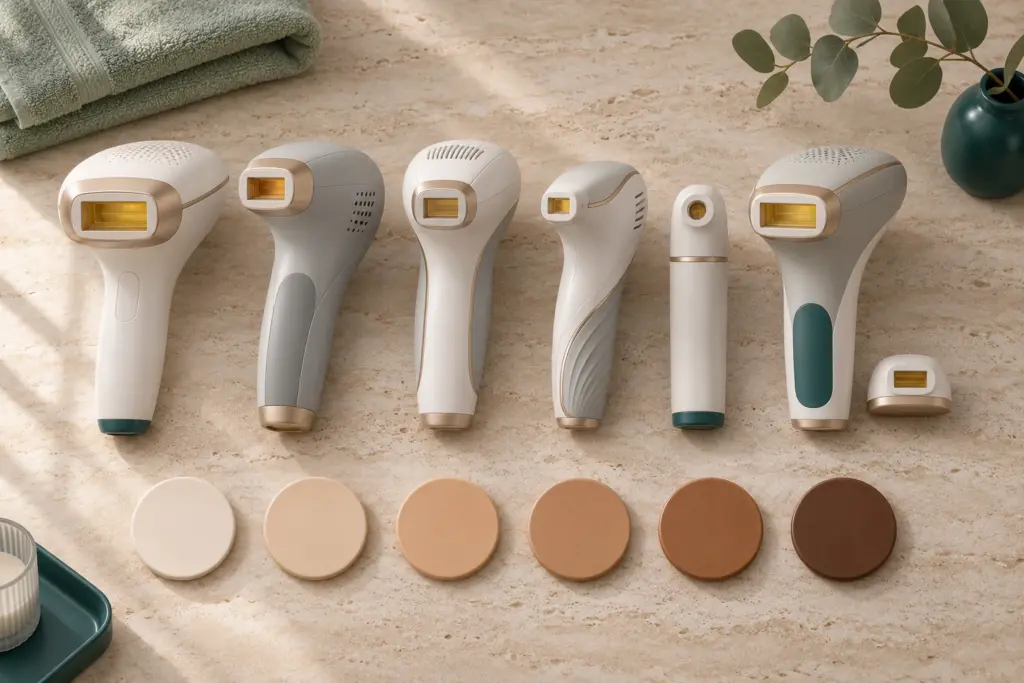
Most at-home “laser” hair removal devices actually use IPL, and the right one for you depends less on the brand than on three things: your skin tone, your hair color and the areas you want to treat.
We ranked six current US models by their published results, FDA records and official instructions, with prices checked November 11, 2026. You will see who each device suits, what it costs, how much time it takes and when a clinic or electrolysis is the better buy.
Editorial details
NuWays MD is independent and reader-supported. When you buy through links on our site, we may earn a commission. As an Amazon Associate we earn from qualifying purchases. Learn more.
Our six picks at a glance
We ranked the six by published evidence first, then by skin-type fit and price, so the list runs from the strongest data to the thinnest. Start with the label that sounds like you, then check the skin-tone chart below: a device outside your range is the wrong choice at any price.
Prices checked Nov 11, 2026No brand paid for placementRanked by published evidenceHow we picked
Ulike Air 10
Best independent evidence here, at the lowest price.
- Earlier model matched a clinic IPL in a 2025 trial
- Contact cooling for more comfortable sessions
- 100-day guarantee when bought from Ulike
Sale price
$259
$349 list price
Skin types I to IVTria Hair Removal Laser 4X
A diode laser with 12-month data, for small areas.
- Two studies tracked results for 12 months
- Built-in skin-tone sensor
- Diode laser rather than IPL
Price
$599.99
Small treatment window
Skin types I to IVBraun Silk-expert Pro 5
Widest IPL range here, with the most safety data.
- Instructions cover skin types I to V
- Adjusts the intensity of each flash to your skin
- Standard cap and face precision cap included
Price
$399.99
IPL5137 kit, one-time
2-year warrantySmoothSkin Pure Adapt
Made by Braun’s IPL maker, with unlimited flashes.
- Manual allows skin tones 1 to 5
- Unlimited flashes, nothing to replace
- Flexible head follows curves
Sale price
$279
$379 regular price
Skin tones 1 to 5Philips Lumea 8000 (BRI937/03)
Curved attachments for the face, body and bikini line.
- Body, face and precision attachments
- SenseIQ skin sensor guides the intensity
- 90-day money-back guarantee from Philips
Price
$449.95
2-attachment kit at Philips
Skin types I to IVEpilaser 980
A 980 nm laser for types V and VI; results not yet published.
- FDA K233224 describes a version for types V to VI
- Checks skin tone before the laser fires
- 60-day money-back offer when bought direct
Price
$995
One-time purchase
Types V and VI onlyNot sure which skin type you are? Check the skin-tone chart ↓
Which at-home devices work for your skin tone and hair color?
Light-based hair removal works best on dark hair against lighter skin. The light is absorbed by pigment (melanin) in the hair, heats the follicle and slows regrowth. Skin pigment absorbs light too, so the darker the skin, the more heat it takes in and the higher the risk of burns or color changes. That is why every device limits the skin tones it can treat. ASLMS; AAD hair-removal options.
Manufacturers describe skin tone with the Fitzpatrick scale, from type I to type VI. Check the skin you plan to treat, not your face in winter: a tan, or an area that is naturally darker, can move you up the scale for that session.
| Device | Technology | Skin types allowed | Hair colors | Price |
|---|---|---|---|---|
| Ulike Air 10 | IPL with contact cooling | Types I to IV | Brown or black; check the chart for blond | $259 sale$349 list |
| Tria 4X | 810 nm diode laser | Types I to IV | Light brown or darker | $599.99 |
| Braun Pro 5 | IPL | Types I to V | Dark blond, brown, black | $399.99 |
| SmoothSkin Pure Adapt | IPL | Tones 1 to 5 | Naturally brown or black | $279 sale$379 regular |
| Philips Lumea 8000 | IPL with attachments | Fair to medium brown (I to IV) | Dark blond, brown, black | $449.952 attachments |
| Epilaser 980 | 980 nm diode laser | Types V and VI only | Medium brown, dark brown, black | $995 |
Allowed by the instructions ExcludedType I is very fair skin that always burns; type VI is deeply pigmented dark brown to black skin.
Sources: Braun skin-tone guide; Ulike Air 10 comparison; Philips suitability; SmoothSkin manual; Tria FAQ; Epilaser 980. Prices were checked Nov 11, 2026, at each brand’s US store and exclude tax and shipping; Amazon prices change and are not shown.
If your skin is type VI
Skip IPL. The Epilaser 980 is the only home device we found with an FDA record covering types V and VI, and its published data are limited (see the review below). A professional long-pulsed Nd:YAG laser has the most evidence in deeply pigmented skin. Our guide to laser hair removal for dark skin explains how to choose a provider.
If your hair is blond, red, gray or white
None of these devices is a good buy. There is too little pigment in the hair to absorb the light, at home or in a clinic. Electrolysis treats each follicle directly, whatever the hair color. Compare it in electrolysis vs. laser and see what electrolysis costs.
The six devices, reviewed from their records
Each review covers who the device fits, the evidence behind it, the trade-off to watch for and the purchase terms that matter after you open the box. They run in the same order as the picks, strongest evidence first. We have not tested these devices hands-on; the reviews come from FDA records, current US manuals and product pages, and the published studies cited, so the limits are shown as plainly as the strengths.
Our pick for skin types I to IV
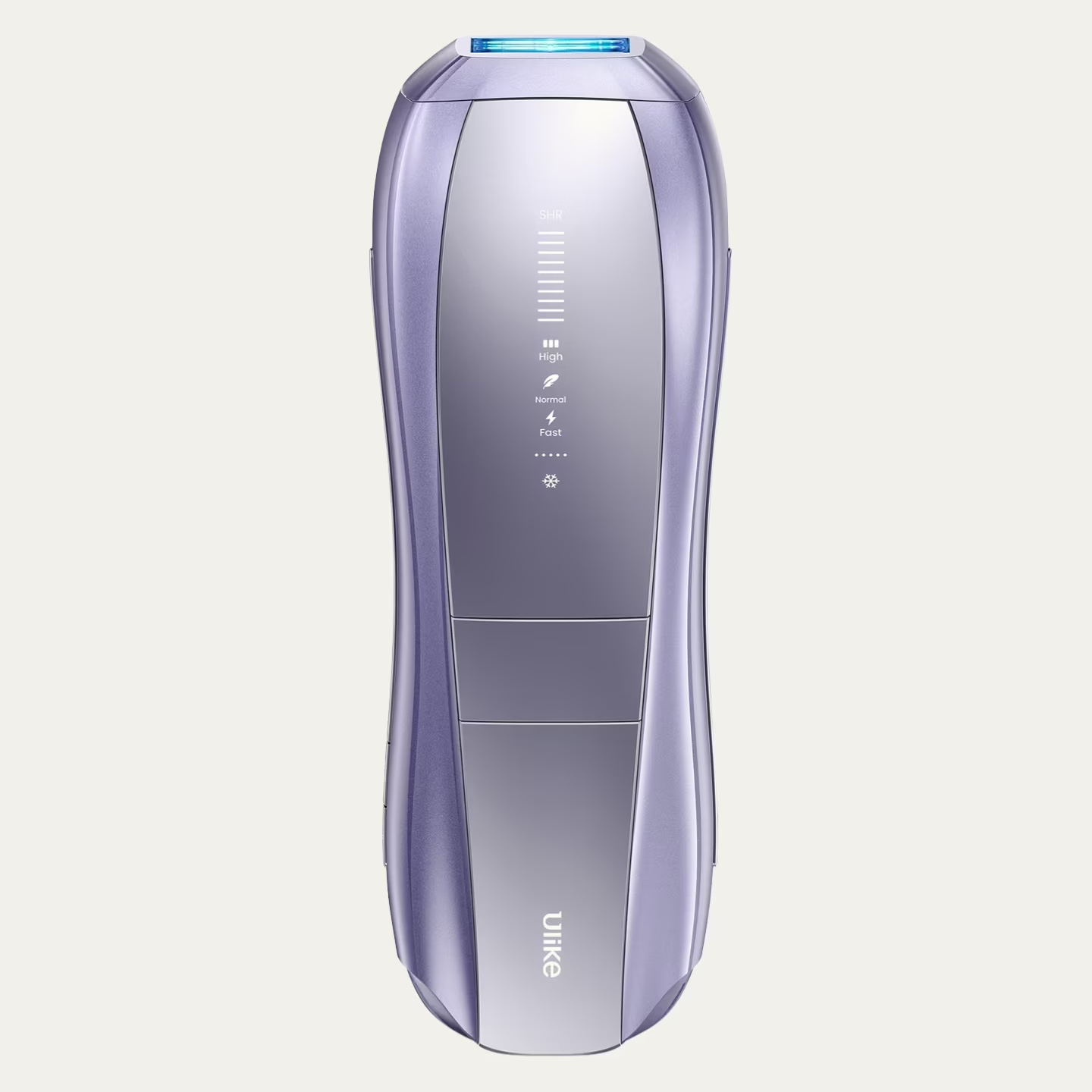
Ulike Air 10
- Technology
- IPL with sapphire contact cooling
- Skin types
- I to IV
- Flashes
- 300,000 advertised
Why we like it
- The strongest independent evidence here: a trial against a clinic IPL
- Contact cooling makes sessions more comfortable for many people
- 100-day guarantee and two-year warranty when bought from Ulike
Watch for
- Excludes skin types V and VI; cooling does not widen the range
- Red, gray and white hair are excluded
- The direct-site guarantee does not apply to Amazon purchases
The strongest independent trial we found used an earlier Ulike model (UI04), and its authors reported no conflicts of interest. In 84 people, one side of the body was treated at home and the other with a clinic IPL system. At one month the home side had the higher response rate; after three months the two sides were comparable, with similar side effects. The comparison was with clinic IPL, not laser, and follow-up lasted three months. FDA clearance K252804 lists both the UI04 used in that trial and the UI20 models sold as the Air 10; match the code on your unit. Yan et al., 2025; FDA K252804; Ulike warranty; refund conditions.
Best long-term results data
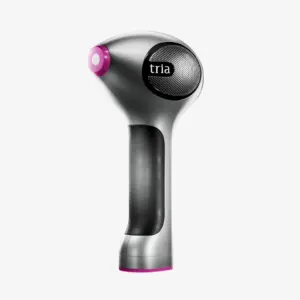
Tria Hair Removal Laser 4X (2nd Gen)
- Technology
- 810 nm diode laser
- Skin types
- I to IV
- Per charge
- About 30 minutes
Why we like it
- The longest published results here: hair counts tracked for 12 months
- Skin-tone sensor blocks use on unsuitable skin
- Tria allows underarms, bikini line and fine facial hair on the upper lip, chin and sideburns
Watch for
- Small window: one charge covers about half a leg
- Not suitable for skin types V and VI; weak on blond, red, gray or white hair
- The store and manual list different warranty periods; confirm before buying
Tria has the longest published follow-up of the six. In a 2012 study, 13 adults with skin types I to IV had eight monthly treatments and, 12 months later, had 44% to 65% fewer hairs than an untreated area, depending on the energy setting. An earlier study of 77 users found about a third fewer hairs 12 months after three treatments. Both studies were small, used earlier Tria models and came from the same investigator. Tria describes a full series of 8 treatments; its before-and-after examples space them two weeks to a month apart. Its clearance on record (K120737) predates the current edition, so ask Tria which clearance applies to the 4X you buy. Wheeland, 2012; Wheeland, 2007; FDA K120737; Tria 4X manual; Tria warranty and returns.
Best for skin type V
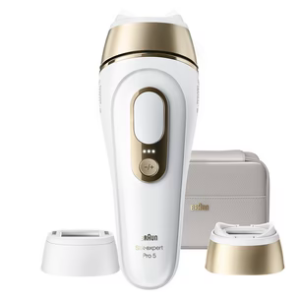
Braun Silk-expert Pro 5 (IPL5137)
- Technology
- IPL with automatic intensity
- Skin types
- I to V
- In the box
- Standard cap, face precision cap
Why we like it
- The widest IPL skin-tone range in this guide, shared with SmoothSkin
- Reads your skin and adjusts each flash, including in the bikini area
- More published safety data than any other IPL here
Watch for
- Excludes type VI skin and light blond, red, gray or white hair
- No contact cooling; its comfort modes lower the intensity instead
- Braun’s money-back offer has conditions and does not cover marketplace returns automatically
Braun recommends one session a week. Its FDA clearance (K190354) names the Silk-expert Pro 5, and the filer was CyDen, the company that also makes SmoothSkin. We found no published hair-count trial of this model, so judge progress against your own photos rather than a percentage on the box. Its safety record is the most documented here: two randomized trials run with Braun’s parent company on its low-energy home IPL found no lasting side effects in skin types II to IV, though one person with type V developed darker spots around the follicles. Six years of customer reports on the same company’s home IPL devices came to about 67 adverse events per 100,000 devices shipped, mostly pain, burns and redness. FDA K190354; Thaysen-Petersen et al., 2015; Hattersley et al., 2023; Braun IPL5137 details; Braun skin-tone guide.
Best value that still covers type V
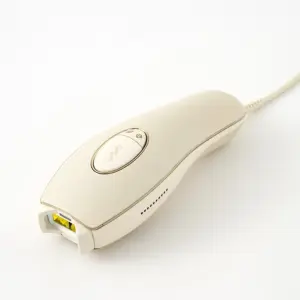
SmoothSkin Pure Adapt
- Technology
- IPL with automatic intensity
- Skin tones
- 1 to 5 (tone 6 excluded)
- Flashes
- Unlimited
Why we like it
- Covers skin tone 5 for less than the Braun
- Unlimited flashes and nothing to replace
- Flexible contact head follows curves
Watch for
- Excludes deep tone 6
- Blond, red, gray and white hair may not respond
- Fewer attachments than the Philips kit
FDA clearance K233782 names the Pure Adapt (model SSG3). That clearance rests on bench testing and its similarity to the earlier SmoothSkin Pure, not on a new hair-count trial. Its maker, CyDen, also filed Braun’s clearance; a 2014 study of CyDen’s earlier iPulse device in 10 people with skin types III to V found 87% fewer terminal hairs six months after four weekly treatments. The manual describes a weekly initial series, then maintenance sessions. FDA K233782; Trelles et al., 2014; SmoothSkin manuals.
Best for face, body and bikini
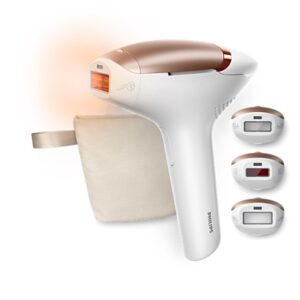
Philips Lumea 8000 Series (BRI937/03)
- Technology
- IPL with SenseIQ skin sensor
- Skin types
- Fair to medium brown (I to IV)
- Attachments
- Body, face, precision
Why we like it
- Curved attachments for the face, body, underarms and bikini line
- Five intensity settings guided by the skin sensor
- Two-year warranty and a 90-day money-back guarantee from Philips
Watch for
- Excludes dark brown and black skin
- No contact cooling listed in the US specifications
- The money-back guarantee requires the receipt and insured return shipping
Philips describes monthly touch-ups after the initial schedule. The face attachment has its own filter and limits, so read the face section of the manual before treating the upper lip or chin. We found no published hair-count trial of the Lumea 8000, which is why it ranks below the devices with study data. FDA clearance K243453 covers Philips Lumea IPL; the letter does not list every retail kit, so confirm your model against the manual. BRI937/03 specifications; Philips US manual; FDA K243453.
Only home option for type VI
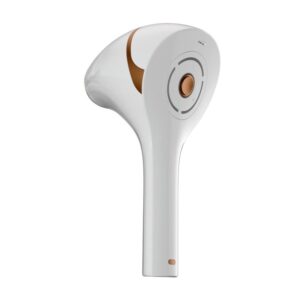
Epilaser 980
- Technology
- 980 nm diode laser, hair by hair
- Skin types
- V and VI only
- Routine
- 2 to 3 sessions a week
Why we like it
- The only home device we found with an FDA record covering types V and VI
- Finds individual hairs instead of flashing a whole patch of skin
- Checks your skin tone before the laser fires
Watch for
- The highest price in this guide
- Published data cover safety and targeting accuracy, not measured hair reduction in deep skin
- Its marketing says there are no risks; the FDA safety test saw mild redness and short-lived blistering
FDA clearance K233224 describes the Epilaser Pro in two versions using 808 or 980 nm light: Brunette for skin types I to IV and Dark for types V to VI. In the safety test, 44 people with skin types I to VI had the same hairs treated up to three times at maximum energy; reactions were at most mild redness or mild blistering that cleared within 48 hours. The efficacy study measured how accurately the device found hairs (above 90% correct hits), not how much hair was reduced. FDA K233224.
Epilaser asks for hair trimmed to about 2 mm rather than shaved, and it markets “no sun restrictions,” which we would not rely on. Ask Epilady to confirm which clearance covers the unit you buy, and test a small area first. Epilaser 980 details.
Ulike Air 10 vs. Braun Silk-expert Pro 5: which should you buy?
These are the two home IPL devices people compare most. Both adjust to your skin tone and both carry a two-year warranty. Ulike has the stronger evidence and the lower sale price; Braun covers one more skin type. The deciding question is your skin type.
Ulike Air 10
$259 sale · skin types I to IV
Choose Ulike if
- Your skin is type I to IV and you want the device with trial data
- You mainly treat legs and arms and want quicker passes
- You will buy direct to use the 100-day guarantee
Braun Pro 5
$399.99 · skin types I to V
Choose Braun if
- The skin you plan to treat is type V, which Ulike excludes
- You want a face precision cap included
Decision test: check the skin on your treatment area against both charts. If it is type V, the choice is made: Braun. If it is type I to IV, choose Ulike for its trial data, cooling and lower sale price; pick Braun only if the included face cap matters more to you.
Do at-home laser hair removal devices actually work?
Yes, for suitable skin and hair, but expect fewer and finer hairs rather than permanent removal. In FDA clearances, “permanent hair reduction” means a long-term, stable drop in the number of hairs regrowing, measured 6, 9 and 12 months after the treatment regimen. It does not mean every hair is gone. FDA indications wording.
The best direct comparison we found treated one side of the body with an earlier Ulike home IPL and the other with a clinic IPL system, in 84 people. After three months of treatment the two sides were comparable, with similar side effects. Follow-up lasted three more months, so it cannot show what happens years later. Yan et al., 2025.
The longest follow-up we found for any home device is for Tria’s diode laser: in a 13-person study, eight monthly treatments left 44% to 65% fewer hairs than an untreated area a year later. That is encouraging but small, and it came from one investigator using earlier Tria models. Wheeland, 2012.
How long until you see results, and how much time does it take?
| Device | Initial routine | After that |
|---|---|---|
| Ulike Air 10 | Ulike shows visible results at about 4 weeks | Touch-ups as the manual directs |
| Tria 4X | 8 treatments, two weeks to a month apart | Repeat treatments as needed |
| Braun Pro 5 | One session a week | Touch-ups when hair returns |
| SmoothSkin Pure Adapt | A weekly initial series | Maintenance sessions |
| Philips Lumea 8000 | Initial schedule in the manual | Monthly touch-ups |
| Epilaser 980 | 2 to 3 sessions a week; Epilaser expects clear reduction by month three | Sessions get shorter as fewer hairs return |
Follow the schedule for your exact model. More sessions or extra passes add risk without making results come faster.
How to use a home device safely
- Check the chart for your model against the skin you plan to treat, in daylight, before your first session.
- Remove surface hair the way your manual says. Most IPL devices need a close shave; Epilaser asks for about 2 mm of hair. Do not wax or pluck, which removes the hair the light needs to reach. AAD preparation.
- Patch-test a small area and wait as long as the manual directs before treating the whole area.
- Keep treated skin out of the sun and off self-tanner. A tan raises your skin type for the device and the risk of burns.
- Track progress honestly: take photos in the same light every two to four weeks and note how often you shave.
Is an at-home device cheaper than laser at a clinic?
For one or two small areas, usually yes; for the biggest reduction, not always. The devices here cost $259 to $995 once. A clinic charges per session, and one area usually needs a series plus occasional maintenance.
- Home device example: Ulike Air 10 at $259 on sale ($349 list) once, plus regular sessions of your own time.
- Clinic example (hypothetical): one area, six sessions at $100 to $200 each, then one touch-up in each of years two and three. Over three years that is $800 to $1,600.
The arithmetic favors a device, but price is only part of the comparison. A clinic can treat skin types and hair a home device cannot, chooses the laser for your skin and usually reduces more hair per session. To price a real quote, use the laser hair removal cost calculator, and for the full home-versus-clinic decision see at-home IPL vs. professional laser.
Costs beyond the device price Checked Nov 11, 2026
- Shaving or trimming: before every session, for as long as you use the device.
- Your time: weekly or more frequent sessions for the first months, depending on the model.
- Returns: Amazon orders follow the seller’s return window, not the brand’s money-back offer.
- Warranty: two years for Braun, Ulike and Philips; confirm Tria’s period before buying.
Safety rules that matter more than any feature
Lower energy does not mean no risk. Home devices can still cause burns, blisters, pigment changes and eye injury when used outside their instructions. AAD on laser side effects.
- Protect your eyes. Never treat the eyebrows or near the eyes, and keep the window flat on the skin before it flashes.
- Skip tattoos, moles, dark spots and broken, irritated or sunburned skin.
- Check medicines and conditions. Some medicines make skin more sensitive to light. Ask your doctor or pharmacist before starting, and do not stop a prescribed medicine to use a device.
- Read the exclusions for pregnancy, breastfeeding, age and medical conditions in your model’s manual.
- Never override the skin sensor or add passes to speed things up.
Face and neck need extra care
Paradoxical hair growth, where treated hair grows back thicker, has been reported mainly after laser or IPL on the face and neck. New or increasing coarse facial hair, especially with irregular periods, deserves a medical check before any device. 2021 meta-analysis; NHS on excess hair. Read more in paradoxical hair growth after laser and laser hair removal with PCOS.
When a clinic or electrolysis is the better buy
A home device is likely the wrong purchase if any of these apply:
- Your skin is type VI and the Epilaser’s price or limited data give you pause. A professional long-pulsed Nd:YAG laser has more evidence in deeply pigmented skin. Laser for dark skin.
- Your hair is blond, red, gray or white. Electrolysis works regardless of hair color. Electrolysis vs. laser.
- You want the most reduction on a large area, such as the full legs or back. A professional series usually reduces more hair per session.
- Facial hair is new or increasing. Get checked for a hormonal cause first.
Frequently asked questions
Is at-home laser hair removal permanent?
It can give long-term reduction, not guaranteed permanent removal. The FDA’s “permanent hair reduction” wording means a stable drop in regrowing hairs measured up to 12 months after the regimen, and most people need touch-ups. FDA indications wording.
Are at-home devices real lasers?
Most are IPL, which uses a broad range of light rather than one wavelength. The Tria 4X and Epilaser 980 are diode lasers. A home laser still runs at energy levels designed for self-treatment, so it is not equivalent to a clinic laser.
What is the best at-home device for dark skin?
For skin type V, the Braun Pro 5 and SmoothSkin Pure Adapt include it in their instructions, and the Braun has more published safety data. For type VI, the Epilaser 980 is the only home device we found with an FDA record covering it, but its hair-reduction results are not published, and a professional Nd:YAG laser is the better-studied option. See laser hair removal for dark skin.
Can men use at-home laser or IPL devices?
Yes, on areas the manual allows, such as the chest, back, arms and legs. Facial permissions are often written differently for men and women, and Tria does not recommend its laser for thicker facial hair, so check your model’s manual before treating a beard area.
Can I use an at-home device for a Brazilian or bikini area?
Only on the areas your model’s manual allows. Permission for the bikini line does not cover genital or anal skin; Tria, for example, excludes the genitals and anus. Philips uses a separate precision attachment for the bikini line and underarms. For reactions after treatment, see Brazilian laser side effects.
Does at-home laser hair removal hurt?
Most people describe a warm snap. Contact cooling, as on the Ulike Air 10, or a lower comfort setting, as on the Braun, can make sessions easier. Pain that keeps increasing is a reason to stop, not to push through.
Are cheap no-name IPL devices on Amazon safe?
Some may be, but many listings give no traceable FDA clearance number, full manual or US warranty. Before buying any device, search the FDA 510(k) database for the brand and model and compare it with the label. “FDA-registered” alone does not mean cleared. FDA on registration vs. clearance; FDA 510(k) database.
Can I use a home device between clinic laser sessions?
Not without agreement from the provider treating you. Combining schedules can add irritation and makes progress harder to judge. Bring the device’s model and instructions to your next appointment.
Will an at-home device work if I have PCOS?
It can reduce hair, but light treatment does not address the hormonal cause, so plan for maintenance and medical care alongside it. See laser hair removal with PCOS.
Sources and editorial notes
Sources checked November 12, 2026. Clinical review pending. How we picked: we ranked six current US models by published evidence first: hair-reduction results (independent studies ahead of manufacturer studies, longer follow-up ahead of shorter), then published safety data and FDA 510(k) records, then skin-type range and price. We used current US manuals and product pages and each brand’s US store price on November 11, 2026. We have not tested these devices hands-on. No brand paid for placement, and a shopping link never decided a pick: the Tria links to its brand store, where we earn nothing. Prices exclude tax and shipping; Amazon prices change and are not shown. The skin-tone chart and cost example are original summaries of the sources below. Product images: Ulike, Tria, Braun, SmoothSkin, Philips and Epilaser.
How we review evidence · Disclosures
View all 37 sources
- Krasniqi et al., 2022: long-term hair reduction systematic review; five randomized trials (223 patients) with at least one hair-cycle follow-up; supports the IPL and laser ranges and the body-area differences.
- Yan et al., 2025: home IPL vs. clinic IPL; randomized split-body trial in 84 adults using an earlier Ulike model (UI04) against clinic broadband light; three months of treatment and three months of follow-up.
- Wheeland, 2012: home-use diode laser, 1-year follow-up; Tria laser in 13 adults, skin types I to IV, eight monthly treatments; 44% to 65% fewer hairs than an untreated control at 12 months.
- Wheeland, 2007: simulated consumer use of a home diode laser; 77 users, three self-treatments; about 33% hair reduction at 12 months.
- Thaysen-Petersen et al., 2015: low-energy home IPL and sun exposure; randomized trial with Braun and Procter & Gamble co-authors; no reactions in skin types II to IV, darker spots around follicles in one type V subject.
- Thaysen-Petersen et al., 2014: skin pigment and low-energy IPL side effects; randomized trial in skin types II to IV; no persistent side effects.
- Hattersley et al., 2023: postmarketing surveillance of home IPL; Procter & Gamble and CyDen data, 2016 to 2021; 67 adverse-event cases per 100,000 devices shipped, mostly pain, burns and redness.
- Trelles et al., 2014: CyDen iPulse home IPL; 10 people, skin types III to V; 87% fewer terminal hairs six months after four weekly treatments.
- 2021 meta-analysis of paradoxical hair growth; association with face and neck treatment; study variation limits a pooled risk estimate.
- American Academy of Dermatology: laser hair removal FAQs; sessions, maintenance and possible side effects.
- American Academy of Dermatology: preparing for laser hair removal; shaving instead of plucking or waxing, sun avoidance and medicines.
- American Academy of Dermatology: ways to remove unwanted hair; pigment limits and electrolysis as an alternative.
- ASLMS: laser hair removal; how light, pigment and hair-growth cycles affect treatment.
- NHS: excess hair growth; when new facial or body hair needs a medical check.
- FDA: registered, cleared and approved devices; what an FDA clearance does and does not mean.
- FDA 510(k) database; where to check a brand and model’s clearance.
- FDA K190354: Braun Silk-expert Pro 5; clearance filed by CyDen and the permanent hair reduction wording.
- FDA K252804: Ulike; clearance listing the UI20 variants sold as the Air 10 and the UI04 used in the Yan trial.
- FDA K243453: Philips Lumea IPL; clearance for the Lumea IPL family; retail kits are not all listed.
- FDA K233782: SmoothSkin Pure Adapt; clearance for model SSG3, based on similarity to the SmoothSkin Pure and bench safety testing, with no new clinical trial.
- FDA K120737: Tria laser system; earlier clearance for the Tria laser; confirm coverage of the current edition.
- FDA K233224: Epilaser Pro; Brunette (types I to IV) and Dark (types V to VI) versions, the 44-person safety test and the targeting study.
- Braun Silk-expert Pro 5 IPL5137; US price, kit contents and the once-weekly routine.
- Braun: choosing a device for your skin tone; skin types I to V and hair colors.
- Ulike Air 10; US price, contact cooling, 100-day guarantee and two-year warranty.
- Ulike: Air 10 vs. Air 3; skin types I to IV, excluded hair colors and the 300,000-flash rating.
- Ulike return and refund policy; conditions for the direct-site guarantee.
- Philips Lumea BRI932/03; US price of the two-attachment kit.
- Philips Lumea BRI937/03; three-attachment kit contents and monthly touch-ups.
- Philips US manual; skin and hair suitability, warranty and money-back terms.
- Philips: Lumea suitability; skin tones and hair colors Lumea can treat.
- SmoothSkin Pure Adapt; US price, unlimited flashes and exclusion of deep skin tones.
- SmoothSkin manuals; skin tones 1 to 5, hair colors and the weekly initial series.
- Tria Hair Removal Laser 4X; US price, skin types I to IV, permitted areas, battery time and the 8-treatment series.
- Tria 4X manual; instructions and restrictions for the current edition.
- Tria delivery, warranty and returns; return terms for unopened products and warranty details.
- Epilaser 980; US price, skin types V and VI, hair colors, 2 mm hair length, routine and 60-day offer.