PRP for Hair Loss: Evidence, Results, Sessions and Cost
PRP scalp injections can improve hair density in some people with pattern hair loss, but the size of the benefit varies. A commonly described starting plan is three monthly visits, with results assessed over several months and maintenance considered afterward. Before buying a package, establish the diagnosis and price the full plan.
Editorial details
The quick answer
Does it work?
A review found about 28 more hairs/cm² than placebo on average, with large differences between studies. That does not predict an individual visible result.
Sessions and results
AAD describes three monthly visits, then maintenance every 3–6 months. Johns Hopkins says scalp results are most noticeable around six months.
Observed prices
Seven public menus list single visits or starting prices of $495–$1,200. Listed three-visit packages span $950–$3,000; eligibility and inclusions differ.
Before buying
Confirm the diagnosis, injection protocol, review point and maintenance cost.
This guide separates the research from the sales package. You will find an evidence comparison, a practical results-review plan, dated examples from public treatment menus and a first-year budget that includes follow-up visits.
What is PRP for hair loss?
PRP is a platelet-enriched preparation made from your blood using a centrifuge, then injected into the scalp. Its proposed effect involves platelet signaling proteins; the procedure does not transplant new follicles. Johns Hopkins: PRP explained
The first appointment should answer what is causing the loss. Gradual pattern thinning, sudden shedding, discrete patches and an inflamed or scarring scalp are different clinical problems. A dermatologist may use an examination, history and, when appropriate, tests or a biopsy to establish the cause. Buying PRP first can leave that decision unresolved. AAD: hair-loss diagnosis and treatment
Does PRP regrow hair? What the studies actually show
Trials suggest PRP can improve density in androgenetic alopecia, or pattern hair loss. Differences between studies make the size of benefit uncertain.
| Evidence | What was studied | Useful finding | Important limit |
|---|---|---|---|
| 2025 meta-analysis | 43 randomized trials, 1,877 participants overall | Placebo comparison favored PRP for density | Different subsets contributed to each outcome; high variability; no significant overall thickness improvement |
| 2018 schedule trial | 40 people with moderate pattern hair loss; two injection schedules followed for six months | The more frequent initial schedule produced a larger hair-count improvement | Small single-center study comparing schedules, without a no-PRP control |
| 2024 PRP-plus-minoxidil review | Five randomized trials comparing combined treatment with minoxidil alone | Pooled results favored the combination for density at several follow-up points | Three trials were at high risk of bias; evidence certainty was rated low to very low |
A hair count is not the same thing as visible coverage
Study measurements may count hairs in a small marked area, measure shaft thickness, score photographs or ask participants about satisfaction. These outcomes are related but not interchangeable. A statistically significant count change does not tell you whether you will consider the cosmetic difference worth the price.
The review’s placebo density comparison involved 18 studies and 883 participants, with a pooled difference of about 28 hairs per square centimeter (95% confidence interval, approximately 13–44) and very high variation between studies. This is an average difference in measured density, not 28 new hairs guaranteed in every square centimeter of your scalp. The authors disclose employment at BTI Biotechnology Institute, which develops platelet-derived technology. Full review and disclosures
Our interpretation: there is enough evidence to ask a qualified clinician about PRP for an appropriate diagnosis, but not enough standardization to treat a package name, centrifuge brand or headline percentage as a reliable prediction. Ask the practice which evidence most closely matches its protocol and your situation.
Who should get an assessment before considering a package?
Anyone without an established explanation for their hair loss should start there. PRP trial results in pattern hair loss cannot simply be transferred to every form of shedding or a scalp condition that needs different treatment. AAD: diagnosis matters
Bring a timeline: when thinning started, whether it is gradual or sudden, changes in health or medicines, recent pregnancy, major weight changes and what you have already tried. Tell the clinician about pain, itching, scaling or patchy loss. These details help frame the examination; they do not diagnose the cause by themselves.
| If your main question is… | Ask at the assessment |
|---|---|
| “My part is widening slowly.” | Is this pattern hair loss, and which established treatments fit my diagnosis? |
| “I suddenly started shedding.” | What could have triggered the change, and is a procedure appropriate now? |
| “I have patches or scalp symptoms.” | Do I need diagnostic testing or treatment of an underlying scalp condition first? |
| “I already use a hair-loss medicine.” | What additional benefit are we trying to measure, and what remains unchanged during the trial? |
| “I want to avoid ongoing treatment.” | Is that expectation compatible with the diagnosis and proposed maintenance plan? |
Use these questions to prepare for the assessment; the clinician determines treatment suitability.
How many PRP sessions do you need, and when should results appear?
Three monthly visits followed by maintenance every 3–6 months is one approach described by the AAD. Research uses several schedules, so ask your clinician why their proposed series fits your diagnosis and when they will review it. AAD treatment overview
The 2018 randomized trial compared three monthly treatments plus a booster three months later with two treatments spaced three months apart. Both groups improved, but the more frequent initial schedule performed better on hair counts at six months. That supports the importance of the schedule; it does not prove that four appointments are the right purchase for everyone. Hausauer and Jones, 2018
Johns Hopkins says scalp results are most noticeable around six months. Use that as a general review horizon, with earlier follow-up for tolerability and questions; it is not a deadline by which everyone responds. Johns Hopkins PRP overview
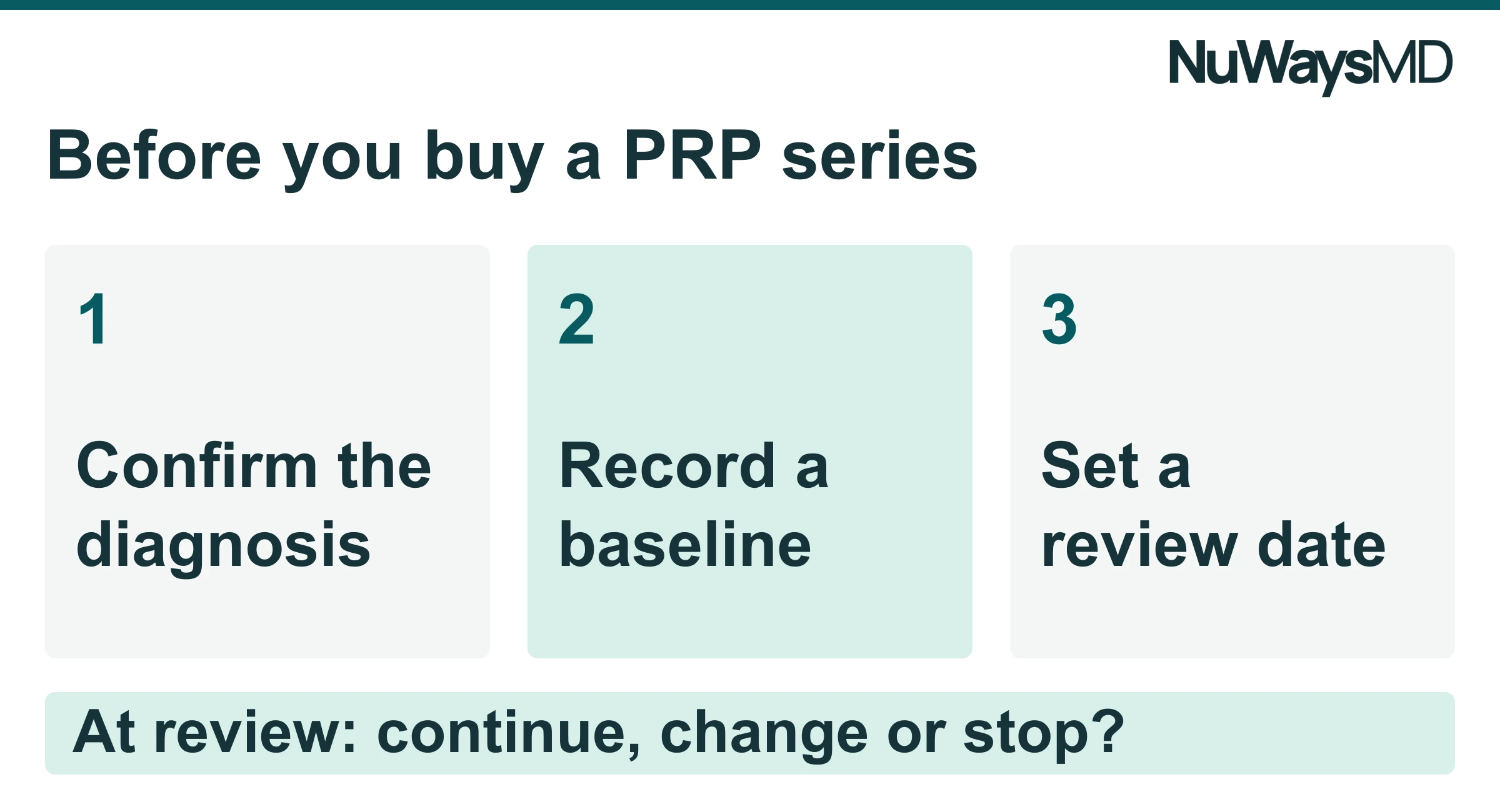
Agree on the review before the first injection
Ask the clinic to record comparable baseline photographs and explain what else it measures. A repeat photograph should use similar lighting, angle, hair part and styling. Wet hair in a “before” image and dry, styled hair afterward do not make a useful comparison.
Write down three things before treatment: the goal, the review date and the decision if there is little change. The goal might concern coverage, shedding or a measured density outcome, but it should be something you and the clinician can revisit. “We will see how it goes” leaves the financial decision open-ended.
Keep a record of other treatments started or stopped. If you begin PRP, a supplement and a prescription at the same time, improvement in your own photographs cannot identify which intervention caused it. That does not mean combined treatment is inappropriate; it means personal observation and a controlled experiment are different kinds of evidence.
Does the result last if you stop?
PRP is not generally presented as a permanent, one-time fix. Johns Hopkins notes that scalp results develop over months and further injections may be needed. Ask what the practice recommends after the initial review, including the possibility of stopping when the benefit does not justify the cost. Johns Hopkins
Does the new ten-year study change that? A September 2026 report describes 234 patients enrolled over 2015–2025. Its abstract reports an improvement at the ten-year assessment in patients receiving maintenance treatment. That is not evidence that three initial injections last ten years without further treatment, or that all 234 participants completed ten years of follow-up. The abstract does not provide the number assessed at each time point or enough comparator detail to resolve those questions. We reviewed the published abstract, not the full manuscript. Gentile, 2026
PRP, minoxidil and Nutrafol: different decisions
These options should not be treated as interchangeable purchases. Minoxidil is a medication used for pattern hair loss; PRP is a procedure; Nutrafol is a dietary supplement. Your diagnosis, medical history and preferences affect which, if any, belongs in your plan. AAD: female pattern hair loss and treatment options
A 2024 review favored adding PRP to minoxidil, but rated the certainty of its evidence low to very low. However, the corresponding combination subgroup in the broader 2025 review did not show a statistically significant density advantage. The reviews used different eligible study sets and should not be counted as independent piles of confirmatory trials. 2024 combination review, 2025 review
Do not stop a prescribed treatment because a PRP package sounds more advanced. Ask the prescriber what should continue, what is being added and how success will be assessed. “Natural” and “your own blood” do not answer those questions.
What does PRP for hair loss cost?
The seven menus below list single visits or starting prices from $495 to $1,200. Six give a three-visit package, ranging from $950 to $3,000. Those are observed prices in a small, deliberately selected set, not a US average or a recommended budget.
We checked public practice pages on October 4, 2026, across South Florida, New York City, Chicago, Dallas and Los Angeles County. We included an explicit PRP hair-restoration price and preserved “starting at” wording, promotion conditions and package commitments. We excluded mixed PRP/PRF offers, facial-only prices and combined microneedling packages from the comparison. We did not call the practices or evaluate their care. Prices exclude unlisted fees; confirm eligibility and the written quote.
| Practice and location | Single visit | Three-visit commitment | What to check |
|---|---|---|---|
| Miami Lakes Med Spa, Miami Lakes, FL | $495 | $950 total; $316.67 per visit | Separate PRP price only; excludes the page’s exosome offering |
| Sarah-Kate Rems, NP, New York City, NY | $1,200 | $3,000 total; $1,000 per visit | Compare the proposed series and maintenance separately |
| ImageLab Med Spa, Chicago, IL | $500 regular | $1,197 total; $399 per visit | Limited-time new-patient package; confirm current eligibility |
| Skinovatio Lincoln Park, Chicago, IL | From $800 | $2,400 for three at the listed rate | Published series total, not a package discount; confirm add-ons |
| Skin Pharm, Dallas, TX | $900 | $2,475 total; $825 per visit | Hair-restoration line, not its lower-priced generic PRP-injection line; separate promotions not deducted |
| Sanjiva Medical Spa, Dallas, TX | $1,000 | $2,700 total; $900 per visit | Price the maintenance plan separately |
| Ziba Med Spa, Tarzana, CA | $500 | No three-visit price found on the page | Ask for the full-series quote; a missing package price is not a zero charge |
Per-visit amounts are package price divided by three, rounded to cents. A $316.67 package rate requires a $950 commitment; it is not an offer to buy one appointment for $316.67. These services may differ in preparation, scalp coverage and included assessment, so price alone cannot establish equivalent care.
When the same website gives two prices
The FABRX Studio page in New York City illustrates why a written quote matters. Its main buying section lists $1,000 for one session and $850 per visit for three ($2,550 total), while its treatment-pricing section lists $830 and $750 per visit ($2,250 total). We excluded it from the range above because the page conflicts with itself. Confirm the applicable price before paying; neither amount should be silently treated as the verified quote.
A first-year budget you can actually inspect
Fictional planning example, not a recommended schedule: a clinic proposes three initial visits and two later maintenance visits. Use the former practice’s recalled $1,800 package and $700 single-visit price purely as planning inputs. You expect $25 in travel or parking for each of the five appointments.
| Cost item | Calculation | Amount |
|---|---|---|
| Initial package | Three visits, one package price | $1,800 |
| Later visits | 2 × $700 | $1,400 |
| Travel and parking | 5 × $25 | $125 |
| First-year total | $1,800 + $1,400 + $125 | $3,325 |
The package-only headline would be $1,800. The planned first-year spending is $3,325 before any separate consultations, medicines or products. A package is one payment structure, but it still involves three appointments; travel belongs against the actual visit count.
Price the visits you may actually need
Choose General estimate in the planner, then add your initial series, later visits and appointment costs. No signup is required.
Build my treatment budget →What to ask before paying upfront
- What is the diagnosis, and who made it?
- How many visits are included, and what happens at the results review?
- Is the quote for scalp injections, microneedling with topical PRP, or a combination?
- Are consultation, anesthetic, follow-up photographs and review visits included?
- What does maintenance cost if I continue, and is it an obligation or a separate decision?
- Can unused visits be refunded or credited? When does the package expire?
- Are supplements optional, and can I see the procedure price without them?
These are quote-comparison questions, not a suggestion to choose the cheapest provider. Our provider selection guide explains how to prepare for a treatment consultation.
Risks, preparation and recovery
PRP involves both a blood draw and injections. Soreness and bruising can occur. Less common risks include bleeding, infection and injury to tissue or nerves; using your own blood does not eliminate procedural risk. Johns Hopkins: PRP risks
Give the treating clinician a full medication and supplement list and discuss blood or platelet disorders, bleeding problems, infections and relevant medical conditions. Ask for written preparation and aftercare instructions. Do not stop prescribed medicines, including blood thinners, simply because a generic online preparation sheet says to avoid them. Any change needs the prescribing clinician’s advice.
Ask the practice when to wash your hair before treatment and when you can wash, style and resume activities afterward. Get instructions for the procedure you will actually receive, including any accompanying treatment.
Contact the practice promptly about worsening pain, spreading redness, drainage or fever rather than waiting for a routine progress photograph. If you are seriously unwell, seek urgent medical care. Confirm an after-hours contact before treatment, especially if you are traveling to the clinic.
PRP, PRF, microneedling and exosomes are not the same evidence
Package names can combine several interventions. Before comparing research or prices, have the practice name exactly what will be injected or applied, how it is prepared and why it is being used.
| Label on the menu | What to clarify |
|---|---|
| PRP injections | Whether the preparation and injection schedule resemble the evidence being cited |
| PRF | Platelet-rich fibrin is a different preparation; do not transfer a PRP study’s result to it without supporting evidence |
| PRP with microneedling | Whether the treatment involves injections, application over needled skin, or both |
| Exosomes or a “regenerative” add-on | Exact product, source and regulatory status; do not treat it as another name for your own PRP |
The FDA states that microneedling devices are not approved to deliver blood products such as PRP into the skin. Its December 2019 safety alert states that there were no FDA-approved exosome products. Check any current product claim against its actual FDA status. These are distinct issues from whether a clinician offers PRP injections. FDA: microneedling devices, FDA: exosome safety alert
Equipment clearance is not FDA approval of a clinic’s hair-regrowth package. Ask what the specific clearance covers. Johns Hopkins regulatory explanation
Frequently asked questions
Is PRP worth it for hair loss?
It may be worth discussing for an appropriate diagnosis when you understand the uncertainty, maintenance and total cost. A useful offer includes baseline assessment and a review point, not just a discounted series. Research suggests benefit in pattern hair loss but cannot predict whether your cosmetic improvement will justify your spending.
Is one PRP session enough?
One visit is usually only the beginning of a proposed series. The AAD describes three monthly visits initially, while research schedules differ. Ask why the proposed number fits your diagnosis and when progress will be assessed. Schedule trial
Can women have PRP for thinning hair?
Women have been included in PRP research, including the 2018 schedule trial. The decision still begins with diagnosing the loss and discussing other treatment options. Evidence in pattern thinning does not apply automatically to postpartum shedding or every other cause. 2018 trial, AAD diagnosis guide
Does PRP hurt?
Expect some discomfort from the blood draw and scalp injections, with possible soreness afterward. The 40-person schedule trial described treatment as well tolerated, but that cannot predict your experience. Ask about comfort measures and which symptoms should prompt a call. Hausauer and Jones, 2018, Johns Hopkins risks
Does PRP work better than minoxidil?
There is no blanket superiority finding. Discuss whether PRP would be an addition, alternative or poor fit in your particular plan. 2025 comparative review
Do I have to buy Nutrafol with PRP?
Ask whether it is optional and request separate prices. A bundle is a commercial arrangement, not proof that the combination produces better results. Our Nutrafol guide evaluates the supplement evidence separately.
What if I see no change after the initial series?
Use the planned review to compare the baseline, diagnosis, treatment record and other therapies. Ask what would justify continuing or changing the plan. Lack of a useful response is a reason to reassess, not automatically to buy more sessions.
Will insurance cover PRP for hair loss?
Budget as self-pay unless your insurer confirms coverage for your exact diagnosis and procedure. Johns Hopkins notes that PRP may not be covered. Obtain the full self-pay amount before agreeing to financing. Johns Hopkins PRP overview
Sources and editorial notes
Sources and public prices checked October 4, 2026. Independent clinical review is pending. No original clinical testing was performed. The budget and review framework are editorial examples. Treatment-menu links are references, not endorsements; the seven-menu sample cannot establish a typical US price.
- Anitua et al., 2025, systematic review and meta-analysis. Read the outcome-specific denominators and commercial affiliations, not only the total study count.
- Hausauer and Jones, 2018, randomized PRP schedule trial. Forty patients, six-month follow-up, two schedules and no untreated control.
- Gentile, 2026, long-term PRP report. Abstract reviewed. The reported ten-year result includes maintenance; follow-up denominators require the full manuscript.
- 2024 review of PRP plus minoxidil versus minoxidil alone. Pooled findings favored combined treatment, but certainty was rated low to very low and three trials had high risk of bias.
- AAD: diagnosis and treatment of hair loss and female pattern hair loss. Clinical context and treatment options.
- Johns Hopkins: PRP injections and cosmetic PRP service. Procedure, preparation and risks.
- FDA: microneedling devices and unapproved exosome products. Regulatory distinctions for separately marketed procedures and add-ons.
- Seven public PRP hair-restoration menus are linked individually in the cost table. The separate FABRX Studio example is excluded because its published prices conflict. Offers can change; confirm the complete current quote before purchase.