Minoxidil Itchy Scalp: Why It Happens and What to Do
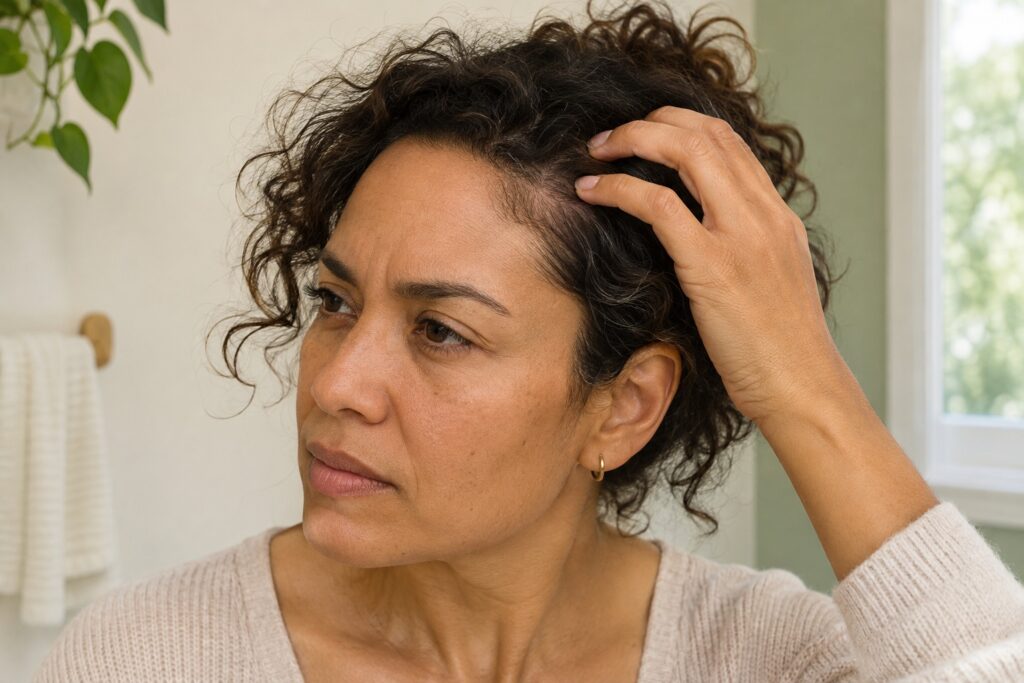
An itchy scalp can make a hair-loss routine hard to stick with, especially when you are worried about losing progress. Minoxidil itself, an ingredient in the formula or a separate scalp condition may be responsible. Working out which one matters more than buying another bottle.
This guide explains what to do about itching, burning and flakes, when foam may help, and when to get the reaction checked.
Editorial details
NuWays MD is independent and reader-supported. When you buy through links on our site, we may earn a commission. As an Amazon Associate we earn from qualifying purchases. Learn more.
How do you stop an itchy scalp from minoxidil?
Stop applying topical minoxidil to an irritated scalp and get advice before restarting or switching. The next step depends on whether you have irritation, an allergy or another scalp problem. Adding several remedies at once can make that harder to work out.
1. Check the reaction
Look for a rash, burning, swelling, broken skin or symptoms beyond the scalp. Use the warning signs below to decide how quickly to seek help.
2. Keep care gentle
A cool, damp compress can soothe irritated skin. Wash gently with a mild shampoo rather than scrubbing flakes off. Avoid scratching, fragranced scalp products and experimenting with oils or exfoliants on the irritated area.
3. Keep the bottle and the timeline
Photograph the ingredient list and the affected area. Note when you started, when itching began, any change of brand or strength, and other products used on your scalp. Bring these details to a pharmacist or treating provider.
The topical solution label gives the stop-use instruction. Gentle skin care and cool compresses are supported by the British Association of Dermatologists’ contact-dermatitis guidance.
Why does minoxidil make your scalp itch?
The main possibilities are irritation from the formula, an allergy to one of its ingredients, or a scalp condition that needs its own treatment. These can overlap, so symptoms alone cannot reliably identify the culprit. Friedman and colleagues’ contact-dermatitis report.
Irritation
The formula can dry or irritate the skin without an allergy. Stinging, tightness, burning and flaking may occur where it is applied. Alcohol and propylene glycol are relevant ingredients to check.
Contact allergy
The immune system may react to minoxidil or another ingredient. An itchy, inflamed rash can resemble ordinary irritation. A reaction that begins after previously comfortable use does not rule allergy out.
Another scalp condition
Seborrheic dermatitis, eczema, psoriasis and other conditions can cause itching and scale. Minoxidil use may coincide with a flare rather than explain every symptom.
Do not assume that visible redness is required. Skin-color changes can be subtle, and itch, burning, tenderness or scaling still matter. A provider can examine the scalp and review the products you use; a persistent reaction may need allergy testing. AAD scalp-itch guidance; 2025 systematic review.
Strength can affect tolerability too. In a trial in men with pattern hair loss, 5% minoxidil solution caused more itching and local irritation than 2% solution. That does not make a lower strength an allergy solution: both still contain minoxidil, and the other ingredients matter. Olsen et al., 2002.
Itching is not evidence of new hair growth. Nor should pain or an inflamed scalp be dismissed as the same thing as temporary minoxidil shedding. Those concerns need different responses.
Will switching from liquid minoxidil to foam stop the itching?
Foam may help when propylene glycol is responsible, but it is not an automatic fix. The inactive ingredients differ between products. Check the exact label rather than assuming every liquid or foam has the same formula.
| Label example | Relevant ingredients | What it means |
|---|---|---|
| Kirkland Signature 5% solution | Minoxidil, alcohol, propylene glycol and water | Changing brands may leave the same irritating or allergenic ingredient in place. |
| Rogaine 5% foam (men’s or women’s) | Minoxidil and alcohol; neither label lists propylene glycol | Removes one possible trigger, but is neither alcohol-free nor allergy-proof. The labeled schedules differ. |
Ingredient examples checked November 4, 2026: Kirkland solution, men’s Rogaine foam and women’s Rogaine foam. The foam labels list the same inactive ingredients, but men’s directions are twice daily and women’s once daily. Follow your exact label.
There is trial evidence for better foam tolerability. In a 24-week trial of 113 women, once-daily 5% foam without propylene glycol caused significantly less local intolerance, especially itching and dandruff, than twice-daily 2% solution. The trial changed the formulation, strength and schedule together; it cannot isolate propylene glycol as the sole explanation. Blume-Peytavi et al., 2011.
If testing identifies an allergy to minoxidil itself, changing the carrier will not remove it. If the problem is propylene glycol, a provider may consider a formulation without that ingredient once the reaction has been assessed. Other ingredients can still cause problems. Contact-allergy evidence.
For routine, texture and price differences after you have a suitable option, see minoxidil foam vs. liquid. A more expensive brand is not inherently gentler, and a lower percentage does not tell you the full ingredient list.
Is minoxidil flaking the same as dandruff?
No. Flakes can accompany dryness, contact dermatitis or dandruff, and their appearance alone does not establish the cause. Itching that started with a treatment deserves a review of that product as well as the scalp.
If dandruff or seborrheic dermatitis is the problem, an appropriate anti-dandruff shampoo may help. The AAD lists ingredients such as ketoconazole, selenium sulfide and zinc pyrithione. The right washing frequency and contact time depend on the product and your hair and scalp, so use its directions rather than a universal daily-shampoo schedule. AAD dandruff advice.
A medicated shampoo is not a workaround for continuing a product that is causing an allergic reaction. Before combining scalp medicines with minoxidil, check with your provider or pharmacist. The topical label specifically cautions against use with other scalp medicines. Rogaine warnings.
What about scalp oils, moisturizers or antihistamines?
Keep the routine simple while the cause is being worked out. Fragrance-free skin care may be useful for dermatitis, but “natural” does not mean non-irritating. Essential oils can cause reactions too, as our rosemary oil vs. minoxidil guide explains. Adding several serums or an exfoliating scrub makes it harder to identify what helps and what makes things worse.
Ask a pharmacist or provider about a suitable soothing product or symptom treatment. Do not use an antihistamine or steroid cream simply to cover up the itch so you can keep applying minoxidil. Dermatitis treatment should address the trigger as well as the discomfort. Contact-dermatitis care.
How long does minoxidil itching last?
There is no reliable “normal adjustment period” that makes an itchy or inflamed scalp safe to ignore. How long it lasts depends on the cause, continued exposure and whether treatment is needed. The label’s stop-use advice takes priority over a promised one- or two-week settling period.
What if it starts after months of use?
A delayed start does not rule out a product reaction. Published allergy cases include people who had already used minoxidil for a long time. Also consider a new bottle or formula, hair dye, shampoo, another scalp treatment or a flare of an existing condition. A timeline is useful, but it is not a diagnosis. 2025 review of reported contact-allergy cases.
What if the scalp still itches after stopping?
Inflamed skin may need time and treatment to recover, and the original cause may not have been minoxidil. Arrange a review if symptoms persist or worsen. Do not restart on a small patch of irritated skin to prove the cause yourself; a suspected allergy needs a more controlled assessment.
How can you tell irritation from a minoxidil allergy?
You usually cannot tell confidently by looking at the rash. A dermatologist may recommend patch testing to distinguish a reaction to minoxidil from one to a carrier or another product.
Medical patch testing checks for delayed contact allergy. Small amounts of selected substances are placed on the skin, usually the back, and the skin is checked at later appointments. It is different from an allergy skin-prick test and from trying the product again at home. AAD explanation of patch testing.
Bring the actual product or a clear photo of every ingredient, including any compounded formula. Ask whether testing should cover minoxidil, its vehicle and other scalp products. The answer can guide a more useful change than working through brands by trial and error.
Do not assume the carrier is always the allergen. A 2025 analysis of 99 published, patch-test-confirmed allergy cases identified minoxidil itself in 74.7% and propylene glycol in 17.1%. These percentages describe selected allergy cases, not everyone with itching or everyone who uses minoxidil. If minoxidil is the confirmed allergen, a foam containing it still contains the trigger. Kiratiwongwan et al., 2025.
What the allergy studies can and cannot tell you
Junge and colleagues’ 2025 review reported 54 patients with positive patch tests to minoxidil and 12 to vehicle ingredients; three reacted to both. The reviews draw on published cases and may overlap, so their totals should not be added together. They help identify possible allergens, but cannot estimate the chance that an ordinary user will develop an allergy or that switching to foam will solve an itchy scalp. Junge et al., 2025.
If your provider says you can restart minoxidil
Restart only with an agreed product and routine, once the scalp is suitable for treatment. Confirm what caused the reaction, whether the formula needs to change and what symptoms should make you stop again.
- Start with dry, intact skin. Apply to a dry scalp, not skin that is still irritated, sunburned or broken. MedlinePlus application precautions.
- Use only the directed amount and frequency. More does not improve results. Do not double a missed application or dilute the product yourself. Rogaine directions.
- Leave time for drying. The Kirkland solution label says to allow two to four hours for the nighttime application to dry before bed. Check the instructions for your exact formula, including before your scalp touches a pillow or hat. Kirkland solution instructions.
- Keep other products steady. Avoid introducing several new hair products at once. Record any agreed change and returning symptoms so your provider can judge what happened.
This is not a home allergy test. If allergy is suspected, ask whether patch testing should come before another application.
Will stopping minoxidil for itching undo your progress?
Minoxidil-supported regrowth generally needs continued treatment, but that is not a reason to keep applying it to an irritated scalp. MedlinePlus explains that most newly grown hair is lost within a few months after stopping. It does not establish a guaranteed safe length for a treatment break. Minoxidil use and discontinuation. Our guide to stopping minoxidil separates expected hair changes from decisions that need your prescriber’s input.
Ask for a plan that addresses both problems: settling the scalp and managing the underlying hair loss. That may mean treating another scalp condition, considering a different vehicle if suitable, or discussing another treatment. Do not double a later dose to make up for missed applications.
If you cannot keep using topical minoxidil, compare the evidence and limitations of laser caps, PRP and Nutrafol versus minoxidil before discussing alternatives. They are not interchangeable substitutes. For women with unexplained thinning, our guide to hair thinning in women explains why the cause comes first.
Is oral minoxidil the answer if topical minoxidil itches?
Oral minoxidil avoids direct contact between the scalp and the topical vehicle, but it is a prescription decision with different risks. Its use for hair loss is off-label in the United States. A suspected or confirmed minoxidil allergy needs to be discussed explicitly; oral treatment is not a do-it-yourself workaround. Review discussion of oral treatment after topical reactions.
Once your provider has identified an appropriate option, our minoxidil cost guide separates over-the-counter products from prescription and subscription costs.
Frequently asked questions
Is it normal for minoxidil to make your scalp itch?
Itching is a recognized side effect, but it is not a harmless adjustment you need to push through. The topical label advises stopping use and asking a doctor if scalp irritation or redness occurs. The cause may be irritation, allergy or another scalp condition. MedlinePlus; Rogaine label.
Does an itchy scalp mean minoxidil is working?
No. Itching is a possible side effect or a sign of another scalp problem, not a measure of regrowth. Track hair changes over time rather than using discomfort as evidence of success.
Should I stop using Rogaine if my scalp itches?
Rogaine’s U.S. topical label advises stopping use and asking a doctor if scalp irritation or redness occurs. Recurrent itching, burning or a rash should be assessed rather than pushed through to protect results. Rogaine label.
Can minoxidil foam still cause itching?
Yes. Removing propylene glycol does not remove minoxidil or every potential irritant. Check the exact ingredients and have a persistent reaction assessed instead of assuming foam cannot be the cause.
Is Kirkland minoxidil more likely to itch than Rogaine?
A brand name alone does not answer that. Compare the exact solution or foam: the Kirkland solution and Rogaine foam shown above have different vehicles, but that is not a head-to-head tolerability study. The ingredient responsible for your reaction matters more than the logo.
Can minoxidil cause itching without redness?
Yes, itching can occur without an obvious red rash. Tell your provider about burning, tenderness, flakes and when symptoms occur, even if the scalp looks normal in a photo. Persistent symptoms still need assessment.
Does oral minoxidil cause an itchy scalp?
An itchy scalp while taking oral minoxidil does not automatically identify the medicine as the cause. Tell the prescriber about new itching or rash, including whether it affects the scalp or the whole body. Hives with breathing difficulty or tongue or throat swelling requires emergency help.
Should I dilute minoxidil or use it less often to stop itching?
Do not dilute it yourself or invent a new schedule. Ask about a suitable formula or treatment plan after the reaction has been assessed. More frequent use or doubling a missed application does not improve the result. MedlinePlus directions.
Sources and editorial notes
Prepared by NuWays MD. Sources checked November 4, 2026. Clinical review pending. This is consumer education, not a diagnosis or an individual treatment plan.
We prioritized U.S. product labels, dermatology guidance and published contact-allergy research. Ingredient examples describe the exact labels linked below; formulas can change. Case reports help identify possible reactions but cannot establish a general allergy rate. The cover is an editorial illustration, not a clinical photograph or treatment result.
How we prepare consumer guidance · Disclosures.
View all 14 sources
- Women’s Rogaine 5% foam, DailyMed label. Inactive ingredients, scalp warnings and stop-use guidance; this example contains alcohol but does not list propylene glycol.
- Men’s Rogaine 5% foam, DailyMed label. Also lists no propylene glycol, with twice-daily directions rather than the women’s once-daily schedule.
- Kirkland Signature 5% solution, DailyMed label. Ingredients and warnings for the exact liquid example, including propylene glycol and alcohol.
- MedlinePlus: topical minoxidil. Side effects, application precautions, missed doses and the loss of treatment-supported regrowth after stopping.
- Friedman et al., 2002: allergic contact dermatitis to topical minoxidil solution. Clinical report distinguishing irritation, contact allergy and seborrheic dermatitis; discusses testing and alternative vehicles.
- Junge et al., 2025: contact dermatitis caused by topical minoxidil. Systematic review of reported reactions and testing, including delayed onset and the limits of switching formulations or route.
- Kiratiwongwan et al., 2025: systematic review and individual participant data meta-analysis. Allergen findings in 99 published, patch-test-confirmed contact-allergy cases; not a population allergy rate.
- Blume-Peytavi et al., 2011: 5% foam versus 2% solution in women. A 24-week randomized trial of 113 women, including local tolerability findings; the compared regimens also differed in strength and frequency.
- Olsen et al., 2002: 5% versus 2% minoxidil solution in men. Randomized trial reporting greater itching and local irritation with the 5% solution.
- American Academy of Dermatology: patch testing. Explains professionally supervised testing for delayed skin allergy and follow-up readings.
- American Academy of Dermatology: treating dandruff. Shampoo options and the importance of product directions and hair-specific routines.
- American Academy of Dermatology: causes of an itchy scalp. Other possible causes and why persistent symptoms may need examination.
- British Association of Dermatologists: contact dermatitis. Trigger avoidance, gentle skin care and cool compresses; treatment depends on the type and severity of dermatitis.
- MedlinePlus: anaphylaxis. Severe allergic-reaction symptoms and the need for immediate emergency care.