SKIN TREATMENTS / COMPARING TREATMENTS
IPL vs. BBL Photofacial: What’s the Difference, and Which Is Right for You?
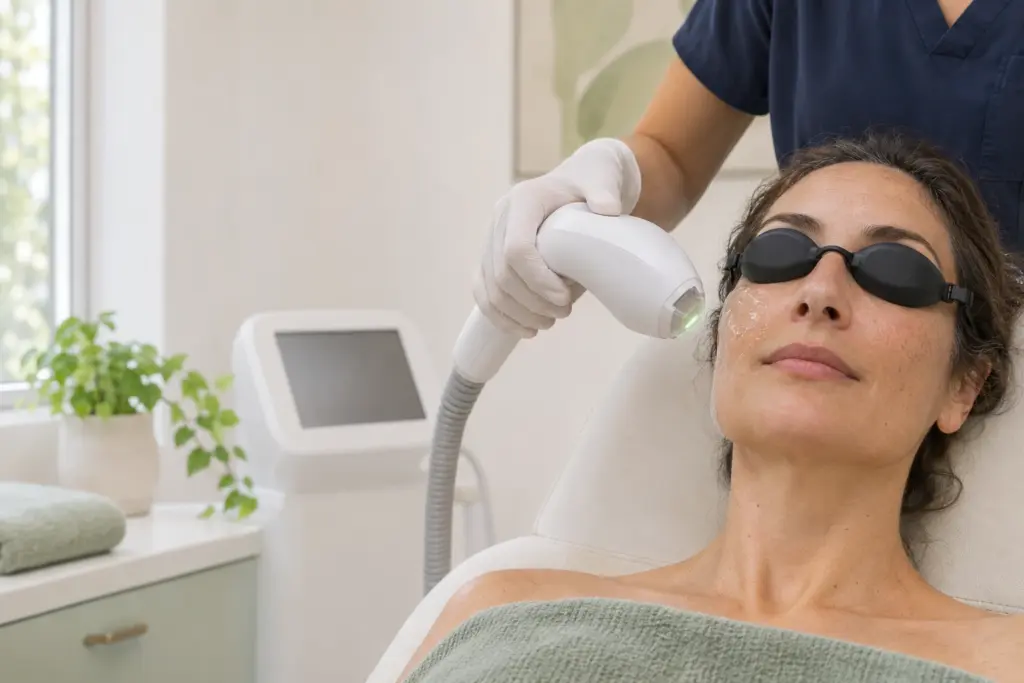
You have probably seen “IPL photofacial” on one med spa menu and “BBL” on another, often at different prices. Both use flashes of filtered light to fade sun spots and redness. Here is how BBL differs from standard IPL, what each treats, who each suits and what a full series costs.
See which fits you ↓Editorial details
BBL (BroadBand Light) is a premium type of IPL made by Sciton. Both use filtered flashes of light to fade brown spots, redness and small broken vessels; BBL adds high power, fast handpieces, built-in cooling, a wide range of filters and extra treatment modes. Many dermatology practices choose BBL for that range of features. Prices overlap: the lowest we found were for standard IPL at med spas, and practices offering both charged the same or a little more for BBL. For everyday sun damage and redness on lighter skin, either can work well in experienced hands, so the provider and your skin type matter as much as the device.
What is IPL?
IPL, short for intense pulsed light, is a handheld flash lamp that sends quick bursts of filtered light into the skin to fade brown spots and redness. A “photofacial” is an IPL treatment of the face. You may also hear it called photorejuvenation or a FotoFacial.
Here is how it works. A laser fires one exact wavelength of light. An IPL flash contains many wavelengths at once, and a filter on the handpiece removes the shorter ones so the light favors a target. Brown pigment in a sun spot absorbs it and breaks up, which is why spots turn darker for a few days and then flake away. Blood in tiny surface vessels absorbs it too, which helps redness and broken capillaries fade. The gentle heat also prompts the skin to renew itself, and many people notice smoother, more even skin over a series of sessions (Baylor College of Medicine).
How a photofacial works: a filtered flash of light
A laser fires one wavelength. IPL devices, including BBL, flash a broad band of light, and a filter picks the part that suits the target: brown pigment, blood vessels or hair. Simplified; not to scale.
Filters are long-pass (they block light below the number) except the 420 nm acne filter, which is band-pass. The axis shows 400 to 1,200 nm; BBL’s 2011 clearance lists a wider 300 to 1,400 nm band. Sources: FDA 510(k) K101916 (Sciton JOULE, BBL indications); FDA product code ONF. Original NuWays MD graphic.
A short history. Dermatologists have used IPL on the skin since the 1990s; one long-term study followed patients first treated in 1996 and 1997 (Weiss et al., 2002). In 2000, a dermatologist published a study of 49 people who had four or more full-face IPL treatments: more than 90% saw visible improvement in spots, redness, texture and pore size, with minimal downtime (Bitter, 2000). That full-face approach is the photofacial most practices offer today.
What is BBL, and what makes it different?
BBL is Sciton’s brand of IPL, first cleared by the FDA in 2003. It works the same way, with features that set it apart from many basic IPL devices. “BBL” here means BroadBand Light, not the Brazilian butt lift, and BBL is not a laser (FDA 510(k) K032460).
Built-in cooling for comfort
BBL’s handpiece chills the skin before, during and after each flash. Its FDA clearance lists this cooling as a way to reduce pain and protect the skin’s surface (FDA 510(k) K101916). Sciton says numbing cream is usually unnecessary (Sciton).
Power and speed
Sciton calls BBL “the world’s most powerful IPL.” Sciton says its BBL HERO handpiece (2020) has four times the speed and three times the peak power, without naming the comparison, which helps with large areas such as the chest, arms or legs (Sciton, 2018; Sciton, 2020).
A wide range of filters
BBL’s clearance lists filters from 420 nm for acne to 695 nm for hair, with settings for pigment and vessels in between. The newest handpiece, BBL HEROic (2024), adds a narrow filter that Sciton aims at small vessels around the nose (FDA K101916; Sciton BBL HEROic).
Treatment programs and pairings
Sciton packages BBL as Forever Young BBL for ongoing anti-aging care, Forever Clear BBL for acne and SkinTyte for gentle tightening. BBL runs on Sciton platforms that also carry lasers such as MOXI, so practices can combine treatments (Sciton Forever Young BBL; Sciton, 2020).
Practices describe the difference in similar terms. A New York dermatology practice calls BBL “Sciton’s proprietary form of IPL with optimized filters and a uniform pulse” (Tribeca Park Dermatology), and a Nashville clinic says that, unlike traditional IPL, BBL “uses a broader, more customizable range of wavelengths” (Skin Pharm).
BBL also has its own published research, including a 2013 Stanford study of skin biopsies, a long-term follow-up of patients treated for 5 to 11 years and a 2023 randomized melasma trial. Those studies are small, and the results section below explains what they found.
Other IPL devices you may see include Lumecca (InMode), Stellar M22 (Lumenis) and Nordlys (now sold by Candela). They are modern IPL systems with their own filters, cooling and software, cleared for similar uses.
What each device’s FDA clearance lists (5 IPL devices)
| Device and maker | What its FDA clearance lists | Skin types stated |
|---|---|---|
| BBL Sciton (JOULE platform, 2011) | Sun spots, freckles, melasma and other pigment; vessels including rosacea; acne; hair | None for pigment or vessels; hair removal in “all skin types” |
| Lumecca InMode | Pigment including freckles and melasma; vessels including rosacea | None stated |
| Stellar M22 Lumenis | Pigment including melasma; vessels; acne; hair | Hair removal in types I to V |
| Nordlys Ellipse (now sold by Candela) | Rosacea, redness, freckles, sun spots, acne, hair | None stated |
| Harmony Dye VL Alma | Sun spots, freckles, melasma (listed as chloasma), vessels including rosacea | Types I to V |
From each device’s FDA 510(k): K101916, K251632, K193500, K150907, K181298. A cleared use is what a device may be marketed for; it is not proof of how well it works.
IPL vs. BBL side by side
The core treatment is the same; the differences are in the equipment, the extras and the price.
| Standard IPL | BBL (Sciton) | |
|---|---|---|
| What it is | A type of light treatment made by many companies | Sciton’s IPL platform, first cleared in 2003 |
| Comfort | Varies by device; many modern IPLs, such as Lumenis systems, also use a continuously cooled tip | Built-in contact cooling, cleared to reduce pain |
| Speed | Varies by device | HERO and HEROic handpieces built for fast passes over large areas |
| Extra programs | Varies by device and practice | Forever Young (anti-aging), Forever Clear (acne), SkinTyte (tightening) |
| Face price we found | From $250 (starting price) to $600 | From $300 (starting price); fixed full-face prices $450 to $600 |
| Research | Many studies since the 1990s, on a range of devices | Several BBL studies, including long-term maintenance data |
Sources: FDA K101916; Sciton; Lumenis; NuWays MD price check, November 23, 2026.
Is BBL better than IPL, and which should you choose?
BBL brings useful features: built-in cooling, fast handpieces for large areas and extra treatment programs. Whether it gives you a better result depends on your concern, your skin and the person using it.
Sciton says BBL HEROic can show visible results in 1 to 2 treatments, compared with 5 to 6 for traditional IPL, and some practices advertise faster results than traditional IPL (Sciton; Glow Theory). No published study has compared BBL head-to-head with another IPL device for skin concerns, and other modern IPL systems also use cooled tips and multiple filters, so compare the specific machine and plan you are offered. The American Academy of Dermatology notes that “your results depend largely on the person performing your treatment” (AAD).
BBL is worth considering if
- You want the face plus neck, chest, hands or arms treated, where a fast handpiece saves time
- You want acne, tightening or a long-term maintenance plan from the same device
- You plan to pair it with MOXI at the same practice
- The provider treats patients with BBL every week and can show results on skin like yours
A standard IPL may be all you need if
- You have a few sun spots or mild facial redness
- You want the lowest price for a series
- The provider is experienced with a modern device that cools the skin
- The price difference would pay for an extra session
Look at other treatments first if
- You have melasma: start with sun protection and prescription creams
- Your skin is Fitzpatrick type V or VI (deeply pigmented): see darker skin
- Your main concern is deep wrinkles, acne scars or loose skin: see alternatives
- You have a tan, are pregnant or have a cold sore outbreak right now
Compare quotes on the same terms. Ask each practice which device and handpiece it uses, how it cools the skin, how many sessions it expects for your concern and what the whole plan costs.
Is BBL a laser? No. BBL and other IPL devices use a flash lamp with filters, not a laser, though clinics often say “BBL laser” and BBL often sits on the same machine as lasers. The FDA classifies IPL as a non-laser light device (FDA product code ONF).
What can IPL and BBL treat?
Both treat the same concerns. They do best on brown sun spots, freckles, redness and small broken vessels, and they are not the right first choice for melasma or deep wrinkles.
| Your concern | How well IPL or BBL works |
|---|---|
| Brown sun spots (age spots) | Great fit Spots darken, then flake off. In a 10-person split-face trial, dark sun spots were graded 82% improved on average after 3 IPL sessions. Small spots respond better than large ones. Have any new or changing spot checked firstAlso consider: pigment lasers such as Q-switched or picosecond lasers |
| Freckles | Great fit In an open study, 71% of people with freckles improved by more than halfAlso consider: a Q-switched laser, which did better in one small trial but left more dark marks |
| Redness and broken capillaries | Great fit Most people see 50% to 75% fewer visible vessels after 1 to 3 laser or light treatments, the AAD saysAlso consider: a pulsed dye laser (such as Vbeam), which some trials found slightly more effective for vessels |
| Overall sun damage and uneven tone | Great fit A full-face series improves spots, redness and tone together. Baylor dermatologists report an average 70% improvement in signs of sun damage |
| Rosacea redness | Can help Persistent background redness can improve, though results vary and redness tends to return; a pooled analysis found IPL improved facial redness compared with no treatment. It works best alongside prescription care and maintenanceAlso consider: prescription treatment from a dermatologist |
| Fine lines, texture and pores | Can help a little Expect some improvement in texture and pore size, not wrinkle removalAlso consider: microneedling, MOXI, Halo or laser resurfacing |
| Acne | Can help Sciton offers BBL for acne as Forever Clear BBL, using blue light. Light treatments rarely clear acne on their own, the AAD saysAlso consider: prescription acne treatment first |
| Melasma | Use caution Heat and light can make melasma darker, and it often returns. In a 120-woman trial, BBL alone did no better than tranexamic acid pills; BBL plus tranexamic acid injections did bestAlso consider: sun protection and prescription creams first; a dermatologist’s plan |
Sources: Galeckas 2008, Kawada 2002, Wang 2006, AAD, Cai 2023, Baylor, AAD acne, Sciton, Trivedi 2017, Jia 2023.
Have dark spots checked first. A spot that looks like an age spot can be a skin cancer, and fading it can delay the diagnosis, the American Academy of Dermatology warns (AAD on age spots). A good provider will examine any spot before treating it.
A note on rosacea. A German expert guideline strongly recommends IPL for rosacea redness and visible vessels (German S2k laser guideline, 2022), and a 2023 pooled analysis found no significant difference between IPL and a pulsed dye laser for facial redness (Cai et al., 2023). Light treats the redness and vessels, not the bumps, so most people also need care from a dermatologist.
What a BBL or IPL session feels like, and recovery
A face session takes about 15 to 30 minutes, feels like quick warm snaps on the skin, and most people go back to work the same day.
- Consultation. The provider checks your skin type, examines spots and asks about medicines, tanning and cold sores.
- Prep. Your skin is cleansed, you put on opaque eye shields, and a thin layer of cool gel goes on.
- Treatment. The provider glides the handpiece over the skin, usually in passes. Each flash feels like a warm snap, like a rubber band; with BBL, the cooled tip takes the edge off (Sciton). Some clinics offer numbing cream.
- Afterward. Skin looks pink and feels like a mild sunburn for a few hours to a few days. You can usually wear makeup and work right away (Sciton; Baylor).
A typical recovery after an IPL or BBL session
Pigment treatments follow this pattern most closely. Your provider’s instructions come first.
- Treatment dayWarmth, redness and mild swelling for hours to 3 days; up to 2 weeks after vessel settings.
- Days 1 to 3Brown spots darken, often to a coffee-ground color. This is expected.
- Days 4 to 7Darkened spots flake off, sometimes over 2 weeks. Do not pick or scrub.
- About 1 weekFacial skin is usually healed; the body can take longer. Call if you see blisters or broken skin.
- First 2 to 4 weeksNo direct sun on treated skin; daily SPF 30+ and a hat. Sciton says 14 days, a German guideline 4 weeks.
Sources: Sciton BBL pre- and post-care instructions; Kaiser Permanente; InMode Lumecca patient brochure; Baylor College of Medicine Dermatology; Tribeca Park Dermatology; AAD on lasers and lights for rosacea; German S2k laser guideline. Original NuWays MD graphic.
Aftercare that protects your results
- Keep treated skin out of direct sun for at least 2 weeks and wear daily SPF 30+; a German guideline advises 4 weeks
- Cleanse gently; do not rub, scrub, pick or exfoliate darkened spots
- Skip hard workouts, saunas, hot tubs and pools until the skin settles
- Use a cool compress for lingering redness or swelling
Sources: Sciton BBL pre- and post-care instructions, Kaiser Permanente, German S2k laser guideline, Tribeca Park Dermatology.
Side effects. Most are short-lived: redness, mild swelling, darkened spots and sometimes bruising or crusting. Less common risks include burns, blisters, light or dark patches (usually temporary), a cold sore flare and eye injury if the eyes are not fully shielded. Risk rises with a tan, darker skin and higher energy settings (Kaiser Permanente; Thaysen-Petersen et al., 2017; eye-safety review, 2025).
After any session
Contact your provider promptly if you notice
- Blisters, broken skin, crusting or drainage
- Signs of infection: spreading redness, warmth or pus
- A cold sore outbreak
Eye symptoms need a doctor the same day. New eye pain, light sensitivity or changes in vision after a face treatment need same-day medical eye care. Go to an emergency room for severe eye pain or sudden vision loss. IPL near the eyes can cause lasting injury if the eyes are not fully shielded (eye-safety review, 2025).
How many sessions you need, and how long results last
Plan on a series of about 3 to 5 sessions, 3 to 4 weeks apart, then 1 to 4 maintenance visits a year to keep new spots and redness in check.
Many people see a difference after the first session, as spots darken and flake off, with full results building across the series (Tribeca Park Dermatology). Visible vessels can respond in 1 to 3 sessions, while overall sun damage usually takes more; one health system says a minimum of 5 to 6 is typical for full photorejuvenation (AAD; Kaiser Permanente).
How long results last. Treated vessels do not come back, but new ones can form; the AAD says results for vessels tend to last 3 to 5 years (AAD). Brown spots can return with sun exposure, which is why daily sunscreen and yearly touch-ups matter. In an older study of 80 patients, most still showed improvement 4 years after a series (Weiss et al., 2002).
Forever Young BBL and long-term maintenance. Sciton sells Forever Young BBL as ongoing care, and practices typically suggest 1 to 4 visits a year depending on age (Tribeca Park Dermatology; AesthetiCare). In a review of 15 patients who had BBL once or twice a year for 5 to 11 years, raters guessed their age at a median of 45 when they were actually 55, about the age they had been when treatment started (Bitter and Pozner, 2013). A 2013 Stanford pilot of 5 women found that 3 BBL sessions shifted the activity of aging-related genes in forearm skin toward a younger pattern (Chang et al., 2013). Both studies were small and were funded or run by people linked to Sciton; the long-term review had no untreated comparison group, and its patients also used their own skincare.
IPL vs. BBL cost
Prices overlap. The lowest we found were for standard IPL at med spas (from $250, or a fixed $350), while fixed full-face BBL prices ran $450 to $600. At practices that offer both, BBL cost the same or started $50 higher.
| Practice and device | Face: 1 session and 3 sessions |
|---|---|
| Beverly Hills Rejuvenation Center, several statesIPL | $350 3 sessions: $900 package |
| Innovative MedSpa, Chicago, ILIPL and BBL | IPL from $250; BBL from $300 3 sessions: from $750 (IPL) or $900 (BBL) |
| Mandel Dermatology, New York and Boulder, COLumecca or BBL, same price | From $450 per area 3 sessions: from $1,350 |
| Beyond Laser & Skincare, Snoqualmie, WABBL HERO | $450 (listed beside an “Original” $500) 3 sessions: $1,200 package |
| Skin Pharm, Nashville, TNBBL | $500 (area not named) 3 sessions: $1,350 package |
| Glow Theory, Carlsbad, CABBL HERO | $575 3 sessions: $1,639 package |
| The Naderi Center, Reston, VABBL | $600 3 sessions: $1,800, or $1,620 with a package special |
| Tribeca Park Dermatology, New York, NYLumecca or BBL, same price | $600 3 sessions: $1,800 (single sessions) |
Posted menu prices, checked November 23, 2026. We did not contact the practices, none paid to be listed, and these are not quotes.
Price the whole plan. Three face sessions ran $900 to $1,800 at fixed prices, or from $750 at starting prices. As examples, five sessions would cost about $1,600 at BHRC’s IPL rates or $3,000 at Tribeca’s single-session price. Then add what menus list separately:
What changes the real bill
- Consultation: free to $250; often credited if you are treated the same day.
- Extra areas: face, neck and chest together ran $900 to $1,000, against $600 for the face alone.
- Maintenance: 1 to 4 visits a year after the series.
- Packages: usually must be used within 12 months to 2 years, and some practices do not refund unused sessions.
- Late cancellations: $100 to $150, a share of the session price or a lost package session.
- Insurance: rarely covers these treatments, the AAD says.
Terms: Naderi Center fees, Glow Theory policies, Skin Pharm packages, Beyond Laser policies, Innovative MedSpa; insurance: AAD. For other procedures, see treatment costs.
Is IPL or BBL safe for darker skin, and who should wait?
IPL and BBL work best on lighter to light-brown skin. Skin pigment absorbs the light too, so the risk of burns and dark or light patches rises with darker skin and with a tan. Studies sort skin with the Fitzpatrick scale, from type I (the fairest) to type VI (the darkest), and almost all IPL research is in types I to IV.
With type IV skin, treatment can work with an experienced provider, lower settings and often a test spot first; a German guideline advises a cautious approach from type IV (German S2k laser guideline; Lee et al., 2026). For types V and VI, several practices we checked recommend other treatments, such as MOXI, microneedling, peels or pigment lasers suited to darker skin (Tribeca; Skin Pharm; Naderi Center), and a 2026 review cites a recommendation against IPL in those types (Lee et al., 2026). Sciton lists BBL HEROic for skin types I to V (Sciton).
Wait or skip if you
- Have a tan, sunburn or self-tanner from the past 2 to 4 weeks
- Are pregnant
- Have melasma, unless a dermatologist recommends IPL
- Take medicines that make you sensitive to light, such as doxycycline or minocycline
- Have seizures triggered by flashing light, or form keloids
- Have an infection, rash or cold sore outbreak in the area
Tell your provider if you
- Took isotretinoin (Accutane) in the past year: some protocols require a 6-month wait and guidance differs, so get your dermatologist’s advice
- Get cold sores
- Bruise easily or take a blood thinner
- Use retinoids or lightening creams
- Have a beard you want to keep, since light can thin hair in the treated area
Sources: Kaiser Permanente IPL contraindications, Sciton, ASDS isotretinoin consensus, Skin Pharm, review of procedures in pregnancy, 2017, German S2k laser guideline, FDA K101916. For tips on choosing who treats you, see how to choose a provider.
What to pair with IPL or BBL, and the alternatives
IPL and BBL treat color: spots and redness. For texture, wrinkles or scars, practices often pair them with a resurfacing treatment, or suggest another option instead.
| Treatment | What it adds or does better |
|---|---|
| MOXI (Sciton)A gentle 1927 nm fractional laser | Surface texture and sun damage; often paired with BBL. Two menus priced MOXI plus BBL at $1,049 and $1,200 a session |
| Halo (Sciton)A hybrid fractional laser | Hybrid fractional resurfacing: it treats tiny, evenly spaced zones of skin with two wavelengths, one of which removes a very small amount of tissue in each zone. One menu priced it at $1,599 for the face |
| Microneedling or a chemical peelNot light-based | Acne scars and texture, or surface pigment with a peel; often a better fit for darker skin. See microneedling vs. chemical peel |
| Pulsed dye laser (such as Vbeam)A 595 nm vascular laser | Targets redness and broken vessels; a common alternative to IPL for vessels |
| Q-switched or picosecond laserPigment lasers | Individual stubborn spots and freckles |
| Daily skincare | Sunscreen every day protects results; some providers prescribe a retinoid or lightening cream before treatment for people prone to dark marks |
Sources: Sciton MOXI; Sciton Halo; AesthetiCare menu; Skin Pharm; AAD; Kaiser Permanente. For deeper resurfacing, see laser resurfacing.
Questions to ask before you book
A good consultation starts with your concern and skin type, then explains which device and settings fit, and why.
- Which device do you use, BBL or another IPL, and why is it right for my concern?
- How often do you treat my skin type, and will you do a test spot?
- Who will treat me, and is a physician on site or supervising?
- How many sessions do you expect, and what change is realistic for me?
- Can I see before-and-after photos of your own patients with my skin type, taken in the same light?
- What does the whole plan cost, including the consultation, extra areas and maintenance? What happens to unused package sessions?
- Which products or medicines should I pause beforehand?
IPL vs. BBL FAQs
What is the difference between IPL and BBL?
BBL (BroadBand Light) is Sciton’s brand of IPL. Both use filtered flashes of light to fade spots and redness. BBL adds built-in cooling, high power, fast handpieces, a wide range of filters and extra programs for acne, tightening and long-term maintenance, and it usually costs more.
Is BBL better than IPL?
BBL offers built-in cooling, fast handpieces and extra programs, and many dermatology practices prefer it. No study has compared the two head-to-head for skin concerns, so for a few sun spots or mild redness, an experienced provider with a modern standard IPL can also get good results.
Is BBL a laser?
No. BBL is a type of intense pulsed light (IPL), which uses a filtered flash lamp rather than a laser. It often runs on the same Sciton machine as lasers such as MOXI and Halo, which is why clinics sometimes call it a laser.
Is BBL more comfortable than IPL?
BBL’s handpiece has built-in contact cooling that its FDA clearance lists for reducing pain, and Sciton says numbing cream is usually unnecessary. Many modern IPL devices also cool the skin, so comfort depends on the device, the settings and the area treated; ask what cooling the device uses.
Is BBL more expensive than IPL?
Often, but not always. The lowest prices we found were for standard IPL at med spas, from $250. Fixed full-face BBL prices ran $450 to $600, and practices that offer both charged the same or $50 more for BBL.
Is BBL or IPL better for rosacea and redness?
Both work on visible vessels and redness the same way. Most people see 50% to 75% fewer visible vessels after 1 to 3 laser or light treatments, the AAD says. Background rosacea redness improves only partly and tends to return, so pair treatment with prescription care.
Is BBL or IPL better for sun spots?
Both fade brown sun spots well, especially small ones: spots darken and flake off within 1 to 2 weeks. Have any new or changing spot checked by a dermatologist before treatment.
Can IPL or BBL treat melasma?
Not as a first choice. Light and heat can darken melasma, and it often returns. Start with sun protection and prescription creams; in one trial, BBL alone did no better than tranexamic acid pills.
Is BBL safe for dark skin?
It is riskiest on darker skin. Most research is in skin types I to IV. With type IV skin, an experienced provider may treat with care and a test spot; with types V and VI, most practices recommend other treatments.
How many BBL or IPL sessions will I need?
Usually 3 to 5 sessions about 3 to 4 weeks apart, then 1 to 4 maintenance visits a year. Visible vessels can respond in 1 to 3 sessions; overall sun damage often takes more.
What is the downtime after a photofacial?
Little to none. Skin may look pink for a few hours to a few days, and treated spots darken and flake off over about 1 to 2 weeks. Most people wear makeup and work the same day.
What is Forever Young BBL?
Sciton’s name for BBL used as ongoing anti-aging care, usually after an initial series, with 1 to 4 visits a year. Small long-term studies suggest regular treatment helps skin look younger, though they had no untreated comparison group.
What is the difference between BBL HERO and BBL HEROic?
Both are Sciton BBL handpieces. HERO (2020) was built for speed on large areas; HEROic (2024) adds motion tracking and a narrow filter for small vessels. Both deliver the same kind of BBL treatment.
BBL vs MOXI: which is better?
They do different jobs, and practices often pair them. BBL targets brown spots and redness; MOXI is a gentle fractional laser for surface texture and sun damage.
How long do BBL or IPL results last?
Treated vessels do not return, and vessel results tend to last 3 to 5 years, the AAD says. Brown spots can come back with sun exposure, so daily sunscreen and yearly touch-ups help results last.
Sources and editorial notes
Sources checked November 23, 2026. Clinical review pending. We read FDA device records, manufacturer documentation, American Academy of Dermatology patient guidance, a German laser guideline, published IPL and BBL studies and the posted menus of eight practices. Studies read only as summaries are marked. NuWays MD provides education, not medical care.
Prices are posted menu prices; we did not contact the practices, and none paid to be listed. Manufacturer statements are labeled as such. The light diagram and recovery timeline are original NuWays MD graphics. How we prepare and update guides.
View all 46 sources
FDA records
- FDA product classification: ONF. Defines powered light-based non-laser instruments “including broad spectrum source devices such as intense pulse light (ipl)”; Class II.
- FDA 510(k) K032460: Sciton Profile BBL (2003). First BBL clearance, 500 to 1,400 nm; cleared by comparison with earlier intense pulsed light systems.
- FDA 510(k) K101916: Sciton JOULE with BBL (2011). BBL filters from 420 nm (acne) through 515 and 560 (pigment, including melasma and freckles), 560 and 590 (vessels, including rosacea) to 640 and 695 (hair); integral cooler indicated to reduce pain and minimize thermal injury; hair removal in “all skin types.”
- FDA 510(k) K193500: Lumenis Stellar M22 (2020). IPL with 9 filters; pigment including melasma, vessels, acne and hair; hair removal in types I to V.
- FDA 510(k) K251632: InMode Optimas MAX with Lumecca Peak (2025). Pigment including melasma and freckles; vessels including rosacea.
- FDA 510(k) K150907: Ellipse Nordlys (2015). IPL wavebands for rosacea, redness, freckles, sun spots, acne and hair; Nordlys is now sold by Candela.
- FDA 510(k) K181298: Alma Harmony XL Dye VL handpiece (2018). 500 to 600 nm IPL for pigment, including chloasma (melasma), and vessels, in skin types I to V.
Manufacturer information
- Sciton press release (2018). Calls BBL “the world’s most powerful IPL (Intense Pulsed Light) device on the market.” Manufacturer claim.
- Sciton press release (2020). Launch of the mJOULE platform with BBL HERO and MOXI; HERO described as having “four times the speed, three times the peak power, and two times the cooling capacity” (comparison not named). Manufacturer claim.
- Sciton BBL HEROic product page. Launched 2024; “Suitable for skin types I-V”; sapphire-crystal cooling; narrow 500 to 650 nm filter for small vessels; Forever Clear acne mode; SkinTyte infrared tightening mode. Manufacturer marketing.
- Sciton BBL HEROic patient page. Claims visible results “in just 1 to 2 treatments” vs “5 to 6” for traditional IPL; no study cited. Manufacturer marketing.
- Sciton Forever Young BBL page. BBL for aging skin; lists 1 to 3 treatments. Manufacturer marketing.
- Sciton BBL patient pre- and post-care instructions. Numbing usually unnecessary; a warm or rubber-band snap sensation; makeup and work usually right away; spots darken then flake; no direct sun for 14 days; avoid strenuous exercise, pools and spas while healing.
- Lumenis: IPL technology page. Describes broad-spectrum pulsed light “transmitted through a continuously cooled applicator” with cut-off filters. Manufacturer information.
- Sciton MOXI page. 1927 nm fractionated non-ablative laser, often paired with BBL. Manufacturer marketing.
- Sciton Halo page. Hybrid fractional laser with a non-ablative 1470 nm and an ablative 2940 nm wavelength. Manufacturer marketing.
Medical guidance and patient information
- American Academy of Dermatology: lasers and lights for rosacea. 50% to 75% fewer visible vessels after 1 to 3 treatments; about 20% less redness in small laser studies; vessel results last 3 to 5 years; “your results depend largely on the person performing your treatment”; insurance rarely covers.
- American Academy of Dermatology: age spots. A spot that looks like an age spot can be skin cancer; have it examined before fading it.
- American Academy of Dermatology: lasers and lights for acne. Light treatments rarely clear acne on their own.
- Baylor College of Medicine Dermatology: intense pulsed light. Photofacial gives an average 70% improvement in signs of sun damage, with some improvement in wrinkles and pore size; redness for 1 to 3 days; spots flake off within 5 to 7 days; most people return to work right away.
- Kaiser Permanente: IPL skin rejuvenation patient information. Typically a minimum of 5 to 6 treatments, 3 to 4 weeks apart; contraindications include pregnancy, light sensitivity, recent tanning, isotretinoin within 6 months, melasma, seizures triggered by light and keloids; cool compress and no hot tubs or saunas while redness settles.
- German S2k guideline: laser therapy of the skin, 2022. Expert consensus. Strongly recommends IPL for rosacea redness and vessels; advises caution from skin type IV; 4 weeks of sun avoidance after treatment; possible hair thinning in men during facial vessel treatment.
- Waldman et al., ASDS consensus, Dermatol Surg 2017 (abstract). Found insufficient evidence to delay several non-ablative laser and light treatments after isotretinoin; does not address photofacial IPL specifically.
- Trivedi, Kroumpouzos and Murase, Int J Womens Dermatol 2017 (pregnancy review). Laser and IPL “are not indicated for cosmetic procedures during pregnancy due to the lack of safety data.”
Studies and reviews
- Bitter, Dermatol Surg 2000 (abstract). 49 people with sun damage, four or more full-face IPL treatments 3 weeks apart; visible improvement in wrinkling, coarseness, pigment, pore size and vessels in more than 90%; 88% satisfied.
- Weiss et al., Dermatol Surg 2002 (abstract). Chart review of 80 patients first treated with IPL in 1996 and 1997; most still improved at 4 years; no comparison group.
- Galeckas et al., Dermatol Surg 2008 (abstract). Split-face, 10 people, 3 sessions; dark sun spots graded 82% improved with IPL and 86.5% with a pulsed dye laser one month later.
- Kawada et al., Dermatol Surg 2002 (abstract). Open study of 3 to 5 IPL treatments; more than half improvement in 71% with freckles and 40% with sun spots; large spots responded poorly.
- Wang et al., J Am Acad Dermatol 2006 (abstract). 32 patients in Taiwan; a Q-switched alexandrite laser improved freckles more than IPL but caused more dark marks, mostly after sun-spot treatment.
- Cai et al., Ital J Dermatol Venerol 2023 (abstract). Pooled analysis of 7 studies: IPL improved facial redness; no significant difference from pulsed dye laser in 5 comparisons.
- Trivedi et al., Int J Womens Dermatol 2017 (melasma review). Light treatments are not cures for melasma and can cause dark marks or a rebound flare; IPL comes after creams, peels and fractional lasers.
- Jia et al., J Cosmet Dermatol 2023 (abstract). Randomized trial in 120 women with melasma in China: Sciton BBL alone, oral tranexamic acid and tranexamic acid injections did not differ; BBL plus injections did best.
- Chang et al., J Invest Dermatol 2013 (Stanford). Pilot of 5 women; 3 monthly BBL sessions on the forearm shifted aging-related gene activity toward a younger pattern 4 weeks later; funded by Sciton.
- Bitter and Pozner, Cutis 2013. 15 patients treated once or twice a year for 5 to 11 years; raters estimated a median age of 45 against an actual 55; no untreated group; Sciton-affiliated authors; patients used their own skincare.
- Thaysen-Petersen et al., Lasers Surg Med 2017 (abstract). Randomized test-site study: darker skin pigmentation and higher energy predicted IPL side effects.
- Lee et al., Plast Reconstr Surg Glob Open 2026. Review of treatments for skin types IV to VI: IPL is a standard for dark spots in types I to IV, with limited research and a cited recommendation against it in types V and VI.
- Ophthalmological complications of aesthetic procedures, J Clin Med 2025. IPL near the eyes can damage the eye if the eyes are not adequately shielded.
Prices
- NuWays MD price check, November 23, 2026: posted menus at Tribeca Park Dermatology, Mandel Dermatology, The Naderi Center, Glow Theory, Skin Pharm, Beyond Laser & Skincare, Innovative MedSpa, Beverly Hills Rejuvenation Center and AesthetiCare (menu updated May 2026). Posted prices, consultation fees and package and cancellation terms; promotions not used, except the Naderi Center’s labeled package special, shown separately.