SKIN TEXTURE / COMPARING TREATMENTS
Microneedling vs. Chemical Peel: Acne Scars, Dark Spots, Recovery and Cost
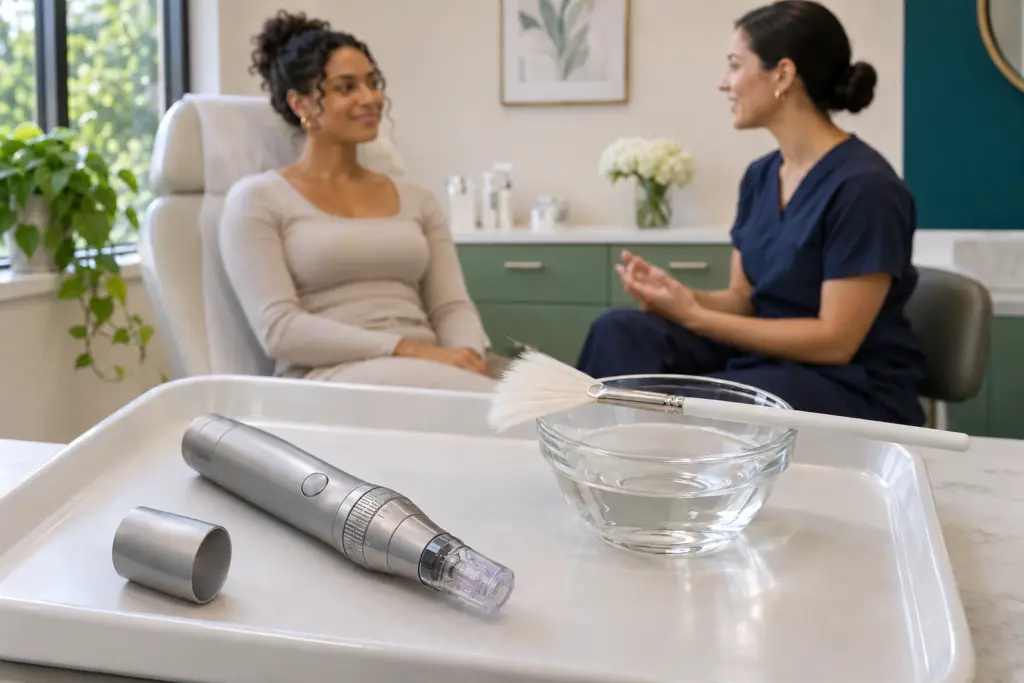
Microneedling and chemical peels both smooth and refresh skin, but they work at different depths, suit different problems and carry different risks for darker skin. Here is which fits your concern, what the trials found, and what recovery and a full series cost.
Find your concern ↓Editorial details
For depressed acne scars, both can help, and neither has clearly won. Of four small trials, one favored microneedling over a light glycolic acid peel, two found no clear difference, and combining them scored highest in both trials that tested it (not significantly in the larger, blinded one). For sun spots, uneven color and fine lines, a peel is the more established choice. Microneedling usually means a few days of redness and less risk of dark patches than stronger peels. On medium to dark skin, either can work with the right strength and a provider experienced with your skin tone; deep and high-strength peels are generally not advised. Have new or changing dark spots examined first, and expect a series of sessions and daily sunscreen.
What is the difference between microneedling and a chemical peel?
Microneedling, also called collagen induction therapy, makes thousands of tiny channels in the skin with fine needles; a chemical peel uses an acid to remove skin layers to a chosen depth. Both prompt the skin to repair itself and make new collagen, but they injure it differently. Microneedling reaches into the dermis, the deeper layer where scars sit, while most of the surface stays intact. A peel works from the top down, so its depth decides what it can treat, how long you heal and how much risk there is to your skin color. AAD on microneedling; peel depths, Gozali and Zhou, 2015.
How deep each treatment reaches
The deeper the injury, the more a treatment can change and the longer you heal. Diagram not to scale.
*In 2018 the FDA evaluated the first authorized microneedling pen up to 1.5 mm for facial acne scars; a later neck-wrinkle study went to 2.5 mm. Peel depths follow a standard dermatology classification; healing times are from the American Academy of Dermatology. Original NuWays MD graphic.
| Treatment | How deep, with examples | Typical plan |
|---|---|---|
| Microneedling | Channels into the dermis A motorized pen with a sterile, single-use cartridge. The first FDA-authorized pen, SkinPen Precision, was evaluated up to 1.5 mm for facial acne scars | 3 to 6 sessions in studies, 2 to 4 weeks apart |
| Light peel | Part or all of the epidermis Glycolic or salicylic acid, Jessner’s solution, or TCA up to 30% | 3 to 5 peels, 2 to 4 weeks apart for acne scars (2 to 5 weeks in general) |
| Medium peel | The epidermis and upper dermis TCA 35%, alone or combined with Jessner’s solution or glycolic acid. Stronger TCA, up to 50%, exists, but a 2015 review advises against it | Can be repeated; a follow-up visit is required. High strengths are not advised for skin types V and VI |
| Deep peel | Into the middle dermis Phenol formulas, under general anesthesia in a surgical setting | Only one in a lifetime. Phenol can disturb heart rhythm, so the heart is monitored. Not recommended for skin types IV to VI |
Plans: AAD chemical peel FAQs, AAD on acne scars and the trials below. Peel agents, heart risk and skin-type limits: Gozali and Zhou, 2015. Needle depth: FDA De Novo summary DEN160029. Healing times are in the recovery section.
Two terms. Skin types means the Fitzpatrick scale used in the studies below, which runs from type I, the fairest skin, to type VI, the darkest; this guide calls types IV to VI medium to dark skin. PIH (post-inflammatory hyperpigmentation) means flat dark marks left after acne or irritation. In darker skin they are common and can outlast the acne, and both treatments can cause them as well as treat them. AAD acne scars overview; AAD on acne in darker skin; Ishfaq et al., 2022.
Branded peels such as the VI Peel are not sold by standard depth names (one menu calls its pigment VI Peel “medium-depth”), so ask which acids, at what strength. RF microneedling, which adds heat, is a different treatment; see microneedling vs. RF microneedling.
Which is better for acne scars, dark spots or wrinkles?
Match the treatment to the problem: microneedling for depressed scars and texture, a peel for surface pigment and sun damage, and often neither alone for deep scars.
| Your concern | Microneedling | Chemical peel |
|---|---|---|
| Rolling or shallow boxcar acne scars | Good fit Rated best suited to rolling and shallow boxcar scars | Sometimes TCA rated effective for boxcar, not rolling |
| Ice pick scars | Sometimes Rated not effective in a 2015 review, yet 11 of 15 improved with microneedling vs 2 of 10 with a light peel in a 2022 trial (a small subgroup; the microneedling group also used vitamin creams) | Good fit TCA CROSS: 65% to 100% TCA dabbed into each scar. Temporary dark patches in 6 of 12 in one trial; ask about pigment risk on darker skin |
| Dark marks after acne (PIH), sun spots | Sometimes An AAD-listed use for dark spots; little comparative data | Good fit Light peels in a series. Have new or changing spots checked first |
| Melasma | Sometimes Studied mainly with creams such as tranexamic acid; results mixed | Sometimes Glycolic acid rated safest and most effective of the peels studied (2024 review) |
| Fine lines, dull or rough skin | Sometimes An AAD-listed use; FDA clearances we read cover wrinkles only in skin types I to IV | Good fit Deeper peels do more but heal longer; deep peels are not advised for skin types IV to VI |
| Large pores | Sometimes An AAD-listed use | Little evidence Not on the AAD’s peel list, though some practices offer peels for pores |
| Active breakouts | Wait Postponed while pimples are painful or pus-filled | Sometimes The AAD lists some types of acne |
Our labels, not a measured ranking. Good fit: an established or well-supported use. Sometimes: depends on the scar, product or plan. Little evidence or Wait: not a listed use, or postpone. Scar ratings: Gozali and Zhou, 2015, Table 2 and text; ice pick counts: Ishfaq et al., 2022; TCA CROSS dark patches: Cochrane review, 2016. Uses: AAD on microneedling, AAD peel overview. Wrinkle clearances: FDA 510(k) K202243. Spot checks: AAD on age spots.
Why scar shape matters. Ice pick scars are narrow, deep pits; boxcar scars are round dips with sharp edges; rolling scars are wide, sloping dips that make skin look wavy. A broad treatment improves the surface around a scar but may not reach the bottom of a deep, narrow one, which is why the American Academy of Dermatology treats ice pick and rolling scars differently. See our guide to skin texture and acne scars. AAD on acne scar treatment.
For pigment, think about the layer. A peel removes pigmented surface cells directly, while microneedling can even out tone as skin heals, the AAD says. For melasma, microneedling is mostly studied as a way to help creams work, with mixed results in analyses from 2022 and 2025. We found no trial comparing the two for age spots or PIH, and the one melasma comparison could not rank them. On darker skin, irritation from either can itself leave PIH, so choose the gentlest option that works and protect your skin from the sun.
Have dark spots checked first. A spot that looks like an age spot can be a skin cancer, and fading it gives the cancer time to grow, the American Academy of Dermatology warns. AAD on age spots.
Which should you choose?
Start with the problem you most want to change, then weigh your skin tone, your downtime and your budget.
Microneedling may make sense if
- Your main concern is rolling or shallow boxcar scars, or rough texture
- You can accept a few days of redness but not a week or more of peeling
- You have medium to dark skin and want a lower risk of dark patches than stronger peels carry
- You can commit to a series, usually 3 to 6 sessions
A chemical peel may make sense if
- Your main concern is sun spots, uneven color or dull, rough skin, and any new or changing spots have been checked
- You have a few narrow ice pick scars, which TCA CROSS targets
- You want a lower price per session: light peels started at $100 on the menus we checked
- Your provider names the acid and strength and has treated your skin tone
Scars and dark marks together? That mix is common after acne, especially in darker skin. Flat dark marks usually fade with time while depressed scars remain, but in darker skin the marks can last much longer than the acne, and dermatologists recommend treating the acne and the dark spots at the same time. Deep or widespread scars may need laser, fillers or subcision. AAD acne scars overview; AAD on acne in darker skin.
Is microneedling or a chemical peel safer for darker skin?
Both can be used on darker skin, with conditions: the right strength, the right provider and strict sun protection. Microneedling carries less risk of lasting color change than medium and deep peels, but it is not free of pigment risk.
Peels. Darker skin is more likely to develop PIH after irritation, and medium and deep peels can also lighten skin. The FDA has noted that peels and lasers “are not typically performed on higher Fitzpatrick skin types due to the risks of pigment change.” A 2015 review does not recommend deep phenol peels for skin types IV to VI or high-strength TCA for types V and VI, and describes salicylic acid peels as having an established safety record in all skin types. AAD chemical peel FAQs; FDA De Novo summary; Gozali and Zhou, 2015.
Microneedling. The American Academy of Dermatology calls it safe for all skin tones, and SkinPen Precision is cleared for acne scars in adults of all skin types. Even so, the FDA lists a darker skin type among reasons microneedling may not suit you, because it can darken or lighten skin, and some authorized devices were not studied in darker skin. The FDA judged darker types adequately studied in SkinPen’s trial, where 11 of 41 people had types V or VI, including 7 of the 20 treated with the pen. AAD on microneedling; FDA 510(k) K202243; FDA on microneedling devices; FDA De Novo summary.
Who does the treatment matters. The American Academy of Dermatology says people with skin of color can safely have a chemical peel when they see a dermatologist with expertise in peels on darker skin; without that, they can develop permanent pigment problems. For microneedling, it warns that treatment by someone without medical training raises the risk of infection, scarring and long-lasting discoloration, and that non-medical spa microneedling does not puncture the skin, so results are less noticeable. Ask who will treat you and which dermatologist oversees the plan. AAD chemical peel FAQs; AAD on microneedling.
If you have medium to dark skin
- Ask who will do the treatment and how many they have done on people with your skin color
- Ask which peel and strength is planned; deep peels and high-strength TCA are generally not advised for darker skin types
- Follow the 2 to 4 week preparation plan your provider gives you, which before a peel can include a retinoid or an antiviral
- Arrive without a tan or sunburn, and use sunscreen every day before and after either treatment
Sources: AAD peel preparation, AAD on acne scar treatment, AAD on microneedling.
Is microneedling more effective than a chemical peel?
Not clearly. We found four small randomized trials comparing the two for acne scars: one favored microneedling, two found no clear difference, and combining them scored highest in both trials that tested it, though not significantly in the larger, blinded one. “No clear difference” is not proof that both work; without placebo groups it could mean neither helped much, a 2016 Cochrane review cautions. The three trials that report timing measured results within a month of the last session, so none shows how long improvement lasts. Microneedling’s clearer advantages are shorter recovery and less risk of dark patches than stronger peels. Cochrane review, 2016.
Three of the four trials, in numbers
Each bar is drawn against its own group. The trials used different peels, improvement thresholds and timepoints, so compare within a panel, not across them. The fourth, from 2019, published only a summary.
Sources: Ishfaq et al. 2022; Pakla-Misiur et al. 2021; Leheta et al. 2011, as analyzed in the 2016 Cochrane review. Original NuWays MD graphic.
- 2022, Pakistan, 60 patients, skin types IV to VI. Six microneedling sessions beat six light glycolic acid peels: 22 of 30 vs 10 of 30 improved more than one scar grade. But the microneedling group also used vitamin creams and was younger, the treating dermatologist recorded results, and side effects were not reported by group. The authors say it cannot show a specific benefit in darker skin. Ishfaq et al., 2022.
- 2021, Poland, 120 adults, skin types not reported. Blinded, with sham treatments. Only microneedling plus a 33% TCA-based peel improved significantly from baseline, but final scores did not differ significantly between groups, and no treatment helped men significantly. Two combination patients left with discoloration after skipping sunscreen. Pakla-Misiur et al., 2021.
- 2019, Egypt, 30 patients, 10 per group. Glycolic acid peels plus microneedling beat either one alone. We read only the summary, which does not give the timing. Saadawi et al., 2019.
- 2011, Egypt, 30 patients, 27 analyzed. TCA CROSS with 100% TCA and needling gave similar improvement after four sessions each. Dark patches lasting about a month followed in 6 of 12 after the peel and none of 15 after needling; recovery averaged 9.6 vs 3.7 days. Leheta et al., 2011, via the 2016 Cochrane review.
The wider evidence is thin. The 2016 Cochrane review found no high-quality evidence for any acne scar treatment. A 2026 network analysis of nine randomized trials, searched through June 2026, found no clear difference in either direction between laser resurfacing and the other treatments, including microneedling and TCA peels, and concluded that no reliable ranking of acne scar treatments exists yet. Its only microneedling-versus-peel data came from the 2021 trial, and none of its trials reported results by scar type. Cochrane review, 2016; Liu et al., 2026.
A realistic benchmark. In the FDA study behind SkinPen Precision, blinded dermatologists graded photos after three sessions. Six months later, 7 of 20 people had improved by a full scar grade, 4 partly and 9 not at all (at one month, 8 of 20 had improved and 4 scored worse). 18 of 20 noticed improvement, and 12 of 20 were satisfied or extremely satisfied. The American Academy of Dermatology says full results usually take several months. FDA De Novo summary DEN160029; AAD on microneedling.
Recovery and downtime: what to expect
Microneedling usually means a few days of redness; a peel’s recovery ranges from a few days of flaking to three weeks, depending on its depth.
After microneedling
- Redness, or darker shading on darker skin, and a sunburn-like feeling for a few days to a week
- Back to work the same day; makeup after 24 hours
- FDA study: 13 of 41 had redness, itching, peeling or tenderness for 1 to 3 days; 5 of 41 had dryness for up to 6 days
After a chemical peel
- Light: redness, then scaling for 3 to 7 days; makeup the same or next day
- Medium: swelling for 48 hours, possible blisters, then crusting and peeling for 7 to 14 days, with daily soaks, antiviral pills and no sun until healed
- Deep: bandages, 2 to 3 weeks at home and strict sun avoidance for 3 to 6 months
- Possible side effects: redness lasting months, temporary darkening, lighter skin after medium and deep peels, rarely scarring
Providers often numb the skin before microneedling. Peels can sting or burn while the acid is on, salicylic acid peels intensely so, a 2015 review notes, and in one trial of increasingly strong glycolic peels, 7 of 23 women stopped because they could not tolerate them. After either treatment, picking at flaking skin, skipping sunscreen or tanning raises the risk of infection, scarring and color changes. AAD on microneedling; AAD chemical peel FAQs; FDA De Novo summary; numbing in the 2021 trial; Gozali and Zhou, 2015; Cochrane review.
After either treatment
Contact your provider promptly if you notice
- Burning, itching or swelling (after a medium peel, some swelling is expected for the first 48 hours)
- Signs of infection: spreading redness, warmth or pus
- A cold sore outbreak, which both treatments can trigger
Sources: AAD chemical peel FAQs, FDA De Novo summary, FDA on microneedling devices. For a day-by-day plan, see microneedling recovery.
Who should wait or skip each treatment?
Some health conditions and medicines rule out microneedling for now, and a safe peel depends on telling the provider your full history.
Microneedling may not suit you if you
- Have keloids, a weakened immune system or uncontrolled diabetes, or heal poorly
- Have a skin infection, hepatitis or HIV, a facial rash, a cold sore outbreak or painful, pus-filled pimples
- Have a bleeding disorder or take a blood thinner, including low-dose aspirin
- Have eczema, psoriasis, vitiligo or an autoimmune disease, or moles, warts or sun-damage spots in the area
- Are tanned or will be in the sun within two weeks
- Are pregnant or breastfeeding, have cancer, or are on chemotherapy, radiation or steroids
- Are allergic to stainless steel or numbing medicines
- Took isotretinoin recently (AAD: wait at least a month; FDA: within 6 months)
Before a peel, tell your provider
- If you take, or have ever taken, isotretinoin
- Every medicine and supplement, including antibiotics, acne treatments and aspirin
- If you get cold sores, so you can take an antiviral
- If your skin scars easily, and past cosmetic treatments or surgery
- Any heart condition, if a deep phenol peel is proposed
The FDA’s list also includes a darker skin type, because of the pigment risk. That is a reason to choose an experienced provider and ask whether your device was studied in darker skin (SkinPen’s acne-scar clearance covers all skin types), not necessarily to skip microneedling, which the AAD calls safe for all skin tones. FDA-authorized microneedling uses are for people 22 and older, and the 2022 and 2021 trials excluded pregnant women. FDA on microneedling devices; AAD on microneedling; AAD peel preparation; Gozali and Zhou, 2015; Ishfaq et al.; Pakla-Misiur et al..
Microneedling vs. chemical peel cost
Per session, the two overlap. Microneedling was $350 to $410 at four practices that post both prices. Most peels ran $100 to $470: light peels and most VI Peels cost less, while Summit’s stronger peels ($390 to $470) cost the same or more, and melasma peel systems more again. At Luminous, Cosmelan, mostly recommended for melasma, was $895 plus $450 at 21 days, followed by home phases.
| Practice | Microneedling | Peels on the same menu | Three-session total |
|---|---|---|---|
| Baylor College of Medicine Skin Studio, Houston, TX | $410 a session; $328 each in a series of 3 | Customized peel (glycolic, TCA, Jessner’s and others): $290 | Microneedling $984; three peels $870 |
| Summit Health, Berkeley Heights, NJ | $390, plus required aftercare (not priced on the menu) | Light peels: $100 to $170 without a facial; VI Peels: $350 to $470, aftercare included; 30% TCA (BioRePeel Blue): $400 | Microneedling $1,170 plus aftercare; three VI Peels $1,050 to $1,410 |
| Taylor Dermatology, Pensacola, FL | SkinPen, face: $350 | VI Peel: $300 to $325 | SkinPen $950; VI Peel $850 |
| Luminous, Austin, TX | SkinPen, full face: $350 | VI Peels: $199 to $275, with a take-home kit; melasma systems: $600 protocol, Cosmelan $895 plus $450 | SkinPen $875; VI Peel $570 or $625 |
Posted regular prices before tax, checked November 22, 2026, at practices whose public menus price both treatments. We did not contact them, none paid to be listed, and this is not a national average or a quote. Totals use a posted package price where one exists, otherwise single sessions.
Compare the cost of a full series. The AAD describes 3 to 5 mild peels for acne scars; the trials used four to six microneedling sessions and the FDA study three. At regular prices, three microneedling sessions cost $875 to $1,170 on these menus and three VI Peels or customized peels $570 to $1,410. Five came to $1,400 to $1,950 and $968 to $2,350 (package price plus single sessions). The peel figures assume a mild-peel schedule, though Summit calls its $470 VI Peel medium-depth, and Summit’s $100 peels are marketed for glow, aging or active acne rather than scars. The treatment cost calculator can total your quotes. Insurance does not cover acne scar treatment or cosmetic peels, the AAD says. AAD on acne scar treatment; AAD peel overview; AAD chemical peel FAQs.
Ask what each price includes
- Consultation and deposit. Summit lists a $40 skin consult, takes a non-refundable $50 new-patient deposit and charges $50 for cancelling with under 24 hours’ notice. Luminous charges $60, credited toward treatment; Taylor’s consultations are free; Baylor requires one before microneedling.
- Aftercare. Summit requires aftercare with microneedling but includes it with VI Peels (its aestheticians earn commission on products). Luminous includes a kit with every VI Peel.
- Numbing, follow-ups and any serum applied after microneedling.
- Package terms. None of the menus posts refund terms, so ask what happens if you stop partway. Summit’s New Jersey offer adds a free fourth VI Peel, BioRePeel or microneedling session to a three-pack through February 26, 2027 (not combinable), and it lists 10% off three “facial treatments” without saying whether peels count. Our totals use regular prices.
Deep peels are done in a surgical setting under general anesthesia, and none of these menus listed one. For more practices, package terms and RF prices, see our microneedling cost guide.
Can you do microneedling and a chemical peel together?
Sometimes, as a combination a trained provider plans for you. Combining scored highest in two small trials, but the studies combined them in different ways, none we found reported results for skin types V or VI, and no guideline sets the order or the gap between them.
- Same session (2021 trial). A 33% TCA-based peel went on before and after microneedling, with needles set to 2 mm, deeper than the 1.5 mm the FDA evaluated for acne scars. Skin types were not reported. Pakla-Misiur et al., 2021; FDA De Novo summary.
- Across sessions (2019 and 2011 studies). Microneedling plus glycolic acid peels beat either alone in 2019 (the summary does not give the order); in 2011, adding glycolic peels to a series of microneedling sessions in skin types III to IV reported fewer post-acne dark marks. We read only the summaries. Saadawi et al., 2019; Sharad, 2011.
- Instead of a deep peel (2014 trial, 20 analyzed). Four sessions of needling with a 20% TCA peel were not significantly different from one deep phenol peel at eight months (8 of 10 vs 10 of 10 rated more than 50% better). After the deep peel, all 10 had redness for three to four months and pigment change for six months; the needling group had no side effects a month out. Cochrane review.
Needling helps whatever goes on the skin afterward reach deeper: the point of a planned pairing, and the risk of an unplanned one. The FDA says the risks of combining microneedling with other products are not known, and the devices are not approved for delivering drugs, cosmetics or vitamins into the skin. 2025 meta-analysis; FDA on microneedling devices.
If a provider suggests both, ask
- Which comes first, and why that order suits your skin
- How many weeks apart, or why in the same session
- Which acid, at what strength, will touch needled skin
- What to avoid at home in between, including acid serums and retinoids
Never put an at-home peel or acid product on freshly needled skin.
Are at-home dermarollers and peels a cheaper option?
At-home kits are not a scaled-down version of either treatment, and strong at-home peels can injure skin. In July 2024 the FDA warned consumers not to buy or use chemical peel products without professional supervision. It said it has not approved any chemical peel products, and that peels sold online with high concentrations of TCA, glycolic, salicylic or lactic acid can cause severe chemical burns, infection, color changes and disfiguring scars. FDA warning, July 2024.
Everyday acid skin care is different: an industry safety panel considered alpha hydroxy acids such as glycolic acid safe at 10% or less, at a pH of 3.5 or higher, with sun protection, and the FDA asks for a sunburn alert on the label. For mild acne scarring, the AAD says a retinoid or salicylic acid can make scars less noticeable. FDA on alpha hydroxy acids; AAD on acne scar treatment.
At-home microneedling products are not meant to puncture the skin and give less noticeable results, the AAD says; overuse irritates skin, and devices that do pierce it can cause infection, scarring or color changes. AAD on microneedling.
Other options: laser, fillers, subcision and more
- Deep or widespread scars. Dermatologists may combine treatments such as surgery that frees scars from the tissue below (subcision), fillers, laser resurfacing or RF microneedling. In the 2016 Cochrane review, fillers had the best-supported evidence, rated moderate quality, but their effect is temporary and they do little for sharp, narrow ice pick and boxcar scars; most fillers last 3 months to 2 years. See laser resurfacing and RF microneedling. AAD on acne scar treatment; Cochrane review.
- Age spots. Besides peels, dermatologists use lasers or freezing (cryosurgery, a common treatment), after checking that the spot is harmless. AAD on age spots.
- Melasma that keeps coming back. Treatment starts with daily sun protection and prescription creams; dermatologists add peels, microneedling, lasers or tranexamic acid when those are not enough. AAD on melasma.
- Active acne. Get breakouts under control first. Dermatologists treat the acne before the scars, partly to prevent new scars. AAD on acne scar treatment.
Questions to ask before you book
A good consultation names your scar type or pigment problem first, then explains why one treatment fits it. Bring these questions.
- Which type of scars or pigment do I have, and which treatment targets it? Have any new or changing spots been examined?
- Who will perform the treatment, what training do they have, and which dermatologist oversees the plan?
- For a peel: which acid, at what strength and depth, and how many have you done on my skin color?
- For microneedling: which device, is it FDA-authorized, what needle depth, and is a new sterile cartridge used every session?
- How many sessions, how far apart, and what change is realistic for me? Can you show before-and-after photos of your own patients with my skin tone and scar type, taken in the same lighting?
- What will recovery look like, and when can I go back to work or wear makeup?
- What does the full plan cost, including the consultation, deposits, aftercare, numbing and follow-ups, and what happens if I stop partway through a package?
- If a serum, platelet-rich plasma or exosomes go on after microneedling, what are they, and what supports using them?
The FDA suggests asking about microneedling training and single-use cartridges; the AAD’s peel questions start with whether a board-certified dermatologist will do the peel. FDA on microneedling devices; AAD peel preparation; AAD on age spots.
Microneedling vs. chemical peel FAQs
Is microneedling or a chemical peel better for acne scars?
Both can help, and the trials comparing them are small. In a 2022 trial in skin types IV to VI, 22 of 30 improved by more than one scar grade two weeks after six microneedling sessions (with vitamin creams), against 10 of 30 after light 35% glycolic acid peels; the treating dermatologist recorded the results. Two other trials found no clear difference, and combinations scored highest, though not significantly in the larger trial. Microneedling heals faster and carries less risk of dark patches than stronger peels. For narrow ice pick scars, TCA CROSS, strong acid dabbed into each scar, is a targeted option, but in one trial it left temporary dark patches in 6 of 12 patients, so ask about pigment risk on darker skin.
Is microneedling or a chemical peel better for hyperpigmentation or dark spots?
Peels are the longer-established option for sun spots and uneven color; the American Academy of Dermatology notes that procedures such as peels work faster than creams but cost more and carry more risk of side effects. Flat dark marks after acne (PIH) usually fade with time, but in darker skin they can last much longer than the acne, and dermatologists recommend treating the acne and the marks together. We found no trial comparing peels with microneedling for age spots or PIH, and on darker skin either treatment can cause new PIH. Have new or changing spots checked by a dermatologist first, and on darker skin choose a dermatologist experienced with your skin tone.
Which is better for melasma?
Neither is a first step: melasma treatment starts with sun protection and prescription creams, and the American Academy of Dermatology says only a board-certified dermatologist should perform peels or microneedling for it. A 2022 meta-analysis found that adding microneedling to creams improved melasma more than creams alone, but a 2025 analysis found microneedling with tranexamic acid no better overall than other treatments, and the FDA has not approved microneedling devices for delivering drugs into the skin. A 2024 review found glycolic acid the safest and most effective of the peels studied. A 2025 study comparing the two could not show which works better, because its groups started at very different severity.
Which is better for wrinkles and fine lines?
For fine lines and rough, sun-damaged skin, peels are a common choice, and deeper peels do more but need weeks of healing; on medium to dark skin, deep peels are not advised for types IV to VI. Microneedling also softens fine lines. The FDA has authorized microneedling devices for facial wrinkles, but the clearances we read cover limited skin types: SkinPen for neck wrinkles in types II to IV, and another device for facial wrinkles in types I to III. Our fine lines and wrinkles guide compares other options, and deeper wrinkles may call for laser resurfacing.
Which is better for large pores?
Large pores are on the American Academy of Dermatology’s list of microneedling uses but not on its list of peel uses, although some practices offer peels for pores. Neither has strong comparative evidence for pores.
Are microneedling and chemical peels safe for dark skin?
Both can be, with the right choices. The American Academy of Dermatology calls microneedling safe for all skin tones, and SkinPen is cleared for acne scars in adults of all skin types, though the FDA lists a darker skin type among reasons it may not suit you because it can darken or lighten skin. For peels, the AAD advises a dermatologist with expertise in peels on darker skin; a 2015 review does not recommend deep peels for skin types IV to VI or high-strength TCA for types V and VI, and describes salicylic acid peels as having an established safety record in all skin types. With either, arrive without a tan and use sunscreen every day.
Which hurts more, microneedling or a chemical peel?
It depends on the peel. In the one trial that measured both, needling hurt more than a TCA CROSS spot peel: average pain scores were 5.4 vs 3.8. Peels can sting or burn while the acid is on (salicylic acid peels intensely, a 2015 review notes), and a deep peel is done under general anesthesia. Providers often apply a numbing cream before microneedling, and treated skin can feel sunburned for a few days.
Should I do microneedling or a chemical peel first?
There is no standard order. The studies that combined them either did both in one session or used them in sequence, always under a provider’s plan. Ask your provider to explain the order and the gap they recommend for your skin.
How long after microneedling can I get a chemical peel, or the other way around?
No guideline sets a gap, in either order, so the provider should set it. Healing times are a floor, not a safe interval: redness after microneedling usually settles within a few days to a week, a light peel heals in 1 to 7 days and a medium peel in 7 to 14. Have one provider plan both, and never apply an at-home peel to recently needled skin.
Can you do microneedling and a chemical peel on the same day?
Only as a planned combination by a trained provider, and the evidence is thin. A 2021 trial applied a TCA-based peel before and after microneedling in one session, with needles set deeper than the FDA evaluated for acne scars; two patients developed skin discoloration after skipping sunscreen, and skin types were not reported. The FDA says the risks of combining microneedling with other products are not known.
Is microneedling more expensive than a chemical peel?
Per session, usually but not always. At the four practices we checked, microneedling was $350 to $410 and most peels $100 to $470; the strongest peels cost the same or more, and melasma peel systems more again, such as Cosmelan at $895 plus $450. Over three to five sessions the totals overlap too, so compare full-plan quotes, including consultation and aftercare charges. See the prices.
How long do the results last?
Neither is permanent. Microneedling results build over several months and then fade as the body loses collagen; the American Academy of Dermatology says some people return for a maintenance session once a year. Most peel results also fade as skin keeps aging. The trials comparing the two measured results only weeks after treatment.
Is microneedling or a chemical peel better than laser for acne scars?
Not clearly, in either direction. The FDA’s review of the first authorized microneedling pen said lasers and peels may give more substantial improvement than the pen, but with higher risk and longer recovery, and are not typically used on darker skin types because of pigment risk. A 2026 network analysis found no clear difference in either direction between laser and microneedling, a TCA peel or the two combined, and concluded that no reliable ranking exists. See laser resurfacing.
Is a VI Peel or a TCA peel better than microneedling?
We found no trial of the VI Peel against microneedling. For TCA peels, in a 2021 trial a 33% TCA-based peel alone and microneedling alone did not differ significantly, and neither improved significantly from baseline. In a 2011 trial, TCA CROSS with 100% TCA and needling gave similar improvement, but half the peel group had temporary dark patches.
Which is better for active acne?
Neither is a scar treatment for active breakouts. Microneedling is postponed while pimples are painful or pus-filled, and dermatologists treat acne before scars. The American Academy of Dermatology lists some types of acne among peel uses, so ask a dermatologist whether a peel fits yours.
Sources and editorial notes
Sources checked November 22, 2026. Clinical review pending. We read the head-to-head trials, a Cochrane review, a 2026 network analysis, FDA device records and safety pages, and the American Academy of Dermatology’s patient guidance, and compared posted prices at four practices that list both treatments. Five studies are cited from their published summaries only, and each is marked. NuWays MD provides education, not medical care.
Prices are posted regular menu prices from practices whose public menus price both treatments; we did not contact them, and none paid to be listed. Session totals are arithmetic from those menus, not quotes. The depth diagram and trial chart are original NuWays MD graphics. How we prepare and update guides.
View all 29 sources
- Ishfaq et al., Journal of Clinical and Aesthetic Dermatology 2022. Randomized trial (allocation by drawn slips) of 60 patients aged 15 to 50 with atrophic acne scars, skin types IV to VI, at one hospital in Pakistan: six microneedling sessions (plus topical vitamins A and C) vs six 35% glycolic acid peels, every two weeks. More than one Goodman and Baron grade better two weeks after the last session: 22 of 30 vs 10 of 30. One dermatologist treated and recorded results; the microneedling group was younger; side effects not reported by group; the authors could not conclude a specific benefit in darker skin without a lighter-skinned comparison group.
- Pakla-Misiur et al., Advances in Dermatology and Allergology 2021. Double-blind randomized trial of 120 adults in Poland: microneedling (needle depth 2 mm), a 33% TCA peel with kojic acid and hydrogen peroxide, or both in one session, four sessions 20 days apart, with sham procedures. Blinded raters 30 days after the last session: only the combination improved significantly from baseline; final scores did not differ significantly between groups; no group improved significantly among men (the paper gives 26 men in its text and 28 in Table 1). 38 of 40 completed the combination arm; two withdrew with discoloration after skipping sunscreen.
- Saadawi et al., Journal of Cosmetic Dermatology 2019 (abstract). 30 patients in Egypt randomly assigned, 10 per group: glycolic acid peel, microneedling or both, six sessions two weeks apart; the combination scored best. The summary gives no assessment timepoint or sequencing. Full text not read.
- Sharad, Journal of Cosmetic Dermatology 2011 (abstract). Microneedling alone vs microneedling with 35% glycolic acid peels in sequence, for scars with post-acne dark marks in skin types III to IV; scars improved, with less post-acne pigmentation in the combination group. The summary’s group counts are inconsistent. Summary only.
- Abdel Hay et al., Cochrane review: interventions for acne scars (2016). 24 randomized trials; no high-quality evidence for any treatment; finding no difference between active treatments could mean neither works. Fillers: moderate-quality evidence, but temporary and of minimal use for sharp ice pick and boxcar scars. Peel vs needling (Leheta 2011, 27 analyzed): four sessions of 100% TCA CROSS vs a dermaroller, similar improvement one month later; dark patches lasting about a month in 6 of 12 after peeling vs 0 of 15; recovery 9.6 vs 3.7 days; pain 5.4 vs 3.8, higher with needling. Deep phenol peel vs needling with 20% TCA (Leheta 2014a, 20 analyzed): similar at eight months; after the deep peel, redness for 3 to 4 months and pigment change for 6 months in all 10. Escalating glycolic peels (Erbağci 2000): 7 of 23 women could not tolerate higher strengths.
- Gozali and Zhou, Journal of Clinical and Aesthetic Dermatology 2015. Narrative review: peel agents by depth (Table 1); TCA above 35% and high strengths in skin types V and VI not recommended; deep phenol peels can cause heart rhythm problems, need cardiac monitoring and are not recommended for types IV to VI; salicylic acid peels have an established safety profile in all skin types; TCA CROSS with 65% to 100% TCA; needling best for rolling and shallow boxcar scars; Table 2 rates treatments by scar type. Expert synthesis, not a trial.
- FDA De Novo decision summary DEN160029: SkinPen Precision (2018). First authorized microneedling device; facial acne scars; depths above 1.5 mm not evaluated for that use; 20 people treated with SkinPen (7 with skin types V or VI) among 41 studied. Blinded photo grading: 8 of 20 improved at one month and 11 of 20 at six months (7 by a full grade); mean 2.80 to 2.35. At six months 18 of 20 noticed improvement and 12 of 20 were satisfied or extremely satisfied. Safety concern placed in higher Fitzpatrick types; benefit-risk comparison with lasers and peels.
- FDA 510(k) K202243: SkinPen Precision (2021). Adds neck wrinkles in skin types II to IV (study depths up to 2.5 mm); acne scars in adults of all skin types. Its comparison device, Exceed, is cleared for facial wrinkles in skin types I to III.
- FDA: Microneedling devices (consumer page). Authorized uses (facial acne scars, facial wrinkles, abdominal scars) for people 22 and older; common and less common risks; reasons the procedure may not suit you, including a darker skin type; single-use cartridges; devices not approved for delivering drugs, cosmetics, vitamins or blood products; risks of combinations not known.
- FDA warning on chemical peel products without professional supervision (July 30, 2024). No chemical peel products are FDA-approved; high-concentration TCA, glycolic, salicylic and lactic acid products sold online can cause burns and scarring.
- FDA: Alpha hydroxy acids in cosmetics. Sunburn alert labeling and the industry panel’s conditions for glycolic and lactic acid products.
- American Academy of Dermatology: chemical peel FAQs, overview and preparation. Healing and aftercare by peel depth, one deep peel per lifetime, side effects including redness that can last months, skin of color and a dermatologist with darker-skin expertise, uses, insurance, and the questions to ask. Overview; Preparation.
- American Academy of Dermatology: microneedling. Uses, safe for all skin tones, more even tone as skin heals, an acne-scar plan of 3 to 5 sessions every 2 to 4 weeks (given in its microneedling with PRP passage), full results over several months, downtime, makeup after 24 hours, who should avoid or wait (including isotretinoin), higher risk when performed without medical training, non-medical spa and at-home devices not meant to puncture skin, and yearly maintenance.
- American Academy of Dermatology: acne scars, consultation and treatment. Treatment depends on scar type; mild peels in a series of 3 to 5, every 2 to 4 weeks; pre-peel priming; microneedling safe for all skin tones; a retinoid or salicylic acid for mild scarring; fillers (most last 3 months to 2 years), lasers, RF and scar surgery; treat acne first; insurance does not cover the cost.
- American Academy of Dermatology: acne scars, overview. Discoloration after acne usually goes away over time while the scar remains; a flat spot of color is likely post-inflammatory hyperpigmentation (PIH), not a scar.
- American Academy of Dermatology: 10 tips for clearing acne in darker skin tones. Dark spots can last much longer than the acne; dermatologists recommend treating acne and dark spots at the same time, and treating acne early to prevent spots and scars.
- American Academy of Dermatology: melasma diagnosis and treatment. Sun protection and creams first; peels, microneedling, lasers and tranexamic acid as add-ons; only a board-certified dermatologist should perform these procedures.
- American Academy of Dermatology: age spots. Have spots examined first, since fading a skin cancer gives it time to grow; lasers and cryosurgery are common options; procedures such as peels work faster than creams but cost more and carry more risk of side effects.
- Bailey et al., JAAD 2022: microneedling as an add-on for melasma (meta-analysis, abstract). 12 studies, 459 patients; microneedling with creams improved melasma more than creams alone at 8 to 16 weeks.
- Sarkar and Lakhani, Dermatologic Surgery 2024: chemical peels for melasma (systematic review, abstract). 24 studies, 1,075 patients; glycolic acid the safest and most effective peel studied.
- Batool et al., Cureus 2025: TCA peels vs microneedling with tranexamic acid for melasma. Non-randomized study of 120 patients; the groups’ starting severity differed sharply (MASI 22.9 vs 9.2), so it cannot rank the treatments.
- Wang et al., Aesthetic Plastic Surgery 2025: microneedling with tranexamic acid for melasma (meta-analysis, abstract). Microneedling enhances delivery through the skin; the combination was no better overall than other treatments, though better than microneedling alone.
- Liu et al., Frontiers in Surgery 2026: atrophic acne scar treatments (systematic review and network meta-analysis). Nine randomized trials from PubMed and PMC through June 20, 2026; no clear difference between laser, the reference treatment, and any other, including microneedling, TCA peels and the two combined; low to very low certainty; no reliable ranking exists; peel data limited to TCA; no trial reported results by scar type. Its only microneedling-versus-peel trial is the 2021 Polish trial (listed there under a different first author, same PMC record).
- NuWays MD price check, November 22, 2026: posted menus at Baylor College of Medicine Skin Studio, Summit Health Berkeley Heights, Taylor Dermatology and Luminous. Regular prices, consultation fees, deposits, aftercare terms and Cosmelan’s follow-up session as posted; Summit’s package discount and New Jersey promotion noted but not used. A selected sample of practices listing both treatments, not a national average.