Microneedling vs. RF Microneedling: Results, Recovery, Risks and Cost
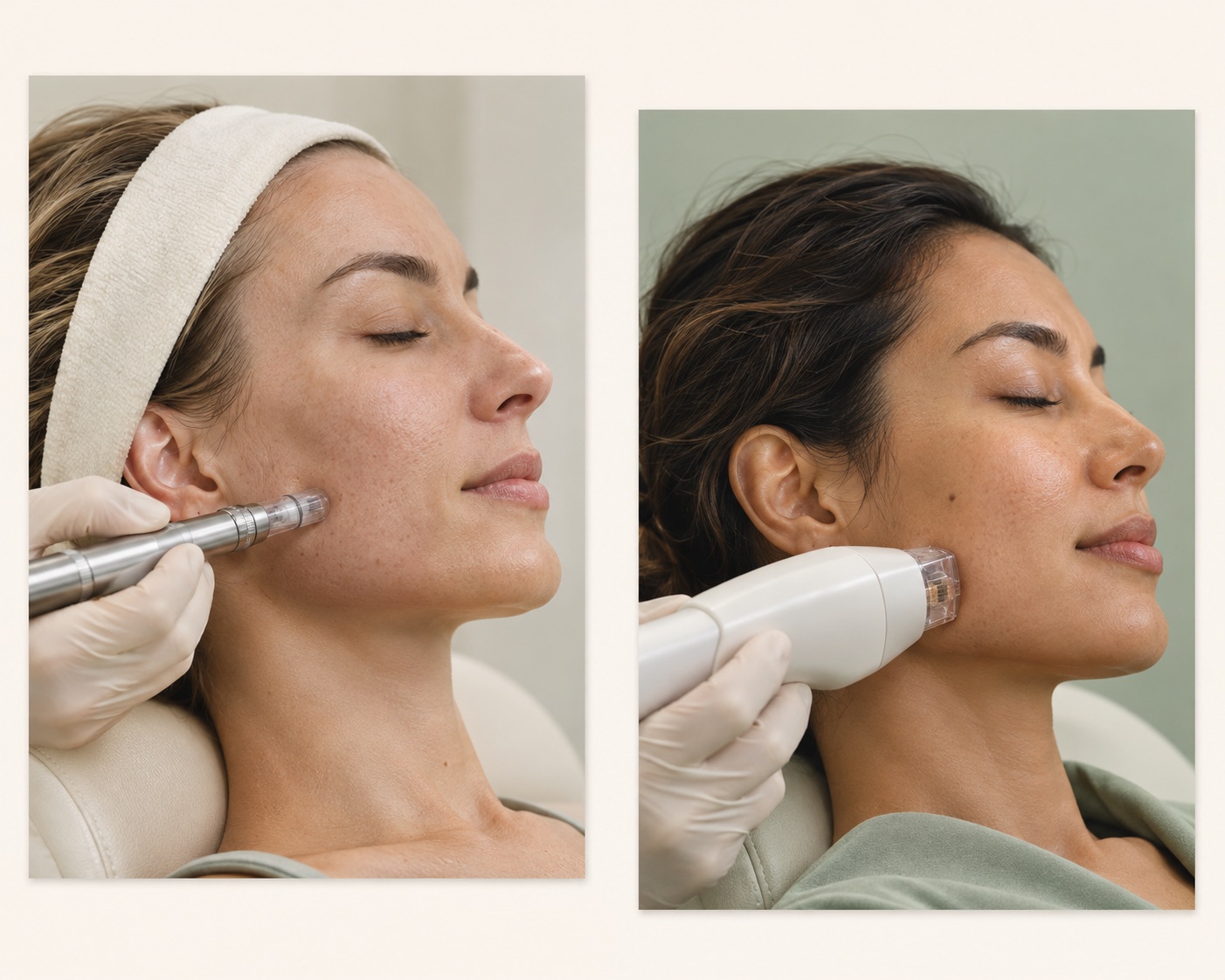
Microneedling makes controlled punctures in the skin. RF microneedling adds radiofrequency energy through an electrode system, creating heat as well as the needle injury. Both can be used in treatment plans for certain scars and signs of aging, but adding heat also changes the risks, recovery and price.
The useful question is whether RF offers a meaningful benefit for your particular concern. This guide compares the evidence, familiar devices, published U.S. prices and the questions that make a consultation worth having.
Editorial details
THE QUICK ANSWER
Regular microneedling uses needles; RF microneedling adds heat. Both can improve selected scars and skin texture, but RF is not automatically the better choice. The added benefit should match your concern closely enough to justify the extra cost and heat-related risks.
Published treatment examples involve three or four roughly monthly visits, with results assessed after healing. Plan for redness and sensitivity with either option. Standard microneedling reactions commonly settle within days to a week; RF recovery depends on the device and treatment plan. Compare recovery.
Our five-practice menu check found $350–$500 for standard face microneedling and $833–$1,250 for RF face treatment. These are selected published prices, not national averages. See current prices and package differences.
FDA has reported burns, scarring, fat loss, disfigurement and nerve damage with certain uses of RF microneedling. Understand the safety distinction before booking.
What is the difference between microneedling and RF microneedling?
With standard microneedling, a motorized pen moves a disposable needle cartridge across the treatment area. The controlled injury initiates a repair response. With RF microneedling, needles or needle electrodes also deliver radiofrequency energy into tissue. The energy pattern depends on the device, tip and settings.
Think of RF as a different treatment exposure, not a stronger setting on the same service. Needle depth, energy, pulse duration and the tissue being treated all matter. A device’s maximum depth is not a recommendation for where your face should be treated. FDA explains the distinction.
| Decision | Standard microneedling | RF microneedling |
|---|---|---|
| What it adds | Controlled mechanical injury | Mechanical injury plus a thermal effect |
| Reasons to discuss it | Certain acne scars, texture and fine lines | Selected scars, texture, wrinkles or laxity, depending on the device and treatment plan |
| Important limitation | Does not replace lost facial volume or remove excess skin | Does not provide a surgical lift; more heat does not automatically improve the outcome |
| Common early recovery | Redness, tenderness, tightness and possible flaking | Redness and swelling; tenderness, pinpoint marks or crusting may also occur |
| Additional decision | Why this depth and session plan? | Why add energy, and how will the provider protect the tissues being treated? |
A roller used at home, a cosmetic needling treatment and a professional medical procedure are not interchangeable. See the separate microneedling guide and RF microneedling guide for a fuller explanation of each.
Which option fits acne scars, wrinkles or loose skin?
For texture and selected acne scars, compare both approaches. For mild laxity, ask what the added RF energy is expected to change. Neither replaces lost facial volume or removes excess skin. The best starting point is the concern and your tolerance for cost, discomfort and recovery.
Acne scars: identify the scar before choosing the machine
Shallow rolling scars, sharply edged boxcar scars and narrow ice-pick scars create different problems. Some scars are tethered beneath the skin. A consultation should explain whether needling alone can address what is present or whether another method belongs in the plan.
Both forms of microneedling have been studied for atrophic acne scars. However, a comparison photograph is less useful if the patient also had subcision, a peel or another treatment that the advertisement leaves out. Ask which interventions produced the result and whether the pictured scars resemble yours. The systematic review of randomized trials includes different devices and combinations, making a single universal improvement percentage inappropriate.
If breakouts are active, the first decision may be controlling acne rather than scheduling a scar procedure. Our skin texture guide helps separate scars, pores and surface roughness before a consultation.
Fine lines and texture: compare the added benefit
For someone primarily bothered by mild surface texture, the added cost and exposure of RF deserve an explanation. A plan should identify what RF is expected to improve beyond standard needling, how that improvement will be assessed and what happens if the first sessions produce little change.
Neither procedure stops expression-muscle movement as Botox does, and neither supplies volume as filler does. Deep folds caused by several factors may need a different discussion. Start with fine lines and wrinkles if you are still sorting out the cause.
Skin laxity: keep the expected change realistic
RF is often marketed for tightening. A modest change in skin firmness is a different goal from removing hanging skin or rebuilding facial volume. Ask the provider to show comparable patients photographed at the same angle and lighting, with the follow-up interval stated.
If your main concern is a hollow or thin area, explicitly discuss volume preservation. FDA’s RF safety communication includes reports of fat loss. That does not establish the likelihood for your particular procedure, but it makes tissue selection and technique part of the decision rather than a detail to skip.
What the research can and cannot tell you
The evidence is encouraging for selected uses, but it is uneven. “Clinically studied” does not mean every device, body area and treatment setting has been compared with alternatives.
Read the studies and their limits
| Evidence | What was studied | What it adds to the decision |
|---|---|---|
| Systematic review of randomized microneedling trials, 2021 | Acne-scar treatments using different needling approaches and comparators | Supports considering needling for appropriate scars; variation between studies limits a single expected percentage of improvement. |
| Systematic review of RF microneedling for acne scars, 2025 | 16 studies involving 481 patients, including six randomized trials | Reports improvement across the included studies; device differences and limited follow-up make precise comparisons difficult. |
| Direct split-face trial, 2025 | 30 women aged 60 or older received four treatments for wrinkles around the eyes | Some outcomes favored RF, but this was a specific older population and protocol, not proof that RF is better for all scars or younger faces. |
Sources: randomized-trial review, RF acne-scar review and direct comparison trial.
The direct comparison used Sylfirm X, a system with non-insulated needles, described in technical material on the manufacturer’s website. It also received manufacturer support from Viol. Those details matter: its results should not be silently extended to every insulated tip or competing platform. Small studies also cannot reliably establish the frequency of rare serious complications.
An individual clinic’s before-and-after gallery answers another question: what that team has achieved in selected patients. It is useful alongside the research, particularly when the clinic discloses the entire treatment plan, but it is not a controlled comparison.
SkinPen, Dermapen, Morpheus8, Secret RF, Genius and Potenza
Brand names help identify equipment, but they do not specify your procedure on their own.
SkinPen and Dermapen
Motorized microneedling platforms without RF in the standard needling treatment
Exact model, intended use, sterile single-use cartridge and the reason for the proposed treatment plan.
Morpheus8
RF microneedling platform family
Exact handpiece and tip, treatment area and the tissue the provider intends to affect.
Secret RF
RF microneedling
Which tip is being used. Cutera lists 25-pin and 64-pin tips.
Genius
RF microneedling
How the provider uses the system’s feedback and chooses the treatment parameters for your concern.
Potenza
RF microneedling
Which tip and energy mode are proposed, rather than treating every Potenza appointment as identical.
Insulated and non-insulated needles distribute energy differently. Insulation is one engineering choice, not a guarantee that a treatment cannot burn, scar or injure tissue. A consumer does not need to select settings; the provider should be able to explain the rationale in ordinary language.
FDA clearance applies to a particular device and its stated indications, not to every service a clinic puts under the brand name. Regulatory and manufacturer references for equipment identification: SkinPen, Dermapen, Secret RF, Genius and Potenza. Our Morpheus8 guide discusses that family separately.
How many sessions, and how far apart?
Published treatment plans often involve several visits. Two specific examples make the commitment easier to understand without assuming that every scar or device needs the same schedule.
SkinPen Precision acne-scar study (FDA summary)
Three treatments, on days 1, 30 and 60
A roughly monthly series for the studied acne-scar treatment, with follow-up at one and six months after treatment. It does not establish the right plan for every skin concern or all SkinPen models.
2025 split-face trial of standard and RF microneedling
Four sessions at four-week intervals; assessment eight weeks after the final session
A direct comparison for wrinkles around the eyes in 30 women aged 60 or older. It is not a general RF schedule for every age, body area or device.
Sources: FDA SkinPen decision summary and the 2025 trial. These examples do not establish that RF requires fewer visits. Ask how the proposed number was chosen, when progress will be reviewed and how the plan changes if recovery takes longer or results are limited.
Do not judge the final result from immediate swelling. Remodeling takes time, and the planned review may occur well after the last appointment. Keep the treatment schedule, recovery time and review date separate when planning around an event.
Recovery and downtime: when can you wear makeup or exercise?
Plan for visible recovery with either procedure. The size of the needles or the word “fractional” does not make the skin ready for normal products immediately.
AAD advises waiting at least 24 hours before makeup. Many aftercare instructions ask you to avoid heavy sweating, hot yoga and saunas for a few days; ask how long for your device, since RF protocols can differ.
Returning to work is different from looking fully recovered. AAD describes redness, swelling or a sunburn-like feeling lasting a few days to a week after microneedling. RF can also leave swelling, pinpoint marks or crusting; there is no single downtime number that applies to every RF device and treatment intensity. AAD recovery guidance.
Makeup, washing, exercise and skincare: the practical checklist
| Activity | Practical planning approach |
|---|---|
| Makeup | AAD advises waiting at least 24 hours after microneedling. Your device instructions, treatment intensity and healing may require longer. |
| Washing and moisturizer | Follow the written product and timing instructions. Avoid assuming your usual exfoliating cleanser is suitable immediately afterward. |
| Exercise, hot yoga and saunas | Many aftercare instructions ask you to avoid heavy sweating, hot yoga and saunas for a few days; ask how long for your device, since RF protocols can differ. |
| Sunscreen and sun exposure | Arrange shade and physical coverage immediately. Ask which sunscreen to use and when it can first be applied to treated skin. |
| Retinoids, acids and scrubs | Resume according to healing and your treating provider’s plan, rather than using stinging as a test. |
| A wedding, photos or travel | Leave a buffer for redness, swelling and possible bruising. A first treatment immediately before an important event is a poor way to learn your recovery pattern. |
The AAD patient guide describes recovery that can last days to a week. These are planning references, not a substitute for the instructions for the procedure you actually receive.
For a day-by-day explanation, including itching, flaking and restarting products, use our microneedling recovery guide.
Risks, darker skin and the FDA warning
Standard microneedling can cause bleeding, bruising, irritation, infection, pigment changes and other complications. RF adds a thermal exposure. In October 2025, FDA warned about reports of burns, scarring, fat loss, disfigurement and nerve damage associated with certain uses of RF microneedling. Some reported injuries required medical or surgical treatment. FDA’s evaluation is ongoing. Read the safety communication.
That warning is not a numerical risk estimate and does not establish that every RF procedure produces these outcomes. It does mean that “minimal downtime” is an incomplete safety explanation.
For darker skin, ask about the provider’s experience treating your skin tone and managing post-inflammatory hyperpigmentation. Both procedures may be considered in appropriate patients, but “suitable for all skin types” does not mean every setting, provider or patient is equivalent.
Before treatment, disclose medications, bleeding issues, impaired healing, prior unusual scars, infections and any implanted device. A pacemaker or other implanted electronic device is especially important in an RF consultation. Pregnancy, active skin disease and recent procedures also belong in the assessment. Your provider should check the actual device’s contraindications.
After treatment: contact the treating practice promptly for worsening pain, blistering, spreading redness, drainage, persistent numbness or an unexpected contour change. Seek urgent medical care for severe symptoms or signs of a significant infection. Do not wait for a scheduled cosmetic review when something is deteriorating.
Add-ons deserve their own scrutiny. FDA has not cleared microneedling devices for delivering cosmetics, drugs or blood products such as PRP into the skin. A package that includes PRP, “exosomes” or another product is a separate evidence and safety question, not an automatic upgrade. FDA’s consumer guidance.
Microneedling vs. RF microneedling costs
Published face-treatment examples checked November 2, 2026 range from $350–$500 for standard microneedling and $833–$1,250 for RF. This five-practice convenience sample is not a national average. Compare the same area and inclusions before treating a lower quote as a saving.
What RF adds to the price at the same practice
■ Standard microneedling ■ RF microneedling
See all five practice menus and what each price includes
| Practice and market | Standard microneedling | RF microneedling | Comparison note |
|---|---|---|---|
| Glow Lounge, Miami, FL | SkinPen face: $350 | Not included in this source observation | Standalone face treatment; package of four: $1,200. The $200 facial add-on is excluded from this comparison. |
| Femme Aesthetics, South Miami, FL | Not included in this source observation | RF face: $1,000 | An RF price only; do not interpret the two Miami rows as a matched comparison. |
| Elite Aesthetics, New York, NY | SkinPen face: $500 | RF face: $1,250 | Face and neck is a different, higher-priced RF service. |
| Rev Med Spas, Quartz Hill, Los Angeles County, CA | SkinPen face: $425 | Morpheus8 face: $833 | Face packages of three: SkinPen $1,125; Morpheus8 $2,249. Confirm numbing and follow-up inclusions. |
| Belle Med, Bellingham, WA | SkinPen full face: $350 | RF full face: $1,000 | Listed three-session packages are $900 and $2,800 respectively. |
These prices should not be turned into a claim that RF is two or three times more effective. Price includes equipment economics, staffing, market positioning and the clinic’s protocol, not just clinical benefit.
Packages change the comparison. At Rev, three listed face sessions cost $1,125 for SkinPen versus $2,249 for Morpheus8: a $1,124 difference. At Belle Med, the listed three-session prices are $900 versus $2,800: a $1,900 difference. These are purchase options, not recommendations to have three treatments.
Compare the full plan, not one appointment
Suppose a written proposal recommends three standard sessions at $400 each and another recommends three RF sessions at $900 each. That is $1,200 versus $2,700, before any separate fees. The additional $1,500 needs a clinical explanation tied to your goal. These figures and session counts are fictional comparison inputs, not treatment recommendations.
Ask whether the quote includes numbing, neck treatment, follow-up visits and management of an unexpected reaction. Separate optional add-ons from the base service. If you buy a package, understand expiration, refunds and what happens if the provider advises stopping after the first visit.
Our microneedling cost guide covers more price sources, package examples and quote details.
Have two written proposals? Compare the full treatment budget, including visits, separate fees and time away.
A useful consultation should answer these six questions
- What exactly are we treating: scars, texture, fine lines, laxity or a combination?
- Why is this procedure a better fit than the other needling option or an alternative?
- What device and tip will you use, and what experience do you have with similar patients?
- What visible change is realistic, and when will we decide whether it is working?
- What recovery instructions and urgent contact arrangements will I receive?
- What is the full proposed cost, and what happens if the plan changes?
If the explanation is mainly “this is our newest machine,” there is more to establish. Our provider-selection guide explains how to check credentials and assess the consultation itself.
Frequently asked questions
Is RF microneedling always better than regular microneedling?
No. RF may offer an additional benefit for some concerns, but it adds cost and a different risk profile. The evidence does not support treating it as the default upgrade for every person seeking smoother skin.
Is SkinPen the same as Morpheus8?
No. Standard SkinPen treatment is microneedling without RF. Morpheus8 is an RF platform family. The relevant comparison is the proposed procedure, including area, device and technique, rather than the brand name alone.
Which hurts more?
Comfort varies with the area, settings, numbing and the individual. RF adds a heat sensation, but a generic ranking cannot predict your experience. Ask how the clinic manages discomfort and what would make it stop or adjust a treatment.
How many treatments will I need?
Examples include three roughly monthly SkinPen acne-scar treatments and four monthly visits in the 2025 standard-versus-RF wrinkle trial. The session examples identify the populations and sources. Your concern, device, healing and response determine the proposed plan; a package of three is not proof that three will be enough.
Can RF microneedling cause fat loss?
Fat loss is among the complications in FDA’s safety communication. The report does not provide your individual probability. Discuss the tissue the provider intends to treat, especially if preserving facial fullness matters to you.
Can I combine either treatment with Botox or filler?
Sometimes a provider may recommend more than one type of treatment, but timing and suitability need a coordinated plan. Tell each provider about recent injections and procedures. A bundled appointment is not proof that every combination or sequence is appropriate.
When should I compare my before-and-after photos?
Ask the provider to set a review interval that allows healing and the intended remodeling response. Immediate swelling can temporarily change texture and contours. Use consistent lighting, angle and facial expression rather than comparing a swollen first-day photo with an older selfie.
Sources and editorial notes
Prepared for U.S. consumers. Price menus, FDA safety guidance, AAD recovery guidance and the direct-comparison abstract rechecked November 2, 2026. Other cited study and manufacturer details retain the September 29 source review. Clinical review is pending. This comparison is educational and does not select a procedure or settings for an individual.
The evidence and session examples distinguish systematic reviews, device labeling and a small direct comparison. Manufacturer documents identify devices and instructions; they are not independent proof of superiority. The cover is an editorial illustration, not a patient result. The fictional quote comparison is a budgeting example.
See our editorial approach and commercial disclosures. Report a correction through Contact.
View all 8 sources
- FDA: microneedling devices. Explains how medical microneedling devices work, their regulatory status and limits on using them to deliver other products.
- FDA: potential risks with certain uses of RF microneedling. The October 2025 safety communication describes reported burns, scarring, fat loss, disfigurement and nerve damage associated with certain RF uses. It does not establish an individual risk percentage.
- FDA: consumer benefits, risks and safety. Consumer guidance on potential benefits, complications and questions to discuss before treatment.
- AAD: microneedling for scars, wrinkles and other concerns. Patient guidance on suitability, expected skin reactions and waiting at least 24 hours before applying makeup.
- 2021 systematic review of randomized acne-scar trials. Reviews randomized acne-scar trials involving different needling approaches and comparators. Variation between studies limits a single expected improvement estimate.
- 2025 systematic review of RF microneedling for acne scars. Reviews 16 RF acne-scar studies involving 481 patients. Device differences and limited follow-up restrict direct comparisons.
- 2025 randomized split-face comparison in older women. A split-face study in 30 women aged 60 or older compares four monthly standard and RF treatments for wrinkles around the eyes. Its findings do not establish that RF is better for every patient or concern.
- FDA SkinPen decision summary. FDA’s De Novo decision summary documents the SkinPen Precision acne-scar study: treatments on days 1, 30 and 60, with follow-up one and six months after treatment.
- Price sources are linked individually in the cost table. Published menus are a convenience sample, may change and may omit fees. Confirm a written proposal with the practice.