Botox vs. Fillers: Which Treats Which Concern?
Botox reduces selected muscle activity; dermal fillers add volume or support. That difference is why Botox is commonly discussed for expression lines, while filler may be considered for lip fullness, a cheek hollow or a particular facial fold. Neither is a complete treatment for skin texture, sun damage or significant sagging.
The useful choice starts with the concern, not which injection seems cheaper or lasts longer. Here is how to understand the overlap, the limits and the questions that make a consultation more productive.
Editorial details
The quick answer
Lines that deepen when you frown, smile or raise your brows
A neuromodulator such as Botox may reduce the muscle activity contributing to them.
A hollow, lost fullness or a contour you want to change
A suitable filler may add volume, if that is what the tissues need.
Crepey texture, discoloration or significant loose skin
Skincare, another procedure or no treatment may be a better fit.
A mix of movement and volume changes
A clinician may discuss both, with a clear purpose for each and no requirement to do everything at once.
Botox and filler work on different parts of the problem
Botox Cosmetic is a brand of onabotulinumtoxinA, a prescription botulinum toxin medicine. People often use “Botox” loosely for the whole category, which also includes brands such as Dysport, Xeomin, Jeuveau, Daxxify and Letybo. Their products and units are not interchangeable.
A clinician uses a neuromodulator to reduce selected muscle contractions. The overlying skin then folds less strongly. It does not physically fill a hollow. The Botox Cosmetic label identifies the medicine, its specific indications and its precautions.
Dermal filler is a material placed in tissue. Hyaluronic acid gels are a common choice for selected volume and contour concerns; other filler materials work differently. The injected product remains after the appointment, so its identity, intended area and removability matter. See filler types and brands for the full comparison.
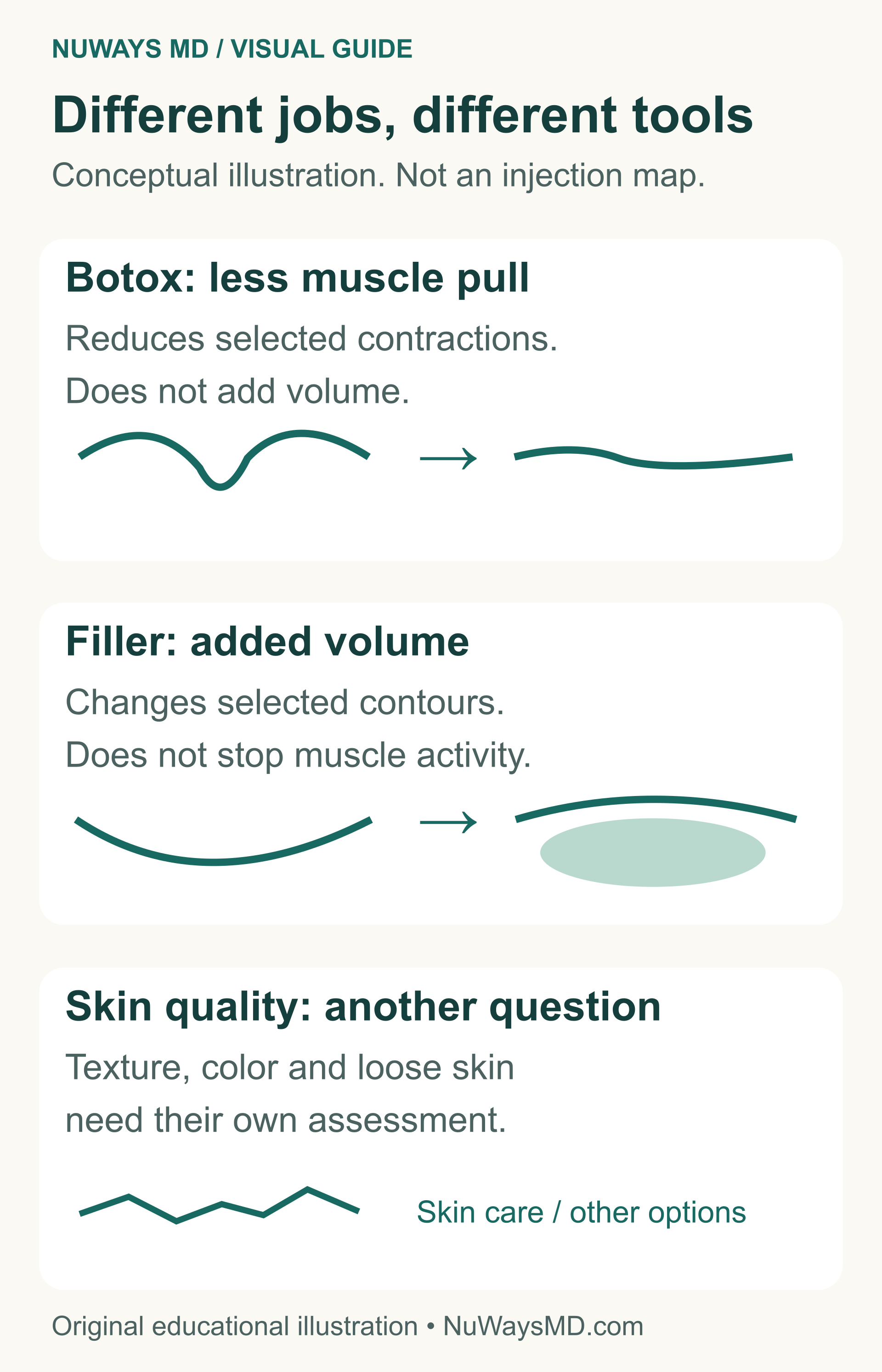
“Dynamic” and “static” lines are useful clues, not a diagnosis
A dynamic line appears or deepens with expression. A static line is visible when your face is resting. An expression line can eventually remain at rest because the skin has changed too. That does not automatically mean it needs filler.
Reducing muscle movement may soften the repeated folding while leaving part of an etched line. Filling a line does not remove the muscle force that creates it. Skin texture, bone structure, fat, loose skin and lighting can all affect what you see. A good assessment looks at your face relaxed and moving.
Botox vs. fillers at a glance
| Question | Botox and similar neuromodulators | Dermal fillers |
|---|---|---|
| Main action | Reduce selected muscle activity | Add volume or support; some materials also stimulate collagen |
| Familiar examples | Botox Cosmetic, Dysport, Xeomin, Jeuveau, Daxxify, Letybo | Juvéderm, Restylane, RHA, Belotero, Revanesse; non-HA products include Radiesse and Sculptra |
| Common discussion | Frown lines, forehead lines and crow’s feet | Selected lip, cheek, chin, fold or hollow concerns |
| When change appears | Often begins within 3–7 days; a review around two weeks helps assess the response | HA changes volume immediately, with early swelling; collagen-stimulating products develop gradually |
| Duration | Often around 3–4 months for conventional cosmetic botulinum toxin treatment; product-specific results vary | Varies substantially by material, product, area and outcome measured |
| Pricing unit | Often biological units or a treatment-area fee | Often syringe, vial or a complete treatment-plan fee |
| If you dislike the result | No routine immediate reversal; effects generally need time to wear off | HA may be reduced with hyaluronidase; other fillers are less readily adjustable |
| Distinctive concern | Unwanted weakness, such as brow or eyelid droop | Blood-vessel blockage, tissue injury, persistent lumps or swelling |
The AAD’s botulinum toxin FAQs describe usual timing and effects. Filler duration cannot be reduced to one competing number: a lip gel, a cheek product and a collagen stimulator are different treatments.
Which treatment matches each concern?
Forehead lines, the “11s” and crow’s feet
When muscle activity is the main driver, a neuromodulator is commonly the relevant starting point. The clinician should assess brow position, eyelid anatomy and how you use your forehead. Weakening a muscle that helps you keep your brows up can feel different from simply softening a crease.
Filler is not a routine substitute for Botox in these areas. Forehead and between-the-brow filler carry particular vascular concerns. A line that remains at rest should prompt reassessment of the whole problem rather than a reflex decision to fill it.
Our Botox beginner guide explains the appointment and result timeline. If you already had treatment and feel heaviness, read forehead Botox side effects.
Lips: more volume or more visible upper lip?
Filler adds material to change fullness or contour. A lip flip uses botulinum toxin to change muscle activity, potentially allowing more upper lip to show. It does not create the same added volume.
A lip flip is off-label for Botox Cosmetic. It can affect lip function, including drinking or certain speech movements, until the effect wears off. Cleveland Clinic’s lip-flip explanation describes these differences. Compare lip flip versus lip filler by the change you want, functional risks and repeat-treatment costs. Our lip filler guide covers swelling, recovery and first-appointment questions.
Smile folds and lines beside the mouth
A fold extending from the nose toward the mouth is not the same problem as a forehead expression line. Filler may soften selected folds, but the surrounding tissues and movement matter. Completely erasing a normal fold can require an amount of volume that changes the face in an unwanted way.
Small muscle-targeted treatments may be considered for certain lower-face concerns, often off-label, but can also affect smiling, eating or speaking. Ask the clinician to name the cause they are treating and the functional trade-off. “It is a wrinkle” is not a complete explanation for either injection.
Cheek hollows, chin projection and jawline contour
A filler may change selected contours or restore volume. Botox does not add cheek projection. Conversely, if a wide lower face is related to a large chewing muscle, adding filler is a different intervention from reducing muscle activity. Neuromodulator treatment of the masseter for cosmetic slimming is an off-label use of Botox Cosmetic.
Loose skin, fat and skeletal anatomy can also affect the jawline. Adding volume cannot substitute for every form of tightening or surgery. The Voluma XC label illustrates how filler indications and limitations are tied to specific areas and patient selection.
Under-eye shadows, bags and crow’s feet
These are often grouped together as “tired eyes,” but they can have different causes. Crow’s feet with smiling involve muscle activity. A hollow may involve volume. Dark pigment, visible vessels, bags or fluid-related puffiness need a different assessment.
Some HA products have an under-eye-hollow indication, such as Volbella XC. That approval does not mean filler treats all dark circles, and adding volume can be a poor fit for a swelling-prone area. Ask what is creating the shadow before choosing a treatment.
Three examples of a useful consultation
These are fictional situations, not treatment recommendations.
“My forehead looks lined when I raise my eyebrows.”
The clinician watches movement and checks whether forehead activity is helping support the brows. A neuromodulator may address part of the concern. The useful discussion includes retained movement, possible heaviness and what a resting crease may still look like.
“My cheeks look flatter, but my skin also feels loose.”
Filler may address selected volume loss, while loose skin may remain. A clear plan explains both components and avoids promising a surgical lift from added volume. The patient can decide whether the likely improvement is enough.
“I want smoother skin and smaller-looking pores.”
Neither injection automatically solves that goal. The consultation turns toward skincare, resurfacing or another suitable option, with recovery and skin tone considered. More injectables are not the default next step.
When neither Botox nor filler is the best first step
Dryness can make fine lines more obvious. Sun damage can create roughness, uneven color and etched lines. Significant skin laxity may exceed what an injectable can reasonably improve. An unexplained new skin change needs a diagnosis before a cosmetic solution.
A simple foundation includes broad-spectrum SPF 30 or higher and suitable moisturizer. A retinoid may help selected fine lines and texture, but irritation and pregnancy considerations matter. The AAD’s wrinkle guidance and retinoid explanation support that distinction. If you are comparing skincare options, use our retinol and retinoid buying guide to compare ingredients, formulas and costs before buying.
For deeper options, read fine lines and wrinkles, microneedling or laser resurfacing. These have their own risks and limits. Choosing no procedure is also a valid outcome when the expected change does not justify the cost or recovery for you.
Results: what research can and cannot compare
Botox and fillers are usually studied for different treatment goals, so there is no meaningful all-purpose winner. An improvement in frown-line severity is a different outcome from increased lip fullness.
A 2021 Cochrane review included 65 trials and 14,919 participants, mostly women. Much of the evidence concerned frown lines; it supported botulinum toxin’s short-term benefit compared with placebo, with limitations for broader comparisons and repeated long-term treatment. This is stronger evidence for a defined indication than for claims that every facial concern benefits from toxin.
Filler studies likewise use product-specific scales, follow-up times and sometimes touch-up treatments. An “up to” duration or satisfaction percentage cannot establish that a filler is better than Botox, or that one brand will produce your preferred appearance. For the fuller evidence discussion, use the dermal filler guide and Botox vs. Dysport comparison.
Recovery and risk: the differences that matter
Both treatments involve injections and may cause bruising, tenderness or swelling. HA filler can create more noticeable early volume changes, particularly in the lips, while Botox’s intended muscle effect develops later. Plan around the actual treatment rather than assuming every injectable is a no-downtime service.
With Botox, unwanted local weakness can produce brow or eyelid droop, asymmetry or changes in expression. The prescribing information also carries a warning about spread of toxin effects. Seek immediate medical help for difficulty breathing, swallowing or speaking after treatment.
With filler, unwanted injection into a blood vessel can threaten skin or vision. Unusual pain, pale or dusky skin, or vision symptoms require immediate attention. Call 911 for vision loss or stroke symptoms. Infection and persistent or delayed lumps and swelling also need clinical assessment. The FDA’s filler safety information explains the risks.
Tell the clinician about neurological or muscle conditions, swallowing problems, allergies, prior injectables, medications, active infection, pregnancy or breastfeeding. Eligibility differs by product. Do not stop prescribed medication to prepare for treatment without the prescriber’s advice.
Can either treatment be reversed?
There is no routine immediate antidote for an unwanted cosmetic Botox effect. A clinician may manage particular symptoms, but muscle effects generally need time to wear off.
HA filler can often be reduced with hyaluronidase, but the process has risks and may not restore the exact previous appearance. It does not work the same way on other filler materials and cannot guarantee reversal of a serious injury. “Dissolvable” should never be treated as permission to take greater risks.
Can you get Botox and filler at the same appointment?
A clinician may combine them when there is a separate reason for each. That does not make a combined package necessary or appropriate for every first-time patient. Ask what each component adds, how its response will be assessed and whether doing the treatments in stages would make the decision clearer.
Staging can help someone understand which change they like or dislike. A single visit may be convenient for a suitable plan. Timing should follow clinical judgment and the products involved, not a discount countdown. Coordinate any planned laser, peel or other procedure too.
Botox vs. filler costs: compare the plan, not the unit
A Botox unit measures biological activity. A filler syringe contains a volume of material. There is no conversion between them.
Fictional budget example: a clinician’s Botox quote totals $420 for the proposed visit. A separate filler quote totals $800 for a named product and plan. If the person later has three comparable Botox visits, that would total $1,260; one $800 filler appointment remains $800, or $1,600 if a second is later chosen. These are arithmetic scenarios, not recommended schedules or proof that either treatment is better value.
The treatments address different concerns and may not be alternatives for that person. Our Botox cost guide explains units and minimum charges. The dermal filler cost guide includes dated menus from South Florida, Manhattan, the Los Angeles area and smaller East and West markets. Use the treatment budget with your clinician’s actual proposed visit totals.
Questions to bring to the consultation
- Is my concern mainly movement, volume, skin quality or loose skin?
- What change should I expect, and what will this treatment leave unchanged?
- Which exact product are you proposing? Is this an approved use?
- Could we start with one priority and assess before adding another treatment?
- What are the risks specific to this area and my medical history?
- How do you handle dissatisfaction, follow-up and an urgent complication?
- What is the full initial price, and what future spending is optional rather than necessary?
Use choosing an injector or med spa to check qualifications and compare the consultation experience. A useful plan should make your decision clearer, including when the answer is to wait.
Frequently asked questions
Is Botox a filler?
No. Botox Cosmetic is a botulinum toxin medicine that affects muscle activity. Dermal fillers are injected materials used for selected volume and contour changes. Some menus group them under “injectables,” which can obscure the distinction.
Which one makes people look frozen?
Excessive or unwanted muscle weakening can limit expression after a neuromodulator. Filler does not act through that mechanism, but too much or poorly suited filler can create an unwanted shape or fullness. Product selection, anatomy, amount and technique all matter.
If a wrinkle is visible at rest, do I need filler?
Not automatically. Skin changes, repeated movement and anatomy may all contribute. Reducing muscle activity may help part of the line, while skincare or resurfacing may better address the remaining component. Some areas are poor candidates for filler.
Which is better for someone in their 20s, 40s or 60s?
Age alone does not select an injectable. The concern, anatomy, health, approved product use and realistic benefit matter more. There is no age at which everyone needs preventive Botox or a set number of filler syringes.
Will stopping either treatment make me age faster?
Stopping does not itself establish accelerated aging. Muscle activity returns as toxin effects wear off; filler-related volume changes evolve according to the material and treatment history. Aging continues throughout, and adjusting to less augmentation may change how you perceive the result.
Sources and editorial notes
Sources checked September 28, 2026. Prepared by NuWays MD Editorial; edited by Darryl H. Clinical review is pending. The mechanism graphic and consultation examples are original educational illustrations. The budget example is fictional and does not prescribe doses or treatment intervals.
- Botox Cosmetic prescribing information: mechanism, approved uses, noninterchangeable units, contraindications and warnings. Off-label examples are identified in the text.
- AAD: botulinum toxin FAQs: typical onset, duration and consultation context.
- Camargo and colleagues, Cochrane review, 2021: 65 trials of botulinum toxin for facial wrinkles. The evidence is concentrated in particular indications and does not establish a universal comparison with fillers.
- FDA: dermal fillers: material-related risks and urgent symptoms.
- Voluma XC labeling and Volbella under-eye patient information: examples of area-specific approvals and patient-selection limitations.
- Cleveland Clinic: lip flip: movement versus added volume and possible functional effects. We use current product labeling for formal indications.
- AAD: wrinkle remedies and retinoids: skincare options and limitations.
- ASDS adverse-event recommendations: clinical assessment and limitations of HA-filler reversal. Treatment recommendations include expert consensus where comparative evidence is limited.
Get new Botox and filler guides by email
Compare treatment options, understand prices and prepare questions for your consultation. Choose your email topics on the next page.
Get Botox and filler updates →Free. Unsubscribe anytime. Your signup isn’t shared with clinics or vendors.