Laser Hair Removal on the Face: Upper Lip, Chin, Results, Risks and Costs
Laser hair removal can reduce coarse, dark facial hair and make shaving less frequent. It works best when the hair contains enough pigment for the laser to target. Fine peach fuzz, gray hair and hormonally driven regrowth need a different conversation before you buy a full-face package.
This guide explains what changes between the upper lip, chin and beard area, what a realistic treatment plan looks like, and how to compare published US prices without confusing a package with a promise of permanent results.
The quick answer
Best starting point
Noticeable, dark, coarse hairs are generally a better target than fine facial fuzz. Have the actual hairs assessed.
Sessions and results
Expect a series. AAD describes six or more visits in its overview and four-to-six-week spacing in its FAQ. Facial or hormonal hair may need maintenance. See the session guidance.
A face-specific risk
Laser or IPL can sometimes increase hair growth. Discuss this before treating fine hair or expanding into surrounding facial areas.
Published prices
In our five-practice sample, upper-lip visits were $40–$300 and full-face visits $95–$350 before packages. These are menu observations, not US averages. See sources and inclusions.
Does laser hair removal work on the face?
Yes, but the answer depends on the hair you want removed. The light is absorbed by pigment in the hair and converted to heat that damages the follicle. Hair color, thickness, skin pigment and growth stage affect how selectively that can happen. Shaving changes the hair above the skin; laser aims to reduce future growth from the follicle. Mayo Clinic: how laser hair removal works.
The practical goals are fewer visible hairs, slower regrowth and less time managing them. “Never shave again” is a much stronger promise. The American Academy of Dermatology specifically distinguishes a woman’s face from many body areas because hormones can drive further growth. An initial response and a later need for maintenance can both be real. AAD overview.
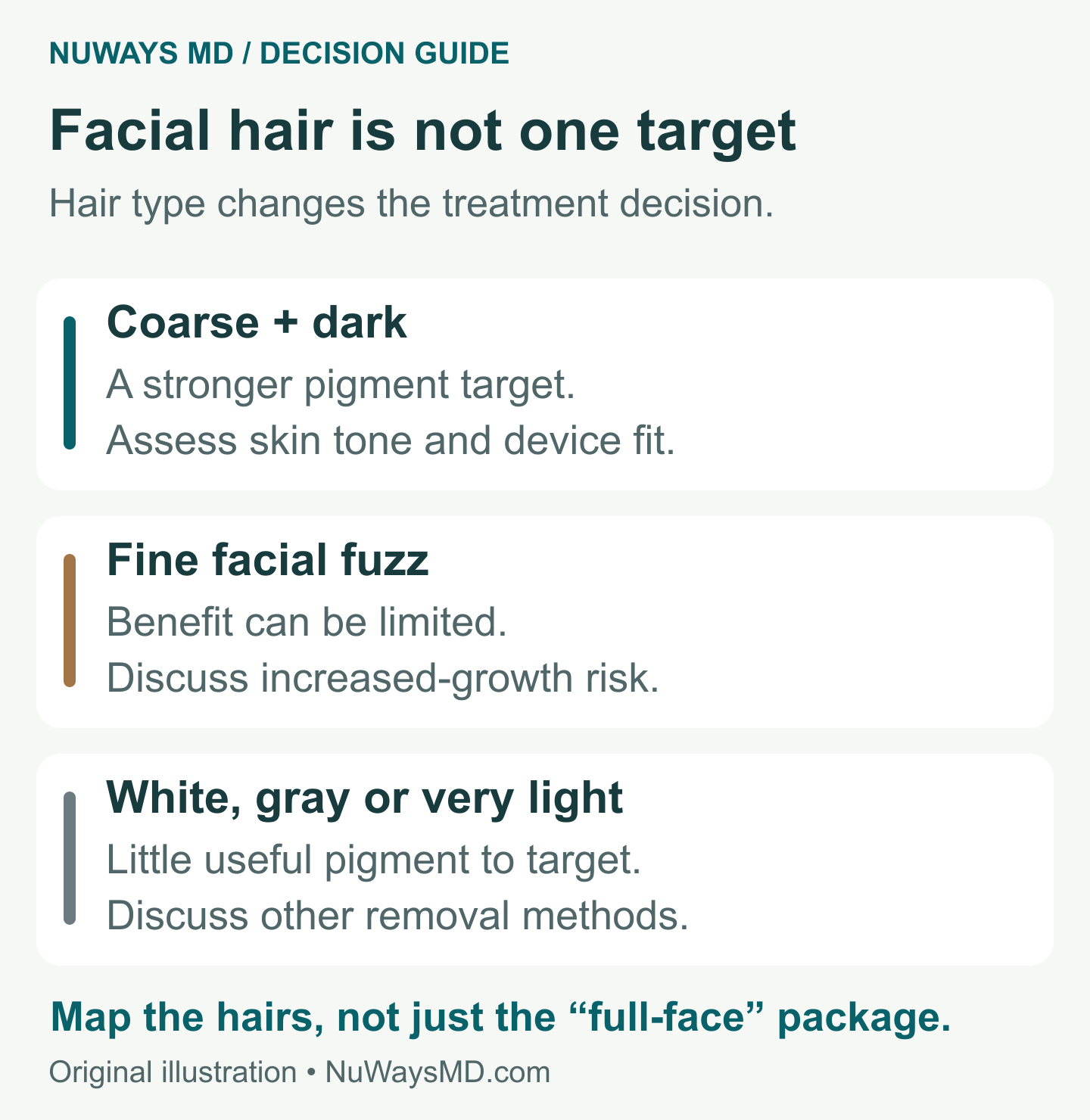
Two people asking for “chin laser” may therefore need quite different advice: one has dense, dark hair; another has three white hairs and a little fuzz. The same area name does not make them the same treatment candidate.
Upper lip, chin or full face: what should be included?
Ask the provider to identify the boundaries before treatment. A full-face price may exclude the neck, and a combined lip-and-chin price may differ from two separate small areas.
| Area or goal | What matters in the assessment | What to settle before treatment |
|---|---|---|
| Upper lip | Hair thickness and pigment, skin tone, recent tanning and proximity to sensitive facial structures | Which hairs are suitable targets and the eye-protection plan |
| Chin and jawline | Coarse hairs mixed with finer ones; ongoing or newly increasing growth | Whether a medical evaluation should accompany hair removal |
| Cheeks and sideburns | The difference between terminal hair, which is thicker and more visible, and fine vellus hair | Whether broad treatment offers enough benefit to justify the risk of increased growth |
| Full face | Several areas with different hair types grouped under one menu item | A treatment map that can leave unsuitable fine-hair areas untreated |
| Beard reduction or shaping | Dense growth, razor bumps, desired future beard shape and patchiness while responding | Exact boundaries and whether the goal is thinning, an edge cleanup or extensive reduction |
For beard shaping, think beyond this month’s preferred style. Draw and agree on the boundary rather than allowing the treatment to gradually creep into hair you might later want. The AAD recognizes laser as an option for men troubled by persistent razor irritation and ingrown hairs. AAD hair-removal options.
Eyebrows and eyelids are a separate safety issue. Mayo Clinic advises against laser hair removal in these areas because of the possibility of serious eye injury. Closing your eyes is not adequate laser eye protection. Do not treat a broad “full-face” offer as permission to include every facial surface.
What about peach fuzz, blonde, red or gray hair?
Fine facial fuzz is a reason to pause before booking laser. It provides a different target from dark, coarse hair, and the face and neck are the areas most associated with paradoxical hypertrichosis: increased growth after a light-based hair-removal treatment.
Hair with little useful pigment, including gray or white hair, is generally poorly suited to laser. Red and blonde hair can also respond poorly. A clinic should explain the expected response for your actual hair rather than relying on the claim that its machine treats every color. The Endocrine Society guideline identifies electrolysis as an alternative for white or blonde hair.
| Option | Useful distinction | Main commitment |
|---|---|---|
| Professional laser | Treats multiple pigmented hairs efficiently; suitability depends on hair and skin | A series, reassessment and possible later maintenance |
| IPL | Uses filtered broad-spectrum light rather than a laser beam | Similar need for careful selection; it also carries a risk of increased hair growth |
| Electrolysis | Treats individual follicles and does not depend on hair pigment | More time for larger or dense areas; an experienced practitioner matters |
| Shaving or trimming | Removes visible hair without targeting the follicle | Repeat upkeep; can remain a reasonable choice for fine hair |
A change in shaving frequency can be useful even if a treatment does not eliminate every hair. Conversely, repeatedly treating pale hair without visible progress deserves reassessment rather than automatic renewal of a package.
Can facial laser make hair growth worse?
It can. In a 2021 systematic review and meta-analysis of 9,733 patients, the pooled estimate of paradoxical hypertrichosis was about 3%. Cases were strongly associated with the face or neck. Results varied greatly between studies, so 3% is not an individual risk estimate or a precise rate for your clinic. The review did not have enough data to establish the relationship with sex or skin type reliably. Outside the face and neck, the reported rate was 0.08%, reinforcing the importance of treatment location; that lower figure should not be used to estimate facial risk. Read the review.
That finding supports a careful selection discussion, not a rule that everyone should avoid facial laser. Ask why the proposed hairs are good targets and whether neighboring fine hairs can be left alone. There is no brand name or simple online checklist that makes the risk zero.
If hair seems thicker or is spreading into an area that previously had little growth, bring dated photographs to the treating clinician. Try to compare the same lighting and time since shaving. The same review found gradual improvement with continued treatment in three of the four studies that reported this outcome. That is a count of studies, not a 75% patient success rate. Further treatment may help some patients, but the clinician should reassess the growth pattern and options before you extend the treated area or purchase more visits.
Facial hair, PCOS and hormones
Laser can address visible hair without addressing why new coarse hair is appearing. PCOS is one possible cause of hirsutism, a pattern of excess coarse hair in women, but facial hair alone does not diagnose it. The Endocrine Society’s patient guidance explains the role of hormones and medical evaluation.
Mention new or rapidly increasing growth, irregular periods, scalp hair thinning or other changes at a medical visit. A clinician may evaluate whether treatment of an underlying condition could help reduce future regrowth alongside hair removal. You should not have to buy a laser package to obtain that assessment.
For someone with persistent hormonal hair, the useful budget question is: “What does the initial plan cost, how will we judge the response, and what would later maintenance cost?” A prepaid six-session package cannot tell you whether your hormones will stimulate additional hair later.
Which lasers are used, including for darker skin?
Common hair-removal technologies include alexandrite, diode and long-pulsed Nd:YAG lasers. Systems such as Candela GentleMax Pro/Pro Plus, Cynosure Elite iQ and Lutronic Clarity II combine alexandrite and Nd:YAG capabilities; Alma Soprano platforms use diode technology. These are examples of equipment families, not a ranking or a guarantee of suitability. See our main laser hair-removal guide for the technology and brand comparison.
For darker skin, protecting pigment in the skin while targeting pigment in the hair is especially important. The Endocrine Society guideline favors a longer-wavelength, longer-pulse light source with appropriate cooling for women of color seeking photoepilation. The consultation should establish the operator’s experience with your skin tone and the exact technology being proposed, including whether it is a laser or IPL.
Bring up your usual skin tone, a recent tan, prior pigment changes and any previous laser reaction. A test spot may be part of the assessment, but a good test-spot response cannot promise that an entire series will be complication-free. Our provider-selection guide shows how to check credentials and ask treatment-specific questions.
How many sessions will you need, and how far apart?
Plan around a series, then reassessment. The AAD overview says unwanted hair can take six or more sessions to remove; its FAQ describes two to six treatments for many patients. Those statements cover different patients and treatment goals. They do not make two visits a dependable facial-hair budget or six visits a guaranteed finish line.
Facial packages may contain six, eight or more sessions. The number for you depends on the hairs being targeted, response, treatment interruptions and ongoing growth. A package is a purchase arrangement. The appropriate treatment plan still needs to be assessed.
The AAD FAQ gives four to six weeks as a common interval and says the dermatologist determines when another session is appropriate. Sessions are spaced because hairs cycle through growth stages; taking appointments closer together simply to finish a package can miss that purpose.
Early hairs do not all disappear immediately. Shedding often unfolds over the following two to three weeks. Keep the skin-care instructions and your next appointment date together, and use our guide to hair shedding after laser to distinguish the waiting period from questions about a poor response.
Preparation, comfort and recovery
Before treatment, disclose medicines, supplements, skin conditions, cold-sore history and prior reactions. Follow instructions about sun exposure and stop methods that pull out the hair, such as waxing or plucking, for the period your provider specifies. Shaving is often used instead because it leaves the follicle target in place. Arrive without products in the treatment area unless instructed otherwise. AAD preparation guide.
The sensation is often brief heat or a snapping feeling, with cooling used to improve comfort and protect the skin. Upper-lip treatment is quick, but the appointment also needs time for assessment and preparation. Tell the practitioner immediately if the sensation becomes concerning rather than trying to tolerate it to get a better result.
| Stage | A practical expectation | What to do |
|---|---|---|
| First hours | Redness and small bumps around follicles can occur | Use the instructed cooling and gentle skin care; avoid rubbing or picking |
| Following days | Mild irritation should settle rather than keep worsening | Protect the area from sun and follow the written plan for makeup, exercise and active skin-care ingredients |
| Following weeks | Treated hairs may shed while other hairs enter growth | Avoid pulling hairs out to test success; compare photographs and shaving frequency over time |
| Any time | Blisters, severe or increasing pain, spreading redness, drainage or a concerning color change need assessment | Contact the treating clinician promptly; seek urgent care for eye symptoms or significant injury |
These stages organize what to watch for, not a diagnosis from a calendar. Treatment intensity, skin response and the area can change recovery. Broad-spectrum sunscreen, shade and a hat are particularly relevant when your face is exposed during everyday travel. See our sunscreen buying guide for choosing a product you will use consistently.
What does facial laser hair removal cost in the US?
The following are selected public menu examples checked September 29, 2026, not city averages, national estimates or endorsements. They include South Florida, New York City, Los Angeles and smaller East and West Coast markets. “Full face” boundaries and included services can differ.
| Practice and market | Upper-lip single session | Full-face single session | Published full-face package |
|---|---|---|---|
| Miami Lakes Med Spa, Miami Lakes, FL | $50 | $95 | $495 for 6, or $82.50 per visit |
| The Dermatology and Laser Group, NYC | $300 | $350 | $1,680 for 6, or $280 per visit |
| Beauty Ranch, Brentwood, Los Angeles | $40 | $145 | Not reported in this comparison |
| Face Forward Skin Center, Lancaster, PA | $50 | $175 | Six initial visits advised at listed rate; later small/large-area prices described separately |
| Down Under Waxing, Bend, OR | $80 | $220 | $1,122 for 6, or $187 per visit, on its women’s menu |
The spread shows why one headline price is a weak substitute for a written quote. It does not establish that the lowest price is unsafe or that the highest delivers better results. Confirm clinician credentials, device, treatment boundaries, appointment scope and follow-up independently of price.
A fictional budget example: six visits at $100 would be $600. A six-visit package at $500 saves $100 if you use it. If two additional visits later cost $100 each, total spending becomes $700. That is arithmetic, not a prediction that you need eight treatments.
Ask about expiration, missed visits, unused-session refunds and whether maintenance pricing survives a change of ownership or location. Keep financing charges separate from treatment prices. The laser hair-removal cost guide explains how to compare the larger budget.
Take the area, device and quote to your consultation
Use the existing worksheet to organize the treatment boundaries, proposed sessions, cost and questions before you buy a package.
Open the hair-removal worksheet →Frequently asked questions
How many sessions does facial laser hair removal take?
A series of six or more visits is a reasonable planning discussion, but there is no guaranteed finishing number. AAD describes two to six treatments for many patients in its general FAQ, while its overview says six or more. Facial hair influenced by hormones can need additional treatment and maintenance. Four to six weeks is a common interval; your provider should set the schedule based on the area and response.
Is facial laser permanent?
Think in terms of durable reduction with possible regrowth. Hormonal influences make permanence especially difficult to promise on a woman’s face. Ask how the practice defines success and prices later visits.
Can I shave my face between sessions?
Shaving or trimming is generally compatible with a laser plan once the skin has settled and your instructions allow it. Waxing, threading or plucking removes the target hair from the follicle and can interfere with the plan. Get the timing in writing.
Is laser better than electrolysis for chin hair?
Laser can treat a larger field of suitable dark hair efficiently. Electrolysis can treat hairs without useful pigment and may make more sense for a few scattered hairs. Neither choice follows from the word “chin” alone.
Should I treat my entire face if only my chin bothers me?
There is no need to buy a larger area merely because it is discounted. Have the surrounding fine hair assessed and ask what benefit is expected from adding it. Untreated areas can remain part of an appropriate plan.
Can I use a home IPL device on my face?
Only consider areas and skin/hair combinations allowed by that specific product’s labeling. Home IPL is not equivalent to an office laser. Facial restrictions vary, particularly around the eyes and for beard hair; do not extend the permitted area based on a social-media demonstration.
What if I see no improvement after several sessions?
Review comparable photographs, the targeted hair type and the treatment record with the clinician. Ask whether the diagnosis, device choice or treatment plan should change. More prepaid visits are not the only possible next step.
Sources and editorial notes
Sources and public prices checked September 29, 2026. This guide separates professional guidance, research findings, published menus and our original decision examples.
- AAD overview, FAQs, preparation and hair-removal options: treatment expectations, repeat visits, preparation and alternatives.
- Mayo Clinic: laser hair removal: pigment targeting, suitability and eye-area precautions.
- Endocrine Society clinical guideline and hirsutism patient information: hormonal assessment, hair-color considerations and photoepilation precautions.
- Snast and colleagues, 2021 systematic review and meta-analysis: paradoxical hypertrichosis. Mostly observational evidence with substantial variation; its pooled estimate is not your individual probability.
- The five named practice links in the price table are the original sources for those observations. We did not request private quotes or inspect the clinics. Prices and package availability can change; calculated per-visit amounts assume all visits are used.
The hair-target diagram is an original conceptual illustration, not a depiction of an individual result or laser settings. The $500 package example is fictional. No original clinical testing was performed. NuWays MD provides education, not medical care; independent clinical review remains pending. Editorial standards · Disclosures.
Keep useful treatment research in your inbox
Choose the NuWays MD newsletter and the topics you want to hear about. Email preferences are separate from saving an article or requesting a consultation.
Choose my emails →