FOR PRACTICES / INDUSTRY ANALYSIS
Med Spa Industry Trends 2026: What Is Changing and How to Compete
A growing market, tougher competition and a changing treatment mix. Here is what the evidence means for your pricing, patient experience and next investment.
Editorial details
Business analysis. This article does not give treatment advice.
The answer first
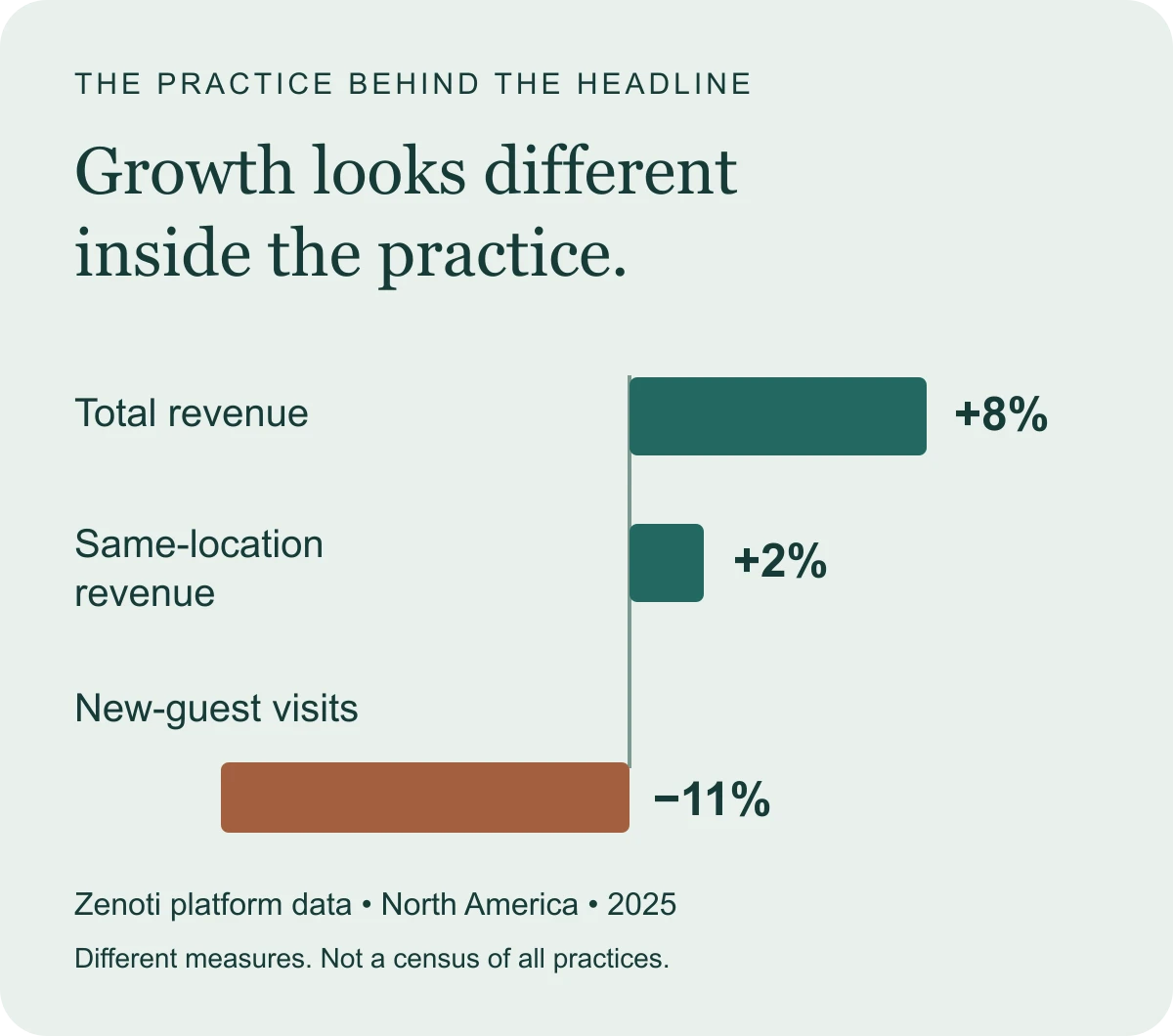
Med spa growth is getting harder to turn into practice growth. In Zenoti’s North American platform data, revenue rose 8% in 2025, but revenue at existing locations grew just 2% and new-guest visits fell 11%. Meanwhile, Juvederm’s global sales fell 15.6% in 2025; Botox Cosmetic grew in Q2 2026.
Our view: the next competitive advantage is a team patients trust to plan and coordinate their care, backed by prices that support the work. Owners should protect what each appointment earns, make follow-up dependable and prove demand before adding another equipment payment.
Zenoti benchmarks · Juvederm annual results · Botox Cosmetic Q2 results
The question behind the headlines is familiar: why should a patient choose your practice when another office sells the same injectable or owns the same device? An expanding menu and a lower advertised price are easy to match. A team that understands the patient’s goals, explains a sensible plan and carries it through gives them a clearer reason to stay.
1 · The market
Is the med spa industry still growing?
Yes, several measures show growth. The more useful question is where that growth comes from. An established practice needs to separate additional locations, higher prices, more visits and a changing treatment mix.
Zenoti’s gap between total revenue and existing-location growth makes that distinction tangible. For your own practice, compare completed visits, collected revenue per visit and new-patient arrivals with the same period last year. A higher ticket can conceal a quieter calendar.
Mesirow’s mid-year 2026 update offers a later signal: following conversations with 20 med spa CEOs, the investment bank estimated growth of 5–8% in early 2026. Taken together, these sources describe a growing market with tougher competition for patients. Mesirow’s update →
| The claim | Our assessment |
|---|---|
| “HA consumption is down 20%.” | Not established: Juvederm’s 2025 sales fell 15.6%. One brand’s revenue does not measure industry-wide HA use. Filler evidence ↓ |
| “Tox is bigger than ever.” | Growth, not a proven record: Several 2026 toxin measures are rising. That is stronger evidence for growth than for an all-time industry high. Toxin evidence ↓ |
| “There are more med spas than McDonald’s.” | Unverified comparison: The sources reviewed do not establish that claim using comparable U.S. counts for the same period. Location data ↓ |
| “Everyone wants natural results.” | A preference signal: A surgical-society survey reports interest in discreet results. Individual patients still define their own goals. Patient experience ↓ |
| “Skin-health treatments are booming.” | Mixed performance: Some spending categories are growing; supplier results vary. Assess the specific service you would offer. Skin and device evidence ↓ |
| “PRP and threads are taking over.” | Replacement unproven: The reviewed sources do not demonstrate that these treatments are displacing filler across the industry. What to evaluate ↓ |
| “A crash is coming.” | A prediction: Slower acquisition and category pressure justify planning. They do not establish an inevitable nationwide crash. Pressure-test the numbers ↓ |
2 · Local competition
Is the med spa industry saturated?
Saturation is a local business question. The test is whether enough suitable patients will choose your team at prices that support the service, within the area you can realistically reach.
AmSpa’s 2024 report estimated 10,488 U.S. med spas in 2023, up from 8,899 in 2022. It also put single-location businesses at 81%. Those dated figures show rapid expansion and a substantial independent-practice presence. AmSpa’s report recap →
What changes when larger groups enter your market?
Mesirow estimates that private equity and strategic buyers together account for roughly 10% of med spas. In an AmSpa market commentary, Xite’s Tommy Newton identifies cash-pay revenue, repeat treatment patterns and fragmented ownership as attractions for buyers. Combining locations can also spread administrative work and create purchasing leverage. Acquisition-market perspective →
That can change the economics of a competing offer. A group may support a lower advertised price through volume terms, earned rebates or a budgeted acquisition promotion. An independent practice should compare its own eligible purchasing arrangements and net costs before matching the offer. The relevant question is what you can sustain while delivering the experience you promise.
The competitive distinction is the operating model. Independent and group practices can both build coordinated care and strong teams. A practice of either kind that gives patients only a treatment name and a price leaves little else to compare.
Compare the offer a patient actually sees
Map competitors around the same patient need, including relevant dermatology and plastic-surgery offices. Check named providers, consultation fees, treatment scope, appointment access and published follow-up terms. For price comparisons, keep product, membership eligibility and included services consistent.
Our Botox pricing research shows how difficult that last step can be. A starting price, a member rate and a nonmember unit price describe different offers. Compare the whole purchasing arrangement before deciding that a neighboring practice is cheaper.
3 · The treatment mix
Are fillers going out of style?
Filler demand is under pressure, and the category is changing. AbbVie’s global Juvederm revenue fell to $993 million in 2025, down 15.6%. In Q2 2026, sales were 6% below the year-earlier quarter. Galderma’s combined fillers-and-biostimulators business, however, grew over the first nine months of 2026.
Galderma describes “continued softness in the Fillers market” while reporting gains in its combined fillers-and-biostimulators market share. Its growth sits inside a soft market, rather than demonstrating a broad recovery. Galderma’s explanation →
For an owner, that is a reason to examine local positioning alongside category demand. Listen to what patients are reconsidering: a particular look, treatment, price or previous experience. Make the consultation and follow-through answer those concerns.
Toxin is growing. Protect what each appointment earns.
Botox Cosmetic’s global revenue rose 5.2% in Q2 2026. Galderma’s neuromodulator sales rose 16.9% at constant currency over the first nine months. Qsight separately estimated 9% growth in neurotoxin patient spending in Q2. These measures point toward stronger toxin business, with different scopes set out below.
For a practice competing on posted unit prices, growth creates an opportunity and a pricing decision. Start with net product cost after earned incentives, variable provider pay, supplies and the appointment time required, including follow-up. Keep each toxin’s units and costs separate.
A lower rate can help fill spare capacity. It also reduces the contribution from existing patients who would have paid the previous price. Compare the extra business an offer brings with the discount applied to the business you already had. The service pricing guide and membership model let you work through both sides.
| Measure and period | Reported change | Read it this way |
|---|---|---|
| Juvederm revenue Q2 2026 vs. Q2 2025 | −6.0% $245 million | Global sales of one HA brand; reported currency. AbbVie → |
| Botox Cosmetic revenue Q2 2026 vs. Q2 2025 | +5.2% $728 million | Global cosmetic brand sales; reported currency. Therapeutic Botox excluded. AbbVie → |
| Galderma neuromodulators Jan–Sep 2026 vs. Jan–Sep 2025 | +16.9% $1.259 billion | Global portfolio sales at constant currency. Nine-month period. Galderma → |
| Galderma fillers and biostimulators Jan–Sep 2026 vs. Jan–Sep 2025 | +8.5% $914 million | Combined global category at constant currency; HA-only growth is not reported here. Galderma → |
| Evolus company revenue Q2 2026 vs. Q2 2025 | +21% $84.1 million | Global total includes $75.2 million in toxin and $8.9 million in HA gels. Evolus → |
| Neurotoxin patient spending Q2 2026 vs. Q2 2025 | +9% Qsight estimate | Commercial spending estimate reported in an interview. Full methods are not public. Qsight → |
Manufacturer revenue and patient spending measure different transactions. Compare each row with its own prior period. Constant currency removes exchange-rate effects.
Why can Sculptra growth coexist with a falling procedure estimate?
Galderma reports double-digit Sculptra growth in 2026. ISAPS estimates that poly-L-lactic acid procedures performed by plastic surgeons globally fell 33.7% in 2025. A growing brand can coexist with a weaker procedure estimate for one specialty. These reports cover different periods and populations; the ISAPS survey also expanded its geographic coverage. ISAPS survey →
HA product development is continuing as well: FDA records show Belotero Volume’s original approval in May 2026 and Intense’s in July. Owners should evaluate each product’s role and permitted uses with their clinical team. Volume record → · Intense record →
4 · The patient experience
What does demand for natural results change?
It makes the quality of the plan more important than the size of the package. Ask what the patient wants to change, what they want to preserve and how they will judge the result.
AAFPRS members reported increased interest in discreet, individualized results in their survey about 2025. That fits the questions an owner should help the team answer: Who assesses the whole concern? Who explains the options? Who follows progress? AAFPRS survey →
Facial balancing is useful when it means considering the face as a whole. A fixed syringe package or promise of perfect symmetry misses that purpose. Providers interviewed by Modern Aesthetics emphasize individual assessment when responding to filler concerns. Provider perspectives →
How treatment-led marketing turns expertise into a commodity
When your ads, website, booking calls and consultations all credit the treatment alone, you teach patients to see every office offering it as interchangeable. The message they hear is: “They all have medical providers. They all offer the same treatment. Why would I pay more?”
That is commoditization: a skilled service starts to look like the same item sold in several places. Price and convenience become the easiest differences to see. When the product gets all the credit, the practice’s assessment, judgment, technique and follow-through disappear from the buying decision.
Shoppers compare the price of pasta, sauce and cheese at grocery stores. At an Italian restaurant, they pay for the chef’s skill in turning those ingredients into a finished lasagna, along with the service and experience. A grocery receipt cannot tell the diner what that meal is worth. The same distinction applies when a practice makes its expertise part of the offer.
Carry that value through every patient touchpoint. Treatment names still help people find and understand your services. Give them the same clear explanation of your contribution wherever they meet the practice.
| Touchpoint | Treatment-only offer | Outcome-led plan |
|---|---|---|
| Ad | “Botox: $12 per unit.” | “A more rested look: explore our Bright Eyes approach and patient results.” |
| Website | A treatment menu and prices are the whole explanation. | Show documented results, the team, how assessment works and clear pricing. |
| Booking call | “Which treatment would you like to book?” | “What would you like to change?” Explain the assessment and who provides it. |
| Consultation | The requested treatment defines the conversation. | Assess the concern, then explain suitable options, the proposed sequence and total cost. |
| Follow-up | The next contact is a reminder to buy the treatment again. | Review progress against the agreed goal and discuss the next step. |
Illustrative messages. The $12 unit price is an example; assessment determines the actual treatment plan.
Consistent, well-documented before-and-after results make your expertise visible before a patient books. Use consented images with comparable lighting and angles, identifying the treatments and elapsed time. Let patients see the work, then explain the judgment and follow-through behind it. Individual results do not guarantee the same outcome for the next patient.
Give “treat to complete” a destination
A complete plan has an agreed goal, suitable options, a sequence, a cost and a point for reassessment. Several modalities may contribute when each has a clear purpose. A focused intervention, referral or decision to wait can also complete the consultation well.
A coordinated plan has a destination
Agree on the goal
What should change, and what should stay?
Explain the options
Why each step, who provides it, and the full cost.
Review progress
Compare the experience and result with the goal.
Complete or reassess
Stop, maintain, revise or refer as appropriate.
Build the team handoff around that plan. The next provider should know the patient’s priorities, previous treatment and reason for the assessment. Give staff time to document and follow up. When a provider changes, a named colleague should take responsibility for the next step so the patient can continue without starting the conversation over.
Skin quality deserves investment discipline, too
Texture, pigment, movement, volume and laxity are distinct concerns. A trend toward subtle results gives a practice a reason to understand those requests, then assess its own demand and delivery capability.
Qsight reported strong growth in skin-rejuvenation spending in Q2 2026. Qsight’s skin-health findings → Supplier revenue moved differently: InMode was essentially flat that quarter, while the company behind Hydrafacial reported a 7.8% decline. Patient spending and supplier sales describe different parts of the market. For a buyer, the decision still rests on demand and economics for the actual service. InMode → · Hydrafacial →
Evaluate PRP/PRF, threads and biostimulatory injectables on their own evidence, suitable uses and delivery requirements. For energy devices, the business case must also fund training and complication response. The FDA’s RF microneedling communication describes serious complications reported with certain uses. FDA communication →
5 · Weight management and wellness
How are GLP-1s affecting med spas?
They put medical weight management and changing aesthetic concerns into the same business conversation. The opportunity starts with what patients actually request and what your licensed team can appropriately provide.
Gallup’s revised 2026 survey estimated that 11% of U.S. adults were currently using GLP-1 medications for weight loss. Qsight’s Q2 spending update described stronger surgical spending alongside continued weakness in nonsurgical body contouring. Together, they are a reason to revisit service assumptions, rather than attribute every change to medication use. Gallup → · Qsight →
Track requests from existing patients, assessment outcomes and referrals. For a weight-management service, build medication sourcing, follow-up workload and qualified staffing into the economics. For an aesthetic service, establish demand for that particular concern and treatment.
A weight-management patient may have no interest in cosmetic care. Before buying a device around an assumed connection, test the service case and compare the full equipment commitments.
6 · Pricing and profit
Is owning a med spa still profitable?
Yes, a practice can be profitable in a competitive market. The deciding numbers are what it collects and what delivering that care costs. A full calendar at the wrong prices can leave less than a quieter calendar with a workable treatment mix.
Here is a hypothetical month: $100,000 in revenue, $50,000 in variable delivery costs and $35,000 in fixed operating costs. That leaves $15,000. Watch what happens when either visits or prices fall.
A 10% price cut can erase two-thirds of the remainder.
See all four calculations
| Scenario | Revenue | Variable costs | After $35,000 fixed costs |
|---|---|---|---|
| Starting position | $100,000 | $50,000 | $15,000 |
| 10% fewer equivalent visits | $90,000 | $45,000 | $10,000 |
| 10% lower prices; same visits | $90,000 | $50,000 | $5,000 |
| Both changes | $81,000 | $45,000 | $1,000 |
Illustrative inputs, not an industry average or Darryl’s accounts. Variable cost per equivalent visit stays constant; fixed salaries belong in fixed costs. Percentage-of-collections pay would change the results. Taxes, financing cash flows and owner distributions are excluded.
In this model, restoring the original contribution after the price cut requires 25% more equivalent visits. Each visit now contributes $40 for every original $100 of revenue, rather than $50. The practice must deliver 1.25 times the visits, with enough capacity to do so.
Test the assumptions for your own treatment mix. At starting variable costs of 40%, 50% or 60% of revenue, the same $10,000 price reduction consumes 16.7%, 20% or 25% of contribution before fixed costs.
A targeted promotion may still work. Budget the additional acquisition and follow-up expense, identify the spare appointments it should fill, and set a date to check the contribution it actually produced. Our service pricing guide walks through the inputs.
Model your pricing in My workspace →
Free account required to save. Use the public calculator without an account.
Plan the year before choosing the payment arrangement
A large package sold into a short promotional window can be difficult to afford and awkward to schedule. Where appropriate, a six- or twelve-month plan can map the initial work, reassessment and maintenance around the patient’s goals, recovery, availability and budget. Treatment intervals belong to the clinical plan.
Show the expected visits and full projected cost, including home care and review appointments. Identify which later decisions depend on progress. That gives patients a manageable sequence and gives the team visibility into future work.
Can a med spa membership improve retention and profit?
A membership can support that plan through suitable ongoing benefits and predictable budgeting. Zenoti reported 13% growth in membership sales in its 2025 med spa data. Design around the care patients value, then check redemption, completed visits and contribution.
Patients can follow a treatment plan while paying per visit, purchasing agreed stages or choosing an optional membership. Monthly payments may spread cash outlay without reducing the total cost. Show the monthly charge, total over the stated term, included services, credit rules and cancellation terms. Keep appointment access and future treatment obligations visible in the model.
Review member groups over the same period: visits completed, collected revenue, delivery costs, unused credits and reasons for leaving. The membership pricing guide and model help turn those observations into an offer you can support.
7 · Put the findings to work
How should owners compete over the next year?
Choose one constraint to fix before adding another service, discount or subscription. Use the market reporting to ask better questions, then use your own records to choose the next move.
Find the patient decision your practice handles well.
Review consultation reasons and feedback. Describe the assessment, options and follow-up patients value. Show that process in your marketing, alongside appropriately consented results and realistic expectations.
Assign responsibility for the complete plan.
Name who coordinates care, answers questions and handles the next provider handoff. Give the team documentation time and an escalation path.
Find where the patient journey stalls.
Separate inquiries, attended consultations, accepted plans and completed visits. Record reasons for pausing. Completing a one-time goal successfully belongs in the results, even when no further treatment is booked. Our guide to turning med spa inquiries into attended consultations provides booking scripts, a follow-up sequence and a 14-day plan to put that review into practice.
Measure contribution by service and provider time.
Use collected revenue less product, supplies and variable delivery costs. Compare that contribution with the provider time occupied, then account for fixed costs. Include future work owed on prepaid packages.
Make equipment earn its place before purchase.
Use suitable inquiries and completed bookings to test demand. Compare buying with referral or better use of equipment you already own. Model a slower start and the staffing it requires.
Fix the handoff before adding software.
Map how goals, consent, balances and follow-up move through the team. Then test vendors against that workflow using our workflow guide and software comparison.
What we will watch next
Same-location visits will help distinguish stronger patient activity from growth through new openings or higher prices. Comparable filler and toxin reports will show whether the current split persists. For an individual practice, contribution, patient feedback and available capacity remain the deciding measures.
Quarterly reporting creates a useful review point. Some updates will change the analysis; others will confirm it. The source dates and periods above make those changes traceable.
Questions owners ask
Should an independent med spa match a chain’s advertised prices?
Compare the exact product, eligibility and included services first. Then test the offer against your own purchasing costs, staffing and available appointments. Match a price when the economics and patient experience work for your practice. A chain’s headline rate alone tells you little about either.
Does “natural-looking” mean using less filler?
Sometimes. The patient’s goals, existing treatment and clinical assessment determine the discussion. Support individualized consultations and reassessment rather than selling a predetermined quantity as the answer for everyone.
Should a practice add every popular treatment?
Start with patient demand, qualified delivery, evidence and the full operating cost. Referral can serve patients well when demand is limited or the service exceeds the team’s capabilities. Establish a workable service case before committing to a device or launch.
How often should an owner review industry trends?
Quarterly is a useful rhythm for company results and available industry reports. Check your own operating measures as often as the decision requires. Annual surveys provide context between releases; a quiet quarter may require no change to your strategy.
Sources and editorial notes
Check the evidence behind the analysis.
Sources checked October 26, 2026. This is a reported business analysis by NuWays MD, with analysis and editing by Darryl H., a former med spa co-owner and operator. His local observations are identified separately from published data. No clinical reviewer has signed off on this article; it gives no treatment protocol or individual medical advice.
The original charts explain published figures and a hypothetical pricing model. Scope notes below identify each source’s reporting period, population and limits. Our assessments and operating recommendations are editorial judgments, separate from the reported results.
- Zenoti: 2026 med-spa benchmark highlights North American Zenoti customers, calendar 2025. Separate platform metrics; not a census or evidence that a software feature caused growth.
- AbbVie: full-year 2025 results 2025 global brand revenue, reported currency basis. Sales are different from procedure volume.
- AbbVie: second-quarter 2026 results Q2 2026 global brand revenue compared with Q2 2025. Cosmetic and therapeutic Botox are separate.
- Mesirow: 2026 mid-year med-spa update Conference conversations with 20 CEOs. Investment-bank estimates, with PE and strategic buyers combined.
- AmSpa: 2024 industry report recap 2024 report describing 2023 locations and business structure. Not a current location census.
- AmSpa / Xite: med spa acquisitions in 2025 and the outlook M&A advisor commentary on cash-pay revenue, repeat demand and consolidation; used for the explanation of buyer interest.
- Galderma: nine-month 2026 trading update Global nine-month 2026 results: neuromodulators +16.9%; combined fillers and biostimulators +8.5%, both at constant currency. The company reports combined-category share gains despite a soft filler market.
- Evolus: second-quarter 2026 results Q2 2026 global company revenue: $75.2 million toxin and $8.9 million HA gels. The reported 21% growth is the company total, not toxin-only growth.
- Qsight interview: second-quarter spending update Q2 2026 spending estimates, including qualitative strong skin-rejuvenation growth. No numeric skin growth rate given; full underlying data and methods are not public.
- ISAPS: 2025 global survey Global plastic-surgeon estimates for 2025, with expanded geographic coverage. Not a survey of all med-spa providers.
- FDA: original Belotero Volume (+) approval Original FDA PMA approval dated May 19, 2026. Approval and commercial availability are separate.
- FDA: original Belotero Intense (+) approval Original FDA PMA approval dated July 9, 2026. Regulatory status does not predict sales.
- AAFPRS: 2025 annual survey, released February 24, 2026 Member survey about 2025; release does not disclose a response count. Provider reports rather than direct national patient polling.
- Modern Aesthetics: filler fatigue interview Expert interview supporting individualized assessment. Clinical opinion rather than proof of the cause of revenue changes.
- InMode: Q2 2026 results filed with SEC Q2 2026 global company revenue. It does not count a particular device’s U.S. procedures.
- SkinHealth Systems / Hydrafacial: Q2 2026 results Q2 2026 supplier revenue, affected by mix and purchasing patterns. Not treatment volume.
- FDA: RF microneedling safety communication FDA communication about reported serious complications with certain RF microneedling uses. Does not establish complication incidence.
- Gallup: updated U.S. GLP-1 use Probability-panel survey of 5,065 U.S. adults. Uses the September 8 revised estimates for weight-loss use.