Oral vs. Topical Minoxidil: Results, Safety and Which Fits You
A tablet can sound like the simple answer to a messy scalp routine. But oral vs. topical minoxidil is more than a convenience choice: you are changing how the medicine reaches your body, the side effects to watch for and the follow-up you need.
Here is what direct comparisons actually show, who each route may suit and what to discuss before starting or switching. This guide focuses on adult pattern hair loss, not every cause of shedding.
Editorial details
NuWays MD is independent and reader-supported. When you buy through links on our site, we may earn a commission. As an Amazon Associate we earn from qualifying purchases. Learn more.
Oral vs. topical minoxidil at a glance
The main trade-off is an easier scalp routine versus greater exposure throughout the body. Neither choice removes the need to establish why your hair is thinning.
| Compare | Topical | Oral |
|---|---|---|
| How it is used | Foam or solution on the scalp | A prescribed tablet taken by mouth |
| U.S. access | Over the counter for labeled products and uses | Prescription; off-label for hair loss |
| Daily routine | Once or twice daily, depending on the exact label | Often once daily, as prescribed |
| Main practical advantage | Treats the scalp with less systemic exposure | No drying time or residue in the hair |
| Main trade-off | Scalp irritation and application burden | More unwanted body hair and systemic safety considerations |
| Review before choosing | Diagnosis, scalp health and ability to follow the label | Diagnosis, medicines, cardiovascular history and monitoring plan |
Sources: men’s foam label, women’s foam label, oral prescribing consensus. A topical percentage and a tablet’s milligrams are different measurements, not equivalent doses.
Is oral minoxidil more effective than topical?
It can work well, but the head-to-head evidence does not justify an automatic “oral is stronger” ranking. A 2024 meta-analysis of four randomized trials involving 279 people found no significant difference in hair density or diameter. Excess hair growth away from the scalp was more frequent with oral treatment. Read the analysis.
The trials are relatively small and short. A result that is not statistically different does not prove that two treatments are identical for every person. It also does not tell you which routine you will keep using.
Men: the 2024 randomized trial
Ninety men were enrolled; 68 completed 24 weeks. Oral minoxidil at 5 mg daily did not outperform 5% topical solution twice daily on the main hair-density outcomes.
A photographic assessment favored oral treatment at the crown, but not the front. That finding is not a claim of “24% more hair” across the scalp. Penha and colleagues.
Women: an earlier direct comparison
A 24-week trial in 52 women compared oral 1 mg daily with 5% topical solution. Both improved hair density; the difference between them was not statistically significant.
This small study cannot establish that tablets are the better first choice for all women. Ramos and colleagues.
Newer evidence: a 2026 trial
In a double-blind study with 100 participants, 90 completed 24 weeks. Photographic improvement was reported in 67% of the oral group and 73% of the topical group, without a significant difference.
Unwanted hair growth was more frequent with oral treatment (30% vs. 9%); contact dermatitis occurred in the topical group (11% vs. 0%). The trial was not designed to prove equivalence, and it excluded people with cardiovascular disease. Chaudhry and colleagues.
Study doses describe the research, not a starting-dose recommendation. The topical formulations, populations and assessment methods differed. Do not combine their percentages into a personal forecast.
These findings make the decision more practical: if you tolerate topical treatment and use it consistently, a tablet is not an obligatory upgrade. If you regularly skip applications or cannot tolerate the formula, a different route may solve a real problem even without a proven average advantage in regrowth.
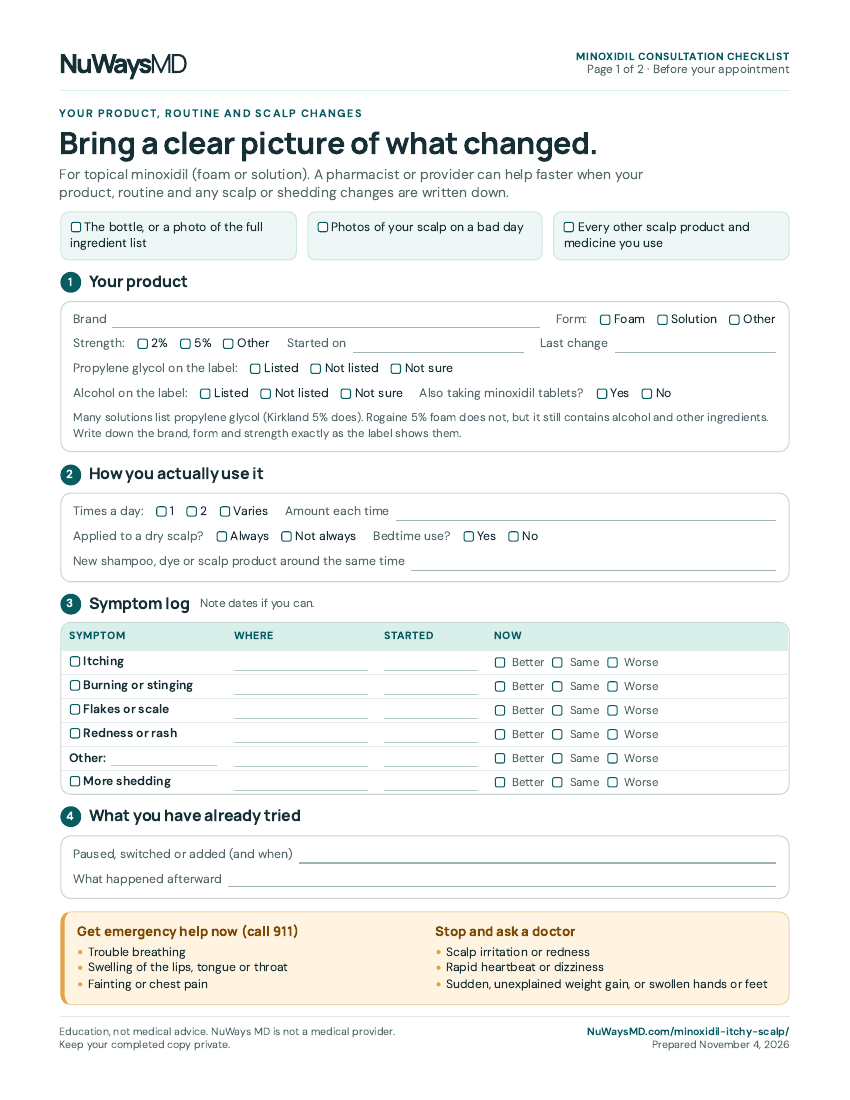
Bring your routine, symptoms and questions together.
Our minoxidil consultation checklist helps you record topical products, scalp symptoms and questions. It also prompts you to note whether you take minoxidil tablets, so your provider can see the whole routine.
Email me the minoxidil checklist →
Free checklist and two-page PDF. Newsletter signup is optional. Keep your completed medical notes on your own copy.
Who should consider topical or oral minoxidil?
Start with the diagnosis and the obstacle you need to solve. Sudden loss, patches, scalp pain or inflammation can need a different evaluation from gradual pattern thinning. A stronger-looking product is not a substitute for that assessment. AAD diagnosis and treatment guidance. For shedding that began during GLP-1 treatment or weight loss, start with the cause before choosing a minoxidil format. See our guide to GLP-1 hair loss and regrowth.
Topical may fit when…
- You meet the product’s labeled criteria and want an over-the-counter option.
- You can apply it consistently and tolerate it on your scalp.
- You want to limit systemic exposure and are concerned about additional body or facial hair.
Heart disease still warrants medical advice before topical use. “On the scalp” does not mean “unable to cause body-wide effects.”
Discuss oral treatment when…
- Application is impractical or repeatedly missed.
- A properly assessed scalp reaction makes topical use difficult.
- Response remains inadequate after diagnosis, application and duration have been reviewed.
A prescriber still needs to decide whether your medical history and other medicines make it appropriate.
Topical label precautions; international expert consensus on oral treatment.
Does the choice differ for men and women?
Yes, particularly in labeled schedules, pregnancy considerations and how unwanted facial hair affects the trade-off. For example, the women’s 5% Rogaine foam label uses once-daily application, while the men’s label uses twice daily. Do not assume every topical routine takes two applications.
For a receding hairline or thinning crown, our guide to hair loss in men explains the main patterns and assessment questions. Women with new thinning may also need an assessment of the pattern and possible contributing conditions. Our guide to hair thinning in women helps frame that conversation. A woman’s result cannot be predicted from a trial conducted only in men.
What if topical minoxidil makes your scalp itch?
A reaction to a solution’s vehicle is different from allergy to minoxidil itself. A propylene-glycol-free foam may address one ingredient problem, but oral minoxidil should not be treated as an automatic workaround for a suspected minoxidil allergy. The consensus identifies safety after topical allergic contact dermatitis as an area needing more research.
Start with our minoxidil itchy-scalp guide; if changing the topical formula is appropriate, compare foam and liquid.
What are the side effects, and is oral minoxidil safe?
Many selected patients tolerate low-dose oral treatment, but it carries different risks from applying minoxidil to the scalp. Safety depends on the person, dose, other medicines and follow-up. “Low dose” is not a guarantee.
In a retrospective study of 1,404 patients, unwanted hair growth was reported in 15.1%, lightheadedness in 1.7%, fluid retention in 1.3% and fast heartbeat in 0.9%. This was not a randomized comparison and cannot rule out uncommon serious events. Its rates should not be substituted for those from a different dose or population. Vañó-Galván and colleagues.
Topical: watch the scalp and beyond
Irritation, redness, itching or flaking can interfere with use. Unwanted facial hair can occur. Labels also list dizziness, rapid heartbeat, swelling and sudden weight gain as reasons to stop and ask a doctor.
Oral: watch systemic effects
Discuss unwanted body or facial hair, dizziness, palpitations and swelling before treatment. Tell the prescriber about low blood pressure, fainting, heart or kidney disease, and all medicines and supplements.
The oral label carries a boxed warning about serious heart-related problems, including fluid around the heart, which can sometimes become dangerous, and worsening angina. That labeling concerns the approved blood-pressure use; it does not give an incidence estimate for low-dose hair treatment. It remains a reason for proper screening and a clear response to symptoms. Minoxidil tablet label.
What monitoring should you expect?
Before accepting a prescription, ask who reviews your blood pressure, cardiovascular and kidney history, and current medicines. Ask what checks are needed for you, when follow-up happens and how to contact someone between visits. Do not assume that every person needs the same laboratory tests or heart testing.
Give the prescriber an accurate medication list, including blood-pressure medicines. Pregnancy, plans to conceive and breastfeeding also belong in that conversation before either route is chosen. Topical labels warn against use in pregnancy or breastfeeding, and oral treatment requires an individualized prescribing decision rather than self-treatment.
Do you need a prescription, and is oral minoxidil FDA approved?
Oral minoxidil is a prescription medicine approved for severe hypertension, not for hair loss. Prescribing it for hair loss is off-label. That can be a legitimate medical decision, but approval of the ingredient for one condition does not mean every advertised hair product is FDA approved. Approved tablet labeling.
Standard labeled topical products are available over the counter. Their directions still specify who should use them, where to apply them and when to seek advice.
What about compounded tablets, chews or combination products?
Ask whether you are receiving a manufactured tablet or a compounded preparation, and which active ingredients it contains. A combination that includes finasteride is not the same treatment tested in a minoxidil-only trial. Our finasteride vs. minoxidil comparison explains what adding a DHT-targeting medicine changes, including the evidence and separate safety questions.
Compounded drugs are not FDA approved; FDA does not review their safety, effectiveness or quality before marketing. Compounding can meet an individual medical need, but a custom formula is not automatically more effective or safer. FDA’s explanation of compounded drugs.
How long do results take, and does either cause shedding?
Think in months for regrowth, while reviewing side effects much sooner. A short period without visible improvement does not prove that a route has failed. At the same time, a trial’s six-month assessment is not permission to ignore a product’s earlier stop-use instructions.
Topical: follow your exact label
Men’s Rogaine foam may show results at two months, with four months needed for some men. Women’s foam describes three months, with six months needed for some women. Each label gives its own point for seeking advice if regrowth is absent.
Oral: agree on a review date
The comparisons above assessed results at about six months. Your prescriber should set earlier safety follow-up and a later hair-response review based on your situation.
Men’s label; women’s label; 24-week trial.
Early shedding can occur with minoxidil and does not prove that regrowth will follow. Record when it began, its severity and any scalp symptoms. Our minoxidil shedding guide explains why leaflet instructions and longer research timelines must be kept separate.
Use comparable photographs, including the same part, lighting and hair condition, rather than checking different mirror angles each day. Ask whether stabilization counts as a useful result for your pattern. Minoxidil generally needs continued use to maintain its benefit; it is not a short course that permanently changes the cause of hair loss. AAD treatment guidance.
Can you switch from topical to oral minoxidil or use both?
A prescriber can plan a switch, but there is no universal do-it-yourself overlap schedule. Explain why you want to change: irritation, missed applications, cost or limited response. Those are different problems and may call for different solutions.
Before calling topical treatment a failure, review whether it reached the scalp, whether the routine matched the label, how consistently it was used and whether the diagnosis still fits. If irritation is the reason, establish what caused it rather than simply moving the same drug into a tablet.
Ask for written instructions covering the last topical application, the first prescribed tablet, any intended overlap and the follow-up date. Do not convert a percentage on a bottle into a tablet dose or copy a dose from a study.
Using both is sometimes considered by a prescriber, but it adds exposure and complexity. The head-to-head trials compare routes; they do not establish that combining them produces better results for everyone. A useful question is: “What benefit are we expecting from keeping both, and when would we stop the extra step?”
If you develop a reaction during a change, tell the prescriber exactly what you used and when. Adding several hair treatments simultaneously makes it harder to understand benefit or harm. The international consensus emphasizes individualized prescribing and continuing evidence gaps.
Which costs less: oral or topical minoxidil?
Compare the complete ongoing cost, not a first-order promotion. For topical treatment, that means the amount you actually use and the replacement interval. For oral treatment, include the prescription visit, refills, follow-up and any required tests as well as the medicine.
Our minoxidil cost guide keeps the dated price examples in one place. Ask whether a subscription price includes consultation, whether a compounded combination is optional and what happens to the price after the introductory period.
A cheaper route is poor value if you cannot tolerate or maintain it. Equally, paying more for delivery, a branded bundle or added ingredients does not establish a better result than the route and formulation your provider recommends.
Topical products to compare if this route fits
These are label-based shopping options, not a ranking from hands-on testing. Compare the exact product, its current price and the routine you can sustain. The generic solutions are value candidates to price-check, not a promise that either is the cheapest.
GENERIC SOLUTION / MEN
Amazon Basics Men’s 5% Solution

5% minoxidil · 6 × 60 mL; six-month supply
1 mL twice daily
Who it suits: For men whose routine uses 5% solution. Compare the current cost per month for this six-month pack.
The trade-off: Contains propylene glycol and alcohol; the larger pack costs more upfront than a smaller supply.
Label check and evidence
The linked pack is 12 fl oz in total. The Amazon listing’s Drug Facts and directions were checked November 5, 2026.
GENERIC FOAM / MEN
Amazon Basics Men’s 5% Foam

5% minoxidil · 3 × 2.11 oz; three-month supply
Half a capful twice daily
Who it suits: For men comparing a generic foam, including those advised to avoid propylene glycol.
The trade-off: Still contains alcohol and minoxidil. No propylene glycol does not mean allergy-proof.
Label check and evidence
The Amazon listing’s Drug Facts and directions were checked November 5, 2026. Propylene-glycol-free does not mean alcohol-free.
NAME-BRAND FOAM / WOMEN
Women’s Rogaine 5% Foam
5% minoxidil · 2 × 2.11 oz; four-month supply
Half a capful once daily
Who it suits: For women who meet the label criteria and prefer a once-daily foam routine.
The trade-off: Contains alcohol and can still cause a reaction. Follow the women’s label, not the men’s schedule.
Label check and evidence
The Amazon directions match the official women’s once-daily label, but part of its safety text incorrectly describes the men’s product. Read the women’s carton and official label rather than that mixed listing text. Official women’s foam label.
Also comparing Kirkland 5% solution? The Kirkland solution listing ↗︎ is a separate men’s solution option. Third-party sellers only: check who sells it, the sealed pack, expiry information and return terms before buying.
Other formats: Amazon Basics Women’s 2% Solution; Men’s Rogaine 5% Foam.
Buying on Amazon? Check the seller and return terms, along with the current price, pack size and exact label.
What should you ask before choosing?
Leave with a reason for the choice and a plan to judge it. Bring your current packaging, medication list, treatment dates and comparable scalp photographs. These five questions keep the visit focused:
- What diagnosis are we treating, and what else needs investigation?
- What specific problem would changing the route solve for me?
- What in my health history or medicines changes the risk?
- What should I do if I get irritation, swelling, palpitations or increased shedding?
- When will we review safety, photographs and whether the treatment is worth continuing?
The goal is a routine you can sustain safely with realistic expectations. If neither route fits, ask about alternatives for the diagnosed cause rather than assuming any supplement or device is interchangeable. Our laser-cap evidence guide and Nutrafol versus minoxidil comparison explain those separate decisions. If you are weighing injections against scalp treatment, see PRP vs. topical minoxidil; that evidence does not compare PRP with tablets.
Frequently asked questions
Is oral minoxidil better for the hairline?
Not established. The 2024 men’s trial did not show a significant photographic advantage at the frontal scalp. Its crown finding should not be presented as proof that tablets restore a receding hairline better.
Does oral minoxidil work faster?
There is no dependable faster-results promise for everyone. Trials assess changes over months, and your response depends on the diagnosis and regimen. Do not increase the dose to accelerate the result.
Will oral minoxidil grow facial or body hair?
It can. Unwanted hair growth is a prominent oral-treatment trade-off and was more frequent than with topical treatment in the randomized-trial review. Discuss how much that possibility matters to you before choosing.
Is 5% topical minoxidil the same as a 5 mg tablet?
No. A percentage describes concentration; milligrams describe an amount of drug. Different absorption and routes mean these numbers cannot be used as a dose conversion.
Can women take oral minoxidil?
A clinician may prescribe it off-label for selected women. Suitability includes medical history, unwanted facial hair and pregnancy or breastfeeding considerations. It is not an over-the-counter replacement for women’s foam.
Does oral minoxidil replace finasteride?
Not automatically. They are different medicines with different roles and risks. If your prescription combines them, ask what each is intended to do; evidence for minoxidil alone does not validate every combination.
What happens if you stop minoxidil?
The benefit usually requires continued treatment. Hair maintained or regrown with treatment can be lost after stopping. Discuss a change with the treating provider, especially if you also take oral minoxidil for blood pressure. Read what to expect when stopping minoxidil, including why topical timelines are not instructions for stopping a prescription tablet.
Sources and editorial notes
Sources checked November 5, 2026. Clinical review pending. This is consumer education, not a prescription or dosing guide. We prioritize direct comparisons, official labels and professional guidance. Small studies cannot settle long-term safety or predict an individual’s response. The cover is an editorial illustration.
View all 12 sources
- Penha and colleagues, 2024 randomized trial: oral versus topical treatment in men; primary outcomes and photographic findings.
- Ramos and colleagues, 2020 randomized trial: direct comparison in women with pattern hair loss.
- Chaudhry and colleagues, 2026 randomized trial: six-month outcomes and differing adverse-effect profiles.
- 2024 meta-analysis of randomized trials: pooled efficacy and safety comparisons, with limited sample sizes.
- Vañó-Galván and colleagues, 2021 safety study: retrospective experience in 1,404 patients; not a randomized comparison.
- International low-dose oral minoxidil consensus: prescribing considerations and unresolved research questions.
- DailyMed minoxidil tablet label: approved indication, boxed warning and patient precautions.
- DailyMed men’s Rogaine foam label: use, timing and stop-use instructions.
- DailyMed women’s Rogaine foam label: once-daily schedule and response timeline.
- MedlinePlus oral minoxidil information: serious symptoms, precautions and follow-up.
- AAD hair-loss diagnosis and treatment: establishing the cause and maintaining treatment benefit.
- FDA on compounded drugs: what FDA approval does and does not cover.